
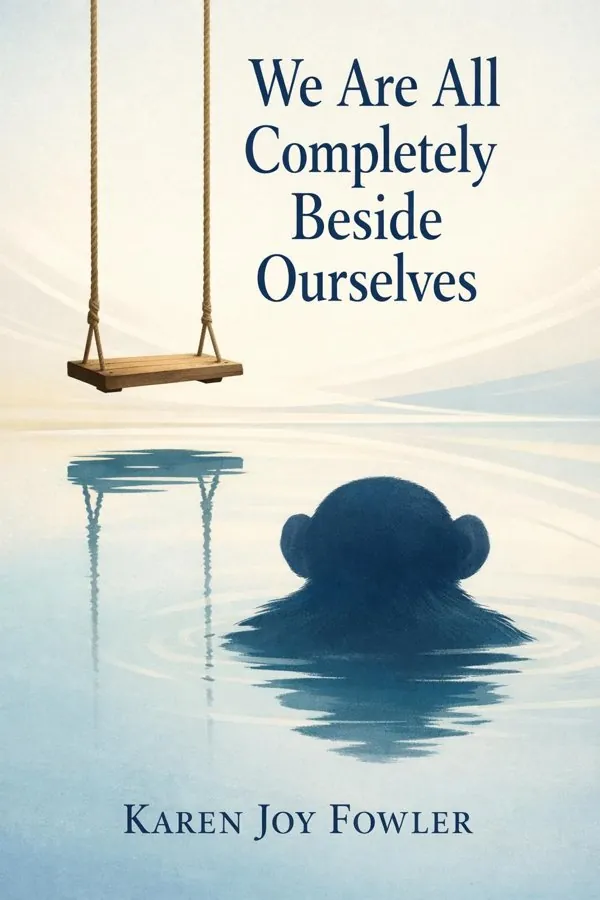
We Are All Completely Beside Ourselves: Summary & Key Insights
 10 min9 chaptersAudio available
Key Takeaways from We Are All Completely Beside Ourselves
A life can be organized around what it refuses to say.
Curiosity can become cruelty when human ambition ignores moral limits.
What a family cannot talk about will eventually shape everything it becomes.
Memory is not a vault; it is a negotiation.
We often define humanity by language, but love complicates that boundary.
What Is We Are All Completely Beside Ourselves About?
We Are All Completely Beside Ourselves by Karen Joy Fowler is a bestsellers book spanning 6 pages. Karen Joy Fowler’s We Are All Completely Beside Ourselves is a daring, emotionally intelligent novel about family, memory, grief, and the moral cost of treating other living beings as tools for human curiosity. Narrated by Rosemary Cooke, the story begins as a seemingly eccentric coming-of-age account and gradually reveals the shocking truth at its center: Rosemary once grew up with a sister named Fern, who was a chimpanzee raised alongside her in a psychological experiment. From that premise, Fowler builds something far deeper than a literary twist. She explores how families survive what they cannot speak about, how memory protects and distorts us, and how the boundary between human and animal is less stable than we like to believe. The novel matters because it forces readers to examine empathy at its widest scale—across species, across trauma, and across fractured relationships. Fowler, an acclaimed American novelist known for blending intellectual rigor with emotional resonance, brings rare authority to these questions. The result is a moving, unsettling, and unforgettable work that challenges how we define kinship, responsibility, and what it means to be truly human.
This FizzRead summary covers all 9 key chapters of We Are All Completely Beside Ourselves in approximately 10 minutes, distilling the most important ideas, arguments, and takeaways from Karen Joy Fowler's work. Also available as an audio summary and Key Quotes Podcast.
We Are All Completely Beside Ourselves
Karen Joy Fowler’s We Are All Completely Beside Ourselves is a daring, emotionally intelligent novel about family, memory, grief, and the moral cost of treating other living beings as tools for human curiosity. Narrated by Rosemary Cooke, the story begins as a seemingly eccentric coming-of-age account and gradually reveals the shocking truth at its center: Rosemary once grew up with a sister named Fern, who was a chimpanzee raised alongside her in a psychological experiment. From that premise, Fowler builds something far deeper than a literary twist. She explores how families survive what they cannot speak about, how memory protects and distorts us, and how the boundary between human and animal is less stable than we like to believe. The novel matters because it forces readers to examine empathy at its widest scale—across species, across trauma, and across fractured relationships. Fowler, an acclaimed American novelist known for blending intellectual rigor with emotional resonance, brings rare authority to these questions. The result is a moving, unsettling, and unforgettable work that challenges how we define kinship, responsibility, and what it means to be truly human.
Who Should Read We Are All Completely Beside Ourselves?
This book is perfect for anyone interested in bestsellers and looking to gain actionable insights in a short read. Whether you're a student, professional, or lifelong learner, the key ideas from We Are All Completely Beside Ourselves by Karen Joy Fowler will help you think differently.
- ✓Readers who enjoy bestsellers and want practical takeaways
- ✓Professionals looking to apply new ideas to their work and life
- ✓Anyone who wants the core insights of We Are All Completely Beside Ourselves in just 10 minutes
Want the full summary?
Get instant access to this book summary and 100K+ more with Fizz Moment.
Get Free SummaryAvailable on App Store • Free to download
Key Chapters
A life can be organized around what it refuses to say. Rosemary Cooke introduces herself as a young woman trying to stay unnoticed, carefully controlling how she speaks, what she reveals, and how much of herself the world is allowed to see. Her narration is fragmented on purpose. She starts in the middle, leaves out crucial facts, circles back, and often seems more comfortable with detours than direct confession. This structure is not a literary gimmick; it is the shape of trauma. People who have lived through rupture often tell their stories indirectly because the truth is not simply hidden from others, but also from themselves.
Rosemary’s fractured voice teaches an important lesson about memory and identity. We tend to imagine that the self is built on a coherent narrative: this happened, then that happened, and now I understand who I am. Fowler suggests the opposite. Identity is often assembled from omissions, defensive habits, and half-buried experiences. Rosemary has learned to become small because being fully visible once led to pain, confusion, and loss.
In everyday life, this idea has practical relevance. People who seem emotionally distant, overly cautious, or oddly detached may not be cold; they may be carrying stories they cannot yet tell. In workplaces, friendships, or families, a person’s inconsistencies can reflect survival rather than dishonesty. The novel invites us to listen for what is missing, not just what is present.
Actionable takeaway: When reflecting on your own story, notice the parts you rush past or avoid entirely. Those omissions may reveal as much about your life as the memories you tell with ease.
Curiosity can become cruelty when human ambition ignores moral limits. At the center of the novel is Rosemary’s father, a scientist involved in an experiment to raise a chimpanzee and a human child together in order to study language acquisition, bonding, and development. On paper, the experiment appears intellectually defensible, even exciting. It promises insight into what separates human beings from other primates. In practice, it transforms the home into a laboratory and the children into subjects.
Fowler does not present the experiment as simple villainy. Rosemary’s parents are not monsters in the cartoon sense; they are people who rationalize harmful choices in the name of knowledge. That nuance is what makes the novel so powerful. Harm often enters ordinary homes not through evil intentions but through systems of justification. The adults tell themselves they are advancing science, nurturing attachment, and doing something meaningful. Meanwhile, the emotional needs of both children are subordinated to research goals they cannot understand.
This dynamic applies far beyond science. Parents may project ambitions onto children, institutions may sacrifice individual dignity for data, and organizations may use people as means rather than ends while maintaining the language of progress. The novel asks readers to examine where ethical lines should be drawn when one party is vulnerable and cannot consent.
In practical terms, the story reminds us that capability does not equal permission. Just because an experiment, policy, or intervention can be designed does not mean it should be carried out. Every system needs moral scrutiny, especially when it involves dependents.
Actionable takeaway: Before supporting any “innovative” project involving vulnerable beings, ask a simple question: who bears the emotional cost, and did they truly have a choice?
What a family cannot talk about will eventually shape everything it becomes. After Fern is removed from the household, the Cooke family does not process the loss together. Instead, each member drifts into a private climate of sorrow, shame, and avoidance. Rosemary’s mother becomes emotionally absent. Her father retreats into professional logic and inward grief. Her brother Lowell turns his anger into action and eventually disappears. The household remains physically intact for a time, but emotionally it has already shattered.
Fowler captures a truth many readers recognize: families often survive catastrophe by refusing to name it. Silence can look like stability from the outside. Meals happen, routines continue, and everyone performs normalcy. But the unspoken event becomes the organizing principle of the home. Children, especially, adapt by suppressing their questions, inventing explanations, or blaming themselves. Rosemary grows up without the language to describe what happened, and that absence distorts her development.
This idea has immediate real-world resonance. Families affected by divorce, addiction, mental illness, death, scandal, or displacement often fall into the same pattern. The pain is acknowledged indirectly through mood, conflict, or estrangement, but not in clear words. Over time, silence does not protect people; it isolates them. Healing becomes harder because each person assumes they are grieving alone.
The novel suggests that language is not merely descriptive; it is reparative. Naming loss does not erase it, but it makes shared mourning possible. Honest speech can interrupt inherited confusion and give shape to what once felt chaotic.
Actionable takeaway: If your family has a subject everyone avoids, consider beginning with one clear sentence of truth. Even imperfect honesty can be the first step toward breaking a damaging silence.
Memory is not a vault; it is a negotiation. One of the novel’s greatest achievements is its portrayal of how recollection shifts under pressure. Rosemary does not simply forget parts of her childhood by accident. Her mind has organized memory in ways that make survival possible. She delays revelation, narrows perspective, and revisits scenes only when she is emotionally able to tolerate them. As readers, we experience discovery in the same staggered way she does.
Fowler’s point is subtle but profound: remembering is not a passive retrieval of facts. It is an active process shaped by fear, guilt, longing, and readiness. This helps explain why traumatic experiences often return in fragments—through sensations, habits, or seemingly unrelated emotional reactions. A person may not have a clean chronological account, yet the past still governs present behavior.
There is a practical lesson here for relationships and self-understanding. When someone says, “I don’t know why I reacted that way,” they may be speaking honestly. Emotions often outrun conscious explanation. Therapy, journaling, conversation, and time can gradually reconnect feeling to story. Rosemary’s journey shows that painful truths usually emerge not in one dramatic breakthrough but in layers.
The novel also encourages humility about personal certainty. Our strongest memories may still be incomplete, self-protective, or selectively interpreted. This does not make them false; it makes them human. Growth often begins when we become curious about our own narrative habits.
Actionable takeaway: When a memory feels charged or oddly fragmented, resist the urge to force clarity. Instead, ask what function that memory may have served in protecting you, and let understanding develop over time.
Recovery rarely arrives as closure; more often, it begins as willingness. As Rosemary grows older, she can no longer sustain the carefully reduced version of herself that college life initially enables. Encounters with others, resurfacing family ties, and the emotional pressure of unresolved history force her to reexamine the past. This return is not triumphant. It is uncomfortable, destabilizing, and sometimes humiliating. Yet it is also necessary. She cannot build an adult identity without reclaiming the childhood she has edited out.
Fowler portrays this process with unusual realism. There is no magical revelation that fixes Rosemary’s life. Instead, she takes hesitant steps toward truth: acknowledging old rage, reinterpreting family behavior, seeing the experiment more clearly, and allowing herself to grieve Fern not as an eccentric anecdote but as a sister. Remembering becomes an ethical act. It restores dignity to what was denied and reconnects feeling with fact.
This is applicable to anyone doing the work of emotional repair. People often postpone difficult reflection because they fear being overwhelmed, disloyal, or broken open beyond repair. The novel suggests that revisiting the past does not have to mean drowning in it. Structured forms of return—through writing, trusted conversation, or professional support—can help transform vague pain into knowable experience.
The important distinction is between rumination and reckoning. Rumination traps a person in circular distress. Reckoning seeks context, language, and integration. Rosemary’s journey models the second path.
Actionable takeaway: Choose one unresolved memory and approach it with structure rather than avoidance—write it down, discuss it with someone safe, or explore it deliberately instead of letting it control you from the shadows.
Guilt can become paralysis, but it can also become a demand for justice. Rosemary’s brother, Lowell, represents one of the novel’s most compelling responses to the family’s past. Unlike Rosemary, who turns inward, Lowell externalizes his grief and anger. He cannot accept Fern’s removal as an unfortunate but settled event. Instead, he becomes increasingly radicalized by the violence humans inflict on animals in laboratories and other systems of exploitation. His choices are disruptive, risky, and morally complicated, yet they arise from a serious ethical awakening.
Through Lowell, Fowler explores what happens when private trauma intersects with political conscience. He recognizes that Fern was not an isolated exception. She belonged to a wider network of nonhuman suffering that society normalizes behind closed doors, technical language, and institutional authority. His activism exposes a question many readers may prefer to keep theoretical: if we truly believe a practice is cruel, what are we obligated to do about it?
The novel does not offer easy endorsement of extremism. It understands the emotional logic behind Lowell’s convictions while also showing the personal cost of living in relentless opposition. Still, his character broadens the book beyond family drama. He turns grief into moral witness and challenges passive sympathy.
In everyday terms, most readers will not become fugitives or activists. But the principle still applies. Awareness should alter behavior. If a system disturbs us, we can learn more, speak more honestly, change consumption habits, support ethical organizations, or refuse convenient ignorance.
Actionable takeaway: Identify one issue that troubles you ethically and move one step beyond concern into action—research it, donate, advocate, or change a habit that keeps the system in place.
Some losses cannot be undone, but they can still be faced with dignity. As Rosemary moves toward reunion—both emotionally and, in important ways, literally—the novel resists sentimental fantasy. There is no restoring the original family, no returning to the innocent years before Fern’s removal, and no way to reverse the consequences of experimentation. Time has altered everyone. Attachment remains, but it exists alongside damage. This is what gives the reunion sections their power: they acknowledge love without pretending that love erases history.
Fowler offers a mature view of reconciliation. Repair is not the same as restoration. To repair a relationship, one may need to accept asymmetry, distance, changed circumstances, and incomplete understanding. Rosemary’s movement toward Fern and toward her family is meaningful not because it fixes the past, but because it refuses further denial. She learns to witness what happened more truthfully and to participate in care as it is still possible.
This idea applies broadly to estranged families, broken friendships, and even one’s relationship with a former self. Many people avoid reconnection because they imagine only two options: full return or permanent severance. The novel suggests a third possibility. One can approach another person with honesty, grief, and tenderness, even when the past remains irreparable.
That lesson is especially important in cultures obsessed with resolution. Some wounds remain visible. Healing may mean learning to live ethically in their presence rather than pretending they are gone.
Actionable takeaway: When seeking reconciliation, define success more realistically. Aim not for complete restoration, but for one truthful, compassionate step that honors what was lost and what still remains.
Wholeness does not mean returning to who you were before harm; it means learning to live truthfully with what happened. By the novel’s end, Rosemary has not solved every family wound or escaped grief. What changes is her relationship to her own history. She is less invested in shrinking herself, less committed to silence, and more able to hold contradiction: love and betrayal, kinship and exploitation, memory and uncertainty. This is acceptance in its deepest form—not resignation, but integration.
Fowler’s final insight is that maturity often involves abandoning tidy categories. Rosemary must accept that her parents loved her and still caused damage. She must accept that Fern was both family and the victim of a system that denied her full status. She must accept that healing does not eliminate sorrow. Such complexity is difficult because it denies the comfort of simple moral sorting. Yet it also opens the possibility of genuine wisdom.
For readers, this is one of the book’s most practical contributions. Many people remain stuck because they think progress requires clean answers: Was my childhood good or bad? Were my parents loving or harmful? Am I healed or broken? The novel argues for a more durable framework. Human lives are mixed, layered, and morally uneven. We become more whole not by simplifying them, but by bearing their full reality.
Acceptance also makes future empathy possible. Once Rosemary stops defending herself from the past at all costs, she can relate to others with greater honesty and care.
Actionable takeaway: Practice replacing either-or judgments about your life with both-and truths. Integration begins when you allow conflicting realities to coexist without forcing them into a simpler story.
All Chapters in We Are All Completely Beside Ourselves
About the Author
Karen Joy Fowler is an American author celebrated for fiction that blends literary sophistication with inventive ideas. Born in 1950, she built a reputation through novels and short stories that explore family, identity, morality, and the social assumptions people rarely question. Her work often crosses boundaries between literary and speculative fiction, using unusual premises to illuminate deeply human concerns. Fowler gained widespread recognition for The Jane Austen Book Club, which was adapted into a film, and for We Are All Completely Beside Ourselves, a critically acclaimed novel shortlisted for the Man Booker Prize. She is also known as a cofounder of the James Tiptree Jr. Award, which honors works that expand ideas about gender. Across her career, Fowler has been praised for her intelligence, wit, emotional subtlety, and ability to transform complex ethical questions into compelling stories.
Get This Summary in Your Preferred Format
Read or listen to the We Are All Completely Beside Ourselves summary by Karen Joy Fowler anytime, anywhere. FizzRead offers multiple formats so you can learn on your terms — all free.
Available formats: App · Audio · PDF · EPUB — All included free with FizzRead
Download We Are All Completely Beside Ourselves PDF and EPUB Summary
Key Quotes from We Are All Completely Beside Ourselves
“A life can be organized around what it refuses to say.”
“Curiosity can become cruelty when human ambition ignores moral limits.”
“What a family cannot talk about will eventually shape everything it becomes.”
“Memory is not a vault; it is a negotiation.”
“We often define humanity by language, but love complicates that boundary.”
Frequently Asked Questions about We Are All Completely Beside Ourselves
We Are All Completely Beside Ourselves by Karen Joy Fowler is a bestsellers book that explores key ideas across 9 chapters. Karen Joy Fowler’s We Are All Completely Beside Ourselves is a daring, emotionally intelligent novel about family, memory, grief, and the moral cost of treating other living beings as tools for human curiosity. Narrated by Rosemary Cooke, the story begins as a seemingly eccentric coming-of-age account and gradually reveals the shocking truth at its center: Rosemary once grew up with a sister named Fern, who was a chimpanzee raised alongside her in a psychological experiment. From that premise, Fowler builds something far deeper than a literary twist. She explores how families survive what they cannot speak about, how memory protects and distorts us, and how the boundary between human and animal is less stable than we like to believe. The novel matters because it forces readers to examine empathy at its widest scale—across species, across trauma, and across fractured relationships. Fowler, an acclaimed American novelist known for blending intellectual rigor with emotional resonance, brings rare authority to these questions. The result is a moving, unsettling, and unforgettable work that challenges how we define kinship, responsibility, and what it means to be truly human.
More by Karen Joy Fowler

You Might Also Like
The Godfather
Mario Puzo
10 min
The Handmaid's Tale
Margaret Atwood
10 min
The Hunger Games
Suzanne Collins
10 min
The Nightingale
Kristin Hannah
10 min
The Seven Husbands of Evelyn Hugo
Taylor Jenkins Reid
10 min
Backwater Justice
Fern Michaels
10 minBrowse by Category
Ready to read We Are All Completely Beside Ourselves?
Get the full summary and 100K+ more books with Fizz Moment.