
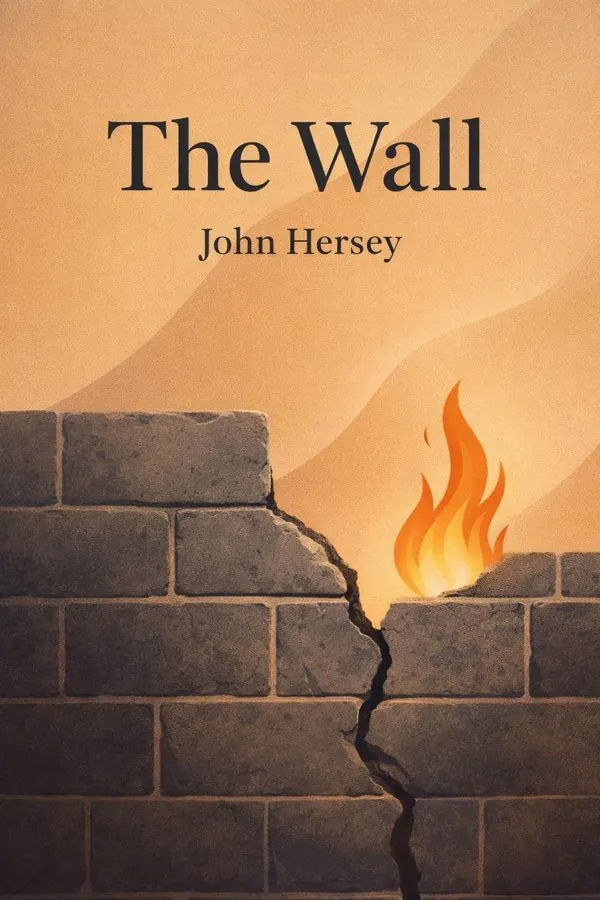
The Wall: Summary & Key Insights
by John Hersey
 10 min9 chaptersAudio available
Key Takeaways from The Wall
Oppression often begins not with spectacular violence but with paperwork, boundaries, and the normalization of separation.
When power seeks to erase a people, preserving the record becomes an act of defiance.
One of Hersey’s most unsettling insights is that extreme cruelty can coexist with daily routine.
In times of destruction, survival depends not only on strength but on mutual responsibility.
Armed revolt is dramatic, but The Wall makes clear that resistance starts much earlier and in many forms.
What Is The Wall About?
The Wall by John Hersey is a war_military book spanning 9 pages. John Hersey’s The Wall is a haunting historical novel that reconstructs the Warsaw Ghetto through the voice of a fictional survivor, Noah Levinson, whose journals preserve the daily reality of Jewish life under Nazi occupation. First published in 1950, the book draws on extensive historical research, survivor testimony, and Hersey’s gifts as one of America’s most respected war correspondents. Rather than offering a distant account of atrocity, The Wall places readers inside the narrowing world of the ghetto: the hunger, fear, bureaucracy, moral compromise, and finally the fierce insistence on dignity through resistance. What makes the novel endure is not only its portrayal of suffering, but its attention to the choices people make when every option is poisoned by violence. Hersey shows how communities fight to preserve memory, culture, and humanity even when physical survival becomes uncertain. The book matters because it transforms statistics into lived experience. It is both a memorial to those destroyed and a meditation on courage, witness, and the necessity of recording truth when regimes are built on erasure.
This FizzRead summary covers all 9 key chapters of The Wall in approximately 10 minutes, distilling the most important ideas, arguments, and takeaways from John Hersey's work. Also available as an audio summary and Key Quotes Podcast.
The Wall
John Hersey’s The Wall is a haunting historical novel that reconstructs the Warsaw Ghetto through the voice of a fictional survivor, Noah Levinson, whose journals preserve the daily reality of Jewish life under Nazi occupation. First published in 1950, the book draws on extensive historical research, survivor testimony, and Hersey’s gifts as one of America’s most respected war correspondents. Rather than offering a distant account of atrocity, The Wall places readers inside the narrowing world of the ghetto: the hunger, fear, bureaucracy, moral compromise, and finally the fierce insistence on dignity through resistance. What makes the novel endure is not only its portrayal of suffering, but its attention to the choices people make when every option is poisoned by violence. Hersey shows how communities fight to preserve memory, culture, and humanity even when physical survival becomes uncertain. The book matters because it transforms statistics into lived experience. It is both a memorial to those destroyed and a meditation on courage, witness, and the necessity of recording truth when regimes are built on erasure.
Who Should Read The Wall?
This book is perfect for anyone interested in war_military and looking to gain actionable insights in a short read. Whether you're a student, professional, or lifelong learner, the key ideas from The Wall by John Hersey will help you think differently.
- ✓Readers who enjoy war_military and want practical takeaways
- ✓Professionals looking to apply new ideas to their work and life
- ✓Anyone who wants the core insights of The Wall in just 10 minutes
Want the full summary?
Get instant access to this book summary and 100K+ more with Fizz Moment.
Get Free SummaryAvailable on App Store • Free to download
Key Chapters
Oppression often begins not with spectacular violence but with paperwork, boundaries, and the normalization of separation. One of the most powerful aspects of The Wall is its portrayal of the early formation of the Warsaw Ghetto, when ordinary city life is gradually divided by decrees, passes, fences, and finally brick walls. Hersey shows that catastrophe does not arrive all at once. It advances through administrative steps that seem procedural to outsiders but are devastating to those trapped inside them.
Through Noah Levinson’s journal entries, readers witness a city turn into a prison. Streets once crossed without thought become forbidden. Neighbors disappear behind classifications. Identity papers determine movement, access, and life chances. Hersey’s insight is that systems of persecution succeed partly because they first redefine what counts as normal. Hunger, crowding, confiscation, and humiliation become daily facts before open annihilation is fully understood.
This idea remains relevant beyond wartime history. In any society, exclusion often starts with language, legal categories, and spatial division: who belongs, who is monitored, who is restricted, who is made invisible. The Wall teaches readers to pay attention to the early signs of dehumanization rather than waiting for history to become unmistakably monstrous.
A practical application is to notice how institutions treat vulnerable groups. Are rules applied equally? Are some people reduced to files, labels, or threats? Whether in public policy, workplaces, or communities, moral collapse begins when barriers harden and empathy thins.
Actionable takeaway: train yourself to recognize the first mechanisms of exclusion, because by the time the wall is visible, injustice has already advanced far inside it.
When power seeks to erase a people, preserving the record becomes an act of defiance. In The Wall, Noah Levinson understands early that he may not be a fighter in the conventional sense, but he can become a witness. His journal is not merely personal reflection. It is an archive of names, scenes, rumors, losses, and moral reckonings. By writing, he resists the Nazi effort to reduce Jewish existence to anonymous disappearance.
Hersey gives extraordinary weight to documentation. Levinson records not only what happens but how it feels, how people argue, justify, despair, and persist. This matters because atrocity thrives when victims are stripped of narrative. A diary, a list, a testimony, even a fragment of memory can challenge that erasure. In this sense, the book honors the real wartime efforts within the ghetto to bury archives and preserve evidence for a future audience.
The lesson extends to modern life. Documentation matters in times of crisis, injustice, and abuse. Journalists, archivists, scholars, organizers, and ordinary citizens all play a role in preserving truth. Whether through testimony, careful records, photographs, or written accounts, keeping an honest record can become a moral obligation.
On a personal level, the novel also suggests that writing helps individuals retain inner coherence when circumstances become chaotic. To narrate experience is to insist that suffering has meaning and that memory has value.
Actionable takeaway: when you encounter wrongdoing, confusion, or institutional harm, document carefully and truthfully. Records preserve reality, support accountability, and protect human dignity against forgetting.
One of Hersey’s most unsettling insights is that extreme cruelty can coexist with daily routine. In The Wall, Nazi persecution intensifies step by step: food rations shrink, disease spreads, deportations begin, and terror becomes systematic. Yet families still search for bread, children still need care, and people still try to make sense of tomorrow. This overlap between the ordinary and the unbearable is central to the novel’s power.
Rather than depicting suffering as one continuous dramatic event, Hersey shows its cumulative nature. Hunger weakens bodies before bullets arrive. Fear is magnified by uncertainty. Rumors about transport, labor, or resettlement muddy judgment. Bureaucratic violence is especially effective because it fragments awareness; each measure may appear temporary, but together they create machinery of destruction.
The book helps readers understand how communities can be trapped between disbelief and knowledge. People do not always fail to act because they are passive. Often they are exhausted, misled, underinformed, or unable to imagine the full scale of what is coming. This makes The Wall a profound study in how evil exploits human limits.
Today, the same pattern can be observed in slower-moving crises: institutional discrimination, authoritarian creep, environmental collapse, or workplace abuse. Harm often escalates through a sequence of “manageable” changes that become overwhelming only in retrospect.
A practical application is learning to read patterns rather than isolated incidents. If conditions keep worsening, if restrictions deepen, if language becomes more degrading, then waiting for complete certainty may be dangerous.
Actionable takeaway: do not judge a crisis only by its most dramatic moments. Pay attention to accumulation, because repeated smaller harms often reveal the true direction of events.
Armed revolt is dramatic, but The Wall makes clear that resistance starts much earlier and in many forms. Before the uprising itself, there are quieter refusals: preserving culture, educating children, gathering intelligence, hiding the vulnerable, recording events, resisting lies, and refusing inward surrender. Hersey broadens the meaning of resistance beyond combat and shows that moral opposition takes shape long before guns are raised.
This is one of the novel’s deepest contributions. In desperate conditions, many people cannot fight militarily. They may be elderly, starving, isolated, or responsible for dependents. Yet they still make choices that deny the oppressor total victory. To continue learning, praying, writing, helping, or speaking truth can become an assertion that the enemy cannot fully define reality.
As the book progresses, underground networks begin to form and a more explicit resistance emerges. But Hersey carefully lays the groundwork by showing how inward transformation happens first. People move from endurance to recognition, from hope in accommodation to understanding that annihilation is the goal. Resistance becomes possible when illusion breaks.
This idea applies broadly. In workplaces, politics, and civil society, opposition to harmful systems rarely begins with a dramatic showdown. It begins when people name what is happening, stop collaborating with false narratives, connect with others, and create alternatives.
Practical examples include whistleblowing, mutual aid, preserving suppressed histories, or refusing dehumanizing language. These acts may look small, but they prepare the ground for larger change.
Actionable takeaway: recognize and honor early forms of resistance. Courage often starts with truth-telling, organization, and the refusal to let injustice define what is normal.
Extreme conditions do not produce simple heroes and villains; they expose painful moral ambiguity. The Wall is especially powerful in its portrayal of ethical conflict inside the ghetto. People must choose whom to feed, whom to trust, whether to collaborate for temporary survival, whether to hide or fight, whether to keep hope alive or tell the harsh truth. Hersey refuses easy judgment because terror distorts every available option.
Levinson’s journal gives readers access to the emotional burden of these choices. A parent may steal to save a child. A community leader may negotiate with occupiers while fearing he is enabling evil. Someone may remain cautious not from cowardice but from responsibility toward family. Someone else may embrace resistance even though it will hasten death. The book insists that morality under oppression is not abstract philosophy; it is decision-making with inadequate information and unbearable consequences.
This complexity is one reason the novel remains important. It pushes readers beyond simplistic historical hindsight. It asks not, “What should they have done?” but “What does it mean to remain human when every choice is compromised?” That question remains urgent in all settings where institutions force people into impossible trade-offs.
In everyday life, the stakes are usually lower, but the principle holds. Ethical maturity requires humility. We should be careful about judging others from positions of safety, while also remaining committed to moral clarity about the system causing the harm.
Actionable takeaway: when evaluating difficult choices, distinguish between the evil of the system and the tragic compromises forced on those trapped within it. Lead with moral seriousness and humility.
Hope becomes more durable when it is organized. As The Wall moves toward the uprising, the atmosphere shifts from stunned suffering to deliberate preparation. Weapons are scarce, prospects are bleak, and no one imagines easy victory. Yet planning itself changes the moral landscape. Tunnels, bunkers, communications, alliances, and hidden stores become instruments not only of survival but of agency.
Hersey shows that preparation is psychologically transformative. A trapped population that once waited for decrees begins making decisions of its own. This matters because resistance is not sustained by emotion alone. Rage and grief may ignite action, but strategy gives it form. The novel captures the painstaking labor behind revolt: persuasion, secrecy, coordination, and the acceptance of risk.
Importantly, preparation in the book is not based on optimism. It is based on clarity. The fighters understand the odds and proceed anyway. Their goal is not conventional military triumph. It is to assert dignity, choose the terms of their final struggle, and demonstrate that Jews did not go silently to extermination. In this sense, preparation transforms despair into purpose.
The lesson applies to modern challenges as well. When facing daunting situations, preparation restores a measure of control. Communities threatened by crisis can make contingency plans, gather resources, train members, and establish communication systems. Individuals facing hardship can do the same on a smaller scale.
Practical examples include emergency planning, legal preparation, coalition building, and learning essential skills before a crisis deepens.
Actionable takeaway: when circumstances feel overwhelming, begin preparing in concrete ways. Planning does not guarantee success, but it converts fear into purposeful action.
Some battles are fought not because they can be won conventionally, but because surrender would complete the oppressor’s moral project. The Warsaw Ghetto Uprising in The Wall is presented with exactly this tragic grandeur. The fighters are outnumbered, underarmed, and surrounded. Yet their revolt alters the meaning of the situation. They may not survive, but they refuse to die as passive objects of another power’s design.
Hersey’s treatment of the uprising is one of the novel’s defining achievements. He emphasizes courage without sentimentality. The struggle is chaotic, brutal, and costly. Buildings burn, bunkers fail, and death is constant. But resistance creates a different kind of victory: the recovery of agency, the preservation of honor, and the transmission of a message to history. The uprising says that even in the face of annihilation, human beings can choose defiance.
This is a crucial distinction. Victory is often measured by territory, survival, or political outcome. The Wall asks readers to consider moral victory as well. There are moments when the refusal to submit carries enduring significance even if immediate defeat is certain.
That insight has contemporary relevance in struggles for justice, memory, and rights. Many campaigns do not achieve quick success. Yet public witness, principled refusal, and courageous action can reshape historical consciousness and inspire future generations.
Still, Hersey does not glorify martyrdom for its own sake. The point is not death; it is chosen dignity under conditions designed to erase it.
Actionable takeaway: redefine victory when confronting overwhelming power. Sometimes the most important win is preserving principle, agency, and truth in the face of attempted humiliation.
Totalitarian violence seeks not only to kill people but to erase the fact that they lived fully human lives. The final movement of The Wall, including the collapse of the ghetto and the postwar framing of the journal, centers on memory as the last and necessary form of survival. Buildings are destroyed, communities are shattered, and countless lives are extinguished. Yet the record remains. Someone reads. Someone remembers. Someone tells.
This closing emphasis gives the novel its lasting moral force. Hersey understands that aftermath is part of the story. What happens once the killing is over? Who gathers the fragments? Who interprets the dead fairly? Who resists the flattening of history into numbers alone? By presenting Levinson’s journal as a surviving document, the book argues that witness can outlast terror and challenge oblivion.
Memory here is not nostalgic sentiment. It is responsibility. To remember honestly is to preserve individuality, complexity, and moral truth. It prevents the dead from being reduced to symbols while also ensuring that the structures that destroyed them are not excused or forgotten.
This matters in modern life whenever communities face trauma, displacement, or injustice. Memorials, oral histories, family archives, educational work, and public testimony are all ways societies resist erasure. Memory also has a practical civic function: it can warn future generations against repetition.
Actionable takeaway: treat remembrance as an active duty. Preserve stories, support historical truth, and refuse to let suffering disappear into abstraction or silence.
All Chapters in The Wall
About the Author
John Hersey (1914–1993) was an American novelist, journalist, and nonfiction writer celebrated for bringing large historical events into intimate human focus. Born in China to missionary parents and educated at Yale and Cambridge, he worked as a correspondent for Time and Life before building a distinguished literary career. Hersey became world-famous for Hiroshima, his landmark 1946 work of reportage about survivors of the atomic bomb, which helped redefine modern journalism. He also won the Pulitzer Prize for Fiction in 1945 for A Bell for Adano. In The Wall, Hersey applied his characteristic blend of research, moral seriousness, and narrative clarity to the Warsaw Ghetto Uprising. His writing remains admired for its compassion, precision, and commitment to preserving human truth amid war and catastrophe.
Get This Summary in Your Preferred Format
Read or listen to the The Wall summary by John Hersey anytime, anywhere. FizzRead offers multiple formats so you can learn on your terms — all free.
Available formats: App · Audio · PDF · EPUB — All included free with FizzRead
Download The Wall PDF and EPUB Summary
Key Quotes from The Wall
“Oppression often begins not with spectacular violence but with paperwork, boundaries, and the normalization of separation.”
“When power seeks to erase a people, preserving the record becomes an act of defiance.”
“One of Hersey’s most unsettling insights is that extreme cruelty can coexist with daily routine.”
“In times of destruction, survival depends not only on strength but on mutual responsibility.”
“Armed revolt is dramatic, but The Wall makes clear that resistance starts much earlier and in many forms.”
Frequently Asked Questions about The Wall
The Wall by John Hersey is a war_military book that explores key ideas across 9 chapters. John Hersey’s The Wall is a haunting historical novel that reconstructs the Warsaw Ghetto through the voice of a fictional survivor, Noah Levinson, whose journals preserve the daily reality of Jewish life under Nazi occupation. First published in 1950, the book draws on extensive historical research, survivor testimony, and Hersey’s gifts as one of America’s most respected war correspondents. Rather than offering a distant account of atrocity, The Wall places readers inside the narrowing world of the ghetto: the hunger, fear, bureaucracy, moral compromise, and finally the fierce insistence on dignity through resistance. What makes the novel endure is not only its portrayal of suffering, but its attention to the choices people make when every option is poisoned by violence. Hersey shows how communities fight to preserve memory, culture, and humanity even when physical survival becomes uncertain. The book matters because it transforms statistics into lived experience. It is both a memorial to those destroyed and a meditation on courage, witness, and the necessity of recording truth when regimes are built on erasure.
More by John Hersey
You Might Also Like
Patriot
Andrew Britton
10 min
War
John Hersey
10 min
An Army at Dawn: The War in North Africa, 1942–1943
Rick Atkinson
10 min
Brave New War: The Next Stage of Terrorism and the End of Globalization
John Robb
10 min
Catch-22
Joseph Heller
10 min
Command and Control: Nuclear Weapons, the Damascus Accident, and the Illusion of Safety
Eric Schlosser
10 minBrowse by Category
Ready to read The Wall?
Get the full summary and 100K+ more books with Fizz Moment.