
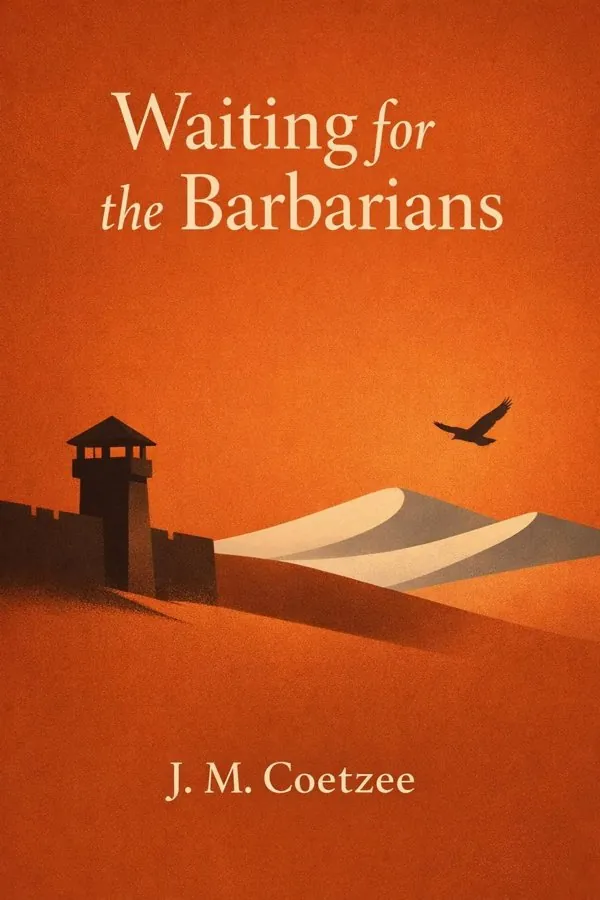
Waiting for the Barbarians: Summary & Key Insights
 10 min9 chaptersAudio available
Key Takeaways from Waiting for the Barbarians
Oppression rarely begins with chaos; it often begins with administration.
When fear enters a political system, truth becomes whatever power can extract.
Moral awakening often starts not with an idea, but with a wounded body.
Trying to make amends does not erase harm, but it can reveal what responsibility truly costs.
A system built on degrading others can quickly turn on anyone who questions it.
What Is Waiting for the Barbarians About?
Waiting for the Barbarians by J. M. Coetzee is a classics book spanning 7 pages. J. M. Coetzee’s Waiting for the Barbarians is a haunting novel about what happens when political power feeds on fear. Set in a remote frontier settlement of an unnamed empire, the story follows an aging magistrate whose orderly administrative life is disrupted by the arrival of Colonel Joll, an agent of the state sent to investigate an alleged barbarian threat. What begins as a vague campaign of security quickly becomes a machinery of torture, suspicion, and public humiliation. As the magistrate witnesses the empire’s violence, he is forced to confront his own complicity, his moral evasions, and the cost of conscience under authoritarian rule. The novel matters because it speaks far beyond its setting: it is about empires, but also about modern states, propaganda, dehumanization, and the stories societies tell to justify cruelty. Coetzee, winner of the Nobel Prize in Literature, writes with extraordinary precision and moral depth. His authority lies not in preaching easy lessons, but in exposing how ordinary people become entangled in systems of domination—and how difficult, yet necessary, it is to resist them.
This FizzRead summary covers all 9 key chapters of Waiting for the Barbarians in approximately 10 minutes, distilling the most important ideas, arguments, and takeaways from J. M. Coetzee's work. Also available as an audio summary and Key Quotes Podcast.
Waiting for the Barbarians
J. M. Coetzee’s Waiting for the Barbarians is a haunting novel about what happens when political power feeds on fear. Set in a remote frontier settlement of an unnamed empire, the story follows an aging magistrate whose orderly administrative life is disrupted by the arrival of Colonel Joll, an agent of the state sent to investigate an alleged barbarian threat. What begins as a vague campaign of security quickly becomes a machinery of torture, suspicion, and public humiliation. As the magistrate witnesses the empire’s violence, he is forced to confront his own complicity, his moral evasions, and the cost of conscience under authoritarian rule. The novel matters because it speaks far beyond its setting: it is about empires, but also about modern states, propaganda, dehumanization, and the stories societies tell to justify cruelty. Coetzee, winner of the Nobel Prize in Literature, writes with extraordinary precision and moral depth. His authority lies not in preaching easy lessons, but in exposing how ordinary people become entangled in systems of domination—and how difficult, yet necessary, it is to resist them.
Who Should Read Waiting for the Barbarians?
This book is perfect for anyone interested in classics and looking to gain actionable insights in a short read. Whether you're a student, professional, or lifelong learner, the key ideas from Waiting for the Barbarians by J. M. Coetzee will help you think differently.
- ✓Readers who enjoy classics and want practical takeaways
- ✓Professionals looking to apply new ideas to their work and life
- ✓Anyone who wants the core insights of Waiting for the Barbarians in just 10 minutes
Want the full summary?
Get instant access to this book summary and 100K+ more with Fizz Moment.
Get Free SummaryAvailable on App Store • Free to download
Key Chapters
Oppression rarely begins with chaos; it often begins with administration. At the opening of Waiting for the Barbarians, the magistrate presides over a frontier settlement that appears calm, even dull. He oversees legal matters, keeps records, supervises trade, and maintains civic order. His life is defined by habit, distance, and a belief that politics happen somewhere else. This apparent normality is essential to Coetzee’s argument: empires survive not only through spectacular acts of force, but through quiet bureaucratic routines that make domination look ordinary.
The magistrate does not think of himself as cruel. He sees himself as practical, moderate, and civilized. Yet his comfort depends on an imperial structure that occupies land, categorizes people, and assumes the right to rule. He is not a sadist, but he benefits from a system that turns inequality into common sense. Coetzee shows that moral danger often lies not in open hatred, but in passive accommodation. The magistrate’s ledgers, hearings, and daily rituals are part of the same imperial order that will later produce torture chambers.
This idea applies far beyond the novel. In real institutions, harmful systems are often sustained by people who tell themselves they are “just doing their jobs.” A workplace may normalize discrimination through policy. A government office may turn suffering into paperwork. A community may enjoy peace because someone else bears the violence that secures it.
Coetzee asks us to examine what our own comfort rests upon. What practices seem harmless only because their victims remain unseen? The magistrate’s routine becomes a warning about moral numbness.
Actionable takeaway: Look critically at the systems you participate in and ask not only whether they function smoothly, but whom that smoothness excludes, exploits, or silences.
When fear enters a political system, truth becomes whatever power can extract. The arrival of Colonel Joll transforms the atmosphere of the settlement from uneasy peace to calculated terror. Joll, a representative of the empire’s secret police, is polished, efficient, and disturbingly certain. He believes that pain reveals truth and that suspicion justifies preemptive violence. Through him, Coetzee dramatizes how states convert anxiety into policy and policy into cruelty.
Joll’s interrogation methods are not portrayed as spontaneous brutality. They are procedural, rationalized, and framed as necessary for security. Prisoners are beaten until they confess to plans that may not exist. Rumor becomes intelligence; fear becomes evidence. The so-called barbarian threat is less a verified reality than a political invention the empire needs in order to mobilize force and reinforce its identity. In this sense, Joll is not merely a villainous individual. He is the embodiment of a system that mistakes domination for knowledge.
The magistrate is repelled by Joll, but he is also initially hesitant, hoping the violence will pass. That hesitation matters. Coetzee suggests that torture thrives not only because interrogators are ruthless, but because bystanders prefer not to interfere. The novel also reveals how language sanitizes cruelty: “investigation,” “security,” and “order” conceal broken bodies.
This pattern is easy to recognize in modern life. Institutions often justify invasive surveillance, harsh policing, or public scapegoating in the name of protection. The question is not only whether a threat exists, but who benefits from amplifying it and what moral limits are sacrificed in response.
Actionable takeaway: Whenever authorities use fear to demand unquestioning obedience, pause and ask what evidence exists, whose suffering is being ignored, and what abuses are being disguised as necessity.
Moral awakening often starts not with an idea, but with a wounded body. The magistrate’s relationship with the young barbarian woman marks a turning point in the novel. She has been tortured by the empire’s forces: her ankles are damaged, her eyesight impaired, and her body bears the marks of interrogation. Until this point, the magistrate has objected to cruelty in the abstract. Through her, suffering becomes intimate, undeniable, and impossible to file away as policy.
Yet Coetzee complicates this awakening. The magistrate’s care for the woman is not pure or heroic. He washes her feet, houses her, and attempts to restore her dignity, but his actions are tangled with guilt, desire, curiosity, and the wish to cleanse himself morally. He wants to understand her pain, but he cannot fully enter her experience. He projects onto her, romanticizes her silence, and uses her as a mirror for his own troubled conscience. This ambiguity is one of the novel’s great strengths. Coetzee refuses to let compassion become self-congratulation.
The relationship exposes a difficult truth: even acts of kindness can contain traces of control. Good intentions do not erase unequal power. The magistrate is moving toward moral awareness, but he is still trapped in habits of interpretation shaped by empire.
In contemporary terms, this speaks to how people respond to the suffering of others. It is easy to make another person’s trauma part of one’s own emotional narrative, especially when trying to “help.” Real ethical attention requires humility. It asks us to care without possessing, to witness without appropriating, and to ask what the harmed person actually needs.
Actionable takeaway: When moved by another person’s suffering, examine your motives honestly and choose forms of care that restore their agency rather than centering your own need to feel virtuous.
Trying to make amends does not erase harm, but it can reveal what responsibility truly costs. The magistrate’s decision to escort the barbarian woman back to her people is one of the novel’s most significant acts. On the surface, it is a gesture of decency: he wants to return her to her home and distance himself from the empire’s violence. But Coetzee presents the journey as morally complex rather than redemptive.
The trip into the frontier forces the magistrate out of his protected administrative world and into a landscape he never fully understood. He crosses not just physical territory, but the mental border that separates imperial certainty from vulnerability. Away from the fort, his authority weakens. He is no longer the settled official interpreting others from a distance. He becomes exposed, uncertain, and dependent. The journey unsettles his assumptions about civilization, belonging, and the empire’s right to define the frontier.
At the same time, the act does not cleanse him. Returning the woman cannot undo what was done to her, nor can it absolve his earlier passivity. Coetzee resists the comforting narrative in which one good deed restores moral balance. Reparation, in this novel, is partial, painful, and insufficient. That is precisely why it matters: genuine accountability does not seek emotional closure for the wrongdoer.
This idea applies to personal and collective life. Apologies, restitution, and repair are essential, but they are not shortcuts to innocence. Whether in relationships, workplaces, or public institutions, taking responsibility often means accepting that some consequences remain and that trust may not be fully restored.
Actionable takeaway: If you have benefited from or contributed to harm, focus less on proving that you are good and more on taking concrete steps to repair what you can, even when the outcome is incomplete.
A system built on degrading others can quickly turn on anyone who questions it. After the magistrate returns from the frontier, the empire no longer sees him as a loyal servant but as a suspect. He is arrested, humiliated, and imprisoned. In one of the novel’s starkest reversals, the man who once held office within the imperial order becomes a victim of that same order. Coetzee uses this inversion to show how authoritarian systems destroy not only designated enemies, but also wavering insiders.
The magistrate’s imprisonment strips him of status, privacy, and dignity. He experiences hunger, filth, ridicule, and public degradation. The treatment he receives mirrors, in reduced but unmistakable form, what the empire has long inflicted on others. This does not make his suffering identical to that of the barbarians, but it forces him to inhabit the vulnerability he once observed from a protected distance. He learns what it means to become an object in a political performance.
Importantly, Coetzee does not romanticize suffering as automatically ennobling. The magistrate becomes weaker, more confused, and at times self-pitying. But his humiliation exposes a larger truth: in regimes organized around fear, no one is secure except those temporarily useful to power. The category of enemy is endlessly expandable.
This dynamic remains relevant wherever institutions silence dissent. Employees who challenge misconduct may be ostracized. Citizens who question official narratives may be monitored or publicly discredited. The lesson is that injustice tolerated against one group creates tools that can later be used against many others.
Actionable takeaway: Defend the rights and dignity of marginalized people before repression reaches you, because systems of abuse grow stronger every time others are left to face them alone.
Power wants to be seen, especially when it is insecure. One of the most disturbing elements in Waiting for the Barbarians is the transformation of violence into public theater. The empire does not merely punish; it stages punishment. Bodies are displayed, fear is ritualized, and humiliation becomes a lesson for the crowd. Coetzee shows that domination is never only physical. It is symbolic. It seeks to instruct everyone watching about who belongs, who rules, and what happens to those placed outside the law.
The public beating of prisoners reveals how empire creates consent through spectacle. By turning suffering into a visible event, authorities make brutality appear legitimate, even educational. The crowd’s role is crucial. Some people are horrified, others curious, others numb. The scene raises a troubling question: what happens to a society when cruelty becomes something to witness rather than resist?
The magistrate is appalled by these performances, but he also recognizes that they are meant to produce a script in which the empire is strong and the enemy is degraded. The spectacle reassures rulers and subjects alike that force is meaningful. Yet beneath the display lies desperation. Governments resort to spectacle when they need repeated demonstrations of power to conceal their fragility.
In modern contexts, public shaming, inflammatory media coverage, and performative crackdowns can function in similar ways. Political actors may exaggerate danger, stage raids, or circulate dehumanizing images to produce fear and loyalty. The medium may change, but the logic remains the same.
Actionable takeaway: Refuse to consume public humiliation as entertainment or proof of order; instead, ask what insecurity or injustice a spectacle of punishment is trying to hide.
The greatest weakness of oppressive power is that it begins to believe its own fantasies. As the novel progresses, the empire’s campaign against the barbarians becomes increasingly irrational. Troops march out in anticipation of attack, supplies are strained, authority frays, and the settlement is left in a condition of uncertainty and decay. Coetzee reveals that the empire is not defeated by a clearly defined external enemy; it is undone by paranoia, overreach, and the internal logic of militarized fear.
This is one of the novel’s most powerful insights. The empire invents a permanent emergency and then reorganizes reality around it. But permanent emergency is unsustainable. It distorts judgment, wastes resources, and erodes trust. Ordinary administration gives way to suspicion. Communities become brittle. Leaders who rely on imagined threats eventually lose contact with the world they claim to control.
The magistrate watches the settlement unravel in the aftermath of imperial aggression. There is no triumphant restoration, only uncertainty. Coetzee suggests that violence justified as defense often produces the very instability it claims to prevent. The empire’s obsession with enemies makes governance impossible because fear cannot build; it can only consume.
This pattern appears in many settings. Organizations driven by suspicion become dysfunctional. Nations that define themselves through endless conflict weaken their own institutions. Even in personal life, constant defensiveness can destroy relationships more effectively than any external challenge.
Actionable takeaway: Be wary of leaders, systems, or habits that depend on perpetual crisis, because fear may create short-term obedience but eventually corrodes the very structures it claims to protect.
Some of the deepest truths in the novel emerge through what cannot be fully explained. Waiting for the Barbarians is narrated by the magistrate, but his account is filled with uncertainty, self-correction, and gaps in understanding. He tries to interpret the woman, the empire, the frontier, and himself, yet language repeatedly proves inadequate. Coetzee uses this narrative instability to explore the limits of knowledge, especially when guilt and suffering are involved.
The magistrate wants clarity. He wants to know what the woman feels, what the barbarians intend, what his own motives mean. But certainty remains elusive. This matters because imperial power often speaks in confident categories: civilized and barbarian, truth and lie, loyalty and treason. The novel challenges those binaries. Human experience is not so easily ordered. Trauma resists neat narration. Moral compromise produces self-deception. Even honest reflection can remain partial.
This is not a flaw in the book; it is one of its central achievements. Coetzee suggests that ethical seriousness begins when we stop pretending to know everything. The magistrate’s uncertainty, though frustrating, is preferable to the violent certainty of figures like Joll. Doubt can be a form of humility.
In practical life, this insight is valuable wherever people rush to interpret others from a distance. Whether in politics, conflict, or personal disagreement, we often impose simplified narratives because ambiguity is uncomfortable. But premature certainty can do real harm.
Actionable takeaway: Practice moral humility by questioning your interpretations, especially when judging people unlike yourself, and make room for the possibility that some realities cannot be fully captured by your preferred story.
Every society reveals itself by the enemies it needs. The title Waiting for the Barbarians points to one of Coetzee’s sharpest ideas: the barbarian is less a known people than a category produced by imperial imagination. The empire requires an outsider against whom it can define civilization, justify repression, and organize loyalty. In that sense, the barbarians function symbolically before they function politically. They are a screen onto which fear, prejudice, and aggression are projected.
Throughout the novel, the actual barbarians remain elusive. They are not developed as a simple invading force because Coetzee is more interested in how the empire talks about them than in proving whether they pose a threat. This absence is crucial. It shows how political systems often manufacture danger through repetition, rumor, and selective evidence. Once a group is named as barbaric, savage, criminal, or alien, extraordinary treatment becomes easier to defend.
The magistrate gradually sees that the empire’s identity depends on this opposition. Civilization, as the empire defines it, requires barbarism somewhere beyond the walls. Without an enemy, its violence loses its rationale. That is why waiting itself matters: the settlement exists in anticipation of attack, and that anticipation shapes everything.
This mechanism is still familiar today. Public discourse often constructs threatening outsiders—migrants, dissidents, rival groups, or cultural others—to unify anxious populations. Such labels flatten human complexity and turn fear into political capital.
Actionable takeaway: When a group is repeatedly described as inherently dangerous or uncivilized, examine who is doing the labeling, what policies it enables, and whose power is strengthened by keeping that fear alive.
All Chapters in Waiting for the Barbarians
About the Author
J. M. Coetzee, born John Maxwell Coetzee in Cape Town in 1940, is a South African-born novelist, essayist, linguist, and one of the most acclaimed writers in modern literature. Educated in South Africa and later at the University of Texas at Austin, he worked in academia while developing a literary career marked by intellectual rigor and moral intensity. His novels often examine oppression, shame, complicity, and the struggle for ethical clarity under violent political systems. Coetzee won the Booker Prize twice, for Life & Times of Michael K and Disgrace, and received the Nobel Prize in Literature in 2003. Known for his spare prose and philosophical depth, he has written fiction, criticism, and autobiographical works. His writing remains central to conversations about power, empire, and the human conscience.
Get This Summary in Your Preferred Format
Read or listen to the Waiting for the Barbarians summary by J. M. Coetzee anytime, anywhere. FizzRead offers multiple formats so you can learn on your terms — all free.
Available formats: App · Audio · PDF · EPUB — All included free with FizzRead
Download Waiting for the Barbarians PDF and EPUB Summary
Key Quotes from Waiting for the Barbarians
“Oppression rarely begins with chaos; it often begins with administration.”
“When fear enters a political system, truth becomes whatever power can extract.”
“Moral awakening often starts not with an idea, but with a wounded body.”
“Trying to make amends does not erase harm, but it can reveal what responsibility truly costs.”
“A system built on degrading others can quickly turn on anyone who questions it.”
Frequently Asked Questions about Waiting for the Barbarians
Waiting for the Barbarians by J. M. Coetzee is a classics book that explores key ideas across 9 chapters. J. M. Coetzee’s Waiting for the Barbarians is a haunting novel about what happens when political power feeds on fear. Set in a remote frontier settlement of an unnamed empire, the story follows an aging magistrate whose orderly administrative life is disrupted by the arrival of Colonel Joll, an agent of the state sent to investigate an alleged barbarian threat. What begins as a vague campaign of security quickly becomes a machinery of torture, suspicion, and public humiliation. As the magistrate witnesses the empire’s violence, he is forced to confront his own complicity, his moral evasions, and the cost of conscience under authoritarian rule. The novel matters because it speaks far beyond its setting: it is about empires, but also about modern states, propaganda, dehumanization, and the stories societies tell to justify cruelty. Coetzee, winner of the Nobel Prize in Literature, writes with extraordinary precision and moral depth. His authority lies not in preaching easy lessons, but in exposing how ordinary people become entangled in systems of domination—and how difficult, yet necessary, it is to resist them.
More by J. M. Coetzee


You Might Also Like






Browse by Category
Ready to read Waiting for the Barbarians?
Get the full summary and 100K+ more books with Fizz Moment.