
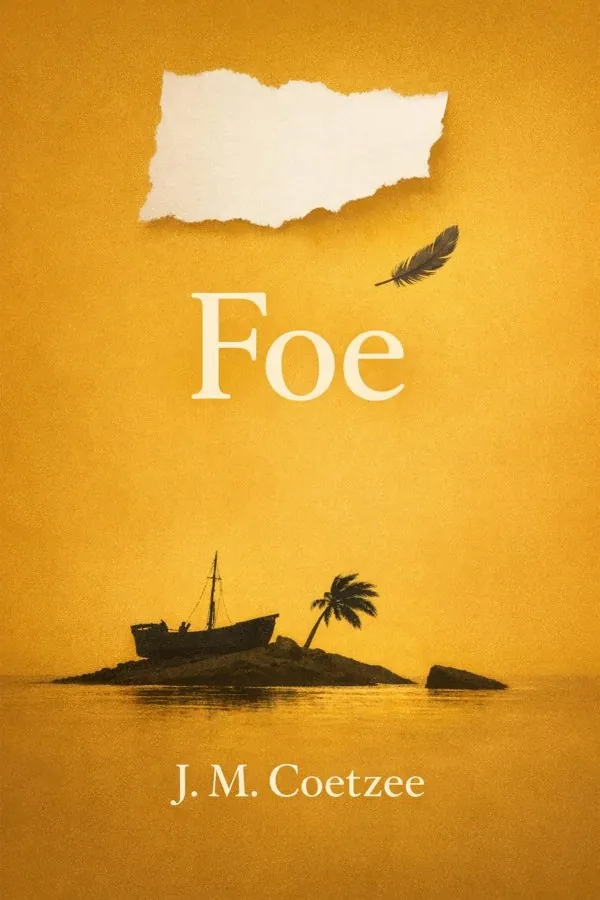
Foe: Summary & Key Insights
 10 min9 chaptersAudio available
Key Takeaways from Foe
Isolation does not automatically produce wisdom, heroism, or self-mastery; often, it exposes the stories we have been taught to expect.
Survival alone is not enough; in society, experience must often be shaped into a saleable narrative before it is believed or valued.
The most powerful presence in Foe belongs to the character who speaks least.
Writers do not merely record reality; they organize it, authorize it, and often dominate it.
A woman may survive extraordinary events and still find that her authority over them is doubted.
What Is Foe About?
Foe by J. M. Coetzee is a classics book spanning 3 pages. J. M. Coetzee’s Foe is a brilliant and unsettling reimagining of Daniel Defoe’s Robinson Crusoe, but it is far more than a literary retelling. First published in 1986, the novel follows Susan Barton, a castaway who lands on an island inhabited by Cruso and Friday, only to discover that survival is not the book’s deepest concern. Instead, Coetzee asks a more disturbing question: who gets to speak, and who is turned into material for someone else’s story? When Susan returns to England and seeks out the writer Daniel Foe to tell her tale, the novel becomes an inquiry into authorship, power, truth, and silence itself. Coetzee’s authority lies in his unmatched ability to make narrative feel morally urgent. A Nobel Prize-winning novelist known for his exacting prose and fierce intellectual clarity, he transforms a familiar colonial adventure into a meditation on language, representation, and exclusion. Foe matters because it reveals that storytelling is never innocent: every narrative elevates certain voices while muting others, and what remains unsaid may be the deepest truth of all.
This FizzRead summary covers all 9 key chapters of Foe in approximately 10 minutes, distilling the most important ideas, arguments, and takeaways from J. M. Coetzee's work. Also available as an audio summary and Key Quotes Podcast.
Foe
J. M. Coetzee’s Foe is a brilliant and unsettling reimagining of Daniel Defoe’s Robinson Crusoe, but it is far more than a literary retelling. First published in 1986, the novel follows Susan Barton, a castaway who lands on an island inhabited by Cruso and Friday, only to discover that survival is not the book’s deepest concern. Instead, Coetzee asks a more disturbing question: who gets to speak, and who is turned into material for someone else’s story? When Susan returns to England and seeks out the writer Daniel Foe to tell her tale, the novel becomes an inquiry into authorship, power, truth, and silence itself. Coetzee’s authority lies in his unmatched ability to make narrative feel morally urgent. A Nobel Prize-winning novelist known for his exacting prose and fierce intellectual clarity, he transforms a familiar colonial adventure into a meditation on language, representation, and exclusion. Foe matters because it reveals that storytelling is never innocent: every narrative elevates certain voices while muting others, and what remains unsaid may be the deepest truth of all.
Who Should Read Foe?
This book is perfect for anyone interested in classics and looking to gain actionable insights in a short read. Whether you're a student, professional, or lifelong learner, the key ideas from Foe by J. M. Coetzee will help you think differently.
- ✓Readers who enjoy classics and want practical takeaways
- ✓Professionals looking to apply new ideas to their work and life
- ✓Anyone who wants the core insights of Foe in just 10 minutes
Want the full summary?
Get instant access to this book summary and 100K+ more with Fizz Moment.
Get Free SummaryAvailable on App Store • Free to download
Key Chapters
Isolation does not automatically produce wisdom, heroism, or self-mastery; often, it exposes the stories we have been taught to expect. When Susan Barton is washed ashore, she seems to enter the recognizable world of the castaway tale. Readers might anticipate ingenuity, conquest over nature, and the gradual construction of a miniature civilization. But Coetzee denies that fantasy almost immediately. Cruso is not Defoe’s energetic empire-builder. He is weary, passive, and strangely uninterested in rescue, productivity, or legacy. His terraces remain unused, his island resists symbolic order, and his life has no triumphant narrative arc.
This matters because Coetzee dismantles the myth of creation at the heart of colonial adventure fiction. In many classic tales, the island becomes a blank space on which the European subject inscribes purpose, labor, and ownership. In Foe, the island is not empty, and it does not validate mastery. Instead, it reveals confusion, futility, and the fragility of human meaning-making. Susan looks for explanations, but the island yields few. Friday’s silence deepens this uncertainty, suggesting that the place contains histories and injuries inaccessible to her.
Practically, this idea applies beyond literature. In modern life, people often romanticize reinvention: moving cities, changing jobs, or starting over is imagined as an opportunity to author oneself from scratch. Coetzee reminds us that no setting is truly blank and no self is created without inherited structures, omissions, and other people’s untold stories.
Actionable takeaway: whenever you encounter a narrative of heroic self-making, ask what realities it leaves out and whose presence makes that myth possible.
Survival alone is not enough; in society, experience must often be shaped into a saleable narrative before it is believed or valued. Once Susan Barton returns from the island, she discovers that her ordeal has no stable meaning until it enters the literary marketplace. Her struggle shifts from enduring hardship to controlling how that hardship will be told. She seeks out the writer Daniel Foe because she wants her account preserved, yet this decision exposes her to a new kind of dispossession. What was lived immediately must now be revised, arranged, dramatized, and made legible to readers.
Coetzee shows England not simply as the center of civilization but as the workshop where raw life is converted into convention. Susan wants truth, but Foe wants shape. He pushes toward familiar plotlines, emotional hooks, and explanatory details that can transform her strange, unresolved experience into a coherent story. In doing so, the novel reveals a difficult fact: stories rarely reach the world untouched by the demands of genre, audience, and authority.
This tension is highly recognizable today. Memoirs are edited for impact, news is framed for clicks, and personal testimony on social media is often pressured into recognizable scripts of trauma, redemption, or outrage. The issue is not that storytelling is false, but that narrative form exerts power. What gets emphasized? What gets cut? Who decides what counts as compelling?
Actionable takeaway: when telling your own story, identify the difference between what happened, what others want to hear, and what you are unwilling to surrender for the sake of a cleaner narrative.
The most powerful presence in Foe belongs to the character who speaks least. Friday, whose tongue has been cut out, stands at the center of the novel’s ethical and political force. He cannot narrate his own history in the conventional sense, and because of that absence, everyone else is tempted to narrate him instead. Susan imagines origins for his silence. Foe sees a mystery that might enrich the story. Readers, too, may feel compelled to decode him. Yet Coetzee turns that impulse into a problem rather than a solution.
Friday represents the limits of representation. He is not merely a symbol of silenced colonial subjects; he also resists being reduced to one. His muteness exposes the violence through which dominant cultures claim to understand others. To speak for someone may appear compassionate, but it can become another form of control. Coetzee does not offer the comfort of recovery, confession, or full translation. Instead, he asks what it means to face a life that cannot be cleanly made available to interpretation.
This has practical relevance in contemporary discussions of advocacy, journalism, scholarship, and leadership. Speaking on behalf of marginalized people may be necessary in some contexts, but it always carries risk. Good intentions do not erase the possibility of appropriation. The challenge is to create conditions in which others can appear without being overwritten.
Actionable takeaway: before interpreting another person’s silence, pause and ask whether you are listening for their reality or merely filling the gap with a version that serves your own need for meaning.
Real experience is often fragmentary, unresolved, and resistant to neat explanation, but stories prefer order. Foe repeatedly stages the conflict between lived reality and narrative expectation. Susan wants to tell what happened on the island, but what happened may not satisfy the demands of narrative logic. There is no clear moral transformation, no grand revelation, no obvious climax. Cruso dies. Friday remains silent. The island yields no complete secret. Yet the literary system around Susan pressures her toward coherence, because readers and publishers expect patterns.
Coetzee’s point is subtle but crucial: plot can clarify reality, but it can also falsify it. Once events are arranged into a meaningful sequence, ambiguity is reduced. Causes become legible, motives seem stable, and endings imply completion where none may exist. This is why Foe feels so unsettling. It refuses the satisfactions that traditional storytelling offers and thereby exposes how much those satisfactions depend on simplification.
This insight matters in daily life. People routinely force complex experiences into usable stories: a breakup becomes a lesson, an illness becomes inspiration, a career detour becomes destiny. Such framings can be comforting and even necessary, but they can also erase contradiction. Not every wound yields wisdom, and not every event can be made meaningful on command.
Actionable takeaway: when reflecting on your own past, allow some experiences to remain incomplete instead of rushing to assign them a moral or a tidy narrative arc.
Empire is not only built through ships, land claims, and labor; it is also built through naming, classification, and the power to describe others. Foe reveals that colonialism operates deeply within language itself. Cruso, Susan, and Foe all participate in efforts to interpret, categorize, and narrate Friday. Even when they do so sympathetically, they are working within a structure where the colonized subject is made intelligible through the colonizer’s terms. Friday’s silence becomes especially disruptive because it interrupts that process. He cannot be fully absorbed into the language that seeks to define him.
Coetzee’s revision of Robinson Crusoe therefore challenges the colonial fantasy of transparent knowledge. In classic imperial narratives, the explorer names a place, maps it, and thereby seems to possess it. In Foe, however, language repeatedly fails to master reality. The island remains opaque. Friday remains partly inaccessible. Susan’s own narrative authority remains unstable. The result is a profound critique of how literature has historically supported colonial power by transforming domination into description.
In contemporary settings, this can be seen in the language institutions use about communities they govern or study. Terms like underdeveloped, vulnerable, or difficult-to-reach may appear neutral but often embed assumptions about who is centered and who is observed. Language frames policy, sympathy, and exclusion alike.
Actionable takeaway: examine the words you use to describe people different from yourself and ask whether those terms illuminate their reality or quietly reinforce your own position of authority.
Human beings dislike gaps in knowledge, yet some gaps deserve protection rather than conquest. One reason Foe remains so haunting is that it frustrates the reader’s desire for completion. We want to know Friday’s history. We want to understand Cruso’s motivations. We want Susan’s story to settle into certainty. Coetzee withholds that satisfaction, forcing us to confront our own hunger for explanation. Why do we need every silence decoded? Why do we feel entitled to a complete account of another person’s pain?
The novel suggests that there is an ethics to not-knowing. This is not the same as indifference. Susan cares deeply about Friday, and readers are invited to care as well. But care does not grant possession. Some experiences cannot be fully recovered, especially when violence has damaged the means of expression. To insist on total understanding may become another form of violation, one that treats opacity as a problem to be solved rather than a condition to be respected.
This idea has practical value in personal relationships, therapy, education, and social debate. People often demand disclosures before offering empathy: explain yourself, prove your trauma, give the backstory. Coetzee warns against making legibility the price of moral recognition.
Actionable takeaway: practice offering seriousness and respect even when you do not have the full story, and resist the reflex to force ambiguity into premature clarity.
To read Foe well is to realize that reading itself carries responsibility. Coetzee does not let us remain passive consumers of a clever literary revision. He implicates the reader in the same structures that shape Susan’s struggle and Friday’s silence. We are trained by literary tradition to seek protagonists, motives, revelations, and closure. We want the hidden truth, the interpretable symbol, the final key. But the novel keeps asking whether these habits are ethically innocent. When we demand a satisfying story, are we also demanding that difficult lives become digestible for us?
This turns reading into a form of moral attention. Instead of extracting meaning as quickly as possible, Coetzee invites patience, humility, and discomfort. The reader must notice what is missing as much as what is present. The silences are not defects to be repaired; they are part of the novel’s argument. In that sense, Foe teaches a discipline of interpretation: remain alert to power, respect uncertainty, and examine your own appetite for narrative mastery.
That lesson matters far beyond literature. In a world saturated with simplified takes, instant commentary, and emotional packaging, careful attention has become rare. Whether reading a novel, a news story, or a public statement, the challenge is the same: can you stay with complexity without flattening it?
Actionable takeaway: in your next difficult reading experience, resist the urge to reduce it immediately to a message and instead ask what forms of patience, doubt, and self-scrutiny the text is trying to teach you.
All Chapters in Foe
About the Author
J. M. Coetzee, born in Cape Town in 1940, is a South African-born novelist, essayist, linguist, translator, and one of the most acclaimed writers of the modern era. He studied mathematics and English before becoming a scholar and later an internationally recognized author. Coetzee is known for his spare, controlled prose and for fiction that confronts questions of power, colonialism, moral responsibility, suffering, and the limits of language. He is a two-time Booker Prize winner and received the Nobel Prize in Literature in 2003. His major works include Waiting for the Barbarians, Life & Times of Michael K, Foe, and Disgrace. Across his career, Coetzee has built a reputation for intellectually rigorous novels that challenge readers to think deeply about politics, ethics, and representation.
Get This Summary in Your Preferred Format
Read or listen to the Foe summary by J. M. Coetzee anytime, anywhere. FizzRead offers multiple formats so you can learn on your terms — all free.
Available formats: App · Audio · PDF · EPUB — All included free with FizzRead
Download Foe PDF and EPUB Summary
Key Quotes from Foe
“Isolation does not automatically produce wisdom, heroism, or self-mastery; often, it exposes the stories we have been taught to expect.”
“Survival alone is not enough; in society, experience must often be shaped into a saleable narrative before it is believed or valued.”
“The most powerful presence in Foe belongs to the character who speaks least.”
“Writers do not merely record reality; they organize it, authorize it, and often dominate it.”
“A woman may survive extraordinary events and still find that her authority over them is doubted.”
Frequently Asked Questions about Foe
Foe by J. M. Coetzee is a classics book that explores key ideas across 9 chapters. J. M. Coetzee’s Foe is a brilliant and unsettling reimagining of Daniel Defoe’s Robinson Crusoe, but it is far more than a literary retelling. First published in 1986, the novel follows Susan Barton, a castaway who lands on an island inhabited by Cruso and Friday, only to discover that survival is not the book’s deepest concern. Instead, Coetzee asks a more disturbing question: who gets to speak, and who is turned into material for someone else’s story? When Susan returns to England and seeks out the writer Daniel Foe to tell her tale, the novel becomes an inquiry into authorship, power, truth, and silence itself. Coetzee’s authority lies in his unmatched ability to make narrative feel morally urgent. A Nobel Prize-winning novelist known for his exacting prose and fierce intellectual clarity, he transforms a familiar colonial adventure into a meditation on language, representation, and exclusion. Foe matters because it reveals that storytelling is never innocent: every narrative elevates certain voices while muting others, and what remains unsaid may be the deepest truth of all.
More by J. M. Coetzee
You Might Also Like






Browse by Category
Ready to read Foe?
Get the full summary and 100K+ more books with Fizz Moment.