
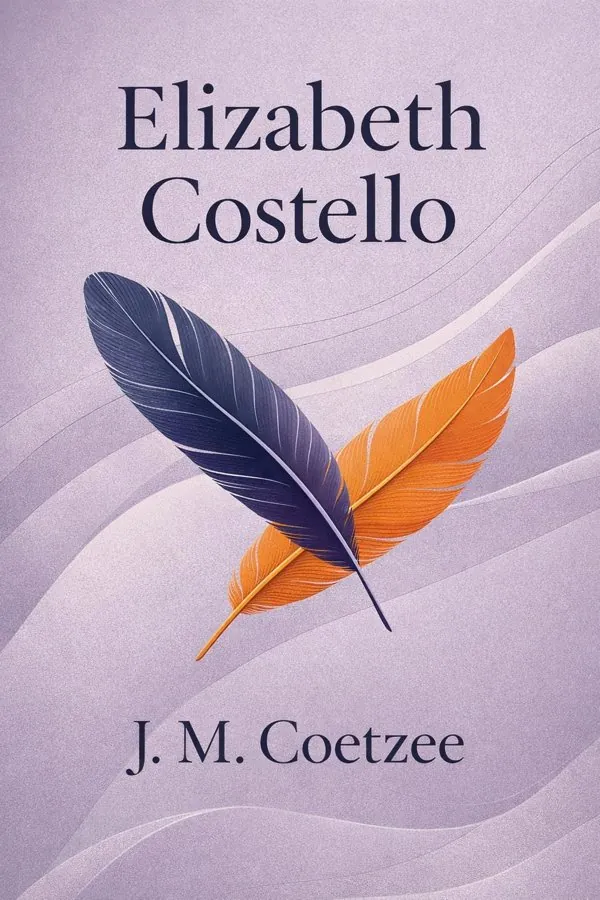
Elizabeth Costello: Summary & Key Insights
 10 min9 chaptersAudio available
Key Takeaways from Elizabeth Costello
Public recognition often reveals uncertainty more sharply than failure does.
What feels realistic in art is often just what a culture has learned to recognize.
A society may pride itself on reason and progress while tolerating routine cruelty it refuses to see.
The deepest moral truths may become invisible when we insist on arguing only in the language of logic.
A person may reject religious certainty and still remain haunted by religious questions.
What Is Elizabeth Costello About?
Elizabeth Costello by J. M. Coetzee is a great_ideas book spanning 6 pages. Elizabeth Costello is J. M. Coetzee’s daring and unsettling novel about an aging Australian writer whose public lectures become stages for some of the hardest questions a human being can ask. As Costello travels from campuses to conferences and from family homes to metaphysical thresholds, she speaks about literature, animal suffering, evil, belief, and the responsibilities of art. Yet the book is far more than a sequence of intellectual performances. It is a portrait of a mind confronting its own limits: the limits of reason, sympathy, language, and even identity. What makes Elizabeth Costello so powerful is that Coetzee refuses easy answers. Instead of presenting a tidy philosophical system, he dramatizes ideas in conflict, showing how convictions can illuminate one truth while obscuring another. The result is a work that reads like fiction, essay, moral inquiry, and spiritual trial all at once. Coetzee writes with extraordinary authority. A Nobel Prize–winning novelist known for his ethical seriousness and formal innovation, he uses Costello to test what literature can do when argument fails. This is a profound book for readers interested in morality, imagination, and the uneasy burden of being human.
This FizzRead summary covers all 9 key chapters of Elizabeth Costello in approximately 10 minutes, distilling the most important ideas, arguments, and takeaways from J. M. Coetzee's work. Also available as an audio summary and Key Quotes Podcast.
Elizabeth Costello
Elizabeth Costello is J. M. Coetzee’s daring and unsettling novel about an aging Australian writer whose public lectures become stages for some of the hardest questions a human being can ask. As Costello travels from campuses to conferences and from family homes to metaphysical thresholds, she speaks about literature, animal suffering, evil, belief, and the responsibilities of art. Yet the book is far more than a sequence of intellectual performances. It is a portrait of a mind confronting its own limits: the limits of reason, sympathy, language, and even identity.
What makes Elizabeth Costello so powerful is that Coetzee refuses easy answers. Instead of presenting a tidy philosophical system, he dramatizes ideas in conflict, showing how convictions can illuminate one truth while obscuring another. The result is a work that reads like fiction, essay, moral inquiry, and spiritual trial all at once.
Coetzee writes with extraordinary authority. A Nobel Prize–winning novelist known for his ethical seriousness and formal innovation, he uses Costello to test what literature can do when argument fails. This is a profound book for readers interested in morality, imagination, and the uneasy burden of being human.
Who Should Read Elizabeth Costello?
This book is perfect for anyone interested in great_ideas and looking to gain actionable insights in a short read. Whether you're a student, professional, or lifelong learner, the key ideas from Elizabeth Costello by J. M. Coetzee will help you think differently.
- ✓Readers who enjoy great_ideas and want practical takeaways
- ✓Professionals looking to apply new ideas to their work and life
- ✓Anyone who wants the core insights of Elizabeth Costello in just 10 minutes
Want the full summary?
Get instant access to this book summary and 100K+ more with Fizz Moment.
Get Free SummaryAvailable on App Store • Free to download
Key Chapters
Public recognition often reveals uncertainty more sharply than failure does. In Elizabeth Costello, an aging novelist is repeatedly invited to speak as if she were an authority whose wisdom has already been settled. Yet each appearance exposes the gap between a celebrated public persona and the fragile, unresolved self behind it. Costello stands before audiences expecting coherence, but what emerges instead is discomfort, contradiction, and self-exposure.
Coetzee uses these scenes to challenge the idea that intellectual life is a matter of mastering arguments and presenting polished conclusions. Costello’s speeches do not confirm control; they dramatize vulnerability. She is introduced as a distinguished author, but her authority keeps slipping. Listeners misunderstand her, resist her, or judge her tone more than her thought. Even her family sees the distance between the woman on stage and the person off it. The “intellectual” appears less as a finished identity than as a mask worn under pressure.
This matters because many of us also perform versions of ourselves in professional and social life. A teacher, manager, writer, or activist may sound certain in public while privately wrestling with doubt. Coetzee suggests that this tension is not hypocrisy; it is part of what thinking honestly looks like. Serious thought rarely arrives fully formed. It comes tangled with insecurity, emotion, and incompletion.
In practical terms, the novel invites us to distrust neat performances of certainty. When someone speaks with total confidence on moral or cultural questions, it is worth asking what complexity has been edited out. Likewise, in our own lives, we can treat uncertainty not as weakness but as evidence of real engagement.
Actionable takeaway: Examine the roles in which you sound most authoritative, and ask what doubts or questions you are hiding beneath that performance.
What feels realistic in art is often just what a culture has learned to recognize. Costello’s reflections on literature suggest that realism is not a transparent window onto the world but a convention shaped by habit, expectation, and power. Readers call a story believable when its details fit familiar forms of life. But that familiarity can also exclude what does not easily fit accepted categories.
Coetzee uses Costello to explore how fiction creates recognition. A novel persuades us not only by describing material facts but by presenting consciousness in ways we already know how to read. That seems innocent until we notice what gets left out. Certain lives, voices, and experiences can appear “unrealistic” simply because dominant forms of storytelling have not made room for them. Realism, then, is selective. It legitimizes some forms of existence while marginalizing others.
This insight extends beyond literature. In workplaces, politics, and media, people are judged credible when they resemble established templates. A leader who behaves in a familiar way seems natural; one who does not may be dismissed as implausible. The same happens in personal relationships. We recognize others through stories we already carry, and those stories can narrow our capacity to see.
Costello’s unease with realism also raises a question about moral imagination. If we can only acknowledge what fits our categories, how do we respond to beings whose inner lives are difficult to picture? Coetzee turns this into an ethical challenge: recognition is never neutral. To recognize one thing is often to overlook another.
Actionable takeaway: Notice what you instinctively call “realistic” or “credible,” and ask which assumptions or cultural templates are shaping that judgment.
A society may pride itself on reason and progress while tolerating routine cruelty it refuses to see. One of the book’s most famous and disturbing sections centers on Costello’s lectures about animals. She asks her audience to confront industrial slaughter not as an abstract policy issue but as a moral catastrophe hidden in plain sight. Her argument is not merely that animals feel pain. It is that human beings have built systems that depend on suppressing imaginative identification with that pain.
Costello resists the comfortable humanist idea that moral worth belongs mainly to rational or language-using beings. Instead, she appeals to fellow-feeling, to the body, to the capacity to imagine another creature’s experience. This puts her at odds with listeners who prefer clean philosophical distinctions. They want criteria, categories, and definitions. She offers something less tidy and more demanding: the claim that moral life begins when we let ourselves be troubled by suffering we would rather keep distant.
The power of this idea lies in its broader application. We often protect ourselves from discomfort by converting living beings into concepts. Factory-farmed animals become units of production. Migrants become statistics. The sick become cases. Costello’s provocation is that ethics fails when abstraction becomes a shield against attention.
In everyday life, this does not require adopting a single political or dietary position overnight. It does require honest examination. Where do your comforts rely on not looking closely? How often do convenience and distance make cruelty feel normal? Moral imagination is not sentimentality; it is disciplined refusal to let suffering disappear behind systems.
Actionable takeaway: Choose one routine habit involving consumption, food, or convenience, and investigate the living realities it hides from your daily view.
The deepest moral truths may become invisible when we insist on arguing only in the language of logic. Costello repeatedly frustrates those who want her to defend her positions through rigorous philosophical proof. She can reason, but she also senses that ethical life cannot be reduced to winning arguments. Rational discourse clarifies, yet it can also flatten experience, especially when what is at stake is suffering, reverence, or shame.
Coetzee does not dismiss reason. Rather, he shows its limits. Costello’s reflections imply that there are domains where argument reaches a threshold beyond which only imagination, metaphor, narrative, or silence can continue the work. To know that an animal suffers is one thing; to let that knowledge alter one’s being is another. To define evil is one thing; to endure its representation is another. Rationality can classify, but it cannot guarantee moral awakening.
This tension matters in modern life because institutions reward people who argue cleanly and defend positions efficiently. In business, academia, and public debate, emotional and imaginative forms of understanding are often treated as secondary. Yet many important decisions involve people whose realities cannot be fully captured by metrics or syllogisms. A parent caring for a dying relative, a judge weighing mercy, or a teacher responding to trauma all operate in spaces where formal reasoning must be joined by felt perception.
Costello’s example encourages intellectual humility. If someone cannot prove a moral intuition in strict analytical terms, that does not mean the intuition is empty. Sometimes language strains because the reality itself exceeds our conceptual tools.
Actionable takeaway: In your next disagreement about a moral issue, ask not only “What is the strongest argument?” but also “What human reality might argument alone be failing to register?”
A person may reject religious certainty and still remain haunted by religious questions. In the sections involving Costello’s relationship to belief, Coetzee explores a condition familiar to many modern readers: not simple faith, and not simple unbelief, but restless exposure to both. Costello does not inhabit a stable doctrine. She circles questions of transcendence, judgment, and meaning without securing a final position.
Her encounters with religious perspectives, including the shadow cast by her sister’s convictions, dramatize how belief is never purely intellectual. Families inherit spiritual tensions. Love and resentment become entangled with doctrine. One person’s faith may appear to another as courage, delusion, obedience, or envy. Coetzee refuses to treat belief as a problem solved by better evidence. Instead, he shows how deeply it reaches into temperament, memory, and the need for orientation.
This is useful because discussions of faith are often polarized. People are expected either to submit fully or to dismiss belief as irrational. Costello occupies a more difficult space. She is drawn to moral seriousness and metaphysical depth, yet suspicious of systems that claim certainty about the unseen. That in-between position can feel lonely, but Coetzee suggests it is intellectually honest.
In practical life, many people live in this tension. They may participate in rituals without firm conviction, feel awe without theology, or reject dogma while longing for significance larger than the self. Rather than forcing resolution, the novel gives dignity to unresolved searching. Doubt is not always emptiness; sometimes it is the form integrity takes when certainty is unavailable.
Actionable takeaway: Write down one spiritual or existential question you usually avoid because you cannot answer it, and allow yourself to examine it without demanding immediate certainty.
Not everything that can be shown should be shown without moral hesitation. In her reflections on evil, Costello raises a disturbing question about literature and art: when creators depict cruelty, degradation, or monstrosity, do they illuminate evil or participate in it? Coetzee refuses the easy answer that art is justified simply because it seeks truth. He asks whether some representations leave a residue that damages both maker and audience.
Costello’s concern is not prudishness. It is moral contamination. To enter imaginatively into scenes of atrocity may be necessary for witness, but it may also require an intimacy with depravity that exacts a price. The writer who insists on total freedom can end up treating human souls as material. The reader who consumes horrors in the name of seriousness may be desensitized rather than awakened. Coetzee therefore complicates the modern belief that exposure always produces understanding.
This issue is highly relevant today. News media, streaming platforms, and social networks constantly circulate images of violence, humiliation, and abuse. We often assume that seeing more means knowing more. Yet repetition can numb rather than deepen responsibility. The line between testimony and spectacle is thin. An artist, journalist, or ordinary user sharing disturbing content must ask not only “Is this real?” but “What does this presentation do to those who encounter it?”
The novel does not call for censorship in any simple sense. It calls for ethical seriousness about form, motive, and consequence. Representation is never innocent. The challenge is to bear witness without exploiting suffering for intensity, status, or aesthetic effect.
Actionable takeaway: Before consuming or sharing disturbing material, pause and ask whether it fosters understanding, care, and accountability—or merely shock and fascination.
People often imagine disagreement as a failure of information when it is really a failure of imaginative reach. Throughout Elizabeth Costello, conversations go wrong not because words are missing but because participants cannot or will not inhabit one another’s frames of experience. Costello speaks passionately, yet audiences hear provocation, exaggeration, or obscurity. Family members listen through old resentments. Colleagues respond to status, manners, or ideology rather than the vulnerable core of what is being said.
Coetzee shows that communication breaks down when empathy is underdeveloped. To understand another person, we need more than literal comprehension. We need a willingness to be unsettled by a perspective that may not fit our habits of thought. Without that willingness, every exchange becomes a sorting exercise: credible or not, rational or emotional, one of us or not. Costello’s struggles reveal how modern discourse can reward clever rebuttal while discouraging transformation.
This idea extends to everyday life. In workplaces, a manager may dismiss an employee’s concern because the emotional style feels unfamiliar. In families, one generation may hear moral urgency as melodrama. Online, people often respond to caricatures of positions rather than the lived fears beneath them. Better communication requires more than clarity; it requires forms of attention generous enough to cross difference.
That does not mean agreement is always possible. Some moral conflicts remain real. But Coetzee suggests that many failures of conversation happen before the actual disagreement begins. We stop at the threshold where another consciousness becomes inconveniently complex.
Actionable takeaway: In your next difficult conversation, restate the other person’s concern in a way they would recognize as fair before offering your own response.
Aging does not simply alter the body; it changes the conditions under which the self can appear in the world. Elizabeth Costello is not presented as a disembodied intellect. Her fatigue, irritability, vulnerability, and social awkwardness matter. Coetzee makes visible what many philosophical works neglect: thought happens in a body that weakens, desires, recoils, and tires. Intellectual authority is therefore inseparable from mortality.
This emphasis deepens the novel’s exploration of identity. Costello is still a celebrated writer, but age has shifted how others receive her and how she experiences herself. She can no longer rely on charisma, stamina, or social ease. Her ideas emerge through a body that reminds her, and us, that the self is not pure reason floating above time. The result is often painful. People may patronize the elderly, mistake frailty for irrelevance, or reduce complexity to decline.
Yet Coetzee also suggests that aging can strip away illusions. As conventional success loses its glamour, older consciousness may become more candid about discomforting truths. Costello’s late-life lectures carry urgency partly because she has less interest in pleasing audiences. Her body’s limitations sharpen the ethical stakes. Mortality presses thought toward what most matters.
This has practical implications for how we understand ourselves and others. We should be wary of cultures that equate worth with smooth performance, productivity, or youthful confidence. Wisdom may arrive haltingly, in inconvenient forms. Likewise, our own intellectual and moral lives will change as our bodies change. That is not a defect in thought; it is part of thought’s human reality.
Actionable takeaway: Pay attention to how age, fatigue, illness, or physical comfort shape your judgments, and extend the same awareness when interpreting others.
The longing for final answers often collides with a world that demands decision without adequate proof. In the book’s final movement, Costello finds herself at a threshold where she is asked to state what she believes. The scene is strange, allegorical, and deeply revealing. Instead of delivering a triumphant declaration, she hesitates. Her predicament captures one of Coetzee’s central insights: human beings are judged, by others and by themselves, even when their convictions remain incomplete.
This conclusion gathers the novel’s major themes. Costello has spoken on animals, literature, evil, and faith, yet she cannot convert her searching into a clean creed. The demand for belief exposes the inadequacy of formulas. What does it mean to “believe” when one’s deepest experiences are ambiguous, bodily, and resistant to doctrine? Coetzee does not mock the question. He intensifies it, suggesting that honest uncertainty may be more serious than borrowed certainty.
In ordinary life, we face similar pressures. Institutions ask us to define values, declare identities, and take positions. Sometimes that is necessary. But the novel reminds us that not all truth takes the form of propositions. A person may live compassionately without a complete metaphysical system. Another may affirm a doctrine while remaining ethically asleep. Judgment, then, cannot rely only on stated beliefs; it must attend to how a life is actually inhabited.
The ending leaves readers unsettled on purpose. Instead of closure, it offers a challenge: to live responsively in the absence of total clarity. That is not relativism. It is a disciplined acceptance that moral and spiritual life often proceed through partial light.
Actionable takeaway: When pressured to produce absolute certainty, practice naming what you genuinely know, what you hope, and what remains unresolved.
All Chapters in Elizabeth Costello
About the Author
J. M. Coetzee, born in 1940 in Cape Town, South Africa, is one of the most acclaimed novelists of the modern era. A novelist, essayist, translator, and academic, he is known for precise, restrained prose and for fiction that probes moral conflict, power, suffering, and the limits of language. His major works include Waiting for the Barbarians, Life & Times of Michael K, Disgrace, and Elizabeth Costello. Coetzee won the Booker Prize twice, a rare achievement, and received the Nobel Prize in Literature in 2003. Though South African by birth, he later became an Australian citizen. Across his career, he has built a reputation for intellectually rigorous, formally inventive writing that challenges readers to confront difficult ethical questions without the comfort of easy conclusions.
Get This Summary in Your Preferred Format
Read or listen to the Elizabeth Costello summary by J. M. Coetzee anytime, anywhere. FizzRead offers multiple formats so you can learn on your terms — all free.
Available formats: App · Audio · PDF · EPUB — All included free with FizzRead
Download Elizabeth Costello PDF and EPUB Summary
Key Quotes from Elizabeth Costello
“Public recognition often reveals uncertainty more sharply than failure does.”
“What feels realistic in art is often just what a culture has learned to recognize.”
“A society may pride itself on reason and progress while tolerating routine cruelty it refuses to see.”
“The deepest moral truths may become invisible when we insist on arguing only in the language of logic.”
“A person may reject religious certainty and still remain haunted by religious questions.”
Frequently Asked Questions about Elizabeth Costello
Elizabeth Costello by J. M. Coetzee is a great_ideas book that explores key ideas across 9 chapters. Elizabeth Costello is J. M. Coetzee’s daring and unsettling novel about an aging Australian writer whose public lectures become stages for some of the hardest questions a human being can ask. As Costello travels from campuses to conferences and from family homes to metaphysical thresholds, she speaks about literature, animal suffering, evil, belief, and the responsibilities of art. Yet the book is far more than a sequence of intellectual performances. It is a portrait of a mind confronting its own limits: the limits of reason, sympathy, language, and even identity. What makes Elizabeth Costello so powerful is that Coetzee refuses easy answers. Instead of presenting a tidy philosophical system, he dramatizes ideas in conflict, showing how convictions can illuminate one truth while obscuring another. The result is a work that reads like fiction, essay, moral inquiry, and spiritual trial all at once. Coetzee writes with extraordinary authority. A Nobel Prize–winning novelist known for his ethical seriousness and formal innovation, he uses Costello to test what literature can do when argument fails. This is a profound book for readers interested in morality, imagination, and the uneasy burden of being human.
More by J. M. Coetzee
You Might Also Like

Browse by Category
Ready to read Elizabeth Costello?
Get the full summary and 100K+ more books with Fizz Moment.