
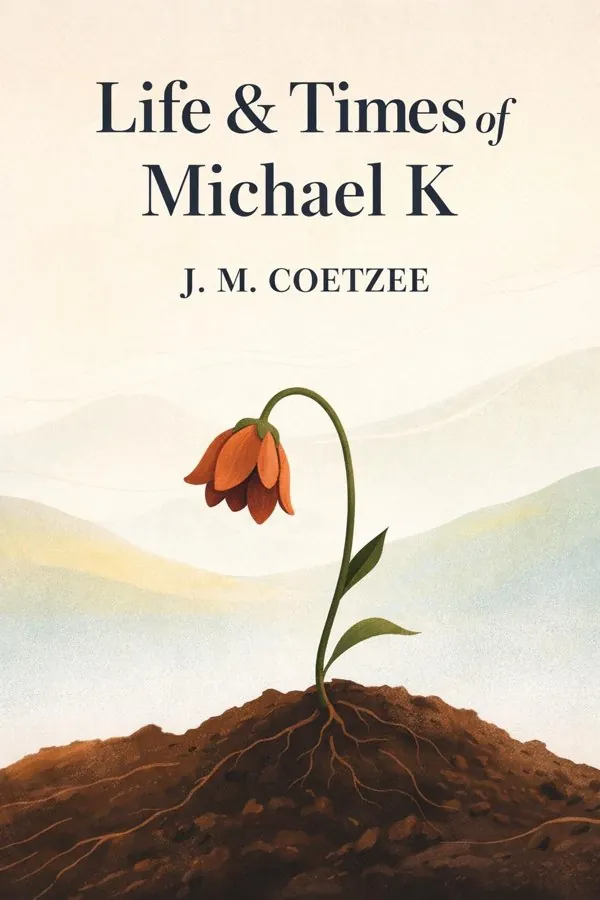
Life & Times of Michael K: Summary & Key Insights
 10 min8 chaptersAudio available
Key Takeaways from Life & Times of Michael K
Sometimes the people society notices least reveal its deepest truths.
A journey becomes profound when it is less about destination than about refusing the terms of captivity.
Real freedom may begin not with possession, but with learning how little you truly need.
Institutions often claim they are helping when they are really trying to make a person legible.
Endurance is most revealing when no audience is present.
What Is Life & Times of Michael K About?
Life & Times of Michael K by J. M. Coetzee is a classics book spanning 5 pages. Set in a South Africa fractured by war, bureaucracy, and suspicion, Life & Times of Michael K tells the story of a man who appears insignificant to everyone but himself. Michael K, a quiet gardener born with a cleft lip and accustomed to being overlooked, leaves Cape Town with his sick mother in a homemade cart, hoping to return her to the rural farm of her childhood. What follows is not a heroic quest in the conventional sense, but a stripped-down journey through checkpoints, labor camps, hunger, and solitude. As institutions try to identify, manage, and contain him, Michael keeps moving toward a life beyond official systems. This novel matters because it asks one of literature’s hardest questions: what does freedom look like for someone with almost no power? J. M. Coetzee, one of the most acclaimed novelists of the modern era and winner of the Nobel Prize in Literature, answers with spare, unsettling precision. His prose is lean, symbolic, and morally searching. The result is a classic meditation on dignity, survival, and resistance that grows more powerful the quieter it becomes.
This FizzRead summary covers all 8 key chapters of Life & Times of Michael K in approximately 10 minutes, distilling the most important ideas, arguments, and takeaways from J. M. Coetzee's work. Also available as an audio summary and Key Quotes Podcast.
Life & Times of Michael K
Set in a South Africa fractured by war, bureaucracy, and suspicion, Life & Times of Michael K tells the story of a man who appears insignificant to everyone but himself. Michael K, a quiet gardener born with a cleft lip and accustomed to being overlooked, leaves Cape Town with his sick mother in a homemade cart, hoping to return her to the rural farm of her childhood. What follows is not a heroic quest in the conventional sense, but a stripped-down journey through checkpoints, labor camps, hunger, and solitude. As institutions try to identify, manage, and contain him, Michael keeps moving toward a life beyond official systems.
This novel matters because it asks one of literature’s hardest questions: what does freedom look like for someone with almost no power? J. M. Coetzee, one of the most acclaimed novelists of the modern era and winner of the Nobel Prize in Literature, answers with spare, unsettling precision. His prose is lean, symbolic, and morally searching. The result is a classic meditation on dignity, survival, and resistance that grows more powerful the quieter it becomes.
Who Should Read Life & Times of Michael K?
This book is perfect for anyone interested in classics and looking to gain actionable insights in a short read. Whether you're a student, professional, or lifelong learner, the key ideas from Life & Times of Michael K by J. M. Coetzee will help you think differently.
- ✓Readers who enjoy classics and want practical takeaways
- ✓Professionals looking to apply new ideas to their work and life
- ✓Anyone who wants the core insights of Life & Times of Michael K in just 10 minutes
Want the full summary?
Get instant access to this book summary and 100K+ more with Fizz Moment.
Get Free SummaryAvailable on App Store • Free to download
Key Chapters
Sometimes the people society notices least reveal its deepest truths. Michael K begins life on the edges of apartheid-era Cape Town, born to a domestic servant and marked by a cleft lip that makes him seem different before he can even speak for himself. He grows up learning that visibility brings danger, judgment, and control. Silence, by contrast, becomes a form of shelter. He is not a man who argues his way into recognition; he slips through the world as someone others classify too quickly and understand too poorly.
Coetzee uses Michael’s marginal status to show how power works. Institutions do not only dominate through overt violence. They also reduce people to categories: laborer, dependent, vagrant, patient, inmate. Michael is repeatedly defined by others before he can define himself. Yet his obscurity is not simply weakness. It also gives him a strange kind of freedom. Because he is underestimated, he remains partially inaccessible to the systems that want to absorb him.
This idea extends beyond the novel. In modern life, people are often flattened into labels: job titles, data profiles, diagnoses, social roles. We may begin to live according to these external descriptions rather than our inner needs. Michael K reminds us that the self can survive even when public identity is thin, awkward, or misunderstood.
The practical lesson is not to romanticize exclusion, but to question the labels imposed on yourself and others. Ask where you have accepted a definition that reduces your humanity. Actionable takeaway: identify one role or label that has come to dominate your self-image, and write down what remains true about you outside it.
A journey becomes profound when it is less about destination than about refusing the terms of captivity. When Michael builds a crude cart to carry his ailing mother out of Cape Town, the object seems pitiful and fragile, part stretcher, part coffin, part act of love. Yet it marks the moment he claims agency. In a country fractured by civil conflict, patrols, roadblocks, and fear, simply choosing one’s direction becomes a radical act.
The physical journey is grueling. Roads are dangerous, public transport is restricted, and ordinary movement is treated with suspicion. Michael and his mother pass through a world where war has made every civilian vulnerable. Her death before they reach their goal deepens the tragedy, but it does not erase the meaning of the effort. The trip becomes less a successful return than an exposure of how broken the social order has become. Travel is no longer a normal human freedom; it is a test administered by the state.
Coetzee shows how conflict deforms the simplest acts. Caring for a parent, traveling home, burying the dead, and finding food become politically charged. This remains recognizable today wherever systems make basic human needs difficult through paperwork, surveillance, or conflict. Even in ordinary life, people face smaller versions of this when illness, debt, or institutional complexity turns simple tasks into ordeals.
Michael’s persistence teaches that agency does not require grandeur. It can begin with one improvised tool, one stubborn choice, one refusal to stop moving. Actionable takeaway: when circumstances feel overwhelming, focus on the smallest next act that restores your direction and autonomy.
Real freedom may begin not with possession, but with learning how little you truly need. One of the most memorable movements in the novel occurs when Michael reaches the rural land associated with his mother’s past and begins to live by growing food. He plants pumpkins, shelters himself with almost nothing, and tries to exist beyond wages, officials, camps, and commands. Gardening, the skill that once tied him to employment, becomes the basis of an alternative life.
This is not pastoral fantasy. Michael’s existence is precarious, hungry, and vulnerable to discovery. But Coetzee makes cultivation a moral and philosophical act. To grow food from the earth is to detach, however temporarily, from systems built on coercion and dependence. Michael does not seek dominance over nature or accumulation of property. He seeks enough. In a world organized around control, enough becomes revolutionary.
The novel invites readers to reconsider their relationship to need. Many social structures maintain power by convincing people that they require more access, approval, and consumption than they actually do. Michael’s sparse life suggests another possibility: by reducing dependency, one can preserve a core of independence. This is not a universal prescription, nor is poverty romanticized. Rather, Coetzee asks what forms of self-rule become imaginable when appetite is disciplined.
A practical application is to examine where your life is overcomplicated by unnecessary dependency, whether digital, financial, or social. You may not withdraw from society, but you can recover some inner freedom by simplifying one aspect of daily living. Actionable takeaway: choose one recurring need in your life and ask how you might meet it more directly, simply, or independently.
Institutions often claim they are helping when they are really trying to make a person legible. Throughout the novel, Michael is captured, processed, questioned, housed, fed, and observed. Camps and medical facilities present themselves as rational responses to disorder. But their deeper purpose is to classify him, assign motives, and fit his life into recognizable narratives. Michael resists not through speeches or revolt, but through refusal. He withholds explanation, slips away, eats little, and remains inwardly unavailable.
Coetzee’s brilliance lies in showing that power is frustrated by opacity. Authorities want Michael to declare what he wants, which side he belongs to, what story he represents. Is he a victim, rebel, simpleton, patient, criminal? He does not cooperate with these frames. His resistance is quiet, even baffling. That is what makes it powerful. He denies institutions the satisfaction of turning him into a case they can solve.
In contemporary life, this theme resonates wherever organizations insist that measurable data equals understanding. Workplaces, schools, healthcare systems, and bureaucracies often operate through forms, metrics, and profiles. These can be necessary, but they can also reduce complexity. People then experience the exhaustion of being managed rather than known.
Michael’s example suggests that preserving an inner life sometimes requires strategic noncompliance with reductive expectations. Not every demand for explanation deserves full access to your selfhood. The practical lesson is to notice when clarity becomes coercion. Actionable takeaway: identify one area where you overshare or overjustify yourself to gain approval, and practice setting a firm, minimal boundary instead.
Endurance is most revealing when no audience is present. After escaping institutions and returning to the open land, Michael enters a more extreme solitude. Hunger, exposure, weakness, and fear become constant companions. Yet these harsh conditions also strip away distraction. In the wilderness, he is reduced to the essentials of body, appetite, memory, and will. The question is no longer how to succeed in society, but how to remain human when society offers only domination.
Coetzee does not sentimentalize isolation. Michael’s life on the land is physically devastating. He becomes gaunt, vulnerable, and nearly spectral. But the wilderness is not merely a backdrop for suffering. It is also the setting in which Michael preserves the part of himself that organized life cannot reach. He chooses obscurity over incorporation. He would rather live precariously on his own terms than securely as a managed subject.
This tension speaks to a universal dilemma. Many people accept environments that deaden them because those environments promise stability. Others romanticize escape without acknowledging its costs. The novel refuses easy answers. Freedom and security are shown as competing goods, and Michael’s choice is difficult precisely because it is not practical in ordinary terms.
For readers, the deeper application is to ask what forms of comfort have begun to erode conviction, creativity, or integrity. You may not need to withdraw, but you may need periods of chosen solitude that reconnect you with what matters beyond performance and control. Actionable takeaway: create one regular space of deliberate solitude each week, free from demands and distraction, to listen for what your life is protecting or sacrificing.
In a noisy world of commands, interrogations, and explanations, silence can become a radical language. Michael K is not eloquent in the conventional literary sense. He rarely offers long reflections, compelling arguments, or persuasive defenses. Others often mistake this for emptiness or incapacity. But Coetzee gradually reveals that Michael’s silence is not simply lack. It is a way of remaining unclaimed.
The novel repeatedly stages encounters in which officials, doctors, and observers try to speak Michael into being. They narrate him, interpret him, and infer motives on his behalf. Their speech is often more revealing about their own assumptions than about Michael himself. By refusing to provide the expected story, Michael protects a part of his identity from colonization. He becomes difficult to absorb into political, psychological, or bureaucratic language.
This does not mean all silence is virtuous. Silence can also be fear, erasure, or damage. But Coetzee asks readers to see that there are moments when withholding words is an assertion of dignity. In everyday life, people are often pressured to explain every choice, disclose every feeling, or perform constant verbal clarity. Yet not all truth can be spoken on demand, and not all listeners are entitled to it.
Practically, this theme encourages discernment. Speaking up is essential in many situations, but so is knowing when silence protects your integrity from manipulation. Actionable takeaway: before responding to a demand for explanation, pause and ask whether your words will create understanding or merely supply material for someone else’s control.
One of the novel’s most striking shifts occurs when Michael is seen through the eyes of a camp doctor. Suddenly the reader encounters a voice that tries to interpret, diagnose, and rescue him. The doctor is fascinated by Michael because he cannot fit him neatly into familiar frameworks. He wants to understand him, perhaps even save him, but his attention is still a form of possession. He turns Michael into a puzzle to be solved.
This section deepens the novel’s moral complexity. The doctor is not simply cruel. He is intelligent, observant, and in some ways compassionate. Yet even sympathy can become invasive when it assumes the right to define another person’s meaning. The doctor imagines Michael as a symbol, a saint of simplicity, a witness to another way of life. In doing so, he risks replacing one imposed narrative with another, gentler but still controlling one.
Coetzee’s point is profound: domination does not only come from hostility. It can also come from interpretation that leaves no room for irreducible otherness. In modern life, this appears when people explain others too quickly through ideology, therapy language, or biography. To understand someone is valuable; to finalize them is dangerous.
The practical application is humility in judgment. Even our most generous readings of others may reflect our needs more than their reality. Actionable takeaway: in your next difficult interaction, replace the urge to interpret the whole person with one honest question, and allow the possibility that some part of them will remain unknown.
Many stories teach us to seek freedom through public victory, legal recognition, or social acknowledgment. Michael K offers a harsher, stranger idea: a person may preserve freedom inwardly even when the world never validates it. Michael is not celebrated, understood, or politically effective in any conventional sense. He leaves no movement behind him and earns no honor. Yet he continues to choose a mode of being that refuses total surrender.
This matters because modern culture often links value to visibility. We are trained to believe that what counts must be witnessed, measured, approved, or shared. Michael’s life challenges that assumption. His resistance is private, nearly invisible. It is meaningful not because others praise it, but because it remains true to his own minimal but persistent sense of what he can live with.
Coetzee does not suggest that public justice is unimportant. On the contrary, the novel’s oppressive world makes political transformation urgently necessary. But he also insists that there is a layer of human dignity that precedes recognition. If institutions fail to honor it, it still exists.
This can be consoling and demanding. It asks readers to care about the moral quality of choices that no one rewards. In work, relationships, or private conduct, integrity often survives without applause. Actionable takeaway: choose one right action this week that aligns with your values even if it brings no recognition, and let the act itself be enough.
All Chapters in Life & Times of Michael K
About the Author
J. M. Coetzee, born John Maxwell Coetzee in Cape Town in 1940, is a South African-born novelist, essayist, linguist, and one of the most celebrated literary writers of the late twentieth and early twenty-first centuries. He studied mathematics and English, worked in academia, and later became known for fiction marked by stylistic precision, philosophical depth, and moral intensity. His major works include Waiting for the Barbarians, Disgrace, Foe, and Life & Times of Michael K. Coetzee won the Booker Prize twice, an exceptionally rare achievement, and received the Nobel Prize in Literature in 2003. Much of his writing explores power, cruelty, responsibility, isolation, and the struggle to preserve human dignity under oppressive systems. He later became an Australian citizen and has continued to write fiction and criticism of lasting global influence.
Get This Summary in Your Preferred Format
Read or listen to the Life & Times of Michael K summary by J. M. Coetzee anytime, anywhere. FizzRead offers multiple formats so you can learn on your terms — all free.
Available formats: App · Audio · PDF · EPUB — All included free with FizzRead
Download Life & Times of Michael K PDF and EPUB Summary
Key Quotes from Life & Times of Michael K
“Sometimes the people society notices least reveal its deepest truths.”
“A journey becomes profound when it is less about destination than about refusing the terms of captivity.”
“Real freedom may begin not with possession, but with learning how little you truly need.”
“Institutions often claim they are helping when they are really trying to make a person legible.”
“Endurance is most revealing when no audience is present.”
Frequently Asked Questions about Life & Times of Michael K
Life & Times of Michael K by J. M. Coetzee is a classics book that explores key ideas across 8 chapters. Set in a South Africa fractured by war, bureaucracy, and suspicion, Life & Times of Michael K tells the story of a man who appears insignificant to everyone but himself. Michael K, a quiet gardener born with a cleft lip and accustomed to being overlooked, leaves Cape Town with his sick mother in a homemade cart, hoping to return her to the rural farm of her childhood. What follows is not a heroic quest in the conventional sense, but a stripped-down journey through checkpoints, labor camps, hunger, and solitude. As institutions try to identify, manage, and contain him, Michael keeps moving toward a life beyond official systems. This novel matters because it asks one of literature’s hardest questions: what does freedom look like for someone with almost no power? J. M. Coetzee, one of the most acclaimed novelists of the modern era and winner of the Nobel Prize in Literature, answers with spare, unsettling precision. His prose is lean, symbolic, and morally searching. The result is a classic meditation on dignity, survival, and resistance that grows more powerful the quieter it becomes.
More by J. M. Coetzee

You Might Also Like




Browse by Category
Ready to read Life & Times of Michael K?
Get the full summary and 100K+ more books with Fizz Moment.