
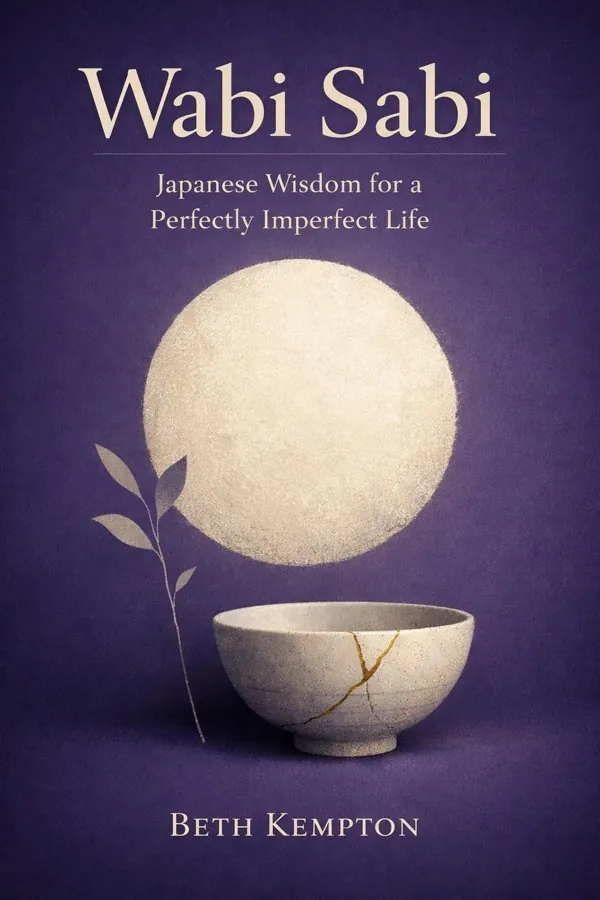
Wabi Sabi: Japanese Wisdom for a Perfectly Imperfect Life: Summary & Key Insights
by Beth Kempton
 10 min9 chaptersAudio available
Key Takeaways from Wabi Sabi: Japanese Wisdom for a Perfectly Imperfect Life
Perfection often looks impressive, but it rarely feels alive.
Clutter is not only physical; it is emotional, mental, and spiritual.
We suffer when we expect life to stay still.
Presence is not something we find by escaping life; it is something we practice inside it.
A philosophy only matters if it can be lived.
What Is Wabi Sabi: Japanese Wisdom for a Perfectly Imperfect Life About?
Wabi Sabi: Japanese Wisdom for a Perfectly Imperfect Life by Beth Kempton is a eastern_wisdom book spanning 8 pages. Wabi Sabi: Japanese Wisdom for a Perfectly Imperfect Life is Beth Kempton’s gentle yet deeply practical guide to one of Japan’s most subtle and transformative ideas: that beauty lives in imperfection, peace grows through simplicity, and meaning is found by accepting life’s constant change. Rather than presenting wabi-sabi as a decorative trend or aesthetic formula, Kempton explores it as a way of seeing, feeling, and living. Through stories, reflections, and insights shaped by her years studying Japanese language and culture, she helps readers understand why modern life so often leaves us exhausted by comparison, productivity, and the pursuit of flawless outcomes. The book matters because it offers a humane alternative. It invites us to slow down, appreciate what is modest and unfinished, and make room for tenderness toward ourselves and others. Kempton is a credible and engaging guide precisely because she approaches the subject with both scholarship and lived experience. The result is a thoughtful bridge between Japanese wisdom and everyday modern challenges, showing how wabi-sabi can bring calm, depth, and authenticity to ordinary life.
This FizzRead summary covers all 9 key chapters of Wabi Sabi: Japanese Wisdom for a Perfectly Imperfect Life in approximately 10 minutes, distilling the most important ideas, arguments, and takeaways from Beth Kempton's work. Also available as an audio summary and Key Quotes Podcast.
Wabi Sabi: Japanese Wisdom for a Perfectly Imperfect Life
Wabi Sabi: Japanese Wisdom for a Perfectly Imperfect Life is Beth Kempton’s gentle yet deeply practical guide to one of Japan’s most subtle and transformative ideas: that beauty lives in imperfection, peace grows through simplicity, and meaning is found by accepting life’s constant change. Rather than presenting wabi-sabi as a decorative trend or aesthetic formula, Kempton explores it as a way of seeing, feeling, and living. Through stories, reflections, and insights shaped by her years studying Japanese language and culture, she helps readers understand why modern life so often leaves us exhausted by comparison, productivity, and the pursuit of flawless outcomes. The book matters because it offers a humane alternative. It invites us to slow down, appreciate what is modest and unfinished, and make room for tenderness toward ourselves and others. Kempton is a credible and engaging guide precisely because she approaches the subject with both scholarship and lived experience. The result is a thoughtful bridge between Japanese wisdom and everyday modern challenges, showing how wabi-sabi can bring calm, depth, and authenticity to ordinary life.
Who Should Read Wabi Sabi: Japanese Wisdom for a Perfectly Imperfect Life?
This book is perfect for anyone interested in eastern_wisdom and looking to gain actionable insights in a short read. Whether you're a student, professional, or lifelong learner, the key ideas from Wabi Sabi: Japanese Wisdom for a Perfectly Imperfect Life by Beth Kempton will help you think differently.
- ✓Readers who enjoy eastern_wisdom and want practical takeaways
- ✓Professionals looking to apply new ideas to their work and life
- ✓Anyone who wants the core insights of Wabi Sabi: Japanese Wisdom for a Perfectly Imperfect Life in just 10 minutes
Want the full summary?
Get instant access to this book summary and 100K+ more with Fizz Moment.
Get Free SummaryAvailable on App Store • Free to download
Key Chapters
Perfection often looks impressive, but it rarely feels alive. At the center of wabi-sabi is a radical shift in values: what is worn, incomplete, weathered, and modest can hold more truth and beauty than what is polished and flawless. Beth Kempton explains that wabi-sabi emerges from a Japanese sensibility shaped by Zen Buddhism, especially the awareness of impermanence, or mujo. Everything changes, everything ages, and nothing stays fixed. Instead of resisting this reality, wabi-sabi asks us to meet it with reverence.
This is why an old wooden table marked by years of use may feel more beautiful than a brand-new one, or why a chipped teacup can seem more precious because it carries memory. Wabi-sabi does not celebrate damage for its own sake. It values the evidence of life. The uneven glaze on pottery, the fading of fabric, the quiet asymmetry of handmade objects all remind us that authenticity matters more than uniformity.
Applied to everyday living, this philosophy softens the harsh standards many people impose on themselves. A home does not need to look magazine-perfect to be welcoming. A creative project does not need to be immaculate to be meaningful. A person does not need to be fully healed, finished, or certain to be worthy.
Kempton encourages readers to notice the subtle beauty already around them: fallen leaves, old books, simple meals, quiet corners, and conversations that are honest rather than polished. In doing so, we become less addicted to surface perfection and more present to life as it really is.
Actionable takeaway: Choose one imperfect object you already own and spend a few minutes appreciating its history, texture, and story instead of wishing it were newer or better.
Clutter is not only physical; it is emotional, mental, and spiritual. One of Kempton’s central insights is that simplicity, in the wabi-sabi sense, is not emptiness or deprivation. It is the intentional removal of what distracts us from what matters most. In Japanese spaces, she noticed how a plain room with tatami mats, soft light, and a single flower arrangement could feel more nourishing than a room filled with expensive decoration. The lesson is not to imitate Japanese interiors literally, but to understand the power of restraint.
Wabi-sabi simplicity creates room for attention. When our homes, schedules, and minds are overloaded, we stop seeing clearly. We rush, react, and consume without reflection. Simplicity allows us to reconnect with atmosphere, rhythm, and meaning. A simple meal eaten slowly can be richer than a lavish one eaten in distraction. A short, honest conversation can matter more than a hundred messages.
This idea can be applied in many ways. At home, it might mean clearing one small area so that it becomes restful rather than stimulating. At work, it might mean focusing on a few essential priorities instead of scattering energy across endless tasks. In relationships, it can mean speaking more sincerely and listening more carefully.
Kempton’s version of simplicity is compassionate rather than strict. She does not argue for minimalist perfection, where every object must justify itself. Instead, she invites us to ask whether our surroundings and habits support presence, calm, and authenticity.
Actionable takeaway: Simplify one part of your life this week, such as your desk, your morning routine, or your digital notifications, and notice whether less creates more clarity.
We suffer when we expect life to stay still. Wabi-sabi begins with the recognition that everything is in flux: seasons turn, relationships evolve, bodies age, homes change, and even our identities shift over time. Kempton shows that this is not a bleak idea but a deeply humanizing one. Impermanence gives weight to fleeting moments. The cherry blossom is beautiful precisely because it does not last.
Modern culture often tries to deny transience. We preserve, archive, optimize, and plan as if enough control could secure permanence. Yet much of our anxiety comes from trying to hold onto what must eventually change. Wabi-sabi offers another response: cherish, don’t cling. When we stop demanding that life remain stable, we can meet each phase with more grace.
This perspective changes how we experience ordinary events. A child’s bedtime routine, a shared meal, a walk through autumn air, or a visit with an aging parent all become more vivid when we remember they are passing. Even difficult periods gain context. Pain is not permanent either. Heartbreak, confusion, and uncertainty move through us and eventually transform.
Kempton encourages seasonal awareness as a practical way to live this truth. By noticing nature’s cycles, we remember that endings are woven into beginnings. Fallen leaves are not failures of the tree; they are part of its rhythm.
Actionable takeaway: At the end of each day, write down one moment you might otherwise have overlooked and reflect on how its temporary nature made it meaningful.
Presence is not something we find by escaping life; it is something we practice inside it. Kempton presents wabi-sabi as a form of everyday mindfulness rooted in sensory attention and quiet appreciation. Rather than seeking peak experiences, this approach teaches us to notice the texture of tea in a cup, the sound of rain against a window, the way light falls across a floor, or the feeling of breath settling in the body.
This matters because much of modern life is lived in abstraction. We think about tomorrow, replay yesterday, and evaluate ourselves constantly. In that mental noise, we miss the life directly in front of us. Wabi-sabi mindfulness restores intimacy with the present. It does not require advanced meditation skills or long retreats. It asks only that we pause and receive what is here.
Kempton links this to the Japanese appreciation for subtlety and atmosphere. A mindful life is not loud. It is sensitive. It values pauses in conversation, quiet transitions, and moments that would be invisible to a hurried eye. This can be especially healing for people who feel chronically overstimulated or emotionally scattered.
In practical terms, mindfulness can be woven into daily rituals. Drink your morning tea without checking your phone. Step outside and notice the weather before starting work. Wash dishes with attention to warmth, movement, and sound. These acts become small anchors in a restless day.
Actionable takeaway: Create one five-minute ritual each day, such as drinking tea, watering plants, or sitting by a window, and do it with full attention and no digital distractions.
A philosophy only matters if it can be lived. One of the strengths of Kempton’s book is that she moves beyond abstract ideas and asks what wabi-sabi looks like at home, at work, and in relationships. In the home, it means choosing comfort, natural materials, and personal meaning over display. A room should support ease and atmosphere, not performance. An old blanket, a handmade bowl, or a quiet reading corner can embody more beauty than a perfectly staged interior.
At work, wabi-sabi challenges the obsession with constant optimization. Not every task will be elegant. Not every plan will unfold neatly. Instead of waiting for perfect readiness, we can focus on steady, sincere effort. Progress may be uneven, but it is still progress. This mindset reduces paralysis and allows creativity to breathe.
In relationships, wabi-sabi is especially powerful. People are not projects to perfect. They are changing, vulnerable, unfinished beings. Accepting this can soften judgment and deepen intimacy. It becomes easier to forgive quirks, misunderstandings, and the natural wear that time places on any bond. Love matures when it is less idealized and more real.
Kempton suggests that living wabi-sabi means curating less and inhabiting more. We stop trying to prove that life is beautiful and begin noticing where beauty already exists. That could mean letting a dinner party be warm instead of flawless, admitting uncertainty in a meeting, or allowing a relationship to deepen through honest conversation rather than polished appearances.
Actionable takeaway: Identify one area of life where you are over-managing appearances and experiment with replacing performance with sincerity.
If we lose touch with nature, we often lose touch with reality. Kempton repeatedly returns to the natural world because wabi-sabi is inseparable from seasonal awareness. Nature shows us what human culture often tries to hide: change is natural, asymmetry is normal, and cycles of growth and decline are inseparable. A flower buds, blooms, fades, and falls. None of these stages is wrong.
Japanese culture has long cultivated close attention to seasonal shifts, from food and festivals to poetry and design. Kempton suggests that this sensitivity can restore our own lives. When we notice the first cool morning of autumn, the scent after rain, or the bare branches of winter, we become participants in time rather than victims of it. Seasonal awareness deepens gratitude and grounds us in a larger rhythm.
This perspective also counters modern sameness. Climate-controlled rooms, artificial lighting, and digital routines can flatten our experience so that every day feels interchangeable. Nature reminds us that life has texture. There are moments for outward expansion and moments for retreat. There are seasons of productivity and seasons of rest.
Practically, this can mean eating more seasonally, walking outside daily, marking small seasonal transitions, or adjusting expectations according to your own inner season. You may not need to force spring energy in a winter period of life.
Actionable takeaway: Begin a simple seasonal practice, such as photographing one natural change each week or noting what the current season is asking of your energy, pace, and attention.
What if your rough edges are not obstacles to expression but the source of it? Kempton connects wabi-sabi with creativity by showing that meaningful work rarely emerges from the pursuit of perfection. Art, writing, conversation, and craftsmanship all come alive when we allow uncertainty, experimentation, and incompleteness. The handmade object is moving because it reveals the hand. The honest piece of writing resonates because it carries a human voice, not a manufactured one.
Perfectionism often appears noble, but it can be a disguised fear of exposure. If everything must be flawless before it is shared, nothing vulnerable ever reaches the world. Wabi-sabi loosens that grip. It suggests that cracks, revisions, and irregularities are not signs of failure but signs of participation. To make anything real, we must risk unevenness.
This applies beyond the arts. Leadership, parenting, teaching, and friendship all require the courage to show up without total control. People trust what feels sincere. A carefully scripted performance may impress, but vulnerability builds connection. Kempton’s message is especially useful for those who constantly delay action because they feel unready.
A wabi-sabi creative practice values process as much as result. Instead of asking, “Is this perfect?” we can ask, “Is this honest?” or “Does this carry life?” That shift lowers fear and increases freedom.
Actionable takeaway: Finish and share one imperfect piece of work this week, whether it is a note, sketch, idea, or conversation, without waiting to make it flawless.
Lasting growth does not begin with self-rejection. One of the most healing dimensions of wabi-sabi is its invitation to accept ourselves as unfinished beings. Kempton does not argue against improvement; rather, she questions the belief that we must become perfect before we can rest, belong, or feel worthy. Wabi-sabi says that incompleteness is not a problem to solve but a condition of being alive.
This is especially important in cultures shaped by comparison and relentless self-optimization. Many people treat themselves more harshly than they would ever treat a friend. They focus on flaws, measure progress obsessively, and postpone joy until some future version of themselves finally arrives. Kempton offers another path: gentleness, honesty, and patient unfolding.
Self-acceptance in this sense is not passivity. It is a stable foundation for change. When we acknowledge our limitations, scars, and contradictions without shame, we can respond more wisely. We become less defensive, less performative, and more open to learning. Growth becomes organic rather than punishing.
In daily life, this could mean letting your body be where it is today, honoring emotional complexity instead of forcing positivity, or recognizing that your life path may be nonlinear. A detour is not always a mistake. Sometimes it is the road.
Actionable takeaway: Replace one self-critical thought this week with a more wabi-sabi question: “What if this unfinished part of me deserves care, not correction, right now?”
Much of modern dissatisfaction comes from the feeling that nothing is ever enough: not our achievements, homes, bodies, relationships, or time. Kempton shows how wabi-sabi interrupts this restless hunger by restoring a sense of enoughness. Because wabi-sabi values modesty, simplicity, and the beauty of what already exists, it weakens the compulsion to endlessly upgrade, compare, and accumulate.
This does not mean ambition is wrong or that comfort should be rejected. The issue is not having goals; it is living in a permanent state of deficiency. When we believe fulfillment always lies in the next purchase, next milestone, or next improved version of ourselves, we become unable to inhabit the present. Wabi-sabi suggests that contentment grows not from completion but from appreciation.
A simple example is the home. Instead of constantly seeing what is outdated or missing, we can notice what supports our life now: the chair where we think, the mug we reach for daily, the window that catches evening light. The same applies inwardly. We may still grow and change, but we can stop relating to ourselves as perpetual renovation projects.
Enoughness also makes generosity easier. When we are less trapped in scarcity and comparison, we can offer more patience, time, and care. We are no longer trying to prove ourselves through excess.
Actionable takeaway: At the end of each day, name three things that were already enough today, whether a meal, a moment of rest, a conversation, or simply your effort.
All Chapters in Wabi Sabi: Japanese Wisdom for a Perfectly Imperfect Life
About the Author
Beth Kempton is a British author, entrepreneur, and Japanologist whose work focuses on Japanese wisdom, meaningful living, and personal growth. She studied Japanese language and culture and has spent many years exploring how traditional Japanese ideas can illuminate modern life. Known for her warm, reflective style, she writes about topics such as simplicity, purpose, mindfulness, and resilience in ways that are accessible without losing depth. Kempton has built a reputation for translating subtle cultural concepts into practical guidance for everyday living. In Wabi Sabi, she draws on both personal experience and long-term engagement with Japan to offer readers a respectful, thoughtful introduction to a philosophy that values imperfection, transience, and authenticity.
Get This Summary in Your Preferred Format
Read or listen to the Wabi Sabi: Japanese Wisdom for a Perfectly Imperfect Life summary by Beth Kempton anytime, anywhere. FizzRead offers multiple formats so you can learn on your terms — all free.
Available formats: App · Audio · PDF · EPUB — All included free with FizzRead
Download Wabi Sabi: Japanese Wisdom for a Perfectly Imperfect Life PDF and EPUB Summary
Key Quotes from Wabi Sabi: Japanese Wisdom for a Perfectly Imperfect Life
“Perfection often looks impressive, but it rarely feels alive.”
“Clutter is not only physical; it is emotional, mental, and spiritual.”
“We suffer when we expect life to stay still.”
“Presence is not something we find by escaping life; it is something we practice inside it.”
“A philosophy only matters if it can be lived.”
Frequently Asked Questions about Wabi Sabi: Japanese Wisdom for a Perfectly Imperfect Life
Wabi Sabi: Japanese Wisdom for a Perfectly Imperfect Life by Beth Kempton is a eastern_wisdom book that explores key ideas across 9 chapters. Wabi Sabi: Japanese Wisdom for a Perfectly Imperfect Life is Beth Kempton’s gentle yet deeply practical guide to one of Japan’s most subtle and transformative ideas: that beauty lives in imperfection, peace grows through simplicity, and meaning is found by accepting life’s constant change. Rather than presenting wabi-sabi as a decorative trend or aesthetic formula, Kempton explores it as a way of seeing, feeling, and living. Through stories, reflections, and insights shaped by her years studying Japanese language and culture, she helps readers understand why modern life so often leaves us exhausted by comparison, productivity, and the pursuit of flawless outcomes. The book matters because it offers a humane alternative. It invites us to slow down, appreciate what is modest and unfinished, and make room for tenderness toward ourselves and others. Kempton is a credible and engaging guide precisely because she approaches the subject with both scholarship and lived experience. The result is a thoughtful bridge between Japanese wisdom and everyday modern challenges, showing how wabi-sabi can bring calm, depth, and authenticity to ordinary life.
You Might Also Like

A New Earth
Eckhart Tolle
10 min
The Daily Stoic
Ryan Holiday, Stephen Hanselman
10 min
Buddhism: Plain and Simple
Steve Hagen
10 min
Enchiridion
Epictetus
10 min
The Book of Tea
Kakuzō Okakura
10 min
The Light We Give: How Sikh Wisdom Can Transform Your Life
Simran Jeet Singh
10 minBrowse by Category
Ready to read Wabi Sabi: Japanese Wisdom for a Perfectly Imperfect Life?
Get the full summary and 100K+ more books with Fizz Moment.