
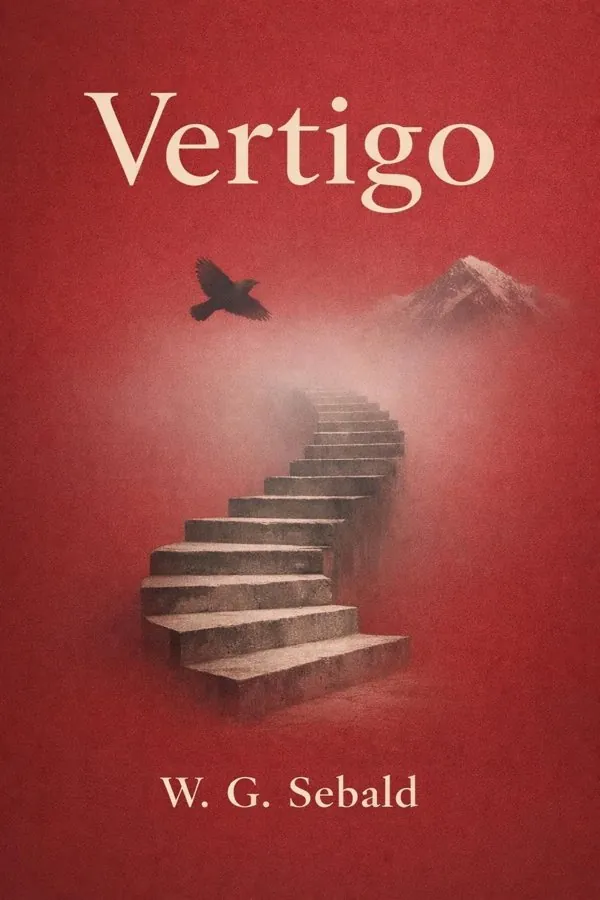
Vertigo: Summary & Key Insights
by W. G. Sebald
 10 min9 chaptersAudio available
Key Takeaways from Vertigo
A life is never simply lived; it is staged, revised, and narrated into meaning.
Sometimes the farther we travel, the more insistently we encounter ourselves.
Illness in Sebald is rarely only physical; it is often a sign that the world itself has become uninhabitable.
Homecoming can be more disorienting than exile.
We trust memory because it feels intimate, but Sebald shows that intimacy does not guarantee accuracy.
What Is Vertigo About?
Vertigo by W. G. Sebald is a classics book spanning 4 pages. Vertigo is W. G. Sebald’s haunting first major prose work, a book that turns travel, reading, memory, and biography into one continuous act of searching. First published in German in 1990, it unfolds through four interlinked sections that move between the life of Stendhal, the journeys of Kafka, Sebald’s own wanderings across Italy and Austria, and an uneasy return to his German homeland. Yet this is far more than a set of literary essays or travel sketches. Sebald uses movement through landscapes and archives to ask how identity is formed, how memory distorts what it preserves, and why the past never remains safely behind us. His method is singular: documentary fragments, photographs, personal recollection, historical detail, and dreamlike narration are woven together until the boundaries between fiction and reality begin to blur. That formal instability is precisely what gives the book its power. Sebald matters because few modern writers have examined exile, historical trauma, and perception with such intelligence and emotional restraint. Vertigo is essential reading for anyone interested in how literature can make uncertainty itself feel truthful.
This FizzRead summary covers all 9 key chapters of Vertigo in approximately 10 minutes, distilling the most important ideas, arguments, and takeaways from W. G. Sebald's work. Also available as an audio summary and Key Quotes Podcast.
Vertigo
Vertigo is W. G. Sebald’s haunting first major prose work, a book that turns travel, reading, memory, and biography into one continuous act of searching. First published in German in 1990, it unfolds through four interlinked sections that move between the life of Stendhal, the journeys of Kafka, Sebald’s own wanderings across Italy and Austria, and an uneasy return to his German homeland. Yet this is far more than a set of literary essays or travel sketches. Sebald uses movement through landscapes and archives to ask how identity is formed, how memory distorts what it preserves, and why the past never remains safely behind us. His method is singular: documentary fragments, photographs, personal recollection, historical detail, and dreamlike narration are woven together until the boundaries between fiction and reality begin to blur. That formal instability is precisely what gives the book its power. Sebald matters because few modern writers have examined exile, historical trauma, and perception with such intelligence and emotional restraint. Vertigo is essential reading for anyone interested in how literature can make uncertainty itself feel truthful.
Who Should Read Vertigo?
This book is perfect for anyone interested in classics and looking to gain actionable insights in a short read. Whether you're a student, professional, or lifelong learner, the key ideas from Vertigo by W. G. Sebald will help you think differently.
- ✓Readers who enjoy classics and want practical takeaways
- ✓Professionals looking to apply new ideas to their work and life
- ✓Anyone who wants the core insights of Vertigo in just 10 minutes
Want the full summary?
Get instant access to this book summary and 100K+ more with Fizz Moment.
Get Free SummaryAvailable on App Store • Free to download
Key Chapters
A life is never simply lived; it is staged, revised, and narrated into meaning. In the first section, “Beyle, or Love is a Madness Most Discreet,” Sebald reconstructs the life of Henri Beyle, better known as Stendhal, through episodes of travel, desire, military ambition, and obsessive memory. Rather than presenting a straightforward literary biography, he shows Beyle as a man perpetually inventing himself through movement and storytelling. Italy becomes the landscape of this self-creation: a place of passion, fantasy, art, and historical residue where the individual imagines he can begin again.
What makes this section powerful is the way Sebald treats biography as a form of detective work. He pieces together a personality from fragments, letters, historical traces, and imaginative reconstruction. Beyle’s loves and ambitions appear less as stable facts than as emotional weather systems that pass through him. This approach suggests that identity is never fixed. We become who we are partly by the stories we tell about our own experiences, and partly by the stories others later assemble from what we leave behind.
In practical terms, this idea applies to the way anyone remembers a former self. Think of how a city visited in youth can become inseparable from first ambition, heartbreak, or freedom. The place is real, but what it means is shaped by repeated retelling. Sebald asks us to notice that memory is always selective and aesthetic.
Actionable takeaway: Revisit one important period of your life and write it twice—first as simple fact, then as a story. Compare the two versions and notice how much identity depends on narration.
Sometimes the farther we travel, the more insistently we encounter ourselves. In “All’estero,” the traveler is no longer a historical figure viewed from a distance but a contemporary narrator moving through northern Italy, from Verona and Venice into alpine regions marked by solitude and estrangement. Although the section appears to be a travel narrative, it quickly becomes something deeper: an account of how external movement triggers internal dislocation. Streets, hotels, train stations, and chance encounters awaken half-buried associations, making travel feel less like escape than exposure.
Sebald’s journeys are not organized around sightseeing or mastery. He lingers in transitional spaces: waiting rooms, corridors, obscure streets, anonymous lodgings. These are places where the self becomes porous, more vulnerable to memory, anxiety, and irrational perception. The traveler discovers that unfamiliar environments do not produce clarity so much as destabilize habitual identity. Even ordinary scenes seem charged with symbolic force, as if the world were sending encrypted messages.
This transforms the meaning of travel. Instead of collecting destinations, Sebald presents wandering as a form of listening. Anyone who has felt unexpectedly unsettled while traveling alone will recognize the experience: a church, a staircase, or a face in a café suddenly opens a chamber of recollection. In modern life, where travel is often reduced to speed and consumption, Sebald reminds us that movement can also be reflective and ethically attentive.
Actionable takeaway: On your next trip, spend one hour without an itinerary. Walk slowly, record what details disturb or attract you, and ask what those reactions reveal about your inner life rather than the place alone.
Illness in Sebald is rarely only physical; it is often a sign that the world itself has become uninhabitable. In “Dr. K.’s Bad Season,” Sebald follows Franz Kafka during his difficult stay in northern Italy, drawing on diaries, letters, and historical record while filtering everything through his own meditative prose. Kafka appears as a traveler incapable of rest, hypersensitive to bodies, architecture, bureaucracy, and his own mental turbulence. The “bad season” is not just a bad trip. It is a condensed image of modern alienation.
Sebald finds in Kafka a writer for whom ordinary reality is subtly hostile. Hotels feel uncanny, landscapes seem accusatory, and social interactions become theaters of embarrassment and self-consciousness. This atmosphere matters because Sebald is not merely paying tribute to Kafka; he is showing how certain writers register historical and psychological pressure before it can be fully explained. Kafka’s fragility becomes a mode of perception, a way of feeling the hidden violence embedded in modern institutions and daily routines.
Readers can apply this insight by reconsidering moments of disproportionate anxiety. Often what seems like private weakness is partly a response to structures that exhaust or estrange us: impersonal workplaces, relentless schedules, administrative absurdity, or environments that deny rest. Kafka’s example shows how literature can validate such unease without simplifying it.
Actionable takeaway: When you feel irrationally overwhelmed by an ordinary setting, pause and ask whether your discomfort is purely personal or also a response to the atmosphere, systems, and expectations surrounding you.
Homecoming can be more disorienting than exile. In “Il ritorno in patria,” Sebald turns toward his native German region, but the return does not provide comfort, closure, or recovered belonging. Instead, familiar landscapes appear estranged, layered with silence and historical repression. Villages, roads, and family spaces seem haunted not by dramatic revelation but by what has gone unspoken for decades. The past survives less as open memory than as omission.
This section is central to the book because it reveals Sebald’s deeper concern: the relationship between private recollection and collective historical amnesia. Returning home does not restore an original identity. It exposes how identity was shaped by what one inherited but was never fully told. Postwar Germany in Sebald’s imagination is a place where catastrophe persists in indirect forms—in habits of speech, emotional restraint, architectural emptiness, and gaps in family narrative.
Many readers will recognize some version of this dynamic. Families and nations often pass down emotional climates rather than explicit explanations. A child senses tension, loss, or shame long before understanding its source. Sebald’s return demonstrates that investigating one’s origins is not sentimental archaeology; it is a confrontation with the structures of forgetting that made one’s own life possible.
Actionable takeaway: Ask an older relative about one event, place, or period that was rarely discussed in your household. Listen not only to what is said, but to hesitations, omissions, and changes in tone. They may reveal as much as the facts themselves.
We trust memory because it feels intimate, but Sebald shows that intimacy does not guarantee accuracy. Across Vertigo, recollection is unstable, recursive, and often strangely theatrical. People remember images more vividly than events, moods more reliably than chronology, and spaces more powerfully than explanations. Rather than correcting this instability, Sebald makes it the core of his method. He writes as if memory were a landscape covered in mist: shapes emerge, disappear, and reappear altered.
This matters because the book rejects the false choice between factual truth and imaginative truth. A remembered scene may be inaccurate in detail yet exact in emotional significance. A photograph may seem objective yet only deepen mystery. Sebald teaches readers that human beings do not store the past as archives do. We preserve fragments, reorder them unconsciously, and invest them with later meanings.
In everyday life, this insight can make us more careful interpreters of our own stories. Consider siblings recalling the same childhood event differently. One remembers fear, another excitement, a third almost nothing. None is necessarily lying. Each memory has been shaped by temperament, later experience, and repeated retelling. Sebald’s genius lies in making this instability not a defect but a subject.
Actionable takeaway: Choose one vivid memory and write down only the sensory details you are certain of. Then list what you may have added later through assumption, family stories, or interpretation. The exercise can sharpen your awareness of how recollection works.
Evidence does not always resolve uncertainty; sometimes it intensifies it. One of Sebald’s signature techniques is the insertion of grainy black-and-white photographs into the prose. In Vertigo, these images do not function like illustrations in a conventional book. They rarely confirm a point cleanly or settle a question of fact. Instead, they interrupt the text with a peculiar authority that is immediately undermined by context, ambiguity, and incompleteness.
A photograph appears to say: this happened, this existed, this was seen. Yet in Sebald’s hands, images often raise more questions than they answer. Who took them? Why this angle, this cropping, this subject? What remains outside the frame? Their documentary texture gives the narrative a historical weight, but their opacity keeps readers uncertain about how to interpret what they see. This creates the distinctive Sebaldian tension between record and dream.
The technique has practical implications beyond literature. In an age saturated with images, we often assume that visual documentation brings us closer to truth. Sebald reminds us that images are also artifacts shaped by selection, context, and omission. A family photo can conceal conflict. A travel snapshot can erase loneliness. A historical image can become iconic while hiding the complexity of the event it represents.
Actionable takeaway: The next time you look at an old photograph, resist the urge to treat it as self-explanatory. Ask what it reveals, what it hides, and what story you automatically impose on it.
Vertigo is not just the title of the book; it is its governing condition. Sebald uses the idea of dizziness, imbalance, and perceptual instability to describe a broader human experience: the feeling that reality cannot be held steady long enough to be fully known. Throughout the book, people become disoriented in cities, by chance resemblances, in historical echoes, and by the pressure of memory. The world tilts, not because it ceases to exist, but because our frameworks for understanding it prove inadequate.
This state of vertigo links the four sections. Stendhal’s passion, Kafka’s unease, the narrator’s travels, and the difficult return home all express different forms of instability. Emotional life, historical consciousness, and sensory experience all participate in the same imbalance. Sebald suggests that modern existence is characterized by such instability: individuals move through inherited ruins, partial histories, and fragile identities while trying to maintain coherence.
This concept is surprisingly useful in ordinary life. Many moments of confusion are not failures of intelligence but encounters with complexity that exceeds our usual categories. Grief, migration, illness, and major life transitions often produce exactly this sensation of vertigo. Instead of forcing immediate clarity, Sebald models a slower response: observe carefully, note patterns, and endure uncertainty long enough for deeper meaning to emerge.
Actionable takeaway: When a situation feels confusing or unreal, name the feeling without rushing to solve it. Treat disorientation as information. Ask what assumptions have been unsettled and what new perception might be forming.
Reading is often described as escape, but in Sebald it becomes a form of uncanny companionship across time. Vertigo links Stendhal, Kafka, and Sebald not as isolated literary monuments but as fellow travelers in a shared landscape of exile, obsession, and restlessness. The book suggests that writers read one another not merely for influence or scholarship, but for recognition. Across languages and eras, they detect familiar anxieties, recurring places, and parallel attempts to make experience legible.
This idea gives the book much of its emotional resonance. Sebald does not stand above his precursors as a critic delivering judgments. He moves beside them, retracing routes, inhabiting rooms, revisiting documents, and allowing their concerns to illuminate his own. Literature becomes a network of echoes in which one consciousness can answer another long after death. That is why Vertigo often feels intimate even when it is historically dense.
For contemporary readers, this offers a richer model of reading. Books are not only sources of information or entertainment; they are ways of discovering minds that clarify one’s own unease. A reader struggling with displacement may find Kafka unexpectedly exact. A reader fascinated by self-fashioning may find Stendhal newly alive. The point is not to imitate these writers, but to let them expand the vocabulary of experience.
Actionable takeaway: Keep a reading journal focused on recognition rather than summary. After each chapter, note one sentence, mood, or scene that feels strangely personal, and ask why it seems to know you.
The past rarely announces itself with monuments alone; more often it lingers in neglected streets, train routes, facades, and habits of looking. One of Sebald’s most important achievements in Vertigo is his ability to make landscapes feel historically saturated. A provincial town, a border region, a hotel room, or a mountain road is never merely scenery. Each place carries sedimented traces of former lives, political upheavals, and forgotten suffering.
Sebald’s landscapes are therefore ethical as well as aesthetic. To look closely at a place is to acknowledge that it has been shaped by forces larger than our immediate purposes. Tourism often strips locations of depth, turning them into consumable surfaces. Sebald resists that flattening. He walks through places as though they were archives written in architecture, atmosphere, and silence. This is especially important in relation to Central Europe, where war, empire, displacement, and repression have left marks that are not always publicly visible.
This perspective can change how we inhabit our own surroundings. Even familiar neighborhoods contain hidden histories: demolished communities, industrial decline, migration patterns, erased languages, former institutions, unresolved injustices. Learning to see these layers encourages humility and attention. It also reminds us that personal life unfolds inside historical structures we did not choose.
Actionable takeaway: Research one ordinary place you pass regularly—a station, street, school, or public square. Find out what stood there before, who used it, and what events shaped it. Let that knowledge alter the way you move through it.
All Chapters in Vertigo
About the Author
W. G. Sebald (1944–2001) was a German-born writer and scholar whose work transformed contemporary literary nonfiction and the novel alike. Born in Wertach, in Bavaria, he moved to England in the 1960s and spent most of his academic career at the University of East Anglia, where he taught literature and helped found the British Centre for Literary Translation. Sebald became internationally acclaimed for books such as Vertigo, The Emigrants, The Rings of Saturn, and Austerlitz, all of which blend fiction, memoir, history, and photography in a distinctive meditative style. His writing is preoccupied with memory, exile, loss, and the lingering effects of war and historical catastrophe. Though his life was cut short in 2001, Sebald remains one of the most influential and admired European writers of the late twentieth century.
Get This Summary in Your Preferred Format
Read or listen to the Vertigo summary by W. G. Sebald anytime, anywhere. FizzRead offers multiple formats so you can learn on your terms — all free.
Available formats: App · Audio · PDF · EPUB — All included free with FizzRead
Download Vertigo PDF and EPUB Summary
Key Quotes from Vertigo
“A life is never simply lived; it is staged, revised, and narrated into meaning.”
“Sometimes the farther we travel, the more insistently we encounter ourselves.”
“Illness in Sebald is rarely only physical; it is often a sign that the world itself has become uninhabitable.”
“Homecoming can be more disorienting than exile.”
“We trust memory because it feels intimate, but Sebald shows that intimacy does not guarantee accuracy.”
Frequently Asked Questions about Vertigo
Vertigo by W. G. Sebald is a classics book that explores key ideas across 9 chapters. Vertigo is W. G. Sebald’s haunting first major prose work, a book that turns travel, reading, memory, and biography into one continuous act of searching. First published in German in 1990, it unfolds through four interlinked sections that move between the life of Stendhal, the journeys of Kafka, Sebald’s own wanderings across Italy and Austria, and an uneasy return to his German homeland. Yet this is far more than a set of literary essays or travel sketches. Sebald uses movement through landscapes and archives to ask how identity is formed, how memory distorts what it preserves, and why the past never remains safely behind us. His method is singular: documentary fragments, photographs, personal recollection, historical detail, and dreamlike narration are woven together until the boundaries between fiction and reality begin to blur. That formal instability is precisely what gives the book its power. Sebald matters because few modern writers have examined exile, historical trauma, and perception with such intelligence and emotional restraint. Vertigo is essential reading for anyone interested in how literature can make uncertainty itself feel truthful.
More by W. G. Sebald
You Might Also Like






Browse by Category
Ready to read Vertigo?
Get the full summary and 100K+ more books with Fizz Moment.