
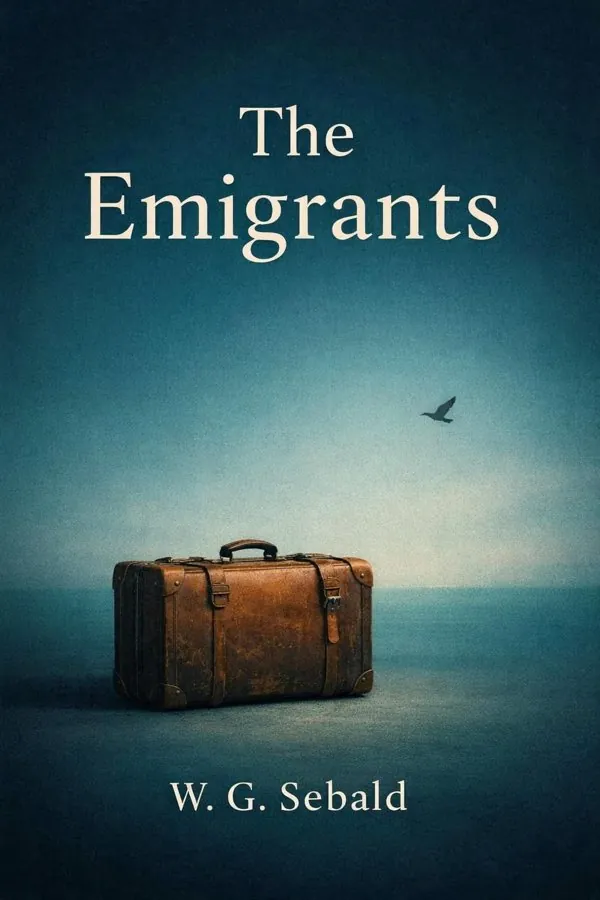
The Emigrants: Summary & Key Insights
by W. G. Sebald
 10 min8 chaptersAudio available
Key Takeaways from The Emigrants
A person can appear settled for decades while inwardly remaining a refugee.
Some of the deepest wounds are inflicted not by what destroys a life immediately, but by what quietly makes ordinary life impossible.
A life devoted to serving others can sometimes conceal an exhausted soul.
Art does not erase loss, but it can become a method of staying in contact with what history tried to destroy.
We trust images because they seem to prove that something existed, yet photographs often deepen mystery rather than resolve it.
What Is The Emigrants About?
The Emigrants by W. G. Sebald is a classics book spanning 5 pages. The Emigrants by W. G. Sebald is a haunting hybrid of novel, memoir, travel writing, and historical meditation. Structured as four interconnected narratives, it follows the lives of displaced twentieth-century Europeans whose outwardly quiet existences conceal deep fractures caused by exile, war, anti-Semitism, and memory. Through the stories of Dr. Henry Selwyn, Paul Bereyter, Ambros Adelwarth, and Max Ferber, Sebald shows that emigration is not only a physical relocation but also a psychological condition marked by dislocation, silence, and unresolved grief. What makes the book so powerful is its refusal to separate private sorrow from public catastrophe: personal breakdowns, vanished families, and melancholic habits all carry the shadow of European history, especially the Holocaust. Sebald’s authority lies in his singular literary method. A German writer long based in England, he wrote with uncommon sensitivity about memory, historical guilt, and the fragility of testimony. His use of photographs, documents, and reflective first-person narration creates an unsettling sense of truth while questioning how truth can ever be fully recovered. The Emigrants matters because it transforms forgotten lives into a moral act of remembrance.
This FizzRead summary covers all 8 key chapters of The Emigrants in approximately 10 minutes, distilling the most important ideas, arguments, and takeaways from W. G. Sebald's work. Also available as an audio summary and Key Quotes Podcast.
The Emigrants
The Emigrants by W. G. Sebald is a haunting hybrid of novel, memoir, travel writing, and historical meditation. Structured as four interconnected narratives, it follows the lives of displaced twentieth-century Europeans whose outwardly quiet existences conceal deep fractures caused by exile, war, anti-Semitism, and memory. Through the stories of Dr. Henry Selwyn, Paul Bereyter, Ambros Adelwarth, and Max Ferber, Sebald shows that emigration is not only a physical relocation but also a psychological condition marked by dislocation, silence, and unresolved grief. What makes the book so powerful is its refusal to separate private sorrow from public catastrophe: personal breakdowns, vanished families, and melancholic habits all carry the shadow of European history, especially the Holocaust. Sebald’s authority lies in his singular literary method. A German writer long based in England, he wrote with uncommon sensitivity about memory, historical guilt, and the fragility of testimony. His use of photographs, documents, and reflective first-person narration creates an unsettling sense of truth while questioning how truth can ever be fully recovered. The Emigrants matters because it transforms forgotten lives into a moral act of remembrance.
Who Should Read The Emigrants?
This book is perfect for anyone interested in classics and looking to gain actionable insights in a short read. Whether you're a student, professional, or lifelong learner, the key ideas from The Emigrants by W. G. Sebald will help you think differently.
- ✓Readers who enjoy classics and want practical takeaways
- ✓Professionals looking to apply new ideas to their work and life
- ✓Anyone who wants the core insights of The Emigrants in just 10 minutes
Want the full summary?
Get instant access to this book summary and 100K+ more with Fizz Moment.
Get Free SummaryAvailable on App Store • Free to download
Key Chapters
Some of the deepest wounds are inflicted not by what destroys a life immediately, but by what quietly makes ordinary life impossible. Paul Bereyter, the narrator’s former schoolteacher, embodies this tragedy. Brilliant, disciplined, and beloved by his students, Paul appears at first to be a figure of order and intellectual vitality. Yet his life has been shaped by the Nazi classification of him as only partly acceptable: because of his Jewish ancestry, he was pushed out of the world in which he should have belonged. Even when he returns to teaching after the war, he does not return to wholeness.
Sebald traces Paul’s life through recollection, testimony, and reflection, revealing how historical persecution lingers long after official restoration. The institutions that excluded him may be gone, but their damage remains lodged within his sense of self. His return to his profession is therefore marked by irony. From the outside, he is reintegrated; from the inside, the terms of belonging have been permanently corrupted. His eventual death feels inseparable from that unresolved contradiction.
This story clarifies one of Sebald’s key insights: trauma is not always dramatic in expression. It can appear as restlessness, overwork, perfectionism, or a painful inability to feel at home in one’s own achievements. Readers can apply this insight beyond historical catastrophe. People who have endured humiliation, discrimination, or institutional rejection often continue to carry those experiences after circumstances improve.
Actionable takeaway: When evaluating recovery, look beyond visible success and ask whether a person has regained safety, dignity, and an inner sense of belonging.
A life devoted to serving others can sometimes conceal an exhausted soul. In the third narrative, Sebald recounts the life of Ambros Adelwarth, a relative who leaves Germany and spends much of his life in service to a wealthy Jewish family in America. His existence is outwardly defined by competence, loyalty, travel, and restraint. He accompanies the emotionally fragile Cosmo Solomon on extended journeys, manages practical details with quiet mastery, and seems almost to erase himself in fulfilling his duties. But this disappearance into service comes at a cost.
Ambros’s story explores the emotional toll of self-suppression. He is a figure of elegance and discipline, yet beneath that composure lies accumulated grief and perhaps a renunciation of personal desire. His bond with Cosmo is one of the most moving and ambiguous relationships in the book, shaped by affection, obligation, and shared vulnerability. As Cosmo deteriorates, Ambros too seems drawn toward collapse. His eventual institutionalization suggests that a life spent containing the suffering of others may become unendurable when one’s own inner life has nowhere to go.
Sebald presents this not as private misfortune alone, but as part of a wider world damaged by exile, class expectation, and emotional silence. Many readers will recognize the pattern in caregivers, dutiful family members, or professionals who become so reliable that no one notices their distress. Constant functionality can hide profound depletion.
Actionable takeaway: Do not confuse competence with well-being; if you are always the one carrying others, create deliberate space to name and tend your own emotional life.
Art does not erase loss, but it can become a method of staying in contact with what history tried to destroy. Max Ferber, the final and perhaps most unforgettable figure in The Emigrants, is a Jewish painter living in Manchester after escaping Nazi persecution as a child. He works obsessively in a studio thick with dust, repeatedly revising his portraits, scraping and reworking surfaces as if the act of painting were also an act of excavation. Ferber’s art is inseparable from memory: not clear, consoling memory, but fractured, stubborn, and physically burdensome remembrance.
Through Ferber, Sebald examines what it means to survive when one’s family and homeland have been annihilated. Ferber’s body, workspace, and routine all bear the marks of persistence without resolution. He continues, but continuation itself feels haunted. The manuscripts and recollections connected to his mother deepen this effect, showing how individual testimony can both reveal and intensify the scale of historical loss.
This narrative offers a practical understanding of creative work. Art, writing, and archiving are often treated as self-expression, but Sebald shows they can also be acts of witness. Anyone sorting family photographs, recording oral histories, or making work from inherited trauma engages in a similar struggle: giving form to what cannot be restored.
Ferber’s studio is a powerful metaphor for memory itself. It accumulates residue, resists neat completion, and demands repeated returns. The goal is not perfect reconstruction but faithful attention.
Actionable takeaway: Treat creative or reflective practice not as a search for closure, but as a disciplined way of bearing witness to what still matters.
We trust images because they seem to prove that something existed, yet photographs often deepen mystery rather than resolve it. One of Sebald’s most distinctive techniques in The Emigrants is his insertion of photographs, letters, records, and other documentary fragments into the prose. These materials give the text a texture of authenticity, inviting the reader to feel that the stories are anchored in verifiable lives. At the same time, they unsettle certainty. The images are often grainy, unexplained, or emotionally opaque. Instead of confirming a stable narrative, they remind us how partial all evidence is.
This matters because Sebald is not simply decorating fiction with archival effects. He is exploring the ethics of representation after catastrophe. When lives have been scattered by migration, suicide, institutionalization, and genocide, testimony rarely comes in complete form. What survives are traces: a faded picture, an anecdote, a travel itinerary, a school memory. Meaning must be assembled from fragments, yet the assembled whole always remains provisional.
The idea has clear relevance today. In an age saturated with digital images and records, people often assume that documentation equals understanding. But anyone who has looked through family archives knows otherwise. A photograph may show a face while concealing fear, estrangement, or the fate that followed. Evidence is indispensable, but it is never enough on its own.
Sebald teaches readers to approach documents with both seriousness and humility. They can preserve presence, but they also testify to absence.
Actionable takeaway: When encountering photographs or records, ask not only what they show, but also what remains outside the frame and beyond recovery.
Leaving home is sometimes less devastating than discovering that home no longer exists within you. Across all four narratives, Sebald portrays exile not merely as relocation but as an enduring psychological and moral condition. His emigrants have crossed borders and built lives elsewhere, yet they remain suspended between worlds. They are neither fully restored to the places they left nor fully absorbed by the places where they settle. This in-between state affects memory, speech, work, and relationships.
What makes Sebald’s treatment so profound is his insistence that exile can persist even when practical adaptation succeeds. A person may learn the language, enter a profession, and inhabit a new country for decades while still feeling estranged from their own life. The emigrants’ habits of reserve, their indirect speech, and their attachment to objects or routines all express this unsettledness. Exile becomes internalized.
This concept applies far beyond wartime migration. Children of immigrants, people estranged from family, and those who have experienced radical social dislocation often describe a similar double consciousness. They may be functional and accomplished, yet unable to locate a simple answer to where they belong. Sebald dignifies that ambiguity rather than trying to cure it with sentimental ideas of reinvention.
Reading this book can help readers better understand the invisible labor of adaptation. Belonging is not achieved by geography alone; it depends on memory, recognition, and the possibility of continuity between past and present.
Actionable takeaway: If you or others seem outwardly settled but inwardly unmoored, recognize that belonging requires more than adjustment—it requires room for history, grief, and divided identity.
History does not end when events pass; it continues in the nervous systems, habits, and silences of those who come after. Although The Emigrants focuses on four individual lives, its deeper subject is the afterlife of twentieth-century European catastrophe. Sebald shows that anti-Semitism, war, forced displacement, and the Holocaust do not remain confined to the generation that directly experienced them. Their effects radiate outward into descendants, witnesses, neighbors, students, and readers. The narrator’s act of reconstruction is itself evidence of this inheritance.
One of the book’s most important contributions is its understanding of trauma as distributed rather than isolated. It appears in awkward pauses, family omissions, compulsive routines, and depressive states that seem larger than personal biography alone can explain. The past survives not only through explicit stories but also through forms of absence: names no longer spoken, places no longer visited, photographs kept without explanation.
This insight is highly practical for contemporary readers. Many families carry unresolved histories of migration, persecution, addiction, violence, or disgrace. Later generations may inherit emotional patterns without fully understanding their source. Sebald’s method suggests that careful listening, archival curiosity, and patient reflection can illuminate these inherited burdens, even if they cannot be solved.
Importantly, the book resists simplistic healing narratives. To understand inherited trauma is not necessarily to transcend it. But recognition can interrupt repetition and deepen compassion.
Actionable takeaway: Investigate recurring silences or emotional patterns in your family or community; understanding their historical roots can transform confusion into informed empathy.
To tell a story carefully can be a form of justice. In The Emigrants, the narrator does more than recount encounters with damaged lives; he assumes the ethical responsibility of remembering people who might otherwise disappear into obscurity. This is crucial because the book is not driven by plot in the conventional sense. Its power comes from attention: to a tone of voice, a remembered room, a travel route, a photograph, a hesitating testimony. Sebald suggests that remembrance is not passive storage but active moral labor.
The narrator’s method is deliberately slow and uncertain. He revisits sites, consults others, compares documents, and acknowledges gaps. This refusal to dominate the material is part of the book’s ethics. Rather than claiming complete authority over other people’s suffering, he approaches it with humility. He reconstructs enough to honor their existence while preserving the irreducible mystery of their inner lives.
There is practical wisdom here for anyone engaged in biography, family history, journalism, teaching, or even friendship. Remembering others well requires patience, accuracy, and restraint. It means resisting the urge to turn complex lives into convenient lessons. It also means accepting that care often takes the form of sustained attention rather than dramatic intervention.
Sebald’s prose models a way of being answerable to the dead and the absent. In a culture that rewards speed and simplification, that stance feels radical.
Actionable takeaway: Practice remembrance as an ethical discipline—listen closely, preserve details responsibly, and avoid reducing another person’s life to a tidy interpretation.
All Chapters in The Emigrants
About the Author
W. G. Sebald, born Winfried Georg Sebald in 1944 in Bavaria, was a German writer, essayist, and academic whose work transformed contemporary literature. He studied German literature and later settled in England, where he taught for many years at the University of East Anglia. Writing in a distinctive style that fused fiction, memoir, travel narrative, criticism, and photography, Sebald became known for his meditations on memory, exile, destruction, and the moral burden of history. His major works include Vertigo, The Emigrants, The Rings of Saturn, and Austerlitz. Though his career was cut short by his death in 2001, Sebald’s influence has only grown. He is widely admired for creating a literary form capable of addressing trauma, historical loss, and remembrance with unusual depth and restraint.
Get This Summary in Your Preferred Format
Read or listen to the The Emigrants summary by W. G. Sebald anytime, anywhere. FizzRead offers multiple formats so you can learn on your terms — all free.
Available formats: App · Audio · PDF · EPUB — All included free with FizzRead
Download The Emigrants PDF and EPUB Summary
Key Quotes from The Emigrants
“A person can appear settled for decades while inwardly remaining a refugee.”
“Some of the deepest wounds are inflicted not by what destroys a life immediately, but by what quietly makes ordinary life impossible.”
“A life devoted to serving others can sometimes conceal an exhausted soul.”
“Art does not erase loss, but it can become a method of staying in contact with what history tried to destroy.”
“We trust images because they seem to prove that something existed, yet photographs often deepen mystery rather than resolve it.”
Frequently Asked Questions about The Emigrants
The Emigrants by W. G. Sebald is a classics book that explores key ideas across 8 chapters. The Emigrants by W. G. Sebald is a haunting hybrid of novel, memoir, travel writing, and historical meditation. Structured as four interconnected narratives, it follows the lives of displaced twentieth-century Europeans whose outwardly quiet existences conceal deep fractures caused by exile, war, anti-Semitism, and memory. Through the stories of Dr. Henry Selwyn, Paul Bereyter, Ambros Adelwarth, and Max Ferber, Sebald shows that emigration is not only a physical relocation but also a psychological condition marked by dislocation, silence, and unresolved grief. What makes the book so powerful is its refusal to separate private sorrow from public catastrophe: personal breakdowns, vanished families, and melancholic habits all carry the shadow of European history, especially the Holocaust. Sebald’s authority lies in his singular literary method. A German writer long based in England, he wrote with uncommon sensitivity about memory, historical guilt, and the fragility of testimony. His use of photographs, documents, and reflective first-person narration creates an unsettling sense of truth while questioning how truth can ever be fully recovered. The Emigrants matters because it transforms forgotten lives into a moral act of remembrance.
More by W. G. Sebald

You Might Also Like






Browse by Category
Ready to read The Emigrants?
Get the full summary and 100K+ more books with Fizz Moment.