
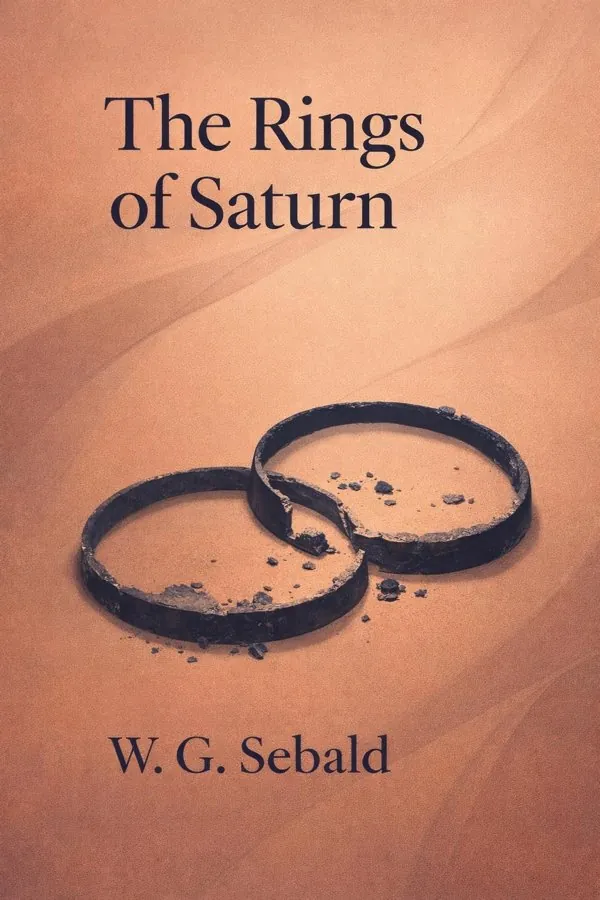
The Rings of Saturn: Summary & Key Insights
by W. G. Sebald
 10 min9 chaptersAudio available
Key Takeaways from The Rings of Saturn
A long walk can become a form of investigation, especially when the walker is not merely passing through a place but listening for what it conceals.
Places often advertise their charm while quietly hiding their collapse.
Grandeur can be one of history’s most misleading surfaces.
The more civilization tries to preserve itself, the more clearly it reveals its fear of disappearance.
A thread is never just a thread in Sebald’s world; it can lead across continents, centuries, and systems of domination.
What Is The Rings of Saturn About?
The Rings of Saturn by W. G. Sebald is a classics book spanning 10 pages. The Rings of Saturn is a book about walking, but also about what rises up when one walks slowly enough to really see. In this haunting, genre-defying work, W. G. Sebald recounts a tour through Suffolk on England’s eastern coast, yet the landscape quickly opens into something much larger: a meditation on memory, ruin, empire, war, industry, and the strange persistence of loss. A seaside town leads to reflections on colonial violence; a country estate evokes the illusions of progress; a vanished harbor becomes evidence of history’s power to erase. Sebald’s method is uniquely his own, blending travel writing, autobiography, archival anecdote, biography, and essay into a continuous stream of thought that feels both intimate and planetary. The result is not a conventional narrative but a deep exploration of how personal experience and collective catastrophe are interwoven. The book matters because it teaches us how to read landscapes as records of human ambition and suffering. Sebald, a German writer and scholar shaped by Europe’s traumatic twentieth century, brings extraordinary moral seriousness and literary intelligence to that task.
This FizzRead summary covers all 9 key chapters of The Rings of Saturn in approximately 10 minutes, distilling the most important ideas, arguments, and takeaways from W. G. Sebald's work. Also available as an audio summary and Key Quotes Podcast.
The Rings of Saturn
The Rings of Saturn is a book about walking, but also about what rises up when one walks slowly enough to really see. In this haunting, genre-defying work, W. G. Sebald recounts a tour through Suffolk on England’s eastern coast, yet the landscape quickly opens into something much larger: a meditation on memory, ruin, empire, war, industry, and the strange persistence of loss. A seaside town leads to reflections on colonial violence; a country estate evokes the illusions of progress; a vanished harbor becomes evidence of history’s power to erase. Sebald’s method is uniquely his own, blending travel writing, autobiography, archival anecdote, biography, and essay into a continuous stream of thought that feels both intimate and planetary. The result is not a conventional narrative but a deep exploration of how personal experience and collective catastrophe are interwoven. The book matters because it teaches us how to read landscapes as records of human ambition and suffering. Sebald, a German writer and scholar shaped by Europe’s traumatic twentieth century, brings extraordinary moral seriousness and literary intelligence to that task.
Who Should Read The Rings of Saturn?
This book is perfect for anyone interested in classics and looking to gain actionable insights in a short read. Whether you're a student, professional, or lifelong learner, the key ideas from The Rings of Saturn by W. G. Sebald will help you think differently.
- ✓Readers who enjoy classics and want practical takeaways
- ✓Professionals looking to apply new ideas to their work and life
- ✓Anyone who wants the core insights of The Rings of Saturn in just 10 minutes
Want the full summary?
Get instant access to this book summary and 100K+ more with Fizz Moment.
Get Free SummaryAvailable on App Store • Free to download
Key Chapters
A long walk can become a form of investigation, especially when the walker is not merely passing through a place but listening for what it conceals. At the beginning of The Rings of Saturn, Sebald sets out across Suffolk after a period of illness, and this physical movement becomes inseparable from mental wandering. The journey is not driven by plot or destination. Instead, one sight, building, or memory triggers another, creating a chain of associations that reveals how geography stores history.
Sebald’s walk shows that attention is never neutral. What appears to be empty countryside is filled with traces of labor, class hierarchy, war, environmental change, and forgotten lives. The act of walking slows perception enough for these hidden connections to surface. His convalescent body also matters: weakness sharpens his awareness of fragility, making the landscape seem less picturesque than vulnerable. Walking becomes a way of entering time, not escaping it.
This idea has practical force beyond literature. A thoughtful walk through your own city or neighborhood can become an exercise in historical reading. Ask what industries once operated there, who built the houses, who was displaced, what natural systems were altered, and which stories have been erased from public memory. Instead of treating movement as exercise alone, treat it as inquiry.
Sebald suggests that thought deepens when pace slows. The world reveals itself not to those who rush through it, but to those willing to notice its scars. Actionable takeaway: take a deliberate walk this week with one question in mind—what happened here before I arrived?—and let observation lead your thinking.
Places often advertise their charm while quietly hiding their collapse. As Sebald moves through Lowestoft and Southwold, he encounters a coastal region marked by erosion not only of land but of livelihoods. Once-thriving trades, especially the herring industry, have faded, leaving behind shuttered buildings, neglected infrastructure, and a mood of historical afterlife. The landscape is not dramatic in the usual sense; its sadness lies in ordinary signs of abandonment.
Sebald is interested in what happens after prosperity ends. He notices how economic decline leaves residues in architecture, social atmosphere, and collective memory. These towns are neither fully alive nor fully dead. They persist in diminished form, as if history had withdrawn its animating force and left only outlines. In this way, the coast becomes a lesson in how communities can become ghostly even while still inhabited.
This perspective sharpens our understanding of contemporary places shaped by deindustrialization. Former factory towns, mining regions, or declining ports often display the same pattern: a visible landscape of remnants paired with an invisible emotional economy of disappointment and nostalgia. Sebald teaches us to read those spaces without sentimentality. He does not romanticize lost industry; he asks what kinds of ambition, exploitation, and ecological damage were tied to it in the first place.
The coast’s physical erosion also mirrors social erosion. Seas reclaim land just as markets and empires abandon once-useful regions. Actionable takeaway: when you encounter a place in decline, resist easy nostalgia. Look for the systems that produced both its past wealth and its present fragility, and ask what kind of future could be imagined from that truth.
Grandeur can be one of history’s most misleading surfaces. At Somerleyton Hall, Sebald reflects on an estate reshaped in the nineteenth century by industrial wealth and technological ambition. The hall appears as a monument to improvement: landscaped grounds, engineering prowess, decorative excess, and aristocratic self-confidence. Yet beneath this spectacle lies a deeper story about the unstable dream of progress.
Sebald reads the estate not simply as a beautiful relic but as evidence of a culture convinced that material expansion could master nature and time. Railways, trade, mechanical ingenuity, and imperial wealth made such places possible. But the very scale of this confidence now appears brittle. The hall survives as a shell of former aspiration, revealing how quickly triumph turns into museum-like residue.
What makes this section powerful is Sebald’s refusal to separate aesthetics from economics. He shows that elegance is often financed by extraction, labor inequity, and colonial networks. The polished surface of country-house civilization depends on systems of power that are rarely visible in the final image. This insight applies widely today. Our own monuments to progress may be airports, data centers, luxury developments, or technological campuses. They too present themselves as symbols of advancement while obscuring the environmental and human costs that sustain them.
Sebald’s lesson is not to reject achievement but to examine its hidden foundations. When a culture speaks confidently of innovation, efficiency, and growth, we should ask who benefits, who pays, and what disappears in the process. Actionable takeaway: the next time you admire an impressive institution, building, or technology, pause to investigate the labor, resources, and historical conditions that made it possible.
The more civilization tries to preserve itself, the more clearly it reveals its fear of disappearance. Sebald’s engagement with Sir Thomas Browne, the seventeenth-century writer and physician from Norwich, introduces one of the book’s central concerns: how human beings confront mortality through art, scholarship, ritual, and language. Browne’s meditations on burial, decay, and the vanity of earthly achievement resonate deeply with Sebald’s own project.
Browne serves as both companion and precursor. Like Sebald, he is fascinated by the strange afterlives of objects and ideas. Urns, bones, manuscripts, and fragments become reminders that survival is always partial. We do not preserve the past intact; we inherit scattered remains and construct meaning from them. Sebald finds in Browne a style of thought that is learned yet melancholy, precise yet aware of the absurd limits of human understanding.
This matters because The Rings of Saturn is not only about historical destruction on a large scale. It is also about the ordinary fact that all human endeavors pass away. Institutions collapse, names vanish, landscapes shift, and even memory itself deteriorates. Browne provides Sebald with a vocabulary for this truth, one that avoids both despair and false consolation.
Readers can apply this insight personally. We often pursue permanence through achievement, possessions, or documentation, yet much of life’s value lies precisely in its transience. Accepting impermanence can make us more attentive, less grandiose, and more humane. Actionable takeaway: choose one object, family story, or local site that seems ordinary, and ask what it might reveal about mortality, remembrance, and the fragile ways humans resist being forgotten.
A thread is never just a thread in Sebald’s world; it can lead across continents, centuries, and systems of domination. From Norwich’s history of silk weaving, The Rings of Saturn expands outward into China, imperial commerce, rebellion, and the circulation of goods and suffering across the globe. Sebald shows how local economies are inseparable from distant histories. What appears in one town as craft or prosperity may depend on invisible labor, political upheaval, and colonial entanglement elsewhere.
This is one of the book’s most modern insights. Long before “globalization” became a routine term, Sebald was tracing how materials, capital, and violence travel together. Silk is not merely a luxury product; it is an emblem of interdependence. A European textile tradition cannot be understood without reference to Asian production, trade routes, state power, and the human cost embedded in commerce.
Sebald’s associative method helps readers perceive connections that ordinary historical narratives keep compartmentalized. Economic history, natural history, and political conflict are not separate domains. They are parts of the same fabric. That approach can sharpen how we think today about supply chains, consumer goods, and ethical responsibility. The clothes we wear, the devices we use, and the foods we buy all carry hidden geographies of labor and extraction.
Rather than promoting guilt for its own sake, Sebald encourages awareness. To understand an object fully is to understand the network of lives and landscapes through which it passed. Actionable takeaway: pick one everyday item you own and trace where it likely came from, who made it, and what environmental or political systems enabled it to reach you.
Nature in The Rings of Saturn is never a peaceful backdrop. Fish stocks, silkworms, storms, and eroding cliffs are all part of a larger testimony about cycles of exploitation and decay. Sebald repeatedly turns to the natural world not to escape history but to illuminate it. Herrings evoke vanished industries and exhausted abundance; coastal erosion reveals the instability of settlement; animal life becomes a mirror for human systems of control and destruction.
This vision unsettles the familiar divide between natural and human history. Sebald implies that landscapes remember what societies try to forget. Overfishing, engineered environments, and ruined habitats expose the illusion that human progress unfolds apart from ecological consequence. The sea does not simply border civilization; it eventually revises it, swallowing coastlines, ports, and towns that once seemed permanent.
The practical value of this idea is immense. Environmental crisis is often discussed through statistics and policy, but Sebald reminds us that ecology is also cultural memory. A depleted river, a treeless area, or a silent shoreline tells a story about prior human choices. To observe nature carefully is to encounter the record of those decisions.
Sebald’s treatment of nature is melancholic, but it is also clarifying. It asks us to see environmental damage not as an abstract issue but as part of the moral history of a place. Actionable takeaway: visit a local natural site and learn one historical fact about how human activity changed it. Let that knowledge reshape how you understand both the environment and your own responsibilities within it.
Empires often describe themselves as civilizing forces, but their archives tell a different story. Through figures such as Roger Casement and Joseph Conrad, Sebald explores the moral devastation at the heart of European imperialism. Casement, known for exposing atrocities in the Congo and the Putumayo region, represents the rare witness who looked directly at imperial violence and refused to dress it in noble language. Conrad, meanwhile, becomes a literary counterpart whose fiction captured the corruption and hollowness beneath colonial rhetoric.
Sebald does not treat these men as historical ornaments. He uses them to show how empire deforms everyone involved: the colonized through brutality, the colonizers through moral disfigurement, and later generations through inherited amnesia. Imperial power depends not only on force but on storytelling, on the ability to disguise extraction as mission and cruelty as necessity.
This insight remains urgent. Modern forms of power still rely on sanitizing language, whether in geopolitics, corporate behavior, or technological expansion. Sebald encourages a suspicious reading of official narratives, especially when they invoke progress, security, or civilization while obscuring those who bear the cost.
Casement’s eventual marginalization also reveals how uncomfortable truth-tellers become when they expose structures too central to national self-image. Conrad’s bleak vision underscores that darkness is not located only in distant places but in the heart of the systems that claim authority over them.
Actionable takeaway: when you read about a nation, institution, or company presenting itself as benevolent, look for testimonies from those most affected by its actions before accepting the official story.
Nothing clarifies impermanence like a city that has almost vanished. Sebald’s visit to Dunwich, once a significant medieval port and now largely consumed by the sea, becomes one of the book’s starkest demonstrations of historical disappearance. Here the past is not preserved in triumphant monuments but reduced to fragments, legends, and submerged remains. Dunwich is both literal place and philosophical emblem: a reminder that what seems established can be erased by time, weather, neglect, and shifting economic currents.
What fascinates Sebald is that disappearance is never total, yet never reversible. Dunwich survives in traces—in archives, local memory, topography, and atmosphere—but not in the form it once possessed. This condition resembles history itself. We do not lose the past cleanly; we lose it unevenly, retaining enough to feel the wound of what is gone.
The lesson extends beyond coastal erosion. Families lose languages, cities lose industries, cultures lose confidence, and individuals lose continuity with earlier selves. In each case, what remains is fragmentary and haunting. Sebald resists the modern obsession with preservation as total rescue. Some losses cannot be repaired, only acknowledged.
This does not make remembrance futile. On the contrary, it gives memory ethical importance. To attend to what has vanished is to resist the arrogance that assumes the present is secure or complete. Actionable takeaway: identify one disappearing element of your own world—a building, dialect, craft, ecosystem, or custom—and record something about it now, before its traces become harder to recover.
The body often understands truths that the mind avoids. The Rings of Saturn begins after illness and ends with a return to the condition of bodily collapse, creating a circular structure that reshapes the entire journey. Sebald suggests that history is not experienced as neat progression but as recurrence, return, and reverberation. Memories rise unpredictably; old catastrophes intrude upon present scenes; personal weakness opens onto civilizational exhaustion.
This circularity matters because the book refuses the comforting idea that humanity moves steadily forward. Again and again, Sebald encounters evidence that destruction, forgetting, and hubris repeat in altered forms. The rings of Saturn themselves evoke a cosmic image of beautiful debris: fragments held in orbit, suspended rather than resolved. The structure of the book mirrors that image, gathering shards of biography, travel, war, trade, and art into a pattern that never fully closes.
On a personal level, illness becomes a mode of perception. Convalescence slows the narrator, making him more receptive to buried associations. Physical frailty undermines fantasies of mastery and invites a more honest relation to dependency, fear, and memory. Many readers recognize this phenomenon: after illness, grief, or burnout, the world can appear both more fragile and more meaningful.
Sebald’s final insight is that understanding may come less from conquering experience than from enduring its unresolvedness. Actionable takeaway: if you are moving through a period of exhaustion or recovery, keep a brief reflective journal for a week. Notice what memories, fears, or historical associations arise when life slows down, and treat them as clues rather than interruptions.
All Chapters in The Rings of Saturn
About the Author
W. G. Sebald (1944-2001) was a German-born writer, critic, and academic whose work transformed contemporary literary nonfiction and fiction alike. Born in Wertach, Bavaria, he later moved to England, where he taught at the University of East Anglia and became an important scholar of European literature. Sebald is best known for books such as The Emigrants, Vertigo, The Rings of Saturn, and Austerlitz, all of which blur the boundaries between memoir, travel writing, fiction, biography, and historical essay. His recurring subjects include memory, exile, war, trauma, and the long shadow of European catastrophe. With his distinctive, meditative prose and use of archival images, Sebald developed a style that was at once intellectually rigorous and emotionally haunting. He remains one of the most influential literary figures of the late twentieth century.
Get This Summary in Your Preferred Format
Read or listen to the The Rings of Saturn summary by W. G. Sebald anytime, anywhere. FizzRead offers multiple formats so you can learn on your terms — all free.
Available formats: App · Audio · PDF · EPUB — All included free with FizzRead
Download The Rings of Saturn PDF and EPUB Summary
Key Quotes from The Rings of Saturn
“A long walk can become a form of investigation, especially when the walker is not merely passing through a place but listening for what it conceals.”
“Places often advertise their charm while quietly hiding their collapse.”
“Grandeur can be one of history’s most misleading surfaces.”
“The more civilization tries to preserve itself, the more clearly it reveals its fear of disappearance.”
“A thread is never just a thread in Sebald’s world; it can lead across continents, centuries, and systems of domination.”
Frequently Asked Questions about The Rings of Saturn
The Rings of Saturn by W. G. Sebald is a classics book that explores key ideas across 9 chapters. The Rings of Saturn is a book about walking, but also about what rises up when one walks slowly enough to really see. In this haunting, genre-defying work, W. G. Sebald recounts a tour through Suffolk on England’s eastern coast, yet the landscape quickly opens into something much larger: a meditation on memory, ruin, empire, war, industry, and the strange persistence of loss. A seaside town leads to reflections on colonial violence; a country estate evokes the illusions of progress; a vanished harbor becomes evidence of history’s power to erase. Sebald’s method is uniquely his own, blending travel writing, autobiography, archival anecdote, biography, and essay into a continuous stream of thought that feels both intimate and planetary. The result is not a conventional narrative but a deep exploration of how personal experience and collective catastrophe are interwoven. The book matters because it teaches us how to read landscapes as records of human ambition and suffering. Sebald, a German writer and scholar shaped by Europe’s traumatic twentieth century, brings extraordinary moral seriousness and literary intelligence to that task.
More by W. G. Sebald


You Might Also Like






Browse by Category
Ready to read The Rings of Saturn?
Get the full summary and 100K+ more books with Fizz Moment.