
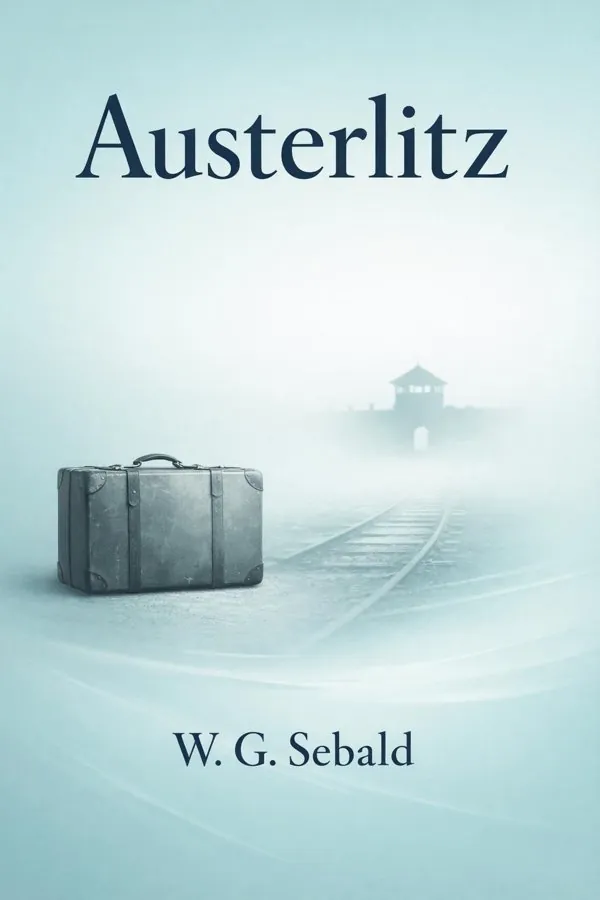
Austerlitz: Summary & Key Insights
by W. G. Sebald
 10 min9 chaptersAudio available
Key Takeaways from Austerlitz
Sometimes a life first becomes visible through what it chooses to study.
A person can live for years inside a life that never fully feels like his own.
Some truths do not arrive gradually; they strike with the force of a delayed revelation.
To search for the past is to enter a landscape where facts and grief are inseparable.
History often survives not as a finished story but as scattered remains that demand interpretation.
What Is Austerlitz About?
Austerlitz by W. G. Sebald is a classics book spanning 4 pages. Austerlitz is W. G. Sebald’s haunting, genre-defying novel about memory, exile, and the long shadow of European catastrophe. First published in English in 2001, it follows Jacques Austerlitz, an architectural historian who gradually discovers that the story he has told himself about his life is incomplete. Sent to Britain as a child on a Kindertransport from Prague, he grows up under another name in Wales, cut off from his language, family, and origins. Only decades later does he begin the painful work of recovering what was buried. What makes the novel extraordinary is not only its plot, but its method: Sebald blends fiction, biography, travel writing, historical reflection, and enigmatic photographs into a meditative narrative unlike almost anything else in modern literature. The result is a book that asks how trauma survives when memory fails, how places store human suffering, and how identity can be shaped by absences as much as by facts. Sebald’s authority comes from his singular literary vision and lifelong engagement with history, displacement, and remembrance. Austerlitz matters because it turns one man’s search into a profound inquiry into how individuals and societies live with the past.
This FizzRead summary covers all 9 key chapters of Austerlitz in approximately 10 minutes, distilling the most important ideas, arguments, and takeaways from W. G. Sebald's work. Also available as an audio summary and Key Quotes Podcast.
Austerlitz
Austerlitz is W. G. Sebald’s haunting, genre-defying novel about memory, exile, and the long shadow of European catastrophe. First published in English in 2001, it follows Jacques Austerlitz, an architectural historian who gradually discovers that the story he has told himself about his life is incomplete. Sent to Britain as a child on a Kindertransport from Prague, he grows up under another name in Wales, cut off from his language, family, and origins. Only decades later does he begin the painful work of recovering what was buried. What makes the novel extraordinary is not only its plot, but its method: Sebald blends fiction, biography, travel writing, historical reflection, and enigmatic photographs into a meditative narrative unlike almost anything else in modern literature. The result is a book that asks how trauma survives when memory fails, how places store human suffering, and how identity can be shaped by absences as much as by facts. Sebald’s authority comes from his singular literary vision and lifelong engagement with history, displacement, and remembrance. Austerlitz matters because it turns one man’s search into a profound inquiry into how individuals and societies live with the past.
Who Should Read Austerlitz?
This book is perfect for anyone interested in classics and looking to gain actionable insights in a short read. Whether you're a student, professional, or lifelong learner, the key ideas from Austerlitz by W. G. Sebald will help you think differently.
- ✓Readers who enjoy classics and want practical takeaways
- ✓Professionals looking to apply new ideas to their work and life
- ✓Anyone who wants the core insights of Austerlitz in just 10 minutes
Want the full summary?
Get instant access to this book summary and 100K+ more with Fizz Moment.
Get Free SummaryAvailable on App Store • Free to download
Key Chapters
Sometimes a life first becomes visible through what it chooses to study. When the unnamed narrator meets Jacques Austerlitz in Antwerp’s grand railway station, their conversation seems at first to revolve around architecture, fortifications, waiting rooms, and public buildings. Yet Sebald quickly shows that Austerlitz’s fascination with structures is not simply academic. Buildings are his way of approaching what cannot yet be spoken directly: confinement, transit, empire, surveillance, loss. He studies train stations, libraries, courts, and prisons because these places hold the emotional and political patterns of European history.
This opening matters because it establishes Sebald’s central method. The novel does not rush toward revelation. Instead, it circles. Austerlitz speaks in long, reflective passages, moving from design details to historical associations, from facades to buried meanings. Architecture becomes a form of memory, preserving the intentions and anxieties of those who built it. A station is never just a station; it is also a site of departures, displacements, and lives interrupted.
In practical terms, the novel invites readers to reconsider the spaces around them. A school, museum, courthouse, or train platform may seem ordinary, but each encodes assumptions about power, movement, belonging, and exclusion. Sebald suggests that careful attention to place can reveal hidden histories we usually overlook.
Austerlitz’s early conversations with the narrator also demonstrate how identity often appears indirectly. People do not always begin with confession. They begin with obsessions, habits, and intellectual passions that hint at deeper wounds. To understand someone, we may need to listen not only to what they declare, but to what they repeatedly return to.
Actionable takeaway: Pay close attention to the places that fascinate you or others most; they may offer clues to buried memories, values, or unresolved histories.
A person can live for years inside a life that never fully feels like his own. One of the novel’s most powerful sections recounts Austerlitz’s childhood in Wales, where he is raised by a strict Calvinist minister and his wife under the name Dafydd Elias. He does not initially understand that this life is a substitute, arranged after his arrival in Britain as a refugee child. The concealment is total enough that his earliest identity becomes inaccessible even to himself.
Sebald portrays this upbringing as emotionally austere and spiritually repressive. The household offers structure but little warmth; language itself becomes a site of estrangement. Austerlitz grows up detached from the child he once was, unable to connect his present existence with any coherent origin. His sense of self is therefore built on omission. What has been lost is not just family history, but continuity.
This idea has broad resonance beyond the historical specifics of the Kindertransport. Many people inherit silences—about migration, family conflict, class shame, political violence, or private grief. When important truths are withheld, children often internalize the resulting uncertainty without knowing its source. They may feel displaced in their own biographies.
Sebald also shows that survival and distortion can coexist. Austerlitz was saved from immediate danger, but the rescue came at the cost of rupture. The novel refuses easy sentimentalism. Protection from catastrophe does not erase the psychic burden of separation, renaming, and emotional suppression.
For readers, this section offers a way to think about identity as something fragile, dependent on stories, names, and recognition. To know who we are, we need not only facts, but a narrative that binds them together. Without that narrative, the self can become disguised even from itself.
Actionable takeaway: If parts of your history feel vague or strangely unreachable, begin tracing them through names, family stories, documents, and places rather than assuming the gaps are meaningless.
Some truths do not arrive gradually; they strike with the force of a delayed revelation. In Austerlitz, the protagonist’s discovery that his childhood identity was hidden from him produces not closure but disorientation. Learning that he came to Britain as a refugee from Prague does not instantly restore the past. Instead, it destabilizes everything he thought he knew about himself. The self he has inhabited for decades turns out to be partial, constructed over a void.
Sebald is especially interested in the timing of this awakening. Why did memory remain inaccessible for so long? The novel suggests that trauma is not always stored as a clear narrative waiting to be unlocked. It can survive as anxiety, compulsion, numbness, recurring images, or unexplained habits of thought. Austerlitz’s scholarly fixations, emotional reserve, and resistance to ordinary attachment all begin to look different once his hidden past comes into view.
This has practical relevance because many lives are shaped by delayed understanding. People may not grasp the significance of childhood events, family secrets, or historical inheritances until middle age or later. Recognition often comes when routines fail, relationships falter, or some accidental clue breaks through denial. The important lesson is that revelation is not the endpoint of self-knowledge. It is the beginning of a more difficult process: integrating what has been discovered.
Sebald also resists the idea that personal history can be neatly recovered. Even after recognition, memory remains fragmentary. The shock lies partly in realizing that there may never be a complete account. What matters is the attempt to face the missing parts honestly.
Actionable takeaway: Treat sudden insights about your past not as final answers, but as invitations to patiently reinterpret the patterns, fears, and attachments that have shaped your life.
To search for the past is to enter a landscape where facts and grief are inseparable. Austerlitz’s journey to Prague marks a decisive turn in the novel, as he moves from abstract unease to active investigation. He seeks records, addresses, traces of his parents, and any surviving evidence of the life interrupted before his transport to Britain. The city becomes both a physical destination and a mental threshold: a place where buried history might become legible.
Sebald handles this search with extraordinary restraint. Prague is not presented as a site of dramatic revelation so much as one of fragments. Austerlitz encounters archives, old neighborhoods, memories of his mother, and clues that connect his childhood to broader historical destruction. What he finds is valuable precisely because it is incomplete. The past emerges in glimpses—in testimony, rooms, photographs, documents, and remembered names.
The episode demonstrates how recovery often depends on methodical, almost archival attention. Austerlitz cannot simply feel his way back into his origins. He must research, travel, ask questions, and endure uncertainty. This gives the novel a practical dimension. Memory is not only internal; it is supported by institutions, records, and material remains. Libraries, registries, and personal artifacts become tools of identity.
At the same time, Sebald reminds us that evidence does not eliminate sorrow. Discovering where one came from may intensify awareness of what cannot be restored. The goal is not to return to innocence or wholeness, but to establish a truthful relation to loss.
Readers can apply this insight whenever they face family mysteries, inherited displacement, or incomplete personal narratives. Investigating the past may be emotionally demanding, but the process itself can transform confusion into a more grounded understanding.
Actionable takeaway: When confronting an unknown part of your history, combine emotional openness with concrete research—visit places, consult archives, speak with witnesses, and preserve whatever fragments you find.
History often survives not as a finished story but as scattered remains that demand interpretation. In the later stages of Austerlitz’s search, locations such as Theresienstadt and Paris become crucial to understanding the fate of his parents and the machinery of twentieth-century violence. These places are not presented as isolated memorial sites. They are woven into everyday geographies, reminding us that catastrophe was embedded in ordinary European life rather than confined to distant exceptions.
Theresienstadt, in particular, represents the terrifying intersection of bureaucracy, deception, and exterminatory logic. Through Austerlitz’s inquiries, Sebald evokes the way institutions turned human beings into administrative problems. Paris, meanwhile, opens onto another map of exile, disappearance, and wartime occupation. The personal search widens into a confrontation with systems larger than any individual biography.
What makes this section powerful is Sebald’s refusal to dramatize horror through spectacle. Instead, he emphasizes documents, testimonies, waiting rooms, streets, facades, and records. This subdued approach reflects a moral principle: some histories are best approached through patient witness rather than emotional performance. The reader is asked to think, not merely react.
There is also a lesson here about how modern societies remember. Memorialization is never complete. Even when ruins are preserved and archives maintained, the emotional reality of what happened remains difficult to absorb. We may know the facts and still fail to grasp them fully. Austerlitz shows that historical understanding requires repeated acts of attention.
In everyday life, this insight encourages us to engage seriously with sites of memory—museums, former prisons, refugee routes, neighborhoods shaped by migration—not as tourist stops but as places where ethical imagination is required.
Actionable takeaway: Approach historical sites and records with deliberate attention, asking not only what happened there, but how ordinary systems and spaces made those events possible.
A photograph can seem to prove that something existed, yet it can never explain what that existence felt like. One of Sebald’s most distinctive techniques in Austerlitz is the incorporation of photographs and documentary traces into the narrative. These images do not function as straightforward illustration. Instead, they deepen uncertainty. They offer material evidence while also underscoring how much remains hidden outside the frame.
For Austerlitz, photographs, letters, films, and official documents become precious because they resist total erasure. They anchor memory to something tangible. Yet Sebald consistently reminds us that evidence is partial. A face in a photograph cannot speak. A record can confirm transport, residence, or identity, but not restore the texture of a lost life. The archive preserves and withholds at the same time.
This tension is central to the novel’s emotional force. Austerlitz seeks documents because they may bring him closer to his parents and childhood, but each discovery also reveals the scale of what is unrecoverable. Sebald thereby avoids a naïve faith in historical proof. Facts matter deeply, but they do not heal by themselves.
The broader application is clear in our own era of images and records. We often assume that storage equals remembrance. But data without attention can become another form of forgetting. Family albums, digital photos, immigration papers, school records, and letters have meaning only when someone interprets them, asks questions about them, and connects them to lived experience.
Sebald’s use of photographs also trains readers to slow down. We must look carefully, resist instant conclusions, and accept ambiguity. This is not a weakness of memory work but its ethical condition.
Actionable takeaway: Preserve documents and photographs, but go further—annotate them, discuss them with others, and record the stories around them before context disappears.
What is forgotten is not always gone; it may be waiting in another form. Austerlitz presents memory not as a stable archive inside the mind, but as something fractured by trauma, displaced in time, and capable of sudden return. The novel is full of delays: decades pass before Austerlitz can begin to ask basic questions about his origins. This delay is not simple neglect. It is part of how psychic survival works when early experience is too overwhelming to assimilate.
Sebald shows that trauma rarely behaves like an orderly narrative. Instead, it appears in atmospheres, compulsions, bodily unease, insomnia, panic, and strange fixations. Austerlitz’s intellectual life, especially his interest in architecture and fortification, can be read as an indirect negotiation with buried histories of confinement and threat. The mind circles what it cannot yet name.
This idea has practical power because it broadens our understanding of memory in real life. People affected by loss, migration, violence, family rupture, or cultural dislocation may not remember in linear ways. They may feel detached from crucial periods of life, only to encounter them later through a smell, a building, a dream, or a document. Healing, therefore, requires patience with fragmentation.
Sebald also resists therapeutic simplifications. The return of memory is not presented as cure. It can be destabilizing, painful, and incomplete. Yet there is dignity in allowing what was suppressed to enter consciousness. A life shaped by silence becomes more truthful when its hidden pressures are recognized.
For readers, the novel offers a compassionate framework for understanding why some experiences remain inaccessible for years. It argues that delayed memory is not failure, but a sign of history’s depth within us.
Actionable takeaway: If difficult memories emerge indirectly or belatedly, meet them with patience and structure—through reflection, conversation, or professional support—rather than forcing them into a neat story too quickly.
To lose a homeland is painful; to lose the language through which that homeland was first known may be even more disorienting. Austerlitz is deeply concerned with exile not just as geographic displacement but as linguistic and psychological estrangement. Sent from Prague to Britain as a child, Austerlitz is severed from his original language and immersed in a new environment that does not explain his rupture. His belonging becomes permanently unstable.
Sebald’s treatment of exile is subtle because he avoids heroic narratives of reinvention. Austerlitz becomes highly educated and intellectually accomplished, yet his life remains marked by distance, hesitation, and incompletion. Success does not undo dislocation. The novel suggests that exile can reshape perception itself, making the world feel provisional, as if one were always passing through stations, libraries, hotels, and waiting rooms rather than fully inhabiting a home.
This theme extends beyond refugee history. Many readers know versions of linguistic or cultural estrangement: growing up between countries, moving across class boundaries, losing a family language, or inhabiting an identity that must constantly translate itself. Sebald helps articulate the invisible labor such lives require. Belonging is not merely a legal or social condition; it is also a felt continuity between memory, language, and place.
At the same time, the novel values the act of reconstruction. To recover fragments of one’s original language, names, and familial world is to regain more than information. It is to restore dimension to the self. Even partial reconnection can be transformative.
The practical lesson is to take seriously the role of language in identity. Names, accents, idioms, and inherited words are not ornamental. They carry emotional history.
Actionable takeaway: Honor the languages, names, and cultural traces in your life by documenting them, practicing them, and asking what parts of your identity they continue to sustain.
The greatest achievement of Austerlitz is its insistence that history is never merely external. Wars, genocides, state policies, and forced migrations do not remain in textbooks or museums; they enter individual lives, shaping habits, fears, relationships, and self-understanding across decades. Austerlitz’s personal quest is therefore not separate from European history but one of its most intimate expressions.
Sebald refuses the comforting idea that the past is finished. The novel shows that historical violence lingers in survivors, descendants, urban landscapes, institutional archives, and cultural silences. A man’s difficulty knowing himself is connected to train schedules, state borders, religious households, propaganda systems, and concentration camps. The scale moves constantly between the private and the civilizational.
This perspective has urgent modern relevance. We often talk about major events as if their consequences ended once treaties were signed or regimes collapsed. Sebald reminds us that historical wounds continue through displacement, inherited silence, broken family lines, and damaged public memory. If we ignore these continuities, we misunderstand both individuals and societies.
The novel also proposes a model of ethical reading and listening. To attend seriously to one person’s story is to encounter the structures that shaped it. That means literature can do something history books alone sometimes cannot: it can make systemic violence felt at the scale of a single consciousness without reducing that consciousness to a mere example.
For readers, the final lesson is demanding but clear. We must cultivate forms of attention capable of linking biography to history, emotion to evidence, and place to memory. That is how hidden continuities become visible.
Actionable takeaway: When encountering personal stories of displacement or loss, ask what larger historical forces shaped them, and let that wider context deepen your empathy and understanding.
All Chapters in Austerlitz
About the Author
W. G. Sebald (1944–2001) was a German-born writer and scholar whose work transformed contemporary literary nonfiction and fiction alike. Born in Bavaria and later based in England, he taught at the University of East Anglia and developed a singular style that blended narrative, essay, memoir, historical reflection, and photographs. His books frequently explore memory, displacement, destruction, and the lingering moral weight of European history, especially the legacy of World War II and the Holocaust. Among his most acclaimed works are Vertigo, The Emigrants, The Rings of Saturn, and Austerlitz. Sebald is admired for his hypnotic prose, intellectual depth, and ability to reveal how personal lives are shaped by vast historical forces. Though his life was cut short in 2001, his influence on modern literature remains profound.
Get This Summary in Your Preferred Format
Read or listen to the Austerlitz summary by W. G. Sebald anytime, anywhere. FizzRead offers multiple formats so you can learn on your terms — all free.
Available formats: App · Audio · PDF · EPUB — All included free with FizzRead
Download Austerlitz PDF and EPUB Summary
Key Quotes from Austerlitz
“Sometimes a life first becomes visible through what it chooses to study.”
“A person can live for years inside a life that never fully feels like his own.”
“Some truths do not arrive gradually; they strike with the force of a delayed revelation.”
“To search for the past is to enter a landscape where facts and grief are inseparable.”
“History often survives not as a finished story but as scattered remains that demand interpretation.”
Frequently Asked Questions about Austerlitz
Austerlitz by W. G. Sebald is a classics book that explores key ideas across 9 chapters. Austerlitz is W. G. Sebald’s haunting, genre-defying novel about memory, exile, and the long shadow of European catastrophe. First published in English in 2001, it follows Jacques Austerlitz, an architectural historian who gradually discovers that the story he has told himself about his life is incomplete. Sent to Britain as a child on a Kindertransport from Prague, he grows up under another name in Wales, cut off from his language, family, and origins. Only decades later does he begin the painful work of recovering what was buried. What makes the novel extraordinary is not only its plot, but its method: Sebald blends fiction, biography, travel writing, historical reflection, and enigmatic photographs into a meditative narrative unlike almost anything else in modern literature. The result is a book that asks how trauma survives when memory fails, how places store human suffering, and how identity can be shaped by absences as much as by facts. Sebald’s authority comes from his singular literary vision and lifelong engagement with history, displacement, and remembrance. Austerlitz matters because it turns one man’s search into a profound inquiry into how individuals and societies live with the past.
More by W. G. Sebald
You Might Also Like






Browse by Category
Ready to read Austerlitz?
Get the full summary and 100K+ more books with Fizz Moment.