
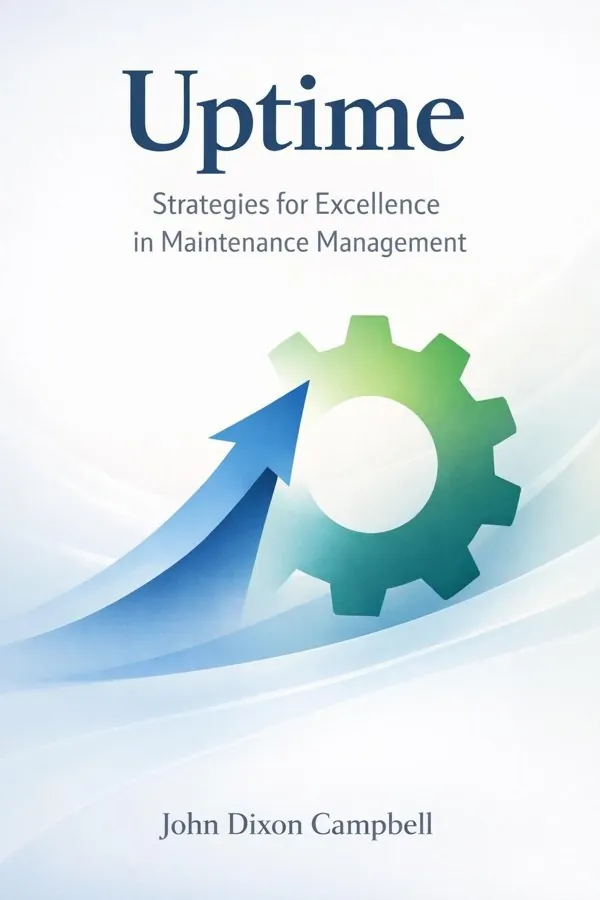
Uptime: Strategies for Excellence in Maintenance Management: Summary & Key Insights
 10 min9 chaptersAudio available
Key Takeaways from Uptime: Strategies for Excellence in Maintenance Management
A maintenance department reveals its true maturity not when everything is running smoothly, but in how often it is forced into crisis mode.
If maintenance teams do not know what success looks like, they will default to what feels urgent.
The cheapest breakdown is the one that never happens.
A skilled technician without a plan is often reduced to solving problems with one hand tied behind the back.
Maintenance costs are often attacked in the wrong place.
What Is Uptime: Strategies for Excellence in Maintenance Management About?
Uptime: Strategies for Excellence in Maintenance Management by John Dixon Campbell is a productivity book spanning 5 pages. Most organizations do not lose performance in dramatic moments of failure alone; they lose it quietly through neglected equipment, poor planning, and maintenance systems that react too late. In Uptime: Strategies for Excellence in Maintenance Management, John Dixon Campbell argues that maintenance is not a support activity operating on the margins of production. It is a central driver of reliability, capacity, cost control, safety, and long-term competitiveness. The book presents a disciplined framework for moving from a reactive, breakdown-based culture to a proactive system built on planning, prevention, measurement, and continuous improvement. What makes this book especially valuable is its practical balance. Campbell does not treat maintenance excellence as an abstract theory. He connects strategy with field-level execution, showing how work identification, preventive and predictive maintenance, scheduling, cost tracking, and organizational culture must work together. Drawing on deep expertise in maintenance management and reliability engineering, he offers a roadmap for leaders, engineers, and frontline teams who want fewer disruptions and better asset performance. For anyone responsible for industrial productivity, this book makes a compelling case that better maintenance is one of the fastest routes to better business results.
This FizzRead summary covers all 9 key chapters of Uptime: Strategies for Excellence in Maintenance Management in approximately 10 minutes, distilling the most important ideas, arguments, and takeaways from John Dixon Campbell's work. Also available as an audio summary and Key Quotes Podcast.
Uptime: Strategies for Excellence in Maintenance Management
Most organizations do not lose performance in dramatic moments of failure alone; they lose it quietly through neglected equipment, poor planning, and maintenance systems that react too late. In Uptime: Strategies for Excellence in Maintenance Management, John Dixon Campbell argues that maintenance is not a support activity operating on the margins of production. It is a central driver of reliability, capacity, cost control, safety, and long-term competitiveness. The book presents a disciplined framework for moving from a reactive, breakdown-based culture to a proactive system built on planning, prevention, measurement, and continuous improvement.
What makes this book especially valuable is its practical balance. Campbell does not treat maintenance excellence as an abstract theory. He connects strategy with field-level execution, showing how work identification, preventive and predictive maintenance, scheduling, cost tracking, and organizational culture must work together. Drawing on deep expertise in maintenance management and reliability engineering, he offers a roadmap for leaders, engineers, and frontline teams who want fewer disruptions and better asset performance. For anyone responsible for industrial productivity, this book makes a compelling case that better maintenance is one of the fastest routes to better business results.
Who Should Read Uptime: Strategies for Excellence in Maintenance Management?
This book is perfect for anyone interested in productivity and looking to gain actionable insights in a short read. Whether you're a student, professional, or lifelong learner, the key ideas from Uptime: Strategies for Excellence in Maintenance Management by John Dixon Campbell will help you think differently.
- ✓Readers who enjoy productivity and want practical takeaways
- ✓Professionals looking to apply new ideas to their work and life
- ✓Anyone who wants the core insights of Uptime: Strategies for Excellence in Maintenance Management in just 10 minutes
Want the full summary?
Get instant access to this book summary and 100K+ more with Fizz Moment.
Get Free SummaryAvailable on App Store • Free to download
Key Chapters
A maintenance department reveals its true maturity not when everything is running smoothly, but in how often it is forced into crisis mode. Campbell begins by challenging the old assumption that maintenance exists primarily to repair broken equipment. In many organizations, maintenance historically evolved as an emergency response function: machines fail, technicians rush in, production waits, and managers celebrate the quick fix. But this cycle creates hidden costs—overtime, unstable schedules, rushed workmanship, spare-parts shortages, safety risks, and recurring failures that never get fully addressed.
The book argues that excellent maintenance management begins when organizations stop glorifying firefighting and start designing for reliability. Reliability-centered thinking asks a different set of questions: Why did the equipment fail? Could the failure have been predicted or prevented? What system conditions allowed the problem to develop? Instead of measuring maintenance only by speed of repair, leading organizations measure how effectively they avoid failures in the first place.
Campbell shows that this shift changes the entire operating mindset. Supervisors stop spending all day reallocating labor to emergencies. Technicians gain time to perform precise, planned work. Production becomes more predictable. Inventory becomes easier to manage. Most importantly, reliability becomes a shared operational goal rather than a maintenance burden.
A practical example is a plant that repeatedly replaces failed bearings on a conveyor. In a reactive culture, the team just stocks more bearings and gets better at changing them quickly. In a reliability culture, they investigate lubrication practices, alignment, contamination, loading conditions, and installation quality to eliminate the repeat failure.
Actionable takeaway: Track how much of your maintenance work is emergency-driven, then make reducing that percentage a formal reliability goal.
If maintenance teams do not know what success looks like, they will default to what feels urgent. Campbell emphasizes that excellence starts with clearly defined objectives linked to business performance. Maintenance cannot operate as a separate technical island; it must support production, quality, safety, environmental performance, and cost competitiveness. That means maintenance goals should be explicit, measurable, and aligned with organizational priorities.
Too often, departments claim vague ambitions such as improving equipment performance or reducing downtime. Campbell argues that these broad statements are not enough. Effective maintenance organizations establish specific targets around equipment availability, planned work percentage, preventive maintenance compliance, maintenance cost per unit of output, backlog levels, spare-parts management, and repeat-failure reduction. These objectives create a framework for action and accountability.
The deeper insight is that objectives shape behavior. If technicians and supervisors are judged only on response speed, they will naturally prioritize rapid repairs over root-cause elimination. If the department is evaluated on schedule compliance and reliability improvement, planning and prevention become more important. In this way, maintenance excellence is not just a matter of skill; it is a matter of system design.
Campbell also stresses the importance of defining roles within the framework. Operations must care for equipment properly, planners must prepare work thoroughly, supervisors must enforce discipline, and leadership must provide resources and remove barriers. Without this structure, even well-intentioned goals remain abstract.
Consider a manufacturing site trying to improve throughput. Rather than simply demanding fewer breakdowns, it can set clear targets: reduce emergency work from 45% to 20%, increase planned work to 70%, and improve critical asset availability by 5%. Those targets create practical direction.
Actionable takeaway: Write three to five maintenance objectives that connect directly to business outcomes, then assign measures, owners, and review dates for each.
The cheapest breakdown is the one that never happens. Campbell treats preventive and predictive maintenance not as isolated programs, but as core disciplines in a high-performing maintenance system. Preventive maintenance focuses on scheduled tasks designed to reduce the likelihood of failure—inspections, lubrication, calibration, cleaning, and component replacement based on time or usage. Predictive maintenance goes a step further by using condition information to detect problems before they become functional failures.
The key lesson is that not all equipment should be maintained in the same way. Campbell warns against both neglect and over-maintenance. Some assets fail predictably and benefit from routine replacement or servicing. Others are better managed through condition monitoring, such as vibration analysis, thermography, oil analysis, or performance trending. The goal is to match the maintenance strategy to the failure behavior and business importance of the asset.
This approach has practical benefits. A plant that waits for pump failure may face production losses, environmental incidents, and secondary damage. A plant that monitors vibration and seal condition can schedule intervention during a convenient shutdown. Likewise, a disciplined lubrication route can prevent a surprising number of recurring failures that are often misclassified as unavoidable wear.
Campbell also highlights that preventive and predictive work must be reviewed regularly. A PM task that never detects a meaningful defect is wasting labor. A recurring failure despite PM may indicate the task is poorly designed or performed too late. Programs become valuable when they are evidence-based and continuously refined.
In practice, a facility might classify critical motors for monthly vibration monitoring, standard motors for quarterly inspection, and low-risk units for run-to-failure management. That kind of differentiation avoids both waste and risk.
Actionable takeaway: Review your top ten recurring equipment failures and determine whether each would be better controlled through preventive tasks, predictive monitoring, redesign, or operator care.
A skilled technician without a plan is often reduced to solving problems with one hand tied behind the back. One of Campbell’s strongest arguments is that maintenance productivity depends heavily on planning and scheduling. In many plants, labor appears expensive not because technicians are ineffective, but because their time is fragmented by missing parts, unclear job scopes, incomplete permits, poor coordination, and a constant stream of interruptions.
Planning means preparing work before the wrench is turned. A good plan defines the job scope, procedures, safety precautions, labor hours, tools, materials, drawings, and access requirements. Scheduling then assigns the prepared work to specific time windows based on priority, resource availability, and production needs. Campbell shows that when these disciplines are applied consistently, total maintenance output rises dramatically without increasing headcount.
The important distinction is that planning improves efficiency while scheduling improves control. Planning reduces wasted motion and uncertainty. Scheduling ensures that the right work gets done at the right time. Together they help organizations shift from opportunistic work execution to deliberate asset care.
A common example is a valve replacement that repeatedly takes twice as long as expected because scaffolding, isolation permits, and replacement parts are not ready when the crew arrives. With proper planning, these obstacles are resolved in advance. With proper scheduling, the work is coordinated with operations so downtime is minimized.
Campbell also notes that planning and scheduling improve morale. Technicians are more effective when expectations are clear and their expertise is used on technical execution rather than logistical improvisation. Managers gain visibility into backlog, labor loading, and future risk.
Actionable takeaway: Separate emergency work from schedulable work, then establish a weekly scheduling routine built only on jobs that have been fully planned and kitted.
Maintenance costs are often attacked in the wrong place. Organizations cut labor, delay repairs, or slash spare-parts inventory, only to discover later that total operating costs rise because failures become more frequent and disruptive. Campbell’s message is that true cost control in maintenance does not come from indiscriminate cuts; it comes from disciplined work management that reduces waste, avoids breakdowns, and makes every maintenance dollar more productive.
He encourages managers to look beyond visible spending categories and examine the full economics of asset care. An emergency repair may cost more than planned maintenance not only because of overtime, but because it interrupts production, damages adjacent components, compromises quality, and forces rushed procurement. By contrast, a well-planned intervention may appear more bureaucratic upfront, but it often minimizes total lifecycle cost.
This is why Campbell links cost control to planning, scheduling, and asset criticality. Not every asset deserves the same investment, but every significant asset deserves a rational strategy. Work should be prioritized according to business impact, and spending should be tracked in ways that support decision-making rather than just accounting compliance. Useful cost information includes failure cost trends, labor distribution, contractor usage, materials consumption, and cost by asset class.
A practical application is in spare-parts management. Excess inventory ties up capital, but stockouts on critical components can trigger long outages. The answer is not simply “more” or “less” inventory, but smarter inventory based on lead time, failure risk, and asset criticality.
Campbell ultimately shows that the most economical maintenance department is rarely the one with the lowest visible budget. It is the one that delivers the highest uptime and lowest total operational disruption.
Actionable takeaway: Start reviewing maintenance costs by asset and failure type, not just by department totals, so spending can be tied to reliability outcomes.
What gets measured does not automatically improve, but what is not measured is usually managed by guesswork. Campbell insists that maintenance excellence requires a rigorous measurement system. Metrics are not administrative extras; they are the feedback loops that tell an organization whether its maintenance strategy is working. Without them, teams cannot distinguish between busyness and effectiveness.
The book advocates measuring both results and process discipline. Result indicators include downtime, equipment availability, mean time between failures, maintenance cost, and production losses due to equipment issues. Process indicators include preventive maintenance completion, schedule compliance, backlog quality, planned versus unplanned work, wrench time, and repeat failures. This combination matters because lagging results alone do not show where problems originate, while process metrics alone can create a false sense of progress.
Campbell warns, however, that metrics must be interpreted intelligently. A high PM completion rate means little if preventive tasks are poorly designed. Low maintenance spending may look impressive until reliability collapses. Fast response time may simply reflect a culture dominated by emergencies. Good metrics clarify behavior only when they are linked to purpose.
In practical terms, measurement should support decision-making at different levels. Frontline supervisors need daily and weekly indicators to manage workload and compliance. Plant leaders need monthly trends to evaluate reliability, cost, and strategic progress. Corporate leaders need comparable standards across sites. The system should be simple enough to use consistently, yet robust enough to reveal systemic issues.
For example, if a plant sees improving schedule compliance but worsening downtime, the data may indicate that critical failure modes are not being addressed by the scheduled work. That insight can trigger a root-cause review rather than more pressure on crews.
Actionable takeaway: Build a small maintenance dashboard with five to seven metrics that combine reliability results with planning and prevention discipline, then review it on a fixed cadence.
The hardest part of maintenance excellence is rarely technical knowledge; it is sustaining disciplined behavior across the organization. Campbell makes the important point that maintenance systems fail when culture undermines them. A company can implement a CMMS, launch preventive routines, and create planning roles, yet still struggle if leaders reward heroics over discipline, operators ignore basic equipment care, and supervisors bypass the process whenever pressure rises.
A culture of excellence treats equipment reliability as a shared value, not a maintenance slogan. Operations runs equipment within proper limits. Maintenance executes quality work instead of temporary fixes. Engineers support defect elimination and design improvement. Management protects planning time, supports training, and resists the temptation to sacrifice long-term reliability for short-term appearance.
Campbell’s insight is that culture shows up in ordinary decisions. Does the plant investigate chronic failures, or just restart as fast as possible? Are technicians given time to complete precision work, or pushed to move on before the job is done? Do managers ask why emergency work is recurring, or simply praise the team for responding quickly? These patterns determine whether systems become habits or paperwork.
A practical example is shutdown work. In a weak culture, shutdown plans are abandoned as soon as a new issue emerges, creating chaos and incomplete tasks. In a strong culture, teams adapt without abandoning discipline: priorities are reassessed, communication is clear, and lessons are captured afterward.
Campbell also emphasizes leadership consistency. Employees quickly learn what truly matters from what leaders tolerate, fund, and celebrate. Reliability culture grows when leadership reinforces precision, planning, and learning.
Actionable takeaway: Identify one behavior currently rewarded in your organization that supports firefighting more than reliability, and replace it with a recognition standard tied to prevention and process discipline.
Equipment reliability improves fastest when maintenance stops being treated as the sole owner of mechanical health. Campbell underscores that many failures originate not in the maintenance shop, but in the daily interaction between operators, equipment, and production demands. When operations and maintenance work in isolation, blame grows and reliability suffers. When they collaborate, small defects are identified earlier, operating discipline improves, and planned work becomes easier to execute.
This partnership begins with clear boundaries and shared responsibilities. Operators are often best positioned to detect early abnormalities—noise, heat, leakage, vibration, product variation, or slow performance drift. Basic cleaning, inspection, and routine checks can be integrated into operator care programs. Maintenance then focuses its technical expertise on higher-skill tasks, analysis, and intervention. This does not reduce the importance of maintenance; it strengthens the entire reliability chain.
Campbell also highlights the planning value of collaboration. Maintenance schedules only work when production cooperates on access, downtime windows, and job priority. Conversely, production planning improves when equipment risk is visible and communicated early. A plant that shares reliability data across departments can make better tradeoffs than one that waits for conflict at the last minute.
Imagine a packaging line where operators repeatedly notice minor misalignment but have no structured way to report or escalate it. The issue grows until a major failure stops production. In a collaborative system, that observation becomes an early work request, the planner reviews it, and maintenance corrects the issue before output is affected.
The broader message is simple: reliability is a cross-functional achievement. Campbell positions maintenance excellence as a plant-wide discipline rather than a departmental project.
Actionable takeaway: Create a simple process for operators to report early equipment abnormalities and ensure those reports are reviewed in the weekly maintenance planning cycle.
Maintenance excellence is not a one-time upgrade; it is a continuous learning process. Campbell closes the loop by showing that even strong systems degrade if organizations stop questioning recurring losses, outdated routines, and poor assumptions. Uptime is sustained through ongoing improvement—using data, experience, and structured analysis to remove defects from the system rather than merely coping with them.
Continuous improvement in maintenance has several layers. At the tactical level, teams refine job plans, optimize PM intervals, improve spare-parts accuracy, and update equipment histories. At the technical level, they perform root-cause analysis on significant failures, redesign weak components, and improve installation and operating practices. At the managerial level, they review metrics, align resources, and strengthen role clarity. All three layers matter because reliability problems usually have both physical and organizational causes.
Campbell is especially persuasive on the importance of learning from failure. A major breakdown should not end with restored operation alone. It should produce insight: What failed? Why now? What signals were missed? What system weakness allowed recurrence? Plants that skip this reflection remain trapped in repetitive loss. Plants that investigate and act build resilience over time.
A useful example is a site that experiences repeated seal failures on process pumps. Rather than replacing seals indefinitely, the team studies flush plans, shaft alignment, installation quality, cavitation conditions, and operator practices. The result may be a revised procedure, better training, and a design modification that permanently reduces failures.
The larger contribution of Campbell’s book is this mindset: maintenance excellence is created through disciplined repetition and improvement, not isolated technical brilliance. Organizations win not by solving one problem once, but by making reliability learning routine.
Actionable takeaway: After every major equipment failure, require a short root-cause review with assigned corrective actions, and track whether those actions actually prevent recurrence.
All Chapters in Uptime: Strategies for Excellence in Maintenance Management
About the Author
John Dixon Campbell is an influential voice in maintenance management and reliability engineering, known for helping industrial organizations rethink maintenance as a strategic contributor to performance rather than a reactive repair function. His work focuses on improving uptime, reducing avoidable equipment failure, and building disciplined systems for planning, prevention, and continuous improvement. Drawing on extensive experience with industrial operations, Campbell has contributed to the development and promotion of best practices in maintenance excellence, asset management, and organizational reliability. He is especially respected for translating technical maintenance principles into management frameworks that leaders can apply across plants and operations. In Uptime, he combines practical field insight with broader operational thinking, making complex maintenance issues understandable and actionable for both specialists and decision-makers.
Get This Summary in Your Preferred Format
Read or listen to the Uptime: Strategies for Excellence in Maintenance Management summary by John Dixon Campbell anytime, anywhere. FizzRead offers multiple formats so you can learn on your terms — all free.
Available formats: App · Audio · PDF · EPUB — All included free with FizzRead
Download Uptime: Strategies for Excellence in Maintenance Management PDF and EPUB Summary
Key Quotes from Uptime: Strategies for Excellence in Maintenance Management
“A maintenance department reveals its true maturity not when everything is running smoothly, but in how often it is forced into crisis mode.”
“If maintenance teams do not know what success looks like, they will default to what feels urgent.”
“The cheapest breakdown is the one that never happens.”
“A skilled technician without a plan is often reduced to solving problems with one hand tied behind the back.”
“Maintenance costs are often attacked in the wrong place.”
Frequently Asked Questions about Uptime: Strategies for Excellence in Maintenance Management
Uptime: Strategies for Excellence in Maintenance Management by John Dixon Campbell is a productivity book that explores key ideas across 9 chapters. Most organizations do not lose performance in dramatic moments of failure alone; they lose it quietly through neglected equipment, poor planning, and maintenance systems that react too late. In Uptime: Strategies for Excellence in Maintenance Management, John Dixon Campbell argues that maintenance is not a support activity operating on the margins of production. It is a central driver of reliability, capacity, cost control, safety, and long-term competitiveness. The book presents a disciplined framework for moving from a reactive, breakdown-based culture to a proactive system built on planning, prevention, measurement, and continuous improvement. What makes this book especially valuable is its practical balance. Campbell does not treat maintenance excellence as an abstract theory. He connects strategy with field-level execution, showing how work identification, preventive and predictive maintenance, scheduling, cost tracking, and organizational culture must work together. Drawing on deep expertise in maintenance management and reliability engineering, he offers a roadmap for leaders, engineers, and frontline teams who want fewer disruptions and better asset performance. For anyone responsible for industrial productivity, this book makes a compelling case that better maintenance is one of the fastest routes to better business results.
You Might Also Like





Browse by Category
Ready to read Uptime: Strategies for Excellence in Maintenance Management?
Get the full summary and 100K+ more books with Fizz Moment.