
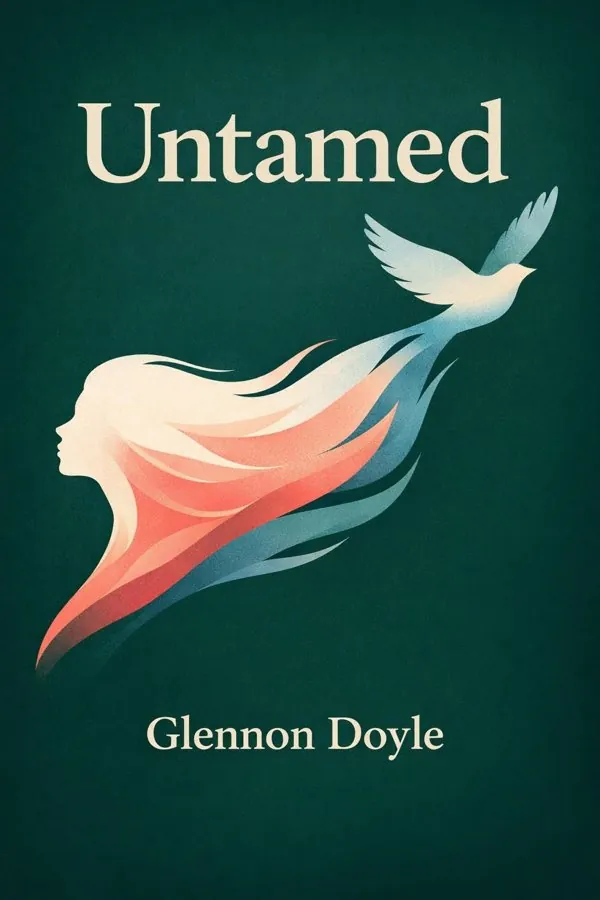
Untamed: Summary & Key Insights
 10 min9 chaptersAudio available
Key Takeaways from Untamed
One of the most radical ideas in Untamed is that many people, especially women, are praised for self-betrayal long before they have words for it.
Doyle challenges a deeply familiar promise: that if you become the right partner, parent, and woman, fulfillment will naturally follow.
Untamed treats crisis not only as pain, but as revelation.
Sometimes love does not complete us; it introduces us to ourselves.
A powerful contribution of Untamed is its refusal to equate family with one approved structure.
What Is Untamed About?
Untamed by Glennon Doyle is a biographies book published in 2020 spanning 9 pages. Untamed is part memoir, part manifesto, and part invitation to wake up. In this deeply personal and widely resonant book, Glennon Doyle argues that many women spend their lives becoming who the world wants them to be instead of becoming who they truly are. Through stories of addiction, eating disorders, marriage, motherhood, faith, divorce, and falling in love with soccer star Abby Wambach, Doyle traces her journey from pleasing and performing to listening inwardly and living honestly. The book matters because it names a quiet but universal pain: the exhaustion of living by external approval. Rather than offering a rigid self-help formula, Doyle encourages readers to trust their inner knowing, challenge inherited roles, and build lives rooted in truth instead of expectation. Her authority comes not from perfection but from lived experience. As a bestselling memoirist, activist, and founder of Together Rising, Doyle writes with unusual candor about recovery, family, spirituality, and identity. Untamed speaks to anyone who has ever wondered whether being “good” has cost them being free.
This FizzRead summary covers all 9 key chapters of Untamed in approximately 10 minutes, distilling the most important ideas, arguments, and takeaways from Glennon Doyle's work. Also available as an audio summary and Key Quotes Podcast.
Untamed
Untamed is part memoir, part manifesto, and part invitation to wake up. In this deeply personal and widely resonant book, Glennon Doyle argues that many women spend their lives becoming who the world wants them to be instead of becoming who they truly are. Through stories of addiction, eating disorders, marriage, motherhood, faith, divorce, and falling in love with soccer star Abby Wambach, Doyle traces her journey from pleasing and performing to listening inwardly and living honestly. The book matters because it names a quiet but universal pain: the exhaustion of living by external approval. Rather than offering a rigid self-help formula, Doyle encourages readers to trust their inner knowing, challenge inherited roles, and build lives rooted in truth instead of expectation. Her authority comes not from perfection but from lived experience. As a bestselling memoirist, activist, and founder of Together Rising, Doyle writes with unusual candor about recovery, family, spirituality, and identity. Untamed speaks to anyone who has ever wondered whether being “good” has cost them being free.
Who Should Read Untamed?
This book is perfect for anyone interested in biographies and looking to gain actionable insights in a short read. Whether you're a student, professional, or lifelong learner, the key ideas from Untamed by Glennon Doyle will help you think differently.
- ✓Readers who enjoy biographies and want practical takeaways
- ✓Professionals looking to apply new ideas to their work and life
- ✓Anyone who wants the core insights of Untamed in just 10 minutes
Want the full summary?
Get instant access to this book summary and 100K+ more with Fizz Moment.
Get Free SummaryAvailable on App Store • Free to download
Key Chapters
One of the most radical ideas in Untamed is that many people, especially women, are praised for self-betrayal long before they have words for it. Doyle argues that from childhood, girls are often taught to be quiet, accommodating, attractive, and agreeable. They learn to monitor themselves constantly: be nice, be pretty, do not take up too much space, do not disappoint anyone. The result is not maturity but disconnection. Instead of developing a relationship with their own desires, they become experts at reading the room and adjusting themselves to fit.
Doyle uses the image of a caged cheetah to explain this conditioning. The cheetah is still powerful, but its instincts have been confined. In the same way, a person can look successful from the outside while feeling trapped on the inside. This idea extends beyond gender. Anyone raised to value approval over truth may find themselves living by scripts they never chose.
In practice, this means noticing where your choices come from. Do you say yes because you mean yes, or because saying no makes you anxious? Do you dress, work, parent, worship, or love in ways that reflect your values, or your training? Even small moments matter: declining an obligation, expressing a real opinion, or admitting you want something different can begin rebuilding inner trust.
Actionable takeaway: Make a short list of three places in your life where you are being “good” at the expense of being honest, and choose one small act of truth this week.
Doyle challenges a deeply familiar promise: that if you become the right partner, parent, and woman, fulfillment will naturally follow. She once believed that marriage and motherhood were the ultimate destinations, places where love, virtue, and purpose would finally align. But Untamed reveals how easy it is to disappear inside roles that are culturally celebrated. When identity becomes performance, even noble roles can become masks.
Her point is not that marriage or motherhood are inherently oppressive. It is that any identity becomes dangerous when it demands self-erasure. Doyle describes the subtle ways women are encouraged to make everyone else comfortable and call that love. They become household managers, emotional shock absorbers, and image maintainers. Over time, they may look devoted while privately feeling numb, resentful, or absent from their own lives.
This section matters because it reframes care. Real love does not require shrinking. Healthy partnership and parenting are not built on martyrdom but on wholeness. A parent who is honest, alive, and self-respecting offers children something far more valuable than perfect sacrifice: a model of integrity. Likewise, a partner who brings their whole self into a relationship creates the possibility of intimacy rather than mere duty.
In daily life, this may look like reexamining the invisible labor you carry, questioning inherited expectations, or allowing your needs to count. It may also mean recognizing that being needed is not the same as being known.
Actionable takeaway: Identify one role you play so often that it has eclipsed your individuality, and ask yourself: who am I when I am not performing this role?
Untamed treats crisis not only as pain, but as revelation. Doyle shows that breakdowns often expose truths we have been working hard not to see. When the life you built can no longer be sustained, the collapse feels terrifying, but it can also become the beginning of real freedom. Instead of viewing unraveling as failure, she reframes it as evidence that the false self can no longer hold.
This is especially powerful because many readers associate instability with weakness. Doyle suggests the opposite: sometimes anxiety, anger, grief, or restlessness are not signs that something is wrong with you, but signals that something is wrong for you. The body and spirit often protest before the mind is ready to admit the truth. What feels like chaos may actually be awakening.
Practically, this means listening differently to your discomfort. If you feel chronically depleted, emotionally absent, or split between what you feel and what you show, the answer may not be to become more efficient at coping. It may be to ask what your pain is trying to reveal. Journaling, therapy, silence, and honest conversations can help separate external expectation from internal truth.
Doyle does not romanticize crisis; it hurts, disrupts families, and dismantles certainty. But she insists that a broken life can become a more truthful one. The goal is not to avoid every collapse. It is to let collapse tell the truth before you rebuild.
Actionable takeaway: The next time you feel deep recurring discomfort, pause before fixing it and ask, “What truth is this feeling trying to deliver?”
Sometimes love does not complete us; it introduces us to ourselves. When Doyle meets Abby Wambach, she experiences not merely attraction but recognition. The relationship becomes a mirror that reflects a self she had buried beneath obligation and conformity. In Untamed, this moment is less a romance plot than a spiritual awakening. Love becomes revelatory when it exposes the distance between the life you are living and the life your soul knows is possible.
Doyle’s insight is that genuine love does not ask for more pretending. It does not reward compliance or demand that you stay split from yourself. Instead, it makes honesty unavoidable. This is why profound connection can feel both exhilarating and destabilizing. It calls old structures into question. If being truly seen feels more natural than performing, you can no longer comfortably return to performance.
Readers can apply this idea beyond romantic relationships. Friendship, mentorship, art, faith communities, and even moments in nature can awaken the truest self. The key question is whether a person or environment invites expansion or demands contraction. Do you feel more alive, more honest, more peaceful in their presence? Or more managed, more careful, more edited?
The lesson is not to chase intensity, but to notice where recognition happens. Relationships should not only offer security; they should make truth easier. The best love does not rescue you from your life. It calls you back into it.
Actionable takeaway: Reflect on the people in your life and name one relationship that helps you become more honest, then invest more intentionally in that connection.
A powerful contribution of Untamed is its refusal to equate family with one approved structure. Doyle shows that when a marriage ends or a family changes form, the real task is not preserving appearances but preserving love, dignity, and truth. She rejects the idea that a family is broken simply because it does not match a conventional ideal. What harms families most is not change itself, but dishonesty, resentment, and the pressure to perform normalcy.
This perspective matters because many people stay in painful situations to protect a public image of stability. Doyle argues that children do not need parents to maintain an illusion. They need adults who model courage, respect, and emotional integrity. A family can be reconfigured and still be deeply loving. In fact, it may become healthier once its members stop pretending.
In practical terms, redefining family means prioritizing communication over image and connection over conformity. Co-parenting, blended families, chosen families, and unconventional partnerships can all become places of safety if they are built around honesty and care. This also requires grieving old expectations. Letting go of a script can feel like failure, even when it is actually liberation.
Doyle invites readers to ask not whether their family looks right from the outside, but whether it is nurturing the humanity of the people inside it. A truthful family may be messier than a polished one, but it is often far more alive.
Actionable takeaway: Replace one inherited belief about what a family “should” look like with a question that matters more: “What structure best supports love, safety, and honesty for us?”
One of Doyle’s most important arguments is that wisdom is not only intellectual; it is embodied. Many people have been trained to distrust their bodies, treating them as objects to control, improve, judge, or override. Doyle writes about disordered eating, addiction, and cultural beauty standards to show how deeply this alienation can run. When the body is treated as a problem to solve, people lose access to one of their clearest sources of truth.
In Untamed, reclaiming the body means listening to it as an ally. Hunger, tension, exhaustion, excitement, dread, and ease are not inconveniences; they are information. The body often signals alignment or misalignment before the conscious mind can explain it. Yet many of us have learned to suppress those signals in order to remain productive, likable, thin, calm, or obedient.
This idea can be applied simply. Notice how your body responds in different environments. Do you clench, shrink, speed up, or go numb around certain people or commitments? Do you breathe more deeply, feel energized, or relax in others? Practices like slowing down before saying yes, eating without moral judgment, resting without earning it, and moving for pleasure rather than punishment can rebuild trust.
Doyle also links this to spirituality. Inner knowing is not separate from the body; it often speaks through it. Learning to hear that voice is part of becoming untamed.
Actionable takeaway: Before making one important decision this week, stop and ask, “What is my body telling me?” then let that answer inform your next step.
Doyle’s parenting philosophy is a sharp departure from the idea that children exist to be managed into social acceptability. She argues that many adults unconsciously train children to prioritize being liked, successful, and well-behaved over being courageous, compassionate, and self-trusting. The problem is not guidance itself, but the way fear can dominate it. Parents often try to protect children by teaching them to conform, even when conformity disconnects them from their instincts.
In Untamed, raising brave children means honoring their inner voice instead of replacing it with constant external authority. This does not mean abandoning boundaries or structure. It means helping children become people who can feel, think, discern, and choose with integrity. A brave child is not one who never struggles, but one who learns that discomfort can be survived and truth can be spoken.
This has practical implications. Instead of asking children to be “good” in the vague, approval-based sense, adults can ask better questions: What do you feel? What do you need? What seems true to you? Parents can model apology, emotional honesty, and respect for boundaries. They can also challenge stereotypes around gender, success, and identity so children do not inherit unnecessary cages.
Doyle’s broader point is that children learn freedom from watching adults practice it. A parent who abandons themselves teaches self-abandonment. A parent who tells the truth teaches courage.
Actionable takeaway: In your next meaningful conversation with a child, replace correction or advice with curiosity by asking one open question that helps them hear themselves.
Untamed is intensely personal, but it never stays private. Doyle connects individual freedom to collective liberation, arguing that the work of becoming more honest should make us more loving and more engaged with others, not more self-absorbed. If your awakening only serves your comfort, it remains incomplete. Real freedom expands your capacity to see, serve, and stand beside other people.
This is where community and activism enter the book. Doyle’s life and work through Together Rising reflect her belief that love should become action. Compassion is not simply a feeling; it is a practice of showing up materially, politically, and relationally. The same courage required to tell the truth in your own life is often required to confront injustice in public life.
For readers, this means asking how personal transformation affects their relationships and responsibilities. Does becoming more authentic make you less defensive, less judgmental, more willing to listen, and more ready to help? Can you support causes, give resources, advocate for vulnerable people, or create spaces where others feel seen? Liberation is contagious when it becomes communal.
Doyle also highlights the healing power of being witnessed. Honest communities do not demand perfection. They allow complexity, change, and struggle. In a world that often rewards image management, mutual truth-telling becomes a form of resistance.
Actionable takeaway: Choose one concrete act of love this week that extends beyond your own growth, whether donating, volunteering, speaking up, or checking in deeply with someone who needs support.
Perhaps the most important lesson in Untamed is that freedom is not a single dramatic decision; it is a daily discipline of remembering who you are. Doyle does not present awakening as a permanent state one reaches and then keeps effortlessly. Conditioning is persistent. Old fears return. Approval remains tempting. Living untamed requires repeated choices to trust inner knowing over outer noise.
This final integration matters because readers may be inspired by the book’s major turning points yet overlook the ordinary work that follows. After the revelation comes maintenance: setting boundaries, tolerating disappointment, disappointing others when necessary, resting, telling the truth sooner, and resisting the urge to seek permission for your own life. Freedom often looks quiet in practice. It is found in routines, relationships, calendars, language, and attention.
A useful way to apply this is to build rituals that reconnect you to yourself. Morning silence, journaling, movement, prayer, therapy, walks, and honest conversation can all serve as check-ins with your inner voice. So can noticing what drains or enlivens you across the week. The goal is not to become fearless but to become faithful to what you know.
Doyle’s vision is not selfish individualism. It is integration: a life where your values, body, choices, and relationships align more closely. To live untamed is to stop abandoning yourself in small acceptable ways.
Actionable takeaway: Create one daily or weekly ritual, even for ten minutes, that helps you hear your own voice before the world tells you who to be.
All Chapters in Untamed
About the Author
Glennon Doyle is an American bestselling author, activist, and public speaker known for her candid writing on recovery, relationships, faith, identity, and personal transformation. She first gained a wide audience through her memoir-driven work and later became especially influential with Untamed, a book that challenged women to trust themselves and reject limiting cultural expectations. Doyle is also the founder of Together Rising, a nonprofit organization that has raised millions of dollars to support people in crisis through direct, community-powered giving. Her work blends memoir, social critique, and encouragement, often focusing on courage, emotional honesty, and self-trust. Admired for her vulnerability and clarity, Doyle has become a prominent voice in conversations about womanhood, family, love, and living authentically.
Get This Summary in Your Preferred Format
Read or listen to the Untamed summary by Glennon Doyle anytime, anywhere. FizzRead offers multiple formats so you can learn on your terms — all free.
Available formats: App · Audio · PDF · EPUB — All included free with FizzRead
Download Untamed PDF and EPUB Summary
Key Quotes from Untamed
“One of the most radical ideas in Untamed is that many people, especially women, are praised for self-betrayal long before they have words for it.”
“Doyle challenges a deeply familiar promise: that if you become the right partner, parent, and woman, fulfillment will naturally follow.”
“Untamed treats crisis not only as pain, but as revelation.”
“Sometimes love does not complete us; it introduces us to ourselves.”
“A powerful contribution of Untamed is its refusal to equate family with one approved structure.”
Frequently Asked Questions about Untamed
Untamed by Glennon Doyle is a biographies book that explores key ideas across 9 chapters. Untamed is part memoir, part manifesto, and part invitation to wake up. In this deeply personal and widely resonant book, Glennon Doyle argues that many women spend their lives becoming who the world wants them to be instead of becoming who they truly are. Through stories of addiction, eating disorders, marriage, motherhood, faith, divorce, and falling in love with soccer star Abby Wambach, Doyle traces her journey from pleasing and performing to listening inwardly and living honestly. The book matters because it names a quiet but universal pain: the exhaustion of living by external approval. Rather than offering a rigid self-help formula, Doyle encourages readers to trust their inner knowing, challenge inherited roles, and build lives rooted in truth instead of expectation. Her authority comes not from perfection but from lived experience. As a bestselling memoirist, activist, and founder of Together Rising, Doyle writes with unusual candor about recovery, family, spirituality, and identity. Untamed speaks to anyone who has ever wondered whether being “good” has cost them being free.
You Might Also Like

An American Marriage
Tayari Jones
10 min
Benjamin Franklin: An American Life
Walter Isaacson
10 min
I Know Why The Caged Bird Sings
Maya Angelou
10 min
Long Walk to Freedom
Nelson Mandela
10 min
Persepolis
Marjane Satrapi
10 min
Surely You're Joking, Mr. Feynman!
Richard P. Feynman
10 minFeatured In
Browse by Category
Ready to read Untamed?
Get the full summary and 100K+ more books with Fizz Moment.