
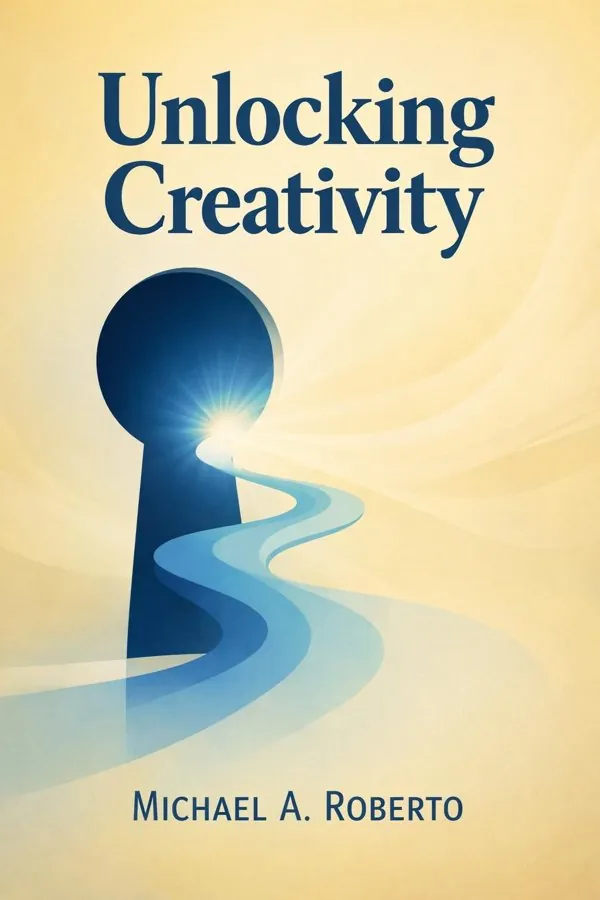
Unlocking Creativity: How to Solve Any Problem and Make the Best Decisions by Shifting Creative Mindsets: Summary & Key Insights
 10 min11 chaptersAudio available
What Is Unlocking Creativity: How to Solve Any Problem and Make the Best Decisions by Shifting Creative Mindsets About?
Unlocking Creativity: How to Solve Any Problem and Make the Best Decisions by Shifting Creative Mindsets by Michael A. Roberto is a creativity book spanning 11 pages. Unlocking Creativity explores the psychological and organizational barriers that hinder creative thinking in workplaces. Michael A. Roberto draws on research and case studies to show how leaders can foster an environment that encourages innovation, risk-taking, and open-mindedness. The book provides practical strategies to overcome fear of failure, groupthink, and rigid processes that stifle creativity.
This FizzRead summary covers all 11 key chapters of Unlocking Creativity: How to Solve Any Problem and Make the Best Decisions by Shifting Creative Mindsets in approximately 10 minutes, distilling the most important ideas, arguments, and takeaways from Michael A. Roberto's work. Also available as an audio summary and Key Quotes Podcast.
Unlocking Creativity: How to Solve Any Problem and Make the Best Decisions by Shifting Creative Mindsets
Unlocking Creativity explores the psychological and organizational barriers that hinder creative thinking in workplaces. Michael A. Roberto draws on research and case studies to show how leaders can foster an environment that encourages innovation, risk-taking, and open-mindedness. The book provides practical strategies to overcome fear of failure, groupthink, and rigid processes that stifle creativity.
Who Should Read Unlocking Creativity: How to Solve Any Problem and Make the Best Decisions by Shifting Creative Mindsets?
This book is perfect for anyone interested in creativity and looking to gain actionable insights in a short read. Whether you're a student, professional, or lifelong learner, the key ideas from Unlocking Creativity: How to Solve Any Problem and Make the Best Decisions by Shifting Creative Mindsets by Michael A. Roberto will help you think differently.
- ✓Readers who enjoy creativity and want practical takeaways
- ✓Professionals looking to apply new ideas to their work and life
- ✓Anyone who wants the core insights of Unlocking Creativity: How to Solve Any Problem and Make the Best Decisions by Shifting Creative Mindsets in just 10 minutes
Want the full summary?
Get instant access to this book summary and 100K+ more with Fizz Moment.
Get Free SummaryAvailable on App Store • Free to download
Key Chapters
For decades, companies have been pouring resources into innovation training, design labs, and brainstorming retreats. And yet, many find their creative output disappointingly stale. The root of this paradox lies not in a shortage of ideas but in organizational dynamics that punish risk and reward conformity. In interviewing executives across industries—from aviation to pharmaceuticals—I heard variations of the same lament: ‘We’re drowning in meetings, compliance forms, and approval layers. There’s no time to think.’ Bureaucracy and busyness, not lack of intelligence, have become the true creativity killers.
Fear of failure is another engine of the crisis. Most people enter the workplace with a natural capacity for curiosity, but they quickly learn that mistakes are career liabilities. I’ve observed how even high-performing teams default to safe, incremental solutions precisely when breakthrough thinking is needed most. This pervasive caution is reinforced by performance evaluations that value predictability over discovery. The result is an atmosphere where employees self-censor before leadership ever needs to intervene.
The creativity crisis, then, is cultural before it is cognitive. When every process is designed to minimize deviation, the very divergence necessary for innovation is treated as a threat. To reverse it, leaders must begin not by asking for new ideas but by asking which habits and structures suffocate them. The first step toward unlocking creativity is diagnosing where it has been locked away.
In the heart of this book lies a conviction: creativity is not about who you are but how you think. I describe six mindsets that shape creative performance, all orbiting around how individuals perceive challenges, uncertainty, and collaboration. Chief among them is the difference between a fixed and a growth mindset. People with a fixed orientation interpret creative ability as innate—something you either have or you don’t—while those with a growth orientation see creativity as a muscle strengthened through practice and feedback. When leaders model a growth mindset, they signal that unconventional thinking and even failed experiments are valuable contributions to learning.
Beyond those two poles, there are other dimensions: whether one views problems as constraints or opportunities; whether ambiguity excites or threatens; whether collaboration feels like synergy or conflict. In studying organizations that sustain innovation year after year, I found that their cultures habitually reinforce expansive rather than defensive ways of thinking. Pixar, for example, has institutionalized the belief that every film begins as an ugly baby—a fragile idea that must be nurtured through multiple revisions rather than judged prematurely. That’s a cognitive stance, not a procedural one.
To develop these mindsets, reflection is essential. Leaders cannot command creativity, but they can create conditions where team members feel empowered to take intellectual risks. This begins when they stop framing creativity as a special talent reserved for a few and start recognizing it as a mode of everyday problem-solving accessible to all.
+ 9 more chapters — available in the FizzRead app
All Chapters in Unlocking Creativity: How to Solve Any Problem and Make the Best Decisions by Shifting Creative Mindsets
About the Author
Michael A. Roberto is a professor of management at Bryant University and a former faculty member at Harvard Business School. He is known for his research on decision-making, leadership, and organizational learning, and has authored several books on these topics.
Get This Summary in Your Preferred Format
Read or listen to the Unlocking Creativity: How to Solve Any Problem and Make the Best Decisions by Shifting Creative Mindsets summary by Michael A. Roberto anytime, anywhere. FizzRead offers multiple formats so you can learn on your terms — all free.
Available formats: App · Audio · PDF · EPUB — All included free with FizzRead
Download Unlocking Creativity: How to Solve Any Problem and Make the Best Decisions by Shifting Creative Mindsets PDF and EPUB Summary
Key Quotes from Unlocking Creativity: How to Solve Any Problem and Make the Best Decisions by Shifting Creative Mindsets
“For decades, companies have been pouring resources into innovation training, design labs, and brainstorming retreats.”
“In the heart of this book lies a conviction: creativity is not about who you are but how you think.”
Frequently Asked Questions about Unlocking Creativity: How to Solve Any Problem and Make the Best Decisions by Shifting Creative Mindsets
Unlocking Creativity: How to Solve Any Problem and Make the Best Decisions by Shifting Creative Mindsets by Michael A. Roberto is a creativity book that explores key ideas across 11 chapters. Unlocking Creativity explores the psychological and organizational barriers that hinder creative thinking in workplaces. Michael A. Roberto draws on research and case studies to show how leaders can foster an environment that encourages innovation, risk-taking, and open-mindedness. The book provides practical strategies to overcome fear of failure, groupthink, and rigid processes that stifle creativity.
You Might Also Like
Dimensions Of Creativity
Margaret A. Boden
10 min
How to Fly a Horse: The Secret History of Creation, Invention, and Discovery
Kevin Ashton
10 min
Imagine: How Creativity Works
Jonah Lehrer
10 min
The Accidental Creative: How to Be Brilliant at a Moment's Notice
Todd Henry
10 min
The Origins of Creativity
Edward O. Wilson
10 min
Wired to Create: Unraveling the Mysteries of the Creative Mind
Scott Barry Kaufman, Carolyn Gregoire
10 minBrowse by Category
Ready to read Unlocking Creativity: How to Solve Any Problem and Make the Best Decisions by Shifting Creative Mindsets?
Get the full summary and 100K+ more books with Fizz Moment.