
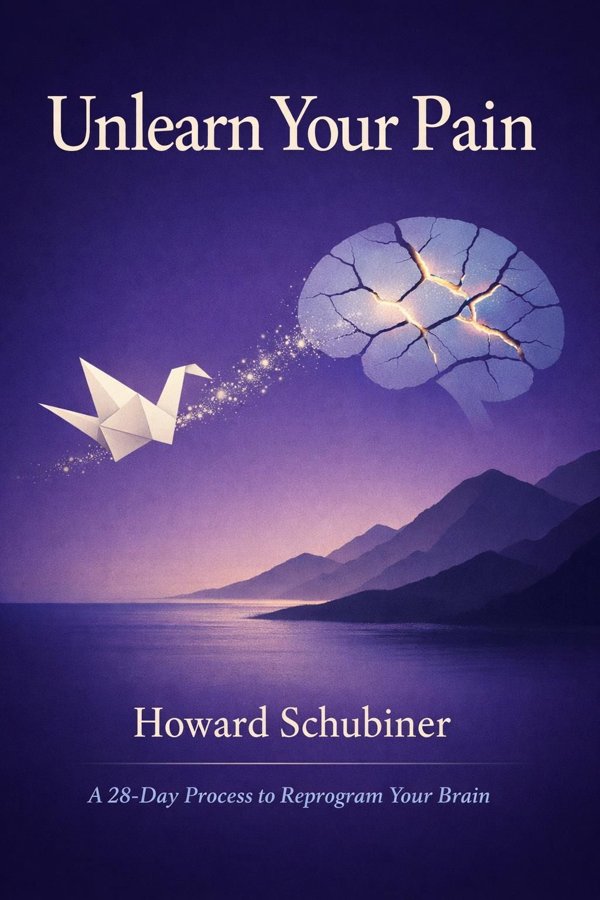
Unlearn Your Pain: A 28-Day Process to Reprogram Your Brain: Summary & Key Insights
 10 min5 chaptersAudio available
What Is Unlearn Your Pain: A 28-Day Process to Reprogram Your Brain About?
Unlearn Your Pain: A 28-Day Process to Reprogram Your Brain by Howard Schubiner is a mental_health book spanning 5 pages. Unlearn Your Pain offers a structured 28-day program designed to help individuals overcome chronic pain by addressing its psychological and emotional roots. Drawing on mind-body medicine and neuroscience, Dr. Howard Schubiner guides readers through exercises that uncover repressed emotions, reduce fear, and retrain the brain to eliminate pain signals. The book integrates cognitive-behavioral techniques, journaling, and mindfulness to promote healing without medication or surgery.
This FizzRead summary covers all 5 key chapters of Unlearn Your Pain: A 28-Day Process to Reprogram Your Brain in approximately 10 minutes, distilling the most important ideas, arguments, and takeaways from Howard Schubiner's work. Also available as an audio summary and Key Quotes Podcast.
Unlearn Your Pain: A 28-Day Process to Reprogram Your Brain
Unlearn Your Pain offers a structured 28-day program designed to help individuals overcome chronic pain by addressing its psychological and emotional roots. Drawing on mind-body medicine and neuroscience, Dr. Howard Schubiner guides readers through exercises that uncover repressed emotions, reduce fear, and retrain the brain to eliminate pain signals. The book integrates cognitive-behavioral techniques, journaling, and mindfulness to promote healing without medication or surgery.
Who Should Read Unlearn Your Pain: A 28-Day Process to Reprogram Your Brain?
This book is perfect for anyone interested in mental_health and looking to gain actionable insights in a short read. Whether you're a student, professional, or lifelong learner, the key ideas from Unlearn Your Pain: A 28-Day Process to Reprogram Your Brain by Howard Schubiner will help you think differently.
- ✓Readers who enjoy mental_health and want practical takeaways
- ✓Professionals looking to apply new ideas to their work and life
- ✓Anyone who wants the core insights of Unlearn Your Pain: A 28-Day Process to Reprogram Your Brain in just 10 minutes
Want the full summary?
Get instant access to this book summary and 100K+ more with Fizz Moment.
Get Free SummaryAvailable on App Store • Free to download
Key Chapters
In medicine, we often treat the body as a separate entity from the mind. But modern neuroscience shows us that the brain is the command center for every sensation we feel. Pain, therefore, is not an external force; it is a brain-generated experience intended to protect us. When you stub your toe, your nerves send signals to your brain, which interprets those signals as pain. But in cases of chronic pain, that system malfunctions.
Many people with back pain, migraines, or digestive disorders—conditions without clear physical pathology—are victims of learned pain responses. Their brains have formed neural pathways that associate certain stimuli, movements, or contexts with danger. These neural networks, once reinforced by fear and rumination, continue firing even when there’s no damage. The person feels trapped in their own biology. But here’s the liberating truth: neural pathways can change. Just as the brain learned to produce pain, it can unlearn it.
Years of research confirm that emotional stress is not merely a mental state—it triggers neurochemical and physiological reactions throughout the body. When we repress anger, sadness, or fear, the body absorbs the tension. This is the foundation of psychophysiologic disorders. The good news is that awareness, expression, and reassurance can deactivate the false alarms of the pain network. When patients begin to understand that the source of their suffering lies not in their tissue but in their learned responses, they often begin to heal almost immediately.
Fear is the primary fuel of chronic pain. When pain appears, we naturally fear it—our mind warns us to avoid aggravating it. We stop certain movements, avoid physical activity, and monitor every bodily sensation. This vigilance sends repeated danger signals to the brain, reinforcing the idea that something is wrong. The brain, trying to protect us, perpetuates pain by keeping the protective mechanism turned on.
This cycle is known as classical conditioning. Just as Pavlov’s dogs learned to salivate at the sound of a bell, many people with pain learn to feel pain when certain triggers appear—lifting a bag, sitting too long, or even anticipating stress. The key to healing is retraining the brain to interpret these triggers differently. If pain can be learned, it can be unlearned. The exercises I guide you through will gradually replace fear and avoidance with curiosity and calm. You will relearn that your body is safe.
This retraining isn’t about pretending the pain isn’t real. It’s about showing your brain, through consistent experience and emotional honesty, that danger has passed. As fear diminishes, neural pathways associated with pain deactivate, and new patterns of comfort take their place.
+ 3 more chapters — available in the FizzRead app
All Chapters in Unlearn Your Pain: A 28-Day Process to Reprogram Your Brain
About the Author
Howard Schubiner, M.D., is an internist and director of the Mind Body Medicine Program at Ascension Providence Hospital in Michigan. He is a clinical professor at Michigan State University College of Human Medicine and a leading expert in psychophysiologic disorders. His work focuses on the intersection of emotional health and chronic pain, and he has authored several books and research papers on mind-body approaches to healing.
Get This Summary in Your Preferred Format
Read or listen to the Unlearn Your Pain: A 28-Day Process to Reprogram Your Brain summary by Howard Schubiner anytime, anywhere. FizzRead offers multiple formats so you can learn on your terms — all free.
Available formats: App · Audio · PDF · EPUB — All included free with FizzRead
Download Unlearn Your Pain: A 28-Day Process to Reprogram Your Brain PDF and EPUB Summary
Key Quotes from Unlearn Your Pain: A 28-Day Process to Reprogram Your Brain
“In medicine, we often treat the body as a separate entity from the mind.”
“Fear is the primary fuel of chronic pain.”
Frequently Asked Questions about Unlearn Your Pain: A 28-Day Process to Reprogram Your Brain
Unlearn Your Pain: A 28-Day Process to Reprogram Your Brain by Howard Schubiner is a mental_health book that explores key ideas across 5 chapters. Unlearn Your Pain offers a structured 28-day program designed to help individuals overcome chronic pain by addressing its psychological and emotional roots. Drawing on mind-body medicine and neuroscience, Dr. Howard Schubiner guides readers through exercises that uncover repressed emotions, reduce fear, and retrain the brain to eliminate pain signals. The book integrates cognitive-behavioral techniques, journaling, and mindfulness to promote healing without medication or surgery.
You Might Also Like

Big Feelings: How to Be Okay When Things Are Not Okay
Liz Fosslien, Mollie West Duffy
10 min
Creative Arts Therapies Handbook: Art, Music and Dance Therapy Practices for Wellbeing
Susan I. Buchalter
10 min
Emotional First Aid: Healing Rejection, Guilt, Failure, and Other Everyday Hurts
Guy Winch
10 min
Lost Connections: Why You're Depressed and How to Find Hope
Johann Hari
10 min
No Time to Panic: How to Stop Worrying and Embrace Life
Matt Gutman
10 min
Overcoming Mobbing: A Recovery Guide for Workplace Aggression and Bullying
Maureen Duffy, Len Sperry
10 minBrowse by Category
Ready to read Unlearn Your Pain: A 28-Day Process to Reprogram Your Brain?
Get the full summary and 100K+ more books with Fizz Moment.