
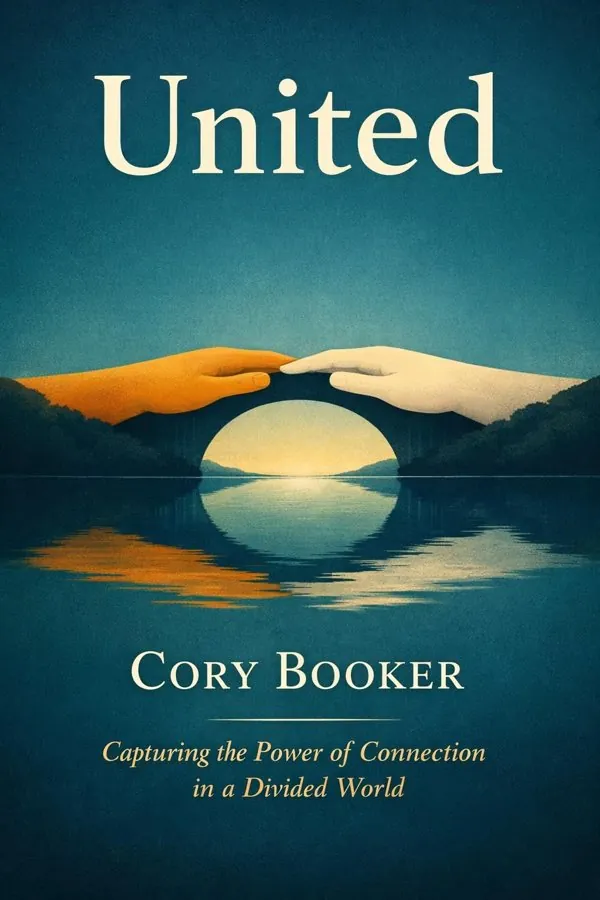
United: Capturing the Power of Connection in a Divided World: Summary & Key Insights
by Cory Booker
 10 min9 chaptersAudio available
Key Takeaways from United: Capturing the Power of Connection in a Divided World
Our first understanding of fairness rarely comes from laws; it comes from the stories our families carry.
Belonging and alienation can exist at the same time, and that tension often becomes the birthplace of purpose.
It is difficult to care deeply about people you never truly learn to see.
Systems shape lives, but systems alone do not heal communities.
You cannot transform a place from a distance.
What Is United: Capturing the Power of Connection in a Divided World About?
United: Capturing the Power of Connection in a Divided World by Cory Booker is a biographies book spanning 9 pages. In United, Cory Booker blends memoir, political reflection, and moral argument to explore a question at the heart of modern democracy: how do people remain connected in a culture shaped by fear, inequality, and division? Drawing on his childhood in New Jersey, his formative years at Stanford, Oxford, and Yale Law School, and his work as Newark’s mayor and later as a U.S. senator, Booker argues that real change begins not with ideology alone but with relationship, empathy, and shared responsibility. The book traces the experiences that taught him how communities are strengthened when people choose solidarity over suspicion and service over self-interest. What makes United especially compelling is Booker’s ability to connect intimate personal stories with larger social challenges, from racism and poverty to political dysfunction and civic disengagement. He writes not simply as a public official, but as someone shaped by neighborhoods, mentors, struggles, and acts of courage. For readers interested in leadership, justice, and the future of civic life, this book offers both inspiration and a practical vision for healing a fractured society.
This FizzRead summary covers all 9 key chapters of United: Capturing the Power of Connection in a Divided World in approximately 10 minutes, distilling the most important ideas, arguments, and takeaways from Cory Booker's work. Also available as an audio summary and Key Quotes Podcast.
United: Capturing the Power of Connection in a Divided World
In United, Cory Booker blends memoir, political reflection, and moral argument to explore a question at the heart of modern democracy: how do people remain connected in a culture shaped by fear, inequality, and division? Drawing on his childhood in New Jersey, his formative years at Stanford, Oxford, and Yale Law School, and his work as Newark’s mayor and later as a U.S. senator, Booker argues that real change begins not with ideology alone but with relationship, empathy, and shared responsibility. The book traces the experiences that taught him how communities are strengthened when people choose solidarity over suspicion and service over self-interest. What makes United especially compelling is Booker’s ability to connect intimate personal stories with larger social challenges, from racism and poverty to political dysfunction and civic disengagement. He writes not simply as a public official, but as someone shaped by neighborhoods, mentors, struggles, and acts of courage. For readers interested in leadership, justice, and the future of civic life, this book offers both inspiration and a practical vision for healing a fractured society.
Who Should Read United: Capturing the Power of Connection in a Divided World?
This book is perfect for anyone interested in biographies and looking to gain actionable insights in a short read. Whether you're a student, professional, or lifelong learner, the key ideas from United: Capturing the Power of Connection in a Divided World by Cory Booker will help you think differently.
- ✓Readers who enjoy biographies and want practical takeaways
- ✓Professionals looking to apply new ideas to their work and life
- ✓Anyone who wants the core insights of United: Capturing the Power of Connection in a Divided World in just 10 minutes
Want the full summary?
Get instant access to this book summary and 100K+ more with Fizz Moment.
Get Free SummaryAvailable on App Store • Free to download
Key Chapters
Our first understanding of fairness rarely comes from laws; it comes from the stories our families carry. Booker’s earliest lessons about justice were shaped by his parents, who never let him forget that their opportunities had been hard won. They faced housing discrimination, racial exclusion, and the daily humiliation of systems designed to limit Black families, yet they responded not with resignation but with determination. Their example taught him that progress is personal before it becomes political.
This idea matters because many people think civic values begin in school or public life, when in fact they are often formed in kitchens, churches, neighborhoods, and family conversations. Booker shows that justice is not an abstract concept reserved for courts and lawmakers. It is a lived reality that determines where people can live, how they are treated, and what futures are made available to them. By grounding his political vision in family memory, he reminds readers that social inequality is not theoretical. It leaves emotional and generational marks.
In practical terms, this means paying attention to the narratives that shape your own moral instincts. What stories about fairness, dignity, and struggle were passed down to you? How have they influenced the way you see people unlike yourself? Booker’s parents modeled a balance of honesty and hope: they did not deny injustice, but they refused to let it define the limits of their children’s aspirations.
Actionable takeaway: examine the family and community stories that shaped your view of the world, and turn those lessons into conscious values that guide how you vote, serve, and treat others.
Belonging and alienation can exist at the same time, and that tension often becomes the birthplace of purpose. Growing up in Harrington Park, Booker lived in a relatively comfortable suburb, but as one of the few Black families in town, he encountered subtle but powerful forms of prejudice. Expectations were lowered, assumptions were made, and he learned early that even success does not protect a person from being misjudged.
Booker does not present these experiences simply as personal wounds. He treats them as training in perception. Living between privilege and exclusion gave him a wider lens on America. He could see both the opportunities that supportive institutions create and the quiet barriers that keep many people from being fully seen. That dual awareness helped shape his drive toward public service. It also gave him insight into a truth many readers will recognize: discomfort, while painful, can deepen empathy and clarify what kind of life you want to lead.
This lesson applies far beyond race or politics. Many people discover their direction after facing rejection, not fitting in, or realizing they are living inside systems that are unfair. Instead of letting resentment harden him, Booker used those moments to ask a larger question: what can I do to widen opportunity for others?
In everyday life, that might mean paying attention to environments where people are underestimated, excluded, or made to feel invisible. It could mean mentoring someone who is overlooked, challenging bias at work, or using your own access to create room for others.
Actionable takeaway: treat your moments of exclusion not only as personal setbacks, but as clues pointing toward the kind of change you are uniquely equipped to make.
It is difficult to care deeply about people you never truly learn to see. Booker’s years beyond his hometown, especially in academic and international settings, broadened his understanding of inequality, identity, and human connection. Exposure to different cultures and economic realities did more than make him more informed; it made him more humble. He came to see that no single community has a monopoly on pain, resilience, or wisdom.
This is one of the book’s most important insights. Empathy is not merely a feeling; it is a discipline of expanding one’s frame of reference. When people remain enclosed within familiar social circles, they often mistake their own experience for universal truth. Booker argues, through story rather than lecture, that real leadership requires crossing those boundaries. You cannot effectively serve people whose lives you have never bothered to understand.
Readers can apply this idea in practical ways. Travel can help, but wider experience does not have to mean international study. It can mean listening closely to someone from another generation, volunteering in a neighborhood unlike your own, reading accounts from people whose lives are shaped by very different constraints, or simply choosing curiosity over certainty in difficult conversations. The point is not to collect experiences for self-improvement, but to become more capable of solidarity.
Booker’s life suggests that empathy becomes stronger when it is grounded in contact. Seeing injustice from multiple vantage points makes simplistic judgments harder to maintain and shared humanity easier to recognize.
Actionable takeaway: intentionally place yourself in settings that stretch your assumptions, and use what you learn to build more informed, compassionate relationships and decisions.
Systems shape lives, but systems alone do not heal communities. Booker’s legal education taught him to respect the power of institutions, policy, and constitutional protections. Law can expose discrimination, protect rights, and create mechanisms for reform. Yet one of the recurring themes in United is that legal change, while essential, is insufficient if it is not matched by human connection, moral courage, and local trust.
This is a subtle but important distinction. Many readers assume the path to justice runs mainly through legislation or court victories. Booker does not dismiss that route; he has spent his career working within it. But he also shows that law is often reactive, while compassion can be proactive. A city does not improve simply because better policies are written. It improves when residents, leaders, activists, educators, and neighbors take ownership of one another’s wellbeing.
Booker’s approach suggests that reform should happen at multiple levels. If housing discrimination exists, legal remedies matter. But so do grassroots efforts to connect families with resources, local advocacy groups that monitor abuses, and community leaders who create trust where institutions have failed. If criminal justice is unjust, changing statutes matters, but so do mentoring programs, reentry support, and public narratives that restore dignity to people who have been reduced to a record or stereotype.
For individuals, this means resisting the temptation to outsource all responsibility to politics. Public policy is vital, but everyday citizenship matters too. Institutions become more just when people demand more from them and bring their own values into action.
Actionable takeaway: support structural reform, but also ask how your direct relationships, volunteer efforts, or professional choices can make justice tangible in someone’s daily life.
You cannot transform a place from a distance. One of the defining choices in Booker’s life was his decision to live in Newark, not as an observer but as a participant in the struggles of the community. Rather than approach urban poverty as a policy problem to be studied from afar, he immersed himself in neighborhood life. This grounded his politics in lived experience and taught him that trust is often the first requirement for meaningful change.
Booker’s stories from Newark reveal that community building is rarely glamorous. It involves listening to residents who are tired of being ignored, showing up repeatedly, and recognizing that people living with hardship often possess the clearest understanding of what needs to change. Presence creates credibility. It also keeps leaders from confusing visibility with service. Being seen in a community is not the same as being accountable to it.
This idea has broad relevance. In workplaces, schools, religious communities, and civic groups, the strongest bonds are built by consistent engagement, not occasional enthusiasm. If you want to improve a struggling institution, the first step is often proximity. Stay long enough to understand the patterns, the pain, the hidden strengths, and the informal leaders. Booker’s example suggests that people are more willing to trust change agents who are willing to share inconvenience and vulnerability.
Practical application might include attending local meetings regularly, volunteering in the same place over time, or becoming the kind of neighbor who knows names, histories, and needs. Community is not created by slogans about togetherness; it is created by people who keep showing up.
Actionable takeaway: choose one community you care about and commit to sustained, face-to-face presence instead of occasional symbolic support.
When politics becomes a contest of ego, image, and tribal loyalty, ordinary people pay the price. Booker’s political career, especially in Newark, exposed him to the friction between idealism and power. Reform is difficult not only because problems are complex, but because political systems often reward conflict, performative outrage, and short-term wins over patient problem-solving. In United, he argues that politics at its best should be an instrument for protecting dignity and widening opportunity.
This perspective reframes leadership. Instead of asking whether a policy is clever, partisan, or media-friendly, Booker asks whether it helps people live safer, freer, more hopeful lives. That may sound obvious, but in polarized environments it is often forgotten. Human dignity becomes easier to defend in speeches than in budgets, negotiations, or institutional reform. Booker insists that public officials must resist cynicism and stay anchored in the actual lives behind policy debates.
For readers, this lesson is useful even outside electoral politics. Any leadership role can drift toward self-protection, image management, or abstract metrics. Booker’s approach is a reminder to ask who is affected by your decisions and whether the vulnerable are being seen clearly. In civic life, it also encourages more mature citizenship. Instead of engaging politics as spectators addicted to scandal, people can evaluate leaders by integrity, service, and measurable impact.
Examples include supporting reforms that improve schools, housing, public safety, and criminal justice while also demanding transparency and accountability. Values are tested in implementation, not just intention.
Actionable takeaway: when judging leaders or policies, make human dignity your main standard and ask who benefits, who is ignored, and what real lives will change.
Leadership is easiest to admire in speeches and hardest to measure in emergencies. Booker’s public image has often been shaped by moments of visible action, including times of crisis in Newark when he responded directly to residents in danger or distress. In United, these moments matter not because they make him look heroic, but because they reveal his deeper belief that leadership is an act of service, not separation.
Crisis strips away rhetoric. It shows whether a leader sees people as responsibilities to manage or neighbors to protect. Booker emphasizes that effective leadership requires courage, but not only the dramatic kind. It also requires the less celebrated courage of staying accessible, telling the truth under pressure, sharing risk, and accepting that authority exists for others, not for personal elevation.
This lesson applies in all kinds of communities. During hardship, people often remember less what leaders said than how they behaved. Did they listen? Did they remain present? Did they act decisively without losing compassion? Booker’s examples suggest that trust is built when leaders demonstrate solidarity in difficult moments rather than retreating into bureaucracy or distance.
In practical terms, this can shape how managers lead teams through layoffs, how teachers support students during upheaval, or how local organizers respond after tragedy. Leadership in crisis is not about performing confidence while others suffer. It is about converting values into timely action.
Booker’s account invites readers to prepare before the emergency comes. Character is not invented in crisis; it is revealed there.
Actionable takeaway: build habits of courage, accessibility, and service now, so that when pressure arrives, your leadership instinct is to move toward people, not away from them.
A divided country cannot be repaired by louder versions of the same arguments that broke it. As Booker’s work expanded from Newark to the U.S. Senate, he confronted a central paradox of American public life: people speak constantly about unity while participating in systems that reward division. United argues that bridge building is not sentimental idealism. It is a practical necessity for any democracy that hopes to survive deep disagreement.
Booker does not confuse unity with uniformity. He does not suggest that serious differences in values, policy, race, class, or ideology can be wished away. Instead, he argues that democratic life depends on the ability to recognize common humanity even amid conflict. This means refusing to reduce opponents to caricatures, seeking coalitions where possible, and protecting the civic norms that make disagreement productive rather than destructive.
For readers, this idea is especially relevant in a media environment shaped by outrage and simplification. Bridge building may look like listening before debating, identifying shared goals beneath surface rhetoric, or creating forums where people can discuss difficult issues without immediate contempt. In professional settings, it could mean facilitating collaboration across departments or identities that rarely interact. In personal life, it may involve repairing relationships strained by politics through honest but respectful conversation.
Booker’s broader point is that connection is not weakness. It is a form of civic strength. Societies fracture when citizens stop imagining a future large enough to include one another.
Actionable takeaway: practice one form of bridge building this week by entering a difficult conversation with the goal of understanding and common ground, not simply winning.
The call to unity becomes empty when treated as a slogan instead of a discipline. Booker’s final message is that connection must be practiced in ordinary life long before it can reshape institutions. Unity is not achieved through inspirational language alone; it is built through habits of generosity, attention, service, and moral imagination. The divided world he describes will not be changed only by national leaders. It changes when individuals decide that other people’s pain is partly their concern.
This is what gives United its emotional force. Booker is not only asking readers to agree with a political vision. He is asking them to adopt a way of living that resists indifference. That means seeing strangers as neighbors, refusing to surrender to cynicism, and acting as if every person possesses equal worth even when society does not treat them that way. Unity, in this sense, is less about sentiment and more about responsibility.
The practical applications are simple but demanding. Check in on someone isolated. Participate in local civic life. Support institutions that create belonging. Interrupt dehumanizing language. Use professional influence to widen access and fairness. Teach children that difference is not a threat. Booker’s vision becomes credible because it is actionable at every scale, from family life to federal policy.
The book ultimately suggests that nations do not heal by accident. They heal because enough people choose courage over comfort and solidarity over apathy.
Actionable takeaway: pick one recurring act of civic or personal service that strengthens connection, and make it a non-negotiable part of your weekly routine.
All Chapters in United: Capturing the Power of Connection in a Divided World
About the Author
Cory Booker is a U.S. senator from New Jersey, a former mayor of Newark, and a prominent voice in American public life. Before entering the Senate, he built his reputation through community-focused leadership in Newark, where he emphasized neighborhood engagement, public accountability, and reform. A graduate of Stanford University, the University of Oxford as a Rhodes Scholar, and Yale Law School, Booker has long linked his academic background with a practical commitment to service. His work has often centered on criminal justice reform, economic opportunity, civil rights, and the moral responsibilities of citizenship. As an author and speaker, he is known for combining political conviction with an emphasis on empathy, compassion, and collective action. United reflects both his personal journey and his broader belief that stronger communities begin with deeper human connection.
Get This Summary in Your Preferred Format
Read or listen to the United: Capturing the Power of Connection in a Divided World summary by Cory Booker anytime, anywhere. FizzRead offers multiple formats so you can learn on your terms — all free.
Available formats: App · Audio · PDF · EPUB — All included free with FizzRead
Download United: Capturing the Power of Connection in a Divided World PDF and EPUB Summary
Key Quotes from United: Capturing the Power of Connection in a Divided World
“Our first understanding of fairness rarely comes from laws; it comes from the stories our families carry.”
“Belonging and alienation can exist at the same time, and that tension often becomes the birthplace of purpose.”
“It is difficult to care deeply about people you never truly learn to see.”
“Systems shape lives, but systems alone do not heal communities.”
“You cannot transform a place from a distance.”
Frequently Asked Questions about United: Capturing the Power of Connection in a Divided World
United: Capturing the Power of Connection in a Divided World by Cory Booker is a biographies book that explores key ideas across 9 chapters. In United, Cory Booker blends memoir, political reflection, and moral argument to explore a question at the heart of modern democracy: how do people remain connected in a culture shaped by fear, inequality, and division? Drawing on his childhood in New Jersey, his formative years at Stanford, Oxford, and Yale Law School, and his work as Newark’s mayor and later as a U.S. senator, Booker argues that real change begins not with ideology alone but with relationship, empathy, and shared responsibility. The book traces the experiences that taught him how communities are strengthened when people choose solidarity over suspicion and service over self-interest. What makes United especially compelling is Booker’s ability to connect intimate personal stories with larger social challenges, from racism and poverty to political dysfunction and civic disengagement. He writes not simply as a public official, but as someone shaped by neighborhoods, mentors, struggles, and acts of courage. For readers interested in leadership, justice, and the future of civic life, this book offers both inspiration and a practical vision for healing a fractured society.
You Might Also Like

An American Marriage
Tayari Jones
10 min
Benjamin Franklin: An American Life
Walter Isaacson
10 min
I Know Why The Caged Bird Sings
Maya Angelou
10 min
Long Walk to Freedom
Nelson Mandela
10 min
Persepolis
Marjane Satrapi
10 min
Surely You're Joking, Mr. Feynman!
Richard P. Feynman
10 minBrowse by Category
Ready to read United: Capturing the Power of Connection in a Divided World?
Get the full summary and 100K+ more books with Fizz Moment.