
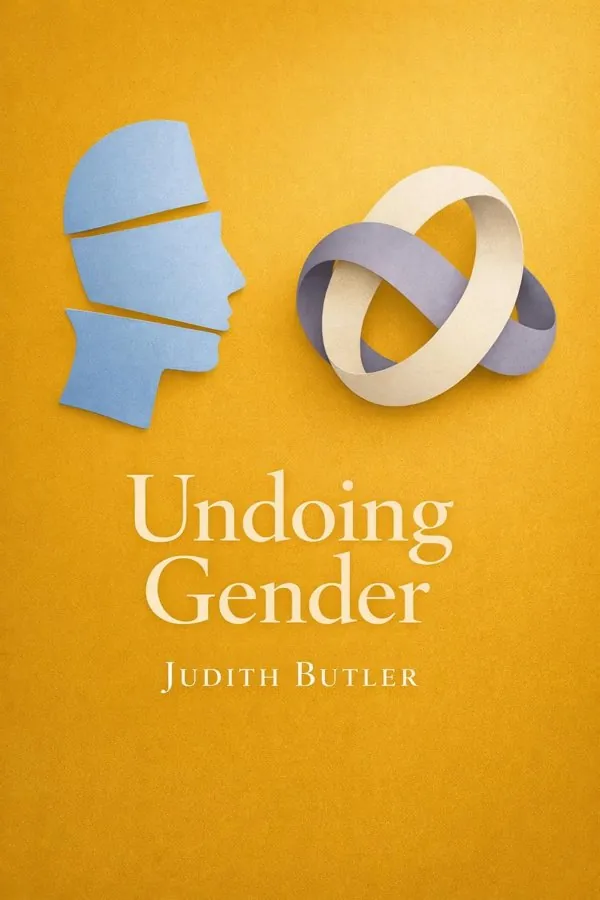
Undoing Gender: Summary & Key Insights
 10 min10 chaptersAudio available
What Is Undoing Gender About?
Undoing Gender by Judith Butler is a sociology book spanning 10 pages. In "Undoing Gender," Judith Butler explores the social and philosophical frameworks that define gender identity and the ways in which these frameworks can be challenged and reimagined. The book examines issues such as gender performativity, recognition, and the politics of human rights, offering a critical analysis of how norms shape our understanding of what it means to be human. Butler argues for a more inclusive and flexible conception of gender that allows for greater freedom and diversity of expression.
This FizzRead summary covers all 10 key chapters of Undoing Gender in approximately 10 minutes, distilling the most important ideas, arguments, and takeaways from Judith Butler's work. Also available as an audio summary and Key Quotes Podcast.
Undoing Gender
In "Undoing Gender," Judith Butler explores the social and philosophical frameworks that define gender identity and the ways in which these frameworks can be challenged and reimagined. The book examines issues such as gender performativity, recognition, and the politics of human rights, offering a critical analysis of how norms shape our understanding of what it means to be human. Butler argues for a more inclusive and flexible conception of gender that allows for greater freedom and diversity of expression.
Who Should Read Undoing Gender?
This book is perfect for anyone interested in sociology and looking to gain actionable insights in a short read. Whether you're a student, professional, or lifelong learner, the key ideas from Undoing Gender by Judith Butler will help you think differently.
- ✓Readers who enjoy sociology and want practical takeaways
- ✓Professionals looking to apply new ideas to their work and life
- ✓Anyone who wants the core insights of Undoing Gender in just 10 minutes
Want the full summary?
Get instant access to this book summary and 100K+ more with Fizz Moment.
Get Free SummaryAvailable on App Store • Free to download
Key Chapters
To undo gender is not to abolish it or deny its importance. It is to interrogate the social and institutional mechanisms through which gender norms are stabilized. Gender, as I frame it, is not a fixed attribute but an ongoing process constituted through acts of recognition. In every moment we are called into being as gendered subjects, and our survival often depends on being recognized within the terms available. Yet these same norms that make recognition possible can also become instruments of violence, erasing lives that do not conform.
Undoing gender thus implies a double movement. On one hand, it is a critique of the constraints imposed by norms that define what is intelligible. On the other, it is an opening toward transformation—a way of living that exposes the contingency of those very norms. The possibility of living differently depends on making visible what norms obscure: that gender is a political and ethical field in flux, contingent on collective practices of recognition and resistance.
I explore this ambivalence through real social contexts: the struggles of transgender and intersex communities, the politics of kinship and marriage, and the intersections of sexuality with human rights. These are not peripheral to gender theory; they are its living laboratories. Every time a life that was rendered unthinkable becomes possible, gender is undone and remade.
Since *Gender Trouble*, the idea of performativity has often been misunderstood as suggesting that gender is a voluntary performance or a theatrical mask one can easily put on or take off. In *Undoing Gender*, I return to this concept to clarify its ethical and political implications. Performativity is not the expression of a pre-existing self but the reiteration of norms that constitute the self in the first place. It describes how socially sanctioned acts—speaking, dressing, moving—produce the illusion of an internal gender identity.
Crucially, this means that agency is not opposed to constraint. Agency emerges only within the constraints of intelligibility; it is exercised precisely in the reworking of the norms that make action possible. This understanding dissolves the naive opposition between freedom and structure. The performance of gender can never be fully controlled, but it can be subversive. Small deviations, re-citations, and resignifications can alter the norms themselves. A drag performance, a name change, or a refusal of gendered expectations—these gestures expose the instability of what counts as "natural" gender.
To perform gender differently is not simply a matter of expression; it is a political practice that intervenes in the regulatory processes that shape our reality. When performance discloses its own artificiality, it invites others to imagine new ways of being.
+ 8 more chapters — available in the FizzRead app
All Chapters in Undoing Gender
About the Author
Judith Butler is an American philosopher and gender theorist known for her influential work in feminist theory, queer theory, political philosophy, and ethics. She is best known for her books "Gender Trouble" and "Bodies That Matter," which introduced the concept of gender performativity. Butler has taught at institutions such as the University of California, Berkeley, and continues to be a leading voice in contemporary social and political thought.
Get This Summary in Your Preferred Format
Read or listen to the Undoing Gender summary by Judith Butler anytime, anywhere. FizzRead offers multiple formats so you can learn on your terms — all free.
Available formats: App · Audio · PDF · EPUB — All included free with FizzRead
Download Undoing Gender PDF and EPUB Summary
Key Quotes from Undoing Gender
“To undo gender is not to abolish it or deny its importance.”
“Since *Gender Trouble*, the idea of performativity has often been misunderstood as suggesting that gender is a voluntary performance or a theatrical mask one can easily put on or take off.”
Frequently Asked Questions about Undoing Gender
Undoing Gender by Judith Butler is a sociology book that explores key ideas across 10 chapters. In "Undoing Gender," Judith Butler explores the social and philosophical frameworks that define gender identity and the ways in which these frameworks can be challenged and reimagined. The book examines issues such as gender performativity, recognition, and the politics of human rights, offering a critical analysis of how norms shape our understanding of what it means to be human. Butler argues for a more inclusive and flexible conception of gender that allows for greater freedom and diversity of expression.
More by Judith Butler
You Might Also Like

Between the World and Me
Ta-Nehisi Coates
10 min
Half the Sky
Nicholas D. Kristof, Sheryl WuDunn
10 min
Men Explain Things To Me
Rebecca Solnit
10 min
Rational Ritual
Michael Suk-Young Chwe
10 min
The New Jim Crow
Michelle Alexander
10 min
Beyond Culture
Edward T. Hall
10 minBrowse by Category
Ready to read Undoing Gender?
Get the full summary and 100K+ more books with Fizz Moment.