
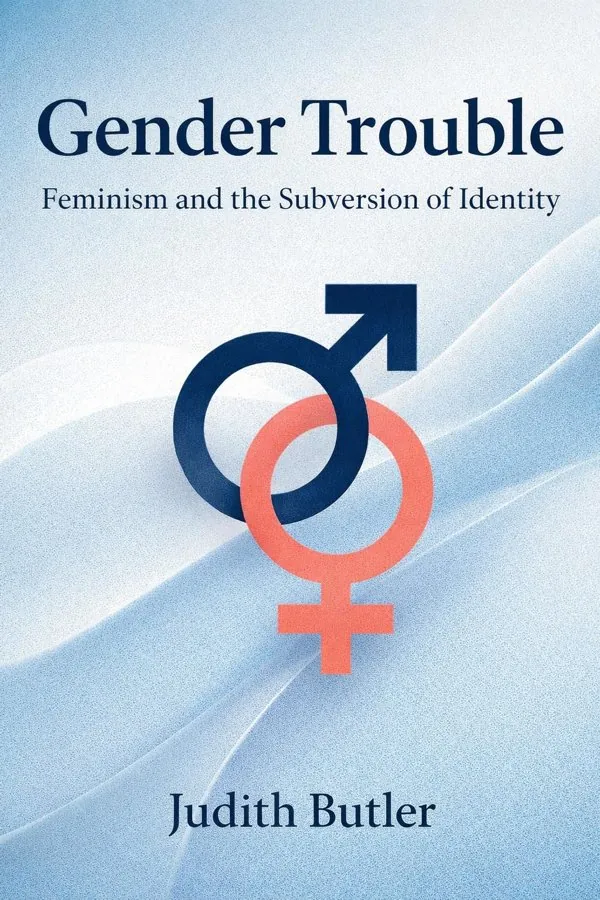
Gender Trouble: Feminism and the Subversion of Identity: Summary & Key Insights
 10 min6 chaptersAudio available
What Is Gender Trouble: Feminism and the Subversion of Identity About?
Gender Trouble: Feminism and the Subversion of Identity by Judith Butler is a sociology book spanning 6 pages. Gender Trouble es una obra fundamental de la teoría feminista y de los estudios de género. Judith Butler desafía las nociones tradicionales de género y sexo, argumentando que el género no es una identidad estable, sino una construcción performativa. A través de un análisis crítico de pensadores como Simone de Beauvoir, Michel Foucault y Jacques Lacan, Butler propone que las categorías de 'hombre' y 'mujer' son el resultado de prácticas discursivas y sociales que pueden ser subvertidas.
This FizzRead summary covers all 6 key chapters of Gender Trouble: Feminism and the Subversion of Identity in approximately 10 minutes, distilling the most important ideas, arguments, and takeaways from Judith Butler's work. Also available as an audio summary and Key Quotes Podcast.
Gender Trouble: Feminism and the Subversion of Identity
Gender Trouble es una obra fundamental de la teoría feminista y de los estudios de género. Judith Butler desafía las nociones tradicionales de género y sexo, argumentando que el género no es una identidad estable, sino una construcción performativa. A través de un análisis crítico de pensadores como Simone de Beauvoir, Michel Foucault y Jacques Lacan, Butler propone que las categorías de 'hombre' y 'mujer' son el resultado de prácticas discursivas y sociales que pueden ser subvertidas.
Who Should Read Gender Trouble: Feminism and the Subversion of Identity?
This book is perfect for anyone interested in sociology and looking to gain actionable insights in a short read. Whether you're a student, professional, or lifelong learner, the key ideas from Gender Trouble: Feminism and the Subversion of Identity by Judith Butler will help you think differently.
- ✓Readers who enjoy sociology and want practical takeaways
- ✓Professionals looking to apply new ideas to their work and life
- ✓Anyone who wants the core insights of Gender Trouble: Feminism and the Subversion of Identity in just 10 minutes
Want the full summary?
Get instant access to this book summary and 100K+ more with Fizz Moment.
Get Free SummaryAvailable on App Store • Free to download
Key Chapters
Feminist theory has long relied on the distinction between sex and gender: sex as biological, gender as cultural. Yet this binary, I argue, cannot sustain itself under scrutiny. The very idea that sex is ‘biological’ already presupposes a cultural act of interpretation—what counts as ‘biology,’ what counts as ‘male’ or ‘female,’ are themselves shaped by discourse. There is no pure, unmediated access to sexual difference; our understanding of bodies is always filtered through norms and languages that render them intelligible.
By maintaining a strict separation between sex and gender, feminist debates inadvertently reproduce the same dualism that underlies patriarchal metaphysics. The attempt to liberate gender from the determinism of biology often leaves biology itself untouched—as if it were an innocent foundation. But bodies do not preexist their cultural meanings. They are the effects of power, formed and sustained by the regulatory practices that dictate which bodies can appear and which must remain invisible. To challenge gender oppression effectively, feminism must therefore interrogate the very production of ‘sex’ as a category.
This realization shifts our political focus. It tells us that the fight is not simply over how gender is expressed but over how the conditions of gender are made possible. It invites us to see cultural construction not as a layer on top of nature but as the site where nature itself is articulated. And if both sex and gender are products of discourse, then they are also sites for contestation—open to innovation, parody, and rearticulation.
Simone de Beauvoir’s famous assertion that ‘one is not born, but rather becomes, a woman’ opens the way to think of gender as a process rather than a state. Yet her conceptualization still presumes a subject who does the 'becoming'—a stable 'one' who undergoes the transformation. In my analysis, I ask whether this 'one' is itself a fiction produced by the very norms it seeks to resist. The subject and its gender emerge simultaneously, through the reiteration of cultural practices that confer intelligibility.
Monique Wittig radicalizes this insight by pronouncing that ‘lesbians are not women,’ thereby exposing the category ‘woman’ as a product of heterosexual institutions. For Wittig, gender difference is not natural but political—a strategy that maintains male dominance. Her work leads me to consider the performative nature of gender identity. Gender is not something we have; it is something we do, repeatedly and under constraint. The act of declaring, comporting, dressing, or desiring in certain ways constitutes the fiction of a coherent gender. These acts are not expressions of a preexisting identity but the means by which such identity is fabricated.
What follows from this is a new understanding of power and resistance. If identity is performative, then every reiteration of its norms carries the possibility of disruption. To perform gender differently is to expose its artificiality, to gesture toward the contingency of the norms that sustain it. In this sense, performance is both the mechanism of subjection and the resource of transformation.
+ 4 more chapters — available in the FizzRead app
All Chapters in Gender Trouble: Feminism and the Subversion of Identity
About the Author
Judith Butler es una filósofa estadounidense nacida en 1956, reconocida por sus contribuciones a la teoría feminista, la filosofía política y la ética. Profesora en la Universidad de California, Berkeley, su trabajo ha influido profundamente en los estudios de género, la teoría queer y la crítica cultural contemporánea.
Get This Summary in Your Preferred Format
Read or listen to the Gender Trouble: Feminism and the Subversion of Identity summary by Judith Butler anytime, anywhere. FizzRead offers multiple formats so you can learn on your terms — all free.
Available formats: App · Audio · PDF · EPUB — All included free with FizzRead
Download Gender Trouble: Feminism and the Subversion of Identity PDF and EPUB Summary
Key Quotes from Gender Trouble: Feminism and the Subversion of Identity
“Feminist theory has long relied on the distinction between sex and gender: sex as biological, gender as cultural.”
“Simone de Beauvoir’s famous assertion that ‘one is not born, but rather becomes, a woman’ opens the way to think of gender as a process rather than a state.”
Frequently Asked Questions about Gender Trouble: Feminism and the Subversion of Identity
Gender Trouble: Feminism and the Subversion of Identity by Judith Butler is a sociology book that explores key ideas across 6 chapters. Gender Trouble es una obra fundamental de la teoría feminista y de los estudios de género. Judith Butler desafía las nociones tradicionales de género y sexo, argumentando que el género no es una identidad estable, sino una construcción performativa. A través de un análisis crítico de pensadores como Simone de Beauvoir, Michel Foucault y Jacques Lacan, Butler propone que las categorías de 'hombre' y 'mujer' son el resultado de prácticas discursivas y sociales que pueden ser subvertidas.
More by Judith Butler
You Might Also Like

Between the World and Me
Ta-Nehisi Coates
10 min
Half the Sky
Nicholas D. Kristof, Sheryl WuDunn
10 min
Men Explain Things To Me
Rebecca Solnit
10 min
Rational Ritual
Michael Suk-Young Chwe
10 min
The New Jim Crow
Michelle Alexander
10 min
Beyond Culture
Edward T. Hall
10 minBrowse by Category
Ready to read Gender Trouble: Feminism and the Subversion of Identity?
Get the full summary and 100K+ more books with Fizz Moment.