
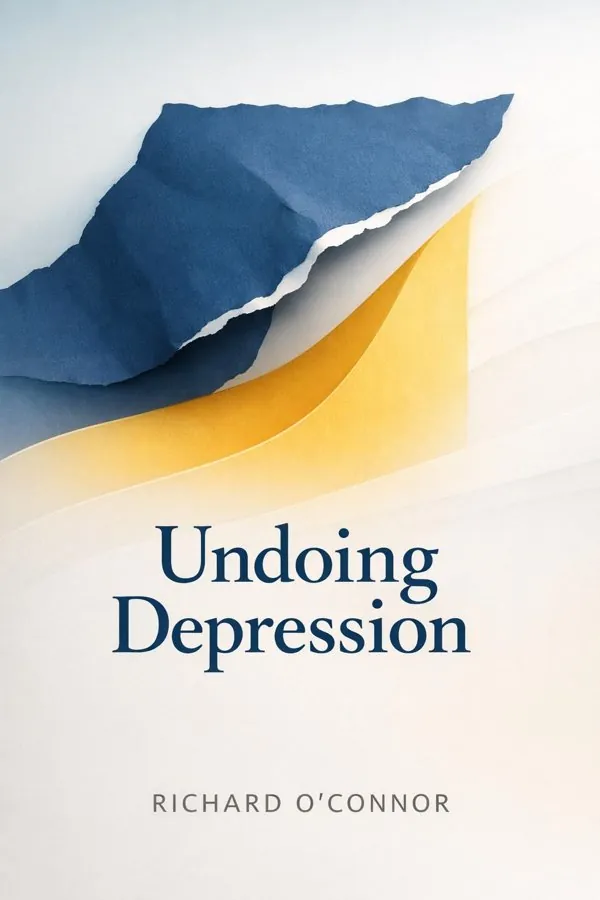
Undoing Depression: What Therapy Doesn't Teach You and Medication Can't Give You: Summary & Key Insights
 10 min11 chaptersAudio available
What Is Undoing Depression: What Therapy Doesn't Teach You and Medication Can't Give You About?
Undoing Depression: What Therapy Doesn't Teach You and Medication Can't Give You by Richard O'Connor is a mental_health book spanning 11 pages. This book offers a comprehensive guide to understanding and overcoming depression through self-awareness and behavioral change. Richard O’Connor, a psychotherapist, explains how depression is not only a chemical imbalance but also a learned pattern of thinking and acting. He provides practical strategies to 'unlearn' depressive habits and develop healthier emotional responses, combining insights from psychotherapy, neuroscience, and personal experience.
This FizzRead summary covers all 11 key chapters of Undoing Depression: What Therapy Doesn't Teach You and Medication Can't Give You in approximately 10 minutes, distilling the most important ideas, arguments, and takeaways from Richard O'Connor's work. Also available as an audio summary and Key Quotes Podcast.
Undoing Depression: What Therapy Doesn't Teach You and Medication Can't Give You
This book offers a comprehensive guide to understanding and overcoming depression through self-awareness and behavioral change. Richard O’Connor, a psychotherapist, explains how depression is not only a chemical imbalance but also a learned pattern of thinking and acting. He provides practical strategies to 'unlearn' depressive habits and develop healthier emotional responses, combining insights from psychotherapy, neuroscience, and personal experience.
Who Should Read Undoing Depression: What Therapy Doesn't Teach You and Medication Can't Give You?
This book is perfect for anyone interested in mental_health and looking to gain actionable insights in a short read. Whether you're a student, professional, or lifelong learner, the key ideas from Undoing Depression: What Therapy Doesn't Teach You and Medication Can't Give You by Richard O'Connor will help you think differently.
- ✓Readers who enjoy mental_health and want practical takeaways
- ✓Professionals looking to apply new ideas to their work and life
- ✓Anyone who wants the core insights of Undoing Depression: What Therapy Doesn't Teach You and Medication Can't Give You in just 10 minutes
Want the full summary?
Get instant access to this book summary and 100K+ more with Fizz Moment.
Get Free SummaryAvailable on App Store • Free to download
Key Chapters
Depression takes root not just in your brain chemistry but in your patterns of living. Over time, you teach yourself how to be depressed. Each disappointment, each moment of self-reproach, each retreat from connection strengthens those habits. Imagine the way a muscle builds with repetition; depression works in much the same way. We repeat certain thoughts — such as 'I’m worthless' or 'Nothing will ever change' — until they become the default mode of interpretation for every event in our lives.
In clinical work and neuroscience alike, we see that repetitive emotional states actually carve pathways in the brain. Your nervous system becomes efficient at producing the familiar depressive responses. That’s why medication alone—though sometimes vital—cannot undo depression. It may adjust the neurochemical environment temporarily, but the patterns of behavior and thought remain encoded through years of reinforcement.
Depression becomes a lens through which you view reality. You unconsciously filter out positive evidence, dwell on loss, and limit your sense of agency. It’s rarely a deliberate choice; more often, it’s the consequence of emotional conditioning. For example, someone who grew up feeling powerless may continue reacting to stress with passivity—even when adulthood grants real power. In the depressive system, this learned helplessness masquerades as truth.
To understand depression deeply, we must recognize these habits as adaptive when first learned. They once served a purpose—perhaps keeping you safe, avoiding conflict, or managing impossible expectations. But what once protected you now confines you. That’s why the work of undoing depression begins not in blame, but in awareness. You must look at how you think and behave, how those patterns reproduce the very suffering you wish to escape, and then gently begin to choose differently.
Healing begins with noticing. Until you see the depressive habits operating, they remain invisible and automatic. Self-awareness is the first interruption—the moment you can say, 'Wait, this is my depression talking.' Without this recognition, every emotional downturn feels like an absolute truth rather than a passing state.
I encourage you to observe your inner dialogue as if you were studying someone else’s language. Notice the critical phrases, the mental defenses, the ways you minimize hope or discount success. These observations must be made with compassion, not judgment. We often confuse awareness with condemnation, but true awareness accepts that these patterns emerged from understandable circumstances. You cannot hate yourself into healing.
Once you develop awareness, you start to see choices. You might recognize, for instance, how you withdraw from friends at the first sign of fatigue, or how you immediately assume rejection when someone is quiet. Each moment of seeing clearly weakens the automatic pull of depressive habit. This isn’t effortless—it can feel strange, even frightening, to watch your mind’s workings in real time. But slowly, awareness becomes a refuge. It gives you the power to pause, to take a breath, to choose an alternative response.
Think of self-awareness as the light switch in a dark room. It doesn’t eliminate the shadows instantly, but it helps you navigate. With practice, this steady illumination allows you to transform what once seemed overwhelming into manageable experiences. Awareness alone doesn’t cure depression, but without it, no other change can take hold.
+ 9 more chapters — available in the FizzRead app
All Chapters in Undoing Depression: What Therapy Doesn't Teach You and Medication Can't Give You
About the Author
Richard O’Connor, Ph.D., is a psychotherapist and author specializing in depression and mental health. He has directed mental health clinics and written extensively on emotional resilience and recovery. His work integrates clinical practice with accessible self-help approaches.
Get This Summary in Your Preferred Format
Read or listen to the Undoing Depression: What Therapy Doesn't Teach You and Medication Can't Give You summary by Richard O'Connor anytime, anywhere. FizzRead offers multiple formats so you can learn on your terms — all free.
Available formats: App · Audio · PDF · EPUB — All included free with FizzRead
Download Undoing Depression: What Therapy Doesn't Teach You and Medication Can't Give You PDF and EPUB Summary
Key Quotes from Undoing Depression: What Therapy Doesn't Teach You and Medication Can't Give You
“Depression takes root not just in your brain chemistry but in your patterns of living.”
“Until you see the depressive habits operating, they remain invisible and automatic.”
Frequently Asked Questions about Undoing Depression: What Therapy Doesn't Teach You and Medication Can't Give You
Undoing Depression: What Therapy Doesn't Teach You and Medication Can't Give You by Richard O'Connor is a mental_health book that explores key ideas across 11 chapters. This book offers a comprehensive guide to understanding and overcoming depression through self-awareness and behavioral change. Richard O’Connor, a psychotherapist, explains how depression is not only a chemical imbalance but also a learned pattern of thinking and acting. He provides practical strategies to 'unlearn' depressive habits and develop healthier emotional responses, combining insights from psychotherapy, neuroscience, and personal experience.
You Might Also Like

Big Feelings: How to Be Okay When Things Are Not Okay
Liz Fosslien, Mollie West Duffy
10 min
Creative Arts Therapies Handbook: Art, Music and Dance Therapy Practices for Wellbeing
Susan I. Buchalter
10 min
Emotional First Aid: Healing Rejection, Guilt, Failure, and Other Everyday Hurts
Guy Winch
10 min
Lost Connections: Why You're Depressed and How to Find Hope
Johann Hari
10 min
No Time to Panic: How to Stop Worrying and Embrace Life
Matt Gutman
10 min
Overcoming Mobbing: A Recovery Guide for Workplace Aggression and Bullying
Maureen Duffy, Len Sperry
10 minBrowse by Category
Ready to read Undoing Depression: What Therapy Doesn't Teach You and Medication Can't Give You?
Get the full summary and 100K+ more books with Fizz Moment.