
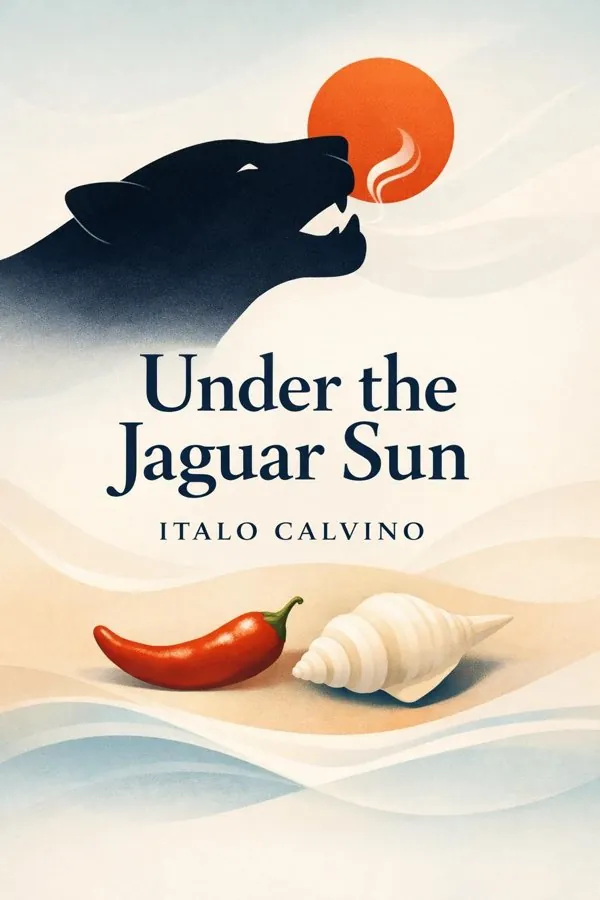
Under the Jaguar Sun: Summary & Key Insights
 10 min9 chaptersAudio available
Key Takeaways from Under the Jaguar Sun
A person never encounters the world directly; we meet it through the filters of our senses.
What appears civilized on the surface often contains impulses far older and more mysterious underneath.
A culture is not understood only through its ideas, laws, or monuments; it also lives in flavors, sounds, and scents.
Some of the deepest human experiences resist explanation, and Calvino turns that limitation into art.
The things that attract us most intensely can also unsettle us, and Calvino refuses to separate delight from threat.
What Is Under the Jaguar Sun About?
Under the Jaguar Sun by Italo Calvino is a classics book. What if the senses were not just ways of perceiving the world, but entire languages through which desire, memory, and culture speak? Under the Jaguar Sun is Italo Calvino’s unfinished, posthumously published collection of three stories, each built around a different sense: taste, hearing, and smell. Rather than offering a conventional plot-driven experience, the book invites readers into richly imagined meditations on how human beings interpret reality through the body. In these stories, eating becomes entangled with ritual and appetite, music becomes a form of emotional and political expression, and scent turns into a mysterious map of identity and longing. The book matters because it shows Calvino at his most elegant and experimental, combining intellectual precision with sensual intensity. Best known for classics such as Invisible Cities, If on a winter’s night a traveler, and Cosmicomics, Calvino was one of the twentieth century’s most inventive literary minds. Here, he turns his attention to embodiment, proving that even the most physical experiences can become vehicles for philosophical reflection. Under the Jaguar Sun is brief, but it opens vast questions about perception, storytelling, and what it means to inhabit the world fully.
This FizzRead summary covers all 9 key chapters of Under the Jaguar Sun in approximately 10 minutes, distilling the most important ideas, arguments, and takeaways from Italo Calvino's work. Also available as an audio summary and Key Quotes Podcast.
Under the Jaguar Sun
What if the senses were not just ways of perceiving the world, but entire languages through which desire, memory, and culture speak? Under the Jaguar Sun is Italo Calvino’s unfinished, posthumously published collection of three stories, each built around a different sense: taste, hearing, and smell. Rather than offering a conventional plot-driven experience, the book invites readers into richly imagined meditations on how human beings interpret reality through the body. In these stories, eating becomes entangled with ritual and appetite, music becomes a form of emotional and political expression, and scent turns into a mysterious map of identity and longing.
The book matters because it shows Calvino at his most elegant and experimental, combining intellectual precision with sensual intensity. Best known for classics such as Invisible Cities, If on a winter’s night a traveler, and Cosmicomics, Calvino was one of the twentieth century’s most inventive literary minds. Here, he turns his attention to embodiment, proving that even the most physical experiences can become vehicles for philosophical reflection. Under the Jaguar Sun is brief, but it opens vast questions about perception, storytelling, and what it means to inhabit the world fully.
Who Should Read Under the Jaguar Sun?
This book is perfect for anyone interested in classics and looking to gain actionable insights in a short read. Whether you're a student, professional, or lifelong learner, the key ideas from Under the Jaguar Sun by Italo Calvino will help you think differently.
- ✓Readers who enjoy classics and want practical takeaways
- ✓Professionals looking to apply new ideas to their work and life
- ✓Anyone who wants the core insights of Under the Jaguar Sun in just 10 minutes
Want the full summary?
Get instant access to this book summary and 100K+ more with Fizz Moment.
Get Free SummaryAvailable on App Store • Free to download
Key Chapters
A person never encounters the world directly; we meet it through the filters of our senses. One of the most powerful ideas in Under the Jaguar Sun is that taste, hearing, and smell are not minor details added to experience, but the very structures through which experience becomes meaningful. Calvino treats each sense as a distinct way of knowing, suggesting that the body is not separate from thought but deeply involved in how we interpret life.
In the title story, food is not simply nourishment. It becomes history, desire, ritual, danger, and communication. In the story centered on hearing, sound creates atmospheres of intimacy, distance, and tension that words alone cannot express. In the story of smell, scent carries memory and identity in ways that resist rational explanation. Across the collection, Calvino reveals that the senses organize emotion and understanding before abstract ideas even begin.
This matters in everyday life because modern culture often privileges sight and verbal explanation while neglecting the subtler dimensions of perception. Yet anyone who has been transported by the smell of rain, unsettled by a familiar voice, or moved by a meal tied to memory already knows what Calvino dramatizes: sensory life is intellectual life. The senses help determine what feels real, what feels intimate, and what feels meaningful.
A practical way to apply this insight is to pay closer attention to how sensory details influence your reactions. Notice how music changes your mood at work, how scent affects comfort in a room, or how meals shape connection with others. Actionable takeaway: spend one day observing how your senses guide your feelings and decisions, and treat those observations as valuable knowledge rather than background noise.
What appears civilized on the surface often contains impulses far older and more mysterious underneath. Calvino’s stories repeatedly show that ordinary acts such as eating, listening, and breathing in the atmosphere around us are never purely neutral. They are charged with longing, curiosity, fear, and fascination. Under the Jaguar Sun explores how desire slips into daily rituals until the familiar becomes strange again.
The title story is the clearest example. A couple traveling in Mexico experiences cuisine not as tourism but as an unsettling revelation. Dishes, flavors, and culinary customs begin to suggest links between appetite and violence, pleasure and sacrifice, refinement and primal instinct. The act of eating becomes layered with erotic energy and cultural symbolism. Rather than separating appetite into neat categories, Calvino lets hunger, sensuality, and imagination overlap.
This idea has wide relevance. Much of life is shaped by rituals we barely examine: morning coffee, shared dinners, playlists on commutes, perfumes worn on special occasions. These routines are not empty habits. They often carry emotional codes. A family recipe may express loyalty. A favorite song may preserve grief. A scent may represent desire, status, or reinvention. Calvino asks readers to look beneath the surface of custom and ask what emotional forces are being enacted.
For readers, this opens a practical path toward self-understanding. If a ritual matters to you, ask why. What need does it satisfy beyond its obvious function? Is it comfort, identity, intimacy, control, or escape? Actionable takeaway: choose one everyday ritual and write down the hidden desires it may contain. You may discover that what seems routine is actually revealing the deepest patterns of your inner life.
A culture is not understood only through its ideas, laws, or monuments; it also lives in flavors, sounds, and scents. Calvino shows that the senses are carriers of civilization. In Under the Jaguar Sun, sensory experience becomes a gateway to collective memory and cultural difference. To taste a dish, hear a musical pattern, or notice a region’s atmosphere is to encounter a worldview embodied rather than explained.
This is especially vivid in the Mexican setting of the title story, where cuisine is not presented as decorative local color. Food becomes a coded expression of myth, conquest, ritual, and mortality. The travelers do not merely sample meals; they are drawn toward an alien symbolic system where appetite and sacrificial history intersect. Calvino suggests that cultural understanding is never complete if it remains only intellectual. One must confront how a culture feels on the tongue, in the ear, or in the air.
In practical terms, this insight changes how we think about travel, reading, and cross-cultural understanding. Many people approach another culture through facts, museums, or headlines alone. Those matter, but they can leave the experience flat. Taste, sound, and smell create a more immediate form of contact. Listening to local music, sharing meals respectfully, or noticing the sensory character of public spaces can reveal values and histories that no summary can fully capture.
This also applies at home. Family traditions, regional recipes, holiday songs, and familiar household scents all preserve cultural continuity. Sensory details are often what survive longest in memory and bind generations together. Actionable takeaway: when exploring a culture, whether your own or another’s, pay attention to its sensory signatures and ask what history or meaning they carry beneath the surface.
Some of the deepest human experiences resist explanation, and Calvino turns that limitation into art. A central idea in Under the Jaguar Sun is that words are powerful but incomplete. Taste, smell, and sound often exceed language, producing meanings we feel before we can define them. Rather than solving this problem, Calvino explores it, showing literature stretching toward what cannot be fully said.
This is one reason the collection feels so distinctive. Calvino does not simply describe sensory experiences in a realistic way; he dramatizes the struggle to translate them into thought. How do you explain a taste that evokes danger and attraction at once? How do you describe a sound that alters the emotional climate of a room? How do you name a scent that awakens memory without producing a clear image? The stories unfold in that tension between sensation and articulation.
For readers, this can be liberating. Modern life often pressures us to label every feeling instantly and present neat explanations for our reactions. But Calvino suggests that uncertainty is not failure. Sometimes the inability to express something completely is evidence of its depth. Artists, writers, therapists, and reflective readers can all benefit from taking seriously the experiences that remain partly untranslatable.
In daily practice, this may mean slowing down before forcing interpretation. If a place feels uneasy, if a song moves you unexpectedly, or if a scent stirs emotion without a clear reason, let the experience unfold before analyzing it. Journaling, sketching, or metaphor can help when direct explanation falls short. Actionable takeaway: the next time you encounter a hard-to-describe feeling, do not rush to define it; first record its sensory qualities and allow meaning to emerge gradually.
The things that attract us most intensely can also unsettle us, and Calvino refuses to separate delight from threat. Under the Jaguar Sun repeatedly presents sensory pleasure as something ambiguous. A beautiful meal may carry violent historical echoes. Music may soothe while also exposing vulnerability. A scent may seduce while destabilizing identity. In Calvino’s world, pleasure is rarely innocent; it often opens doors to darker or more ancient forces.
This complexity gives the collection much of its power. In the title story, culinary fascination leads not toward simple enjoyment but toward reflections on ritual sacrifice and the consuming nature of desire itself. The sensuous and the unsettling are inseparable. Calvino invites readers to see appetite not merely as indulgence but as a force with moral, cultural, and psychological depth. We are not just consumers of beauty and sensation; we can also be changed, implicated, or overwhelmed by them.
This idea matters beyond literature. In real life, many forms of pleasure carry risk or contradiction: ambition can energize and consume, romance can deepen intimacy and expose insecurity, luxury can provide comfort and cultivate dependence. Calvino’s insight is not anti-pleasure. Instead, it asks for awareness. What captivates us deserves attention not only for how good it feels but also for what it asks of us.
A practical application is to examine moments of strong attraction with curiosity. When something feels irresistible, ask what else accompanies the pleasure. Is there loss, obsession, fear, status anxiety, or moral compromise hidden inside it? This creates a more mature relationship with desire. Actionable takeaway: when you feel strongly drawn to an experience, pause and identify both the pleasure it offers and the potential costs or transformations it may bring.
To travel is not just to move through space; it is to discover how fragile one’s assumptions really are. In Under the Jaguar Sun, travel destabilizes the travelers’ confidence in their own categories. Foreign places are not reduced to postcard scenery. Instead, they become encounters with unfamiliar symbolic systems, sensory codes, and emotional intensities that challenge easy interpretation.
Calvino is especially interested in what happens when observers believe they are merely exploring but slowly realize they are also being transformed. In the title story, the couple’s culinary experiences in Mexico become a confrontation with meanings they cannot fully master. Their role as travelers, eaters, and interpreters becomes unstable. The more they seek understanding, the more they confront mystery. Travel here is not about collecting experiences but about surrendering to uncertainty.
This has clear relevance today. Many people approach travel as consumption: see the highlights, take the photos, and move on. Calvino offers a more demanding model. Genuine encounter requires humility. It means accepting that another place may not fit the frameworks you bring with you. Even outside literal travel, this applies whenever we enter unfamiliar social worlds, professions, communities, or perspectives. The first lesson is often that our confidence was premature.
A practical way to apply this idea is to replace instant judgment with attentive curiosity. When something in a new environment seems strange, ask what assumptions you are making before deciding what it means. Try to experience before interpreting. Actionable takeaway: on your next trip or in your next unfamiliar situation, focus less on mastering the experience and more on noticing how it challenges your usual way of seeing.
Much of life passes unnoticed not because it lacks meaning, but because we fail to attend to it. Calvino’s sensory focus demonstrates that careful attention can turn fleeting impressions into profound insight. A taste that lasts seconds, a sound that fades quickly, or a trace of perfume in the air may seem ephemeral, yet Under the Jaguar Sun treats these passing moments as worthy of serious contemplation.
This approach reflects one of Calvino’s great strengths as a writer: he can magnify what is ordinarily overlooked. Instead of racing toward plot resolution, he lingers over textures of perception. In doing so, he trains readers to become more alert. The stories suggest that awareness itself is a creative act. What we notice, and how deeply we notice it, determines the richness of our world.
That lesson is especially valuable in distracted modern life. Notifications, schedules, and constant mental noise can flatten experience. Meals are eaten while scrolling. Music becomes background filler. The atmosphere of a place is ignored unless something goes wrong. Calvino reminds us that attention is not passive. It is a disciplined form of presence that can restore nuance to daily existence.
Practical examples are simple but powerful. Eat one meal without multitasking and notice flavors in sequence. Listen to a piece of music with full concentration and observe emotional shifts. Walk through a neighborhood and identify the changing smells and sound textures. These small acts deepen perception and often sharpen memory as well. Actionable takeaway: choose one ordinary sensory experience each day and give it your complete attention for five uninterrupted minutes.
We often imagine identity as a story we tell ourselves, but Calvino suggests it is also something lived through the body. Under the Jaguar Sun presents perception as part of the self. What we crave, what repels us, what sounds familiar, and what scents awaken us all contribute to who we are. Identity is not only beliefs and memories; it is patterns of embodied response.
This is particularly resonant in the story built around smell, where scent becomes a subtle but powerful force tied to attraction, recognition, and uncertainty. Smell is one of the least verbalized senses, yet it can trigger immediate judgments and emotional reactions. Calvino uses this to show that the self is not fully transparent to itself. We may think we know who we are, but our bodily reactions reveal hidden loyalties, desires, and fears.
This matters because people often try to understand themselves only through conscious reasoning. Reflection is important, but it can miss the body’s intelligence. Consider how certain environments make you tense before you can explain why, or how a familiar meal makes you feel secure, or how a voice can inspire trust or discomfort instantly. These reactions are not trivial. They are part of the texture of selfhood.
A practical application is to include bodily awareness in self-reflection. When making decisions, ask not only what you think, but what you sense. Do you feel constricted, energized, calm, or unsettled? Over time, these patterns can reveal values and boundaries more clearly than abstract analysis alone. Actionable takeaway: during your next important decision, note your physical and sensory responses alongside your rational arguments and let both inform your choice.
A work does not need to be finished in order to be meaningful, and Under the Jaguar Sun is a striking example of that truth. Published after Calvino’s death and left incomplete as part of a larger sensory project, the book carries an unavoidable sense of incompletion. Yet this does not weaken its impact. Instead, the fragmentary quality becomes part of its meaning, reminding readers that art, like life, often arrives as a series of luminous partial revelations.
Calvino had envisioned a broader set of stories organized around the senses, but only three were completed. Rather than seeing the collection merely as an unfinished plan, readers can experience it as a concentrated demonstration of his method. Each story feels exploratory, deliberate, and open-ended in ways that suit the themes of perception and mystery. Because the senses themselves offer partial access to reality, the book’s incompleteness echoes its subject matter.
This idea is useful beyond literary criticism. Many people delay creating, sharing, or appreciating work because it is not perfect or total. Calvino’s collection suggests another standard: a work can be valuable if it captures something essential, even if it leaves gaps. Essays, projects, relationships, and careers are often understood only in retrospect as incomplete but still deeply significant.
A practical lesson is to stop equating worth with finality. You can learn from drafts, fragments, and experiments. They may reveal a mind in motion more vividly than polished closure does. Actionable takeaway: revisit one unfinished project of your own and ask what truth or beauty it already contains instead of focusing only on what is missing.
All Chapters in Under the Jaguar Sun
About the Author
Italo Calvino was an Italian writer born in 1923 in Santiago de Las Vegas, Cuba, and raised in Italy. He became one of the most celebrated literary voices of the twentieth century, admired for combining clarity, wit, imagination, and philosophical depth. After participating in the Italian Resistance during World War II, he began publishing fiction that evolved from neorealism into increasingly inventive and experimental forms. His major works include Invisible Cities, If on a winter’s night a traveler, Cosmicomics, and Our Ancestors. Calvino was deeply interested in language, structure, myth, science, and perception, and his writing often transforms abstract ideas into vivid literary experiences. He died in 1985, leaving behind a body of work that continues to influence readers and writers around the world.
Get This Summary in Your Preferred Format
Read or listen to the Under the Jaguar Sun summary by Italo Calvino anytime, anywhere. FizzRead offers multiple formats so you can learn on your terms — all free.
Available formats: App · Audio · PDF · EPUB — All included free with FizzRead
Download Under the Jaguar Sun PDF and EPUB Summary
Key Quotes from Under the Jaguar Sun
“A person never encounters the world directly; we meet it through the filters of our senses.”
“What appears civilized on the surface often contains impulses far older and more mysterious underneath.”
“A culture is not understood only through its ideas, laws, or monuments; it also lives in flavors, sounds, and scents.”
“Some of the deepest human experiences resist explanation, and Calvino turns that limitation into art.”
“The things that attract us most intensely can also unsettle us, and Calvino refuses to separate delight from threat.”
Frequently Asked Questions about Under the Jaguar Sun
Under the Jaguar Sun by Italo Calvino is a classics book that explores key ideas across 9 chapters. What if the senses were not just ways of perceiving the world, but entire languages through which desire, memory, and culture speak? Under the Jaguar Sun is Italo Calvino’s unfinished, posthumously published collection of three stories, each built around a different sense: taste, hearing, and smell. Rather than offering a conventional plot-driven experience, the book invites readers into richly imagined meditations on how human beings interpret reality through the body. In these stories, eating becomes entangled with ritual and appetite, music becomes a form of emotional and political expression, and scent turns into a mysterious map of identity and longing. The book matters because it shows Calvino at his most elegant and experimental, combining intellectual precision with sensual intensity. Best known for classics such as Invisible Cities, If on a winter’s night a traveler, and Cosmicomics, Calvino was one of the twentieth century’s most inventive literary minds. Here, he turns his attention to embodiment, proving that even the most physical experiences can become vehicles for philosophical reflection. Under the Jaguar Sun is brief, but it opens vast questions about perception, storytelling, and what it means to inhabit the world fully.
More by Italo Calvino



You Might Also Like



Browse by Category
Ready to read Under the Jaguar Sun?
Get the full summary and 100K+ more books with Fizz Moment.