
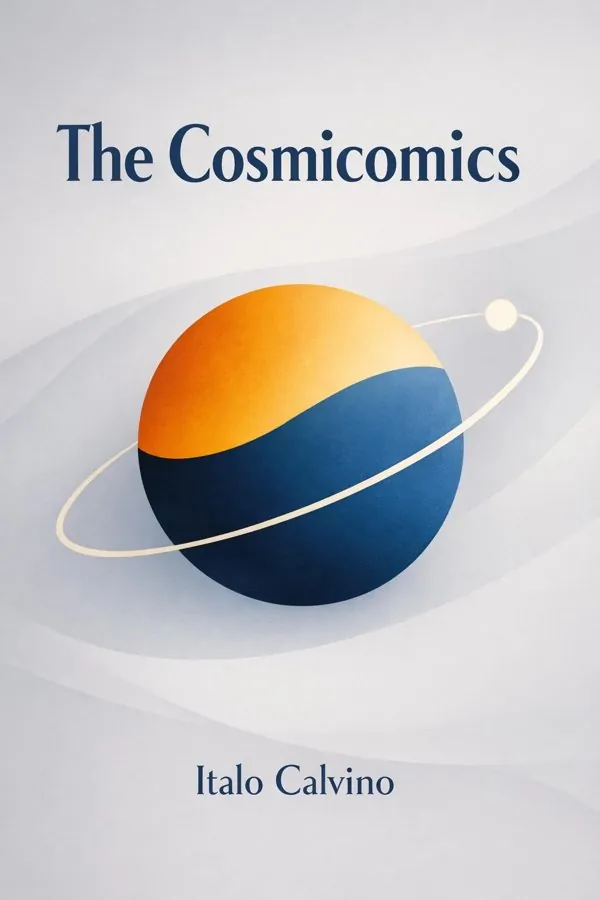
The Cosmicomics: Summary & Key Insights
 10 min9 chaptersAudio available
Key Takeaways from The Cosmicomics
Some of the deepest human emotions become clearer when placed against an impossible sky.
Identity may begin long before we have words, roles, or visible shape.
To make a sign is to declare, however briefly, that we were here.
Sometimes the biggest truths are best understood by imagining them compressed into a single point.
We rarely notice how much of reality depends on the categories we inherit.
What Is The Cosmicomics About?
The Cosmicomics by Italo Calvino is a classics book spanning 11 pages. The Cosmicomics is one of Italo Calvino’s most dazzling and original books: a collection of stories that begins with scientific facts and turns them into playful, philosophical fictions. First published in 1965, the book is narrated largely by the unforgettable Qfwfq, a shape-shifting consciousness who has existed since the beginning of the universe and remembers everything from the formation of galaxies to the emergence of life. Through him, Calvino imagines cosmic events not as distant abstractions but as intimate dramas filled with desire, jealousy, memory, loneliness, and wonder. What makes the book endure is its rare ability to unite opposite modes of thought. It is intellectually curious yet emotionally warm, ironic yet sincere, fantastical yet grounded in scientific speculation. Calvino does not explain the universe in a textbook sense; he humanizes it, showing how even the grandest cosmological ideas can reflect ordinary human experiences. A major figure in twentieth-century literature, Calvino brings unmatched inventiveness, precision, and wit to these stories, making The Cosmicomics a modern classic for readers who love fiction that stretches both the imagination and the mind.
This FizzRead summary covers all 9 key chapters of The Cosmicomics in approximately 10 minutes, distilling the most important ideas, arguments, and takeaways from Italo Calvino's work. Also available as an audio summary and Key Quotes Podcast.
The Cosmicomics
The Cosmicomics is one of Italo Calvino’s most dazzling and original books: a collection of stories that begins with scientific facts and turns them into playful, philosophical fictions. First published in 1965, the book is narrated largely by the unforgettable Qfwfq, a shape-shifting consciousness who has existed since the beginning of the universe and remembers everything from the formation of galaxies to the emergence of life. Through him, Calvino imagines cosmic events not as distant abstractions but as intimate dramas filled with desire, jealousy, memory, loneliness, and wonder. What makes the book endure is its rare ability to unite opposite modes of thought. It is intellectually curious yet emotionally warm, ironic yet sincere, fantastical yet grounded in scientific speculation. Calvino does not explain the universe in a textbook sense; he humanizes it, showing how even the grandest cosmological ideas can reflect ordinary human experiences. A major figure in twentieth-century literature, Calvino brings unmatched inventiveness, precision, and wit to these stories, making The Cosmicomics a modern classic for readers who love fiction that stretches both the imagination and the mind.
Who Should Read The Cosmicomics?
This book is perfect for anyone interested in classics and looking to gain actionable insights in a short read. Whether you're a student, professional, or lifelong learner, the key ideas from The Cosmicomics by Italo Calvino will help you think differently.
- ✓Readers who enjoy classics and want practical takeaways
- ✓Professionals looking to apply new ideas to their work and life
- ✓Anyone who wants the core insights of The Cosmicomics in just 10 minutes
Want the full summary?
Get instant access to this book summary and 100K+ more with Fizz Moment.
Get Free SummaryAvailable on App Store • Free to download
Key Chapters
Some of the deepest human emotions become clearer when placed against an impossible sky. In “The Distance of the Moon,” Calvino imagines a time when the Moon passed so near the Earth that people could climb up to it by ladder from a boat. What begins as a whimsical premise becomes a story about longing, unspoken love, missed timing, and the sadness of change. The closeness of the Moon is not just a scientific fantasy; it represents a world in which the unreachable briefly feels touchable. Yet even in that intimacy, people fail to connect in the ways they hope.
The story works because Calvino transforms a cosmic hypothesis into a familiar emotional pattern. Characters gather moon-milk, leap between worlds, and drift through lunar gravity, but their real struggle is relational: who loves whom, who notices whom, and who is left behind when the universe changes course. The Moon gradually moving away mirrors how people experience loss in real life. A friendship cools, an opportunity closes, a family scatters, or a period of life ends before we fully understand its value.
In practical terms, this story invites readers to reflect on temporary moments of closeness. Think of childhood summers, early romance, or a creative phase when everything felt possible. We often assume such moments will return unchanged, but Calvino reminds us that conditions shift. The emotional truth is simple: proximity does not guarantee connection, and wonder does not last forever unless we attend to it.
Actionable takeaway: when life brings a rare moment of closeness, beauty, or possibility, do not postpone what matters—say what you feel before the Moon drifts farther away.
Identity may begin long before we have words, roles, or visible shape. In “At Daybreak,” Calvino imagines existence before stable bodies and before the world has fully taken form. Qfwfq recalls a state of diffuse awareness, where entities are more like tendencies, presences, or potentials than solid individuals. Rather than presenting creation as a clean beginning, Calvino explores the hazy threshold between nonbeing and being, suggesting that consciousness emerges gradually through relation, differentiation, and desire.
This story is less about plot than about becoming. The entities in it sense one another before they can fully know one another. There is recognition before language, attraction before structure, and individuality before clear boundaries. Calvino uses this pre-material setting to capture a truth about human experience: much of who we are forms before we can explain it. We feel before we define. We orient ourselves toward others before we understand our own shape.
That idea has modern applications. Anyone who has entered a new phase of life—a new city, new career, new relationship, or even a new understanding of self—knows the experience of being “not yet formed.” We often expect certainty too early. But Calvino suggests that ambiguity is not failure; it is part of creation. Personal growth can feel like floating in half-light, sensing future contours without yet inhabiting them.
The story also reframes uncertainty as generative. In creative work, research, entrepreneurship, or emotional development, the first stage is often formless. You gather intuitions before you discover structure. The challenge is to remain attentive without rushing to closure.
Actionable takeaway: when you find yourself in an undefined stage of life, resist the urge to force immediate clarity—treat uncertainty as the raw material from which your next form will emerge.
To make a sign is to declare, however briefly, that we were here. “A Sign in Space” begins with a scientific idea about cosmic movement and recurrence, then turns into a witty meditation on meaning, ownership, memory, and rivalry. Qfwfq places a sign in a point of space so that when he returns after a vast galactic cycle, he will recognize it. But the simple act of marking a place becomes complicated once others see, imitate, alter, or overwrite the sign. What seemed like a stable anchor turns into a struggle over interpretation.
Calvino reveals that signs are never purely personal. The moment we leave a trace—writing a note, making art, posting online, naming a project, decorating a room—we enter a social world of response and distortion. We want our signs to preserve identity, but they also expose us to competition and misunderstanding. The story is funny because its cosmic scale exaggerates a familiar problem: even when we try to make something unmistakably ours, the world reshapes it.
This idea is especially relevant today. Brands, personal profiles, creative portfolios, academic work, and digital content all function as signs in space. We hope they communicate originality, but they exist in crowded environments where imitation, algorithmic flattening, and shifting context can dilute meaning. Calvino does not advise silence, though. Instead, he shows that sign-making is an unavoidable part of being conscious and social.
A practical reading of the story encourages intentionality. Ask not only what mark you are leaving, but why. Are you expressing something real, or merely competing for visibility? Are you creating durable meaning, or chasing recognition? The best signs are not the loudest; they are the most deeply connected to purpose.
Actionable takeaway: leave marks that reflect genuine values rather than a need to dominate attention, because meaning lasts longer than display.
Sometimes the biggest truths are best understood by imagining them compressed into a single point. In “All at One Point,” Calvino reimagines the scientific notion that everything in the universe was once concentrated together. Before expansion, all beings, matter, and possibility coexist in unimaginable closeness. Yet instead of treating this as an abstract cosmological theory, Calvino turns it into a comic and poignant social scene in which there is no room, no distance, and no separation—only total proximity.
The brilliance of the story lies in how it links physical compression with emotional and social tension. If everything is together, then desire, irritation, generosity, vanity, and love are intensified. Calvino suggests that the universe does not begin in emptiness but in overcrowded relationality. Creation itself may emerge from pressure—the pressure of too much closeness, too many possibilities, too much latent energy needing expression.
This becomes a powerful metaphor for human life. Many turning points arise from conditions of compression: a family living in a small space, a startup team under pressure, a society packed with competing needs, or an individual whose unexpressed thoughts build until they must change form. Expansion often follows density. A new life chapter can begin because the old arrangement no longer contains what is building within it.
The story also challenges modern assumptions that distance is always healthier than closeness. While boundaries matter, creativity and transformation often begin in intense contact—with ideas, people, constraints, and contradictions. Calvino invites us to see friction not merely as discomfort but as a force that can generate worlds.
Actionable takeaway: when life feels crowded, pressured, or overfull, ask what new form is trying to emerge from that intensity instead of only trying to escape it.
We rarely notice how much of reality depends on the categories we inherit. In “Without Colors,” Calvino imagines a primordial world before the atmosphere gave things their present hues. The universe appears drained, strange, and incomplete, and color arrives not just as decoration but as a transformation in how reality can be perceived and inhabited. By stripping the world of color first, Calvino helps readers grasp how perception itself structures experience.
The story explores the relationship between environment and consciousness. What we call reality is never purely objective; it is always filtered through available conditions of seeing. Before color, objects exist, but their meaning and emotional charge are altered. Once color enters, the world becomes more differentiated, seductive, and alive. Beauty, desire, and danger all intensify. Calvino’s point is subtle: changes in perception can create entirely new forms of experience without changing the underlying world.
This has practical relevance far beyond astronomy. A new concept, a different cultural lens, a diagnosis, a historical insight, or an emotional awakening can function like the arrival of color. Suddenly a familiar life looks different. For example, learning about burnout may recast one’s work habits; understanding privilege may change how one sees institutions; falling in love may illuminate ordinary surroundings. The world has not disappeared and been replaced, but perception has deepened.
The story also warns against assuming our present way of seeing is final. What feels obvious now may simply be the atmosphere we happen to live in. Growth often begins when we recognize that our vision is partial.
Actionable takeaway: challenge one fixed way of seeing by deliberately exposing yourself to a new perspective—another discipline, culture, or vocabulary—and let it add fresh color to your understanding.
Play is often more revealing than seriousness because it shows how deeply rivalry lives inside us. In “Games Without End,” Calvino presents cosmic beings engaged in endless contests that continue across eras and transformations. What might seem like innocent play becomes a portrait of competition, repetition, pride, and the human need to measure ourselves against others. The cosmic scale makes the behavior amusing, but the pattern is recognizably everyday.
Calvino suggests that competition is both creative and exhausting. Games generate structure, motivation, and meaning. They allow participants to invent rules, test skill, and experience excitement. But when the game never ends, it ceases to be liberating and becomes a trap. Winning loses satisfaction, losing becomes identity, and every interaction turns strategic. Qfwfq and his rivals embody the absurdity of endless scorekeeping.
This theme speaks directly to contemporary life. Professional advancement, social media comparison, status anxiety, academic metrics, and even wellness culture can turn existence into permanent competition. People begin by playing but end by being played by the systems they internalize. Calvino does not condemn ambition altogether; rather, he reveals the comic futility of making every domain a contest.
A practical lesson lies in distinguishing meaningful challenge from compulsive comparison. Healthy games have boundaries, chosen rules, and room for joy. Unhealthy ones consume attention long after they stop serving growth. Ask whether the contest you are in still helps you become better, or whether it only keeps you emotionally entangled.
Actionable takeaway: identify one recurring comparison in your life that feels endless, and replace it with a self-defined measure of progress that restores play instead of pressure.
Change becomes hardest to understand when it happens inside the family. In “The Aquatic Uncle,” Calvino turns evolutionary theory into a domestic drama by focusing on N'ba N'ga, a relative who refuses to leave the water even as others adapt to terrestrial life. The story is comic, but beneath the humor lies a profound reflection on generational conflict, identity, and the cost of progress. Evolution is not presented as a smooth upward march; it is experienced as disagreement over what counts as improvement.
N'ba N'ga represents attachment to an older mode of life that others see as obsolete. But Calvino refuses to make him merely foolish. The aquatic world contains values—continuity, skill, belonging, environmental fit—that the land-dwellers may be too quick to dismiss. At the same time, remaining unchanged can become a refusal to engage with emerging possibilities. The tension feels deeply human: every era produces people who embrace transition and others who see it as betrayal.
This story applies to many forms of modern change. Families argue about technology, migration, education, careers, politics, and tradition in much the same way. One generation may celebrate adaptation while another fears loss. In workplaces, too, teams split between established expertise and new methods. Calvino’s genius is to show that both sides often possess partial truth.
The practical insight is that change should not be judged only by novelty or by loyalty to the past. A wiser response asks what each mode preserves and what each sacrifices. Progress that mocks the old becomes shallow; tradition that rejects all adaptation becomes brittle.
Actionable takeaway: the next time you face a conflict between tradition and change, name one valuable thing the old way protects and one meaningful possibility the new way opens.
Nothing is stranger than becoming a relic while still being alive. In “The Dinosaurs,” Calvino explores extinction, prejudice, and historical memory through Qfwfq, who belongs to a species thought monstrous and obsolete. When he encounters the world that comes after, he discovers that the dead continue to live in stories—usually distorted ones. The dinosaur becomes not just a creature but a label, a myth, and a source of fear.
This story shows how societies simplify the past to reassure themselves about the present. Those who came before are often turned into caricatures: primitive, violent, naive, or irrelevant. Yet Calvino gently unsettles that narrative by giving the supposed dinosaur an interior life full of sensitivity, awkwardness, and adaptability. The effect is both comic and moving. We see how painful it is to be misunderstood by those who know only the legend of your kind.
The theme extends far beyond paleontology. Individuals frequently outlive old versions of themselves while others continue responding to outdated reputations. A person who was once reckless, shy, poor, unsuccessful, or marginalized may still be treated according to stale assumptions. Institutions and cultures suffer similarly when they define whole groups by inherited myths rather than lived complexity.
Calvino’s contribution here is ethical as well as imaginative. He asks readers to reconsider the categories by which they dismiss what seems outdated. The past is not dead material; it contains experience, memory, and perspective that may still speak meaningfully to the present.
Actionable takeaway: question one label—about yourself, another person, or a group—that may be preserving an outdated story, and replace it with direct curiosity about present reality.
The farther things move apart, the more intensely they may still affect one another. In “The Light-Years,” Qfwfq notices a sign in distant space referring to him, and that message—crossing incomprehensible distances—reshapes his sense of self. Calvino uses astronomical scale to examine shame, reputation, memory, and the uneasy fact that we are always being seen from somewhere, even if only in imagination. Distance, rather than dissolving personal meaning, can magnify it.
The story captures a peculiarly modern anxiety: information about us travels beyond our control. What someone says, writes, remembers, or infers can reach us across time and space, altering how we understand our own history. Yet Calvino goes beyond anxiety. He shows that identity is relational and distributed. We are not only who we think we are; we are also formed by echoes, traces, and signals that return to us from afar.
This resonates in an age of digital permanence, remote networks, and long memory. A comment online, a review, an old photograph, or a message from someone after many years can unexpectedly reactivate buried parts of the self. On a more intimate level, emotional light-years exist in families and friendships too. Someone far away can still exert moral and psychological gravity.
Calvino’s deeper insight is that no one fully escapes the constellation of their connections. But that need not be paralyzing. Awareness of relational identity can foster humility and care. Since our words travel farther than we realize, expression carries responsibility.
Actionable takeaway: act as if what you say about others—and about yourself—may travel much farther than intended, and choose language you would not regret meeting again in the distance.
All Chapters in The Cosmicomics
About the Author
Italo Calvino (1923–1985) was one of the most influential Italian writers of the twentieth century and a master of imaginative, intellectually adventurous fiction. Born in Cuba to Italian parents and raised in Italy, he participated in the Italian Resistance during World War II, an experience that informed his early writing. Over time, his work moved from neorealism toward fable, fantasy, and formal experimentation. Calvino became renowned for books such as The Baron in the Trees, Invisible Cities, If on a Winter’s Night a Traveler, and The Cosmicomics. His fiction is celebrated for its clarity, wit, structural ingenuity, and ability to combine playfulness with philosophical depth. Few writers have matched his skill in making abstract ideas feel vivid, elegant, and emotionally resonant.
Get This Summary in Your Preferred Format
Read or listen to the The Cosmicomics summary by Italo Calvino anytime, anywhere. FizzRead offers multiple formats so you can learn on your terms — all free.
Available formats: App · Audio · PDF · EPUB — All included free with FizzRead
Download The Cosmicomics PDF and EPUB Summary
Key Quotes from The Cosmicomics
“Some of the deepest human emotions become clearer when placed against an impossible sky.”
“Identity may begin long before we have words, roles, or visible shape.”
“To make a sign is to declare, however briefly, that we were here.”
“Sometimes the biggest truths are best understood by imagining them compressed into a single point.”
“We rarely notice how much of reality depends on the categories we inherit.”
Frequently Asked Questions about The Cosmicomics
The Cosmicomics by Italo Calvino is a classics book that explores key ideas across 9 chapters. The Cosmicomics is one of Italo Calvino’s most dazzling and original books: a collection of stories that begins with scientific facts and turns them into playful, philosophical fictions. First published in 1965, the book is narrated largely by the unforgettable Qfwfq, a shape-shifting consciousness who has existed since the beginning of the universe and remembers everything from the formation of galaxies to the emergence of life. Through him, Calvino imagines cosmic events not as distant abstractions but as intimate dramas filled with desire, jealousy, memory, loneliness, and wonder. What makes the book endure is its rare ability to unite opposite modes of thought. It is intellectually curious yet emotionally warm, ironic yet sincere, fantastical yet grounded in scientific speculation. Calvino does not explain the universe in a textbook sense; he humanizes it, showing how even the grandest cosmological ideas can reflect ordinary human experiences. A major figure in twentieth-century literature, Calvino brings unmatched inventiveness, precision, and wit to these stories, making The Cosmicomics a modern classic for readers who love fiction that stretches both the imagination and the mind.
More by Italo Calvino
You Might Also Like



Browse by Category
Ready to read The Cosmicomics?
Get the full summary and 100K+ more books with Fizz Moment.