
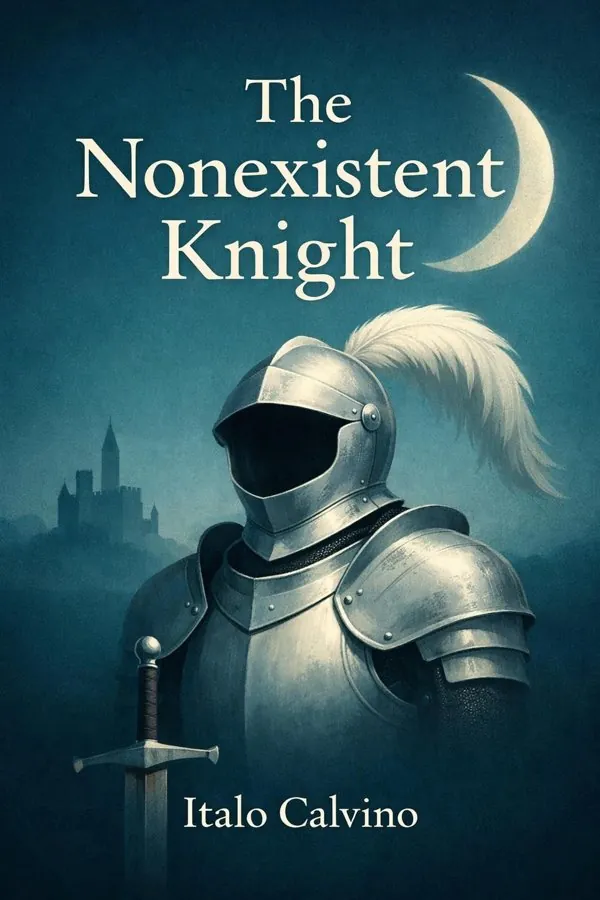
The Nonexistent Knight: Summary & Key Insights
 10 min9 chaptersAudio available
Key Takeaways from The Nonexistent Knight
Perfection can be more unsettling than failure.
We often discover what a person is by placing them beside what they are not.
A surprising amount of human life depends on documents, testimonies, and stories that certify who we are.
Desire often attaches itself not to the most available person, but to the most elusive one.
What looks like identity is often costume.
What Is The Nonexistent Knight About?
The Nonexistent Knight by Italo Calvino is a classics book spanning 4 pages. What if the most perfect person in the room turned out to be empty inside? That dazzling paradox drives Italo Calvino’s The Nonexistent Knight, a witty, melancholic, and brilliantly inventive novel first published in 1959 as the final volume of his “Our Ancestors” trilogy. Set in the legendary world of Charlemagne’s knights, the book follows Agilulfo, an immaculate warrior who has no body at all—only a spotless suit of armor animated by will, discipline, and strict adherence to rules. Around him move characters who are messier, more impulsive, and more recognizably human, and through their collisions Calvino builds a fable about identity, duty, desire, and the fragile stories we tell about ourselves. This short novel matters because it turns fantasy into philosophy without ever becoming heavy. Calvino uses comedy, romance, quest, and satire to ask timeless questions: Are we defined by what we do, what we feel, or what others believe about us? Is order a path to meaning—or a mask for emptiness? Few writers combine lightness and depth as gracefully as Calvino, one of the twentieth century’s great literary stylists. The result is a classic that feels playful on the surface and startlingly modern underneath.
This FizzRead summary covers all 9 key chapters of The Nonexistent Knight in approximately 10 minutes, distilling the most important ideas, arguments, and takeaways from Italo Calvino's work. Also available as an audio summary and Key Quotes Podcast.
The Nonexistent Knight
What if the most perfect person in the room turned out to be empty inside? That dazzling paradox drives Italo Calvino’s The Nonexistent Knight, a witty, melancholic, and brilliantly inventive novel first published in 1959 as the final volume of his “Our Ancestors” trilogy. Set in the legendary world of Charlemagne’s knights, the book follows Agilulfo, an immaculate warrior who has no body at all—only a spotless suit of armor animated by will, discipline, and strict adherence to rules. Around him move characters who are messier, more impulsive, and more recognizably human, and through their collisions Calvino builds a fable about identity, duty, desire, and the fragile stories we tell about ourselves.
This short novel matters because it turns fantasy into philosophy without ever becoming heavy. Calvino uses comedy, romance, quest, and satire to ask timeless questions: Are we defined by what we do, what we feel, or what others believe about us? Is order a path to meaning—or a mask for emptiness? Few writers combine lightness and depth as gracefully as Calvino, one of the twentieth century’s great literary stylists. The result is a classic that feels playful on the surface and startlingly modern underneath.
Who Should Read The Nonexistent Knight?
This book is perfect for anyone interested in classics and looking to gain actionable insights in a short read. Whether you're a student, professional, or lifelong learner, the key ideas from The Nonexistent Knight by Italo Calvino will help you think differently.
- ✓Readers who enjoy classics and want practical takeaways
- ✓Professionals looking to apply new ideas to their work and life
- ✓Anyone who wants the core insights of The Nonexistent Knight in just 10 minutes
Want the full summary?
Get instant access to this book summary and 100K+ more with Fizz Moment.
Get Free SummaryAvailable on App Store • Free to download
Key Chapters
Perfection can be more unsettling than failure. Agilulfo, the knight who does not exist, is one of literature’s most memorable paradoxes: a man with no body, no flesh, no visible self, yet a flawless public identity. He is nothing but an empty suit of white armor held together by discipline, precision, and unwavering will. In Charlemagne’s army, where other knights are sloppy, boastful, distracted, or impulsive, Agilulfo stands out as the ideal servant of order. He knows every regulation, performs every duty exactly, and keeps his armor gleaming as if cleanliness itself were a moral law.
But Calvino turns this perfection into a question. If Agilulfo exists only through rules and function, what remains when duty is stripped away? He symbolizes the kind of life built entirely on performance: efficient, respected, and externally coherent, yet inwardly hollow. Many modern readers will recognize this condition. A person can become a perfect employee, a perfect professional, or a perfect online persona while losing touch with spontaneity, vulnerability, and desire. Agilulfo is admirable because he is disciplined; he is tragic because discipline has replaced being.
Calvino does not merely mock order. He shows its power. Agilulfo’s emptiness is what allows him to function so impeccably. Without the chaos of appetite and emotion, he becomes pure form. Yet the novel suggests that form without substance eventually collapses under its own rigidity. Identity cannot survive forever as a checklist.
In practical terms, Agilulfo invites us to examine where we may be overidentified with roles. Are you living as a title, a reputation, or a routine rather than as a whole person? The takeaway is simple: value discipline, but do not mistake polished performance for a complete self.
We often discover what a person is by placing them beside what they are not. Calvino does this masterfully by setting Agilulfo against two younger knights, Rambaldo and Torrismondo, who embody more recognizably human forms of uncertainty. Rambaldo enters the story driven by romantic ideals, youthful ambition, and the desire for glory. He wants to avenge his father, win honor, and pursue love, especially in the form of Bradamante, whose courage dazzles him. He is impulsive, emotional, and alive with longing. Torrismondo, by contrast, is haunted by deeper doubts about his origins and belonging. His struggle is not simply to win distinction but to understand who he is and where he comes from.
Together, these characters reveal the costs and benefits of being fully human. They are inconsistent where Agilulfo is exact, vulnerable where he is invulnerable, and often confused where he is certain. Yet their disorder is also their richness. They desire, suffer, misjudge, hope, and learn. If Agilulfo represents pure form, Rambaldo and Torrismondo represent embodied life—messy, unfinished, and subject to contradiction.
This contrast gives the novel much of its emotional and philosophical depth. Calvino suggests that uncertainty is not merely a weakness. It may be the very condition of growth. Rambaldo’s immaturity, for example, makes him foolish at times, but it also leaves room for transformation. Torrismondo’s doubts are painful, yet they push him into a more serious search for truth. In real life, people often envy certainty and composure, imagining that confidence equals authenticity. Calvino questions that assumption. Sometimes confusion is a sign that a deeper self is trying to emerge.
The practical lesson is to stop treating uncertainty as failure. Doubt, vulnerability, and inconsistency can be signs of a life that is genuinely being lived. The takeaway: embrace your unfinishedness, because growth rarely looks as polished as perfection.
A surprising amount of human life depends on documents, testimonies, and stories that certify who we are. In The Nonexistent Knight, Agilulfo’s entire status rests on a claim: he was awarded knighthood for saving the virginity of the noble maiden Sofronia. When that claim is challenged, the consequences are enormous. If the event did not occur as recorded, then Agilulfo’s legitimacy may collapse. Since his very existence depends on official recognition and proper form, the investigation becomes not just a legal matter but an existential crisis.
Calvino uses this plotline to explore how identity is socially constructed. Agilulfo is, in one sense, “real” because institutions say he is real. He occupies a role, carries authority, and fulfills expectations. Yet if the foundation story proves false, what remains? The search for Sofronia becomes a search for verification itself—the human need to anchor identity in externally recognized facts. The irony is sharp: the character with the strongest devotion to objective order depends on a fragile narrative that may not withstand scrutiny.
This idea feels strikingly modern. Careers, credentials, social status, and even digital identities often rely on records and validations. A title can open doors; a rumor can close them. We like to imagine a stable self beneath these labels, but Calvino reminds us that public identity can be contingent and theatrical. The novel does not argue that evidence and institutions are meaningless. Rather, it shows that they are powerful but incomplete. They can establish status, not essence.
A practical application is to distinguish between legitimacy and identity. Your résumé, achievements, and public reputation matter, but they do not exhaust who you are. If one external marker is threatened, your entire self need not disappear with it. The takeaway: build a life that can survive beyond official validation, because proof may support identity, but it cannot fully create it.
Desire often attaches itself not to the most available person, but to the most elusive one. Bradamante, the fierce and brilliant female warrior, becomes one of the novel’s most fascinating emotional centers because her passion for Agilulfo exposes the strange magnetism of form without substance. She is drawn to his purity, his distance, his impeccable self-command. Agilulfo’s emptiness does not repel her; it intensifies her longing. He seems untouched by the muddiness of ordinary life, and that very inaccessibility becomes seductive.
But Calvino complicates matters further through the narrative frame. The story is told by Sister Theodora, a nun writing from a convent, whose voice is reflective, playful, and increasingly intimate with the tale she recounts. As the novel unfolds, narration itself becomes a mask, another kind of armor. The boundary between storyteller and story grows porous, and the reader begins to sense that the act of telling is itself bound up with desire, memory, fantasy, and self-invention.
Bradamante’s passion and Sister Theodora’s narration reveal that identity is never merely objective. We are also shaped by the stories others tell about us and the fantasies they project onto us. People may fall in love not with who someone is, but with what that person represents: order, mystery, rescue, purity, rebellion. In everyday life, this happens constantly—in romance, celebrity culture, leadership, and even friendship. We desire ideals, then struggle when reality intrudes.
Calvino’s insight is not cynical but clarifying. Desire can illuminate what we lack, what we admire, and what we fear. Yet it also distorts. The actionable takeaway: examine whether you are responding to a real person or to a carefully imagined symbol. When desire is strongest, ask what story you are telling—and why you need it.
Sometimes the deepest truths become visible only when seriousness is lightened by play. One of Calvino’s greatest achievements in The Nonexistent Knight is his ability to address identity, emptiness, desire, and social order through comedy. The premise itself is absurd: a knight who has no body but continues to serve with perfect efficiency. The scenes around Charlemagne’s camp often sparkle with satire, exaggeration, and farce. Yet the laughter is not decorative. It is the method by which Calvino frees readers to confront unsettling ideas.
Comedy helps because it exposes conventions. What people accept as natural often looks ridiculous when slightly exaggerated. By making Agilulfo a suit of armor animated by will alone, Calvino reveals how much ordinary social life already resembles such absurdity. People obey systems, recite formulas, and cling to titles with a seriousness that can appear comic once defamiliarized. Humor creates distance, and distance allows insight.
At the same time, comedy keeps the novel humane. Calvino does not punish his characters for being contradictory; he observes them with irony and sympathy. Their vanity, longing, confusion, and pretensions are funny because they are recognizable. This balance is useful beyond literature. In workplaces, families, and public life, rigid seriousness often reinforces empty performance. A touch of humor can puncture illusion and restore proportion. It can remind us that institutions are human constructions, not sacred absolutes.
The practical application is not to trivialize life’s difficulties, but to use wit as a diagnostic tool. When a system becomes absurdly formal, or when you catch yourself overperforming an identity, humor may reveal what earnestness hides. The takeaway: cultivate the ability to laugh at empty rituals, because comedy can be one of the clearest paths to honesty.
Duty can organize a life, but it cannot always animate one. Agilulfo is sustained by obligation: he exists because he fulfills a function with absolute rigor. He serves, obeys, and upholds order. In a world full of disorderly desires, this seems noble. Yet Calvino gradually shows that duty alone, detached from appetite, embodiment, and relational warmth, produces a brittle kind of existence. Agilulfo can continue, but he cannot fully live.
This is one of the novel’s quiet moral arguments. A meaningful life requires more than correctness. It requires some contact with the irrational elements that make human experience dense and alive: love, uncertainty, fatigue, sensuality, grief, accident, and even error. Characters like Rambaldo and Bradamante are less orderly than Agilulfo, but they are also more capable of change because they are touched by feeling. Their humanity makes them unstable, but also real.
Many readers will recognize the temptation of duty-first living. People may devote themselves entirely to productivity, family obligation, ideological consistency, or moral rectitude, hoping that enough discipline will settle the question of meaning. Calvino’s warning is subtle: structure is necessary, but life cannot be reduced to structure. A person who does everything right may still feel absent from their own days.
In practical terms, this means checking whether your responsibilities leave room for presence. Do you allow time for reflection, affection, creativity, or bodily experience? Do you relate to others as tasks or as people? Duty is honorable, but it should support life, not replace it.
The takeaway: keep your commitments, but make space for feeling and spontaneity, because a well-ordered life is not automatically a fully inhabited one.
Identity is rarely discovered in a single revelation; more often, it is assembled from fragments. Throughout The Nonexistent Knight, characters move through quests, misunderstandings, genealogies, and romantic entanglements that keep disrupting any stable answer to the question “Who am I?” Torrismondo’s uncertainty about his lineage, Agilulfo’s dependence on external legitimacy, Rambaldo’s immature striving, and Bradamante’s conflicted desire all point to the same truth: the self is not a fixed possession but an unstable construction.
Calvino’s world may be medieval and fantastical, but the problem is modern. We inherit names, histories, expectations, and institutions long before we understand ourselves. We then spend years trying to reconcile inner experience with outer labels. Sometimes the labels fit too tightly; sometimes they do not fit at all. The novel suggests that fragmentation is not an exception. It is the human condition.
This does not mean identity is impossible. Rather, it means authenticity is less about uncovering a hidden essence than about noticing the forces shaping us and choosing among them consciously. Calvino resists easy resolution. His characters’ searches are comic, painful, and partial. That incompleteness is the point. A self is not a trophy obtained after one successful quest; it is an ongoing negotiation between role, desire, history, and action.
Readers can apply this by becoming more attentive to the fragments from which they build meaning: family narratives, professional ambitions, romantic ideals, social expectations, and personal habits. Which of these truly express you, and which are inherited scripts? The takeaway: do not wait for a final, perfect identity to appear; instead, build a more honest self by examining the pieces you already live with.
A novel about Charlemagne’s knights should, by all logic, feel distant from contemporary life. Instead, The Nonexistent Knight feels eerily current because Calvino understood a problem that has only intensified: the split between image and being. Agilulfo anticipates the modern subject who is highly functional, publicly validated, and inwardly estranged. He could be read as a bureaucrat, a brand, a résumé, a social media persona, or any identity maintained through relentless performance.
The book also feels modern in its distrust of simple authenticity. Calvino does not offer a sentimental opposite to Agilulfo, as if all one must do is “be oneself.” The other characters are often confused, self-deceived, or theatrical in their own ways. This is crucial. Modern identity is not solved by discarding form altogether. We need institutions, language, and roles. The challenge is learning to inhabit them without disappearing into them.
The novel’s narrative playfulness also anticipates later literary experiments. Sister Theodora’s presence reminds us that storytelling itself shapes reality. We do not simply live; we narrate our lives, and those narratives can conceal, reveal, distort, or redeem. In an age saturated with self-presentation, this insight feels especially fresh.
Practically speaking, Calvino’s novel remains relevant because it helps readers diagnose contemporary emptiness without moral panic. It asks: Where are you overorganized and underalive? Where are you mistaking visibility for existence? Where are you in love with a symbol rather than a person? These questions are timeless.
The takeaway: read the novel not as an antique fantasy but as a mirror. Its medieval armor reflects a distinctly modern anxiety—how to remain real in a world that rewards performance.
All Chapters in The Nonexistent Knight
About the Author
Italo Calvino (1923–1985) was one of the most influential and inventive writers of the twentieth century. Born in Cuba to Italian parents and raised in Italy, he became known for fiction that blends fantasy, allegory, intellectual play, and moral seriousness. After participating in the Italian Resistance during World War II, he began publishing novels, stories, and essays that moved from neorealism toward increasingly imaginative and experimental forms. His major works include The Baron in the Trees, Invisible Cities, Cosmicomics, and If on a Winter’s Night a Traveler. Calvino’s writing is admired for its clarity, wit, and unusual ability to make abstract ideas feel vivid and entertaining. In The Nonexistent Knight, he shows this gift at its finest, turning a fantastical premise into a lasting exploration of identity, form, and authenticity.
Get This Summary in Your Preferred Format
Read or listen to the The Nonexistent Knight summary by Italo Calvino anytime, anywhere. FizzRead offers multiple formats so you can learn on your terms — all free.
Available formats: App · Audio · PDF · EPUB — All included free with FizzRead
Download The Nonexistent Knight PDF and EPUB Summary
Key Quotes from The Nonexistent Knight
“Perfection can be more unsettling than failure.”
“We often discover what a person is by placing them beside what they are not.”
“A surprising amount of human life depends on documents, testimonies, and stories that certify who we are.”
“Desire often attaches itself not to the most available person, but to the most elusive one.”
“What looks like identity is often costume.”
Frequently Asked Questions about The Nonexistent Knight
The Nonexistent Knight by Italo Calvino is a classics book that explores key ideas across 9 chapters. What if the most perfect person in the room turned out to be empty inside? That dazzling paradox drives Italo Calvino’s The Nonexistent Knight, a witty, melancholic, and brilliantly inventive novel first published in 1959 as the final volume of his “Our Ancestors” trilogy. Set in the legendary world of Charlemagne’s knights, the book follows Agilulfo, an immaculate warrior who has no body at all—only a spotless suit of armor animated by will, discipline, and strict adherence to rules. Around him move characters who are messier, more impulsive, and more recognizably human, and through their collisions Calvino builds a fable about identity, duty, desire, and the fragile stories we tell about ourselves. This short novel matters because it turns fantasy into philosophy without ever becoming heavy. Calvino uses comedy, romance, quest, and satire to ask timeless questions: Are we defined by what we do, what we feel, or what others believe about us? Is order a path to meaning—or a mask for emptiness? Few writers combine lightness and depth as gracefully as Calvino, one of the twentieth century’s great literary stylists. The result is a classic that feels playful on the surface and startlingly modern underneath.
More by Italo Calvino

You Might Also Like




Browse by Category
Ready to read The Nonexistent Knight?
Get the full summary and 100K+ more books with Fizz Moment.