
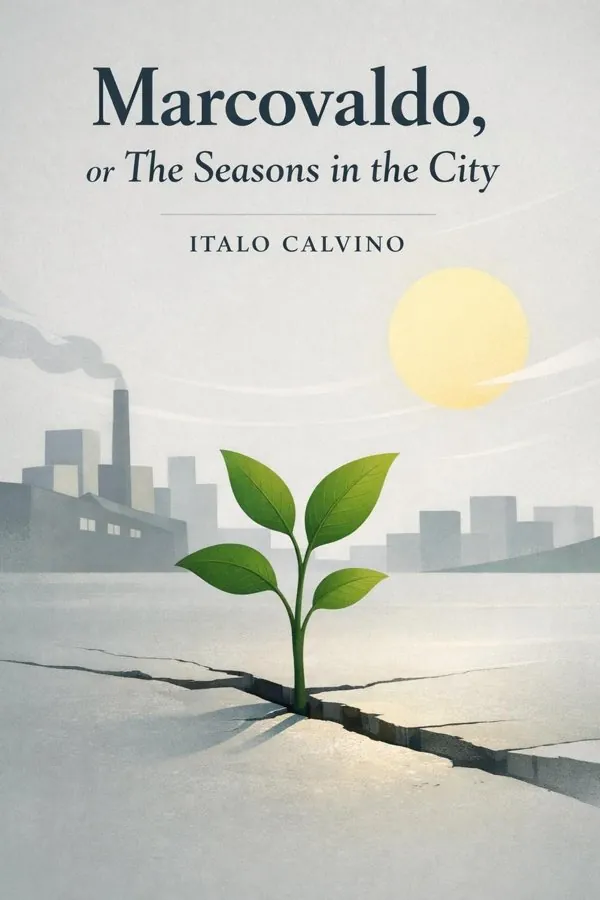
Marcovaldo, or The Seasons in the City: Summary & Key Insights
 10 min10 chaptersAudio available
Key Takeaways from Marcovaldo, or The Seasons in the City
A city does not erase nature; it merely hides it in damaged, accidental, and easily misunderstood forms.
We often imagine that a fresh layer of snow can cover reality and give us a new beginning, but Calvino shows how quickly the city dirties every dream of purity.
In conditions of poverty, even affection becomes entangled with need.
Hope often returns before conditions truly improve.
Modern life sells escape most effectively to those who cannot leave.
What Is Marcovaldo, or The Seasons in the City About?
Marcovaldo, or The Seasons in the City by Italo Calvino is a classics book spanning 10 pages. Marcovaldo, or The Seasons in the City is Italo Calvino’s tender, witty, and quietly devastating portrait of an ordinary laborer trying to stay human in an increasingly artificial world. First published in 1963, the book gathers twenty short stories that follow Marcovaldo through the changing seasons of a modern industrial city. He notices mushrooms growing by a tram stop, chases traces of animals and light, dreams of clean air and open space, and repeatedly misreads the city’s false promises as signs of natural wonder or escape. Again and again, hope blooms—and just as often, it collapses. What makes the book enduring is that Calvino transforms small comic incidents into a profound meditation on poverty, consumerism, urban alienation, and the fragile persistence of imagination. Marcovaldo is naive, but his naivety is also a form of moral clarity: he still expects the world to contain beauty, meaning, and seasons. Calvino, one of the twentieth century’s most inventive literary voices, writes with extraordinary lightness and precision, showing how comedy can reveal deep social truths. This is a classic not because it offers grand solutions, but because it captures, with unforgettable simplicity, what modern life often steals from us—and what we still long to recover.
This FizzRead summary covers all 10 key chapters of Marcovaldo, or The Seasons in the City in approximately 10 minutes, distilling the most important ideas, arguments, and takeaways from Italo Calvino's work. Also available as an audio summary and Key Quotes Podcast.
Marcovaldo, or The Seasons in the City
Marcovaldo, or The Seasons in the City is Italo Calvino’s tender, witty, and quietly devastating portrait of an ordinary laborer trying to stay human in an increasingly artificial world. First published in 1963, the book gathers twenty short stories that follow Marcovaldo through the changing seasons of a modern industrial city. He notices mushrooms growing by a tram stop, chases traces of animals and light, dreams of clean air and open space, and repeatedly misreads the city’s false promises as signs of natural wonder or escape. Again and again, hope blooms—and just as often, it collapses.
What makes the book enduring is that Calvino transforms small comic incidents into a profound meditation on poverty, consumerism, urban alienation, and the fragile persistence of imagination. Marcovaldo is naive, but his naivety is also a form of moral clarity: he still expects the world to contain beauty, meaning, and seasons. Calvino, one of the twentieth century’s most inventive literary voices, writes with extraordinary lightness and precision, showing how comedy can reveal deep social truths. This is a classic not because it offers grand solutions, but because it captures, with unforgettable simplicity, what modern life often steals from us—and what we still long to recover.
Who Should Read Marcovaldo, or The Seasons in the City?
This book is perfect for anyone interested in classics and looking to gain actionable insights in a short read. Whether you're a student, professional, or lifelong learner, the key ideas from Marcovaldo, or The Seasons in the City by Italo Calvino will help you think differently.
- ✓Readers who enjoy classics and want practical takeaways
- ✓Professionals looking to apply new ideas to their work and life
- ✓Anyone who wants the core insights of Marcovaldo, or The Seasons in the City in just 10 minutes
Want the full summary?
Get instant access to this book summary and 100K+ more with Fizz Moment.
Get Free SummaryAvailable on App Store • Free to download
Key Chapters
A city does not erase nature; it merely hides it in damaged, accidental, and easily misunderstood forms. One of the most memorable episodes in Marcovaldo begins when the title character spots mushrooms growing near a tram stop. To everyone else, they are insignificant or suspicious. To Marcovaldo, they appear as a miracle: a small, secret gift from the natural world rising through soot, concrete, and routine. His discovery awakens hunger, hope, and fantasy all at once. Yet the episode ends not in pastoral delight but in illness and disappointment, because even nature in the city has been contaminated by the environment surrounding it.
Calvino uses this comic misadventure to show a central tension in modern life. We still crave contact with the natural world, but our access to it is distorted by pollution, scarcity, and ignorance. Marcovaldo’s excitement is genuine, yet it is also tragic because the city has severed people from the knowledge needed to live in harmony with nature. He can see wonder, but he cannot safely possess it.
This idea remains highly relevant. Today many people seek nature through tiny urban gardens, houseplants, rooftop bees, or weekend escapes, often treating these fragments as compensation for a life lived indoors and under pressure. Calvino reminds us that the desire itself is healthy, but it cannot be satisfied by romanticizing whatever scraps remain.
A practical application is to pay closer attention to the environments we inhabit without idealizing them. Notice the trees on your street, the birds on your commute, or the weather changing across a week—but also ask what conditions support or damage these forms of life. Appreciation should lead to care, not fantasy.
Actionable takeaway: cultivate daily awareness of small natural details around you, and turn that awareness into one concrete act of stewardship, such as reducing waste, supporting green spaces, or learning more about your local ecosystem.
We often imagine that a fresh layer of snow can cover reality and give us a new beginning, but Calvino shows how quickly the city dirties every dream of purity. When winter arrives, Marcovaldo sees snow not as inconvenience but as transformation. The city, usually grimy and mechanical, suddenly looks silent, soft, and almost magical. Snow promises what urban life rarely offers him: stillness, beauty, and a temporary suspension of hardship. For a brief moment, the city seems redeemed.
But the illusion cannot last. Traffic, labor, soot, and practical necessity break the spell. Snow becomes slush, danger, mess, and burden. What looked like a poetic reset is absorbed back into the rhythms of modern life. Calvino’s irony is gentle but sharp: beauty appears, yet the structures of the city quickly convert it into another problem to manage.
This episode speaks to a common human pattern. We pin our hopes on symbolic renewals—a new year, a move, a cleaned desk, a seasonal change—believing that external freshness will transform inner or social conditions. Sometimes these rituals help, but Calvino reminds us that without deeper change, old systems reassert themselves. Snow cannot reform a city built on exhaustion.
In everyday life, this insight encourages us to distinguish between atmosphere and reality. A vacation, a new planner, or a beautifully organized room may lift our spirits, but lasting renewal requires changes in habits, relationships, and structures. Marcovaldo’s mistake is not that he loves snow; it is that he expects appearance alone to alter life.
Actionable takeaway: when a moment of freshness arrives, enjoy it fully—but pair that feeling with one practical change, such as simplifying your schedule, resetting a habit, or solving a recurring source of stress before the old mess returns.
In conditions of poverty, even affection becomes entangled with need. Across Marcovaldo’s stories, animals are never just decorative presences. They represent alternative forms of life, fleeting companionship, instinct, and freedom, but they also expose how hard urban existence makes tenderness. Whether Marcovaldo encounters stray creatures, imagines solidarity with animals, or sees his family drawn toward them, Calvino suggests that people deprived of comfort often project hope onto beings that seem closer to nature and less corrupted by the city’s rules.
Yet these encounters are rarely sentimental. The city does not permit simple pastoral bonds. Animals may become burdens, commodities, or victims of human schemes. The very desire for innocent companionship is shaped by material scarcity. Marcovaldo is drawn to creatures because they seem to promise an uncalculated world, but his reality constantly intrudes: there is not enough space, money, knowledge, or security to sustain the bond he imagines.
Calvino’s brilliance lies in showing that this is not merely about animals. It is about what poverty does to emotional life. The poor are often denied the luxury of harmless attachment. Every object, every animal, every opportunity is measured against necessity. In such a world, innocence survives only briefly.
Modern readers can see this dynamic in many forms: families who want pets but cannot afford care, urban children who know nature mainly through screens, or people who seek emotional relief in small acts of contact with nonhuman life. These longings are real and important, even when circumstances complicate them.
The practical lesson is to respect how material conditions shape emotional possibilities. Instead of romanticizing simplicity, we should create environments where care is sustainable—whether that means supporting shelters, improving living conditions, or making room in daily life for responsible connection with the natural world.
Actionable takeaway: identify one way to make compassion more concrete in your environment, such as helping an animal welfare effort, supporting a family burdened by costs, or creating a more livable routine for those who depend on you.
Hope often returns before conditions truly improve. In Marcovaldo, spring is not a clean rebirth in open countryside but a subtle stirring beneath the city’s hardened surfaces. Marcovaldo senses signs of change where others notice nothing: a shift in the air, a burst of color, the promise hidden in neglected corners. His responsiveness to spring reveals one of his most important traits. He remains open to renewal even when life gives him little reason to expect it.
Calvino uses this seasonal sensitivity to highlight both the dignity and the danger of hope. Marcovaldo’s instinct is beautiful because it preserves wonder in a dehumanizing environment. At the same time, it leaves him vulnerable to disappointment, misinterpretation, and exploitation. The city is full of false springs: advertisements, products, distractions, and fantasies of improvement that imitate renewal without delivering it. Genuine seasonal change exists, but it arrives filtered through concrete, commerce, and fatigue.
This idea has practical relevance far beyond literature. Many people live in environments where life feels overbuilt, overscheduled, and emotionally airless. In such conditions, small changes matter: more daylight after winter, a walk during lunch, a tree budding outside an apartment window. These details do not solve structural problems, but they can restore a sense of time, rhythm, and participation in a world larger than work.
Calvino invites us to become more seasonally literate—to notice that our minds and moods are shaped by light, weather, and recurring cycles, even when technology encourages us to live as if every month were the same. Spring matters not because it is magical, but because it reminds us that life still moves beneath surfaces that seem fixed.
Actionable takeaway: reconnect your routine to the actual season by adding one small ritual—walking outside at the same time each day, opening windows when possible, or tracking visible changes in your neighborhood for a week.
Modern life sells escape most effectively to those who cannot leave. One of Marcovaldo’s most revealing experiences involves a tropical billboard, a bright commercial image promising paradise in the middle of industrial drabness. For Marcovaldo, such images are not merely advertisements; they are invitations to dream. He sees in them a way out of monotony, poverty, and enclosure. But the paradise is flat, manufactured, and unreachable. It exists to stimulate desire, not satisfy it.
Calvino anticipates a world saturated with aspirational imagery. The billboard represents consumer culture’s genius: it turns longing into a marketable condition. Rather than helping people change their lives, it offers symbols of freedom, pleasure, and nature as substitutes. Marcovaldo’s mistake is not foolishness alone. He is responding exactly as the system expects—by investing emotional energy in an image designed to convert deprivation into fantasy.
This is one of the book’s sharpest social critiques. Urban alienation does not only deprive people materially; it colonizes their imagination. The poor are not merely excluded from abundance—they are constantly shown polished visions of it. The result is a painful mix of hope, envy, and confusion, in which signs replace experiences.
The theme is even more relevant in the age of social media, digital advertising, and endless lifestyle branding. Beaches, minimalist homes, wellness retreats, and curated happiness now appear everywhere, often functioning like Calvino’s billboard: not as paths to flourishing but as engines of dissatisfaction.
A practical response is to examine which images consistently make you feel both drawn and diminished. Ask whether they point toward real values—rest, beauty, freedom—or simply keep you consuming symbols of those values. Often the answer is not to reject desire, but to pursue it in more grounded ways.
Actionable takeaway: choose one recurring fantasy sold to you by media and translate it into a small real-world version—an afternoon outdoors, a screen-free meal, or a budget-friendly outing that offers actual experience instead of image.
When small lights vanish, an entire way of seeing may vanish with them. In one of the collection’s most poignant motifs, fireflies represent more than insects in the night. They symbolize the fragile persistence of enchantment in a world increasingly dominated by artificial illumination, industrial pollution, and functional thinking. Marcovaldo notices them because he is still capable of wonder; he recognizes that night should contain mystery, darkness, and living signals not made by machines.
Calvino mourns, without becoming sentimental, the shrinking space for spontaneous beauty. Fireflies are easy to overlook if one values only utility. Yet their disappearance marks a deeper loss: the erosion of environments in which unplanned forms of life and imagination can survive. The modern city brightens everything while impoverishing perception. Constant illumination does not equal vision. Sometimes it blinds us to subtler realities.
This theme extends to contemporary life in obvious ways. Light pollution hides stars; noise drowns silence; algorithmic feeds crowd out idleness and surprise. We live amid unprecedented stimulation and still feel that something delicate has gone missing. Calvino helps us name that loss. The issue is not nostalgia for a perfect past, but concern for the conditions under which attention, awe, and ecological life remain possible.
Practically, this means valuing darkness, quiet, and unprogrammed time as real goods. Not every moment should be optimized, illuminated, or monetized. Children especially need access to experiences that are not fully controlled and explained in advance.
Actionable takeaway: create one pocket of preserved mystery in your week—turn off lights to look at the night sky, take a walk without headphones, or spend time in a place where you can notice living things without trying to document or use them.
Alienation is not always dramatic; sometimes it feels like moving through fog, unable to grasp where you are or how things fit together. Calvino uses fog as both literal weather and social metaphor. In Marcovaldo’s city, fog blurs outlines, distorts movement, and isolates individuals from one another. Streets become uncertain, distances deceptive, intentions unclear. The environment mirrors the mental experience of modern urban life: disorientation within systems too large, impersonal, and opaque to comprehend.
Marcovaldo is especially vulnerable to this confusion because he lacks power and privileged knowledge. He inhabits institutions he does not control and economic structures he cannot interpret. The fog therefore expresses class as well as psychology. The modern city does not simply overwhelm everyone equally; it renders some people more legible and mobile than others. Those at the margins must navigate spaces that were not designed for their clarity or comfort.
Calvino’s insight applies to bureaucracies, digital platforms, workplaces, and financial systems today. Many people feel surrounded by rules, interfaces, and expectations that remain partly invisible until they punish a mistake. Confusion becomes normal. In such conditions, individuals often blame themselves for what are actually structural forms of obscurity.
The practical value of this idea lies in recognizing confusion as meaningful data. When everything feels murky, the answer is not always to push harder alone. It may be to seek maps: ask questions, find guides, make processes visible, and reduce unnecessary complexity where you can. Clarity is not a luxury. It is a form of dignity.
Actionable takeaway: identify one area of life that feels chronically foggy—finances, healthcare, work expectations, paperwork—and take one concrete step toward visibility, such as writing down the process, asking a knowledgeable person for help, or simplifying the next decision.
Scarcity breeds ingenuity, but ingenuity under pressure can easily become self-defeating. Marcovaldo is constantly tempted by little schemes: opportunities to gain food, comfort, status, or advantage in a world where he has too little of all four. These plans are often comic, improvised, and driven by perfectly understandable desire. Yet they tend to backfire, exposing how consumer society manipulates hope at the smallest scale.
Calvino is not mocking ambition itself. Rather, he shows how systems of scarcity train people to chase marginal gains instead of changing underlying conditions. Marcovaldo’s schemes feel reasonable because his world offers so few stable paths to security. The city overflows with goods, promotions, and promises, but access remains unequal. This mismatch creates a culture of hustle, shortcuts, and wishful calculation in which the poor must always be alert for a possible edge.
The stories therefore illuminate a pattern still familiar today: people lured into bad deals, overwork, impulse purchases, speculative side hustles, or offers that seem clever but solve little. Consumer culture thrives by presenting every lack as an opportunity for personal improvisation rather than a sign of structural imbalance.
A practical lesson here is to distinguish survival creativity from manipulative opportunity. Not every bargain is beneficial; not every workaround is freedom. Sometimes the smartest move is restraint, collective support, or a clearer view of what problem is actually being solved. Calvino encourages skepticism toward systems that endlessly stimulate appetite while withholding security.
Actionable takeaway: before committing to a tempting purchase, shortcut, or money-making idea, pause to ask three questions: what need am I trying to meet, what are the real costs, and is there a simpler or more stable way to address the same problem?
Resilience is not constant optimism; it is the ability to begin again after repeated disillusionment. Across all twenty stories, the deepest pattern in Marcovaldo is not plot but recurrence. Seasons return, hopes revive, and the protagonist keeps responding to the world as if beauty might still be possible. He is disappointed often, sometimes absurdly so, yet he does not become fully cynical. This quality makes him both comic and admirable.
Calvino suggests that human beings endure not by mastering modern life, but by preserving some responsiveness to rhythm, surprise, and possibility. Marcovaldo’s failures are real, but so is his refusal to reduce existence to grim efficiency. He notices what others miss. He dreams beyond what his circumstances justify. He suffers because of this openness, but it also keeps him alive in a spiritual sense.
The book’s final wisdom lies here: resilience is cyclical, not linear. We do not permanently solve alienation, fatigue, or longing. We pass through them repeatedly, and each season asks for a fresh adjustment. To live well in difficult conditions, one must cultivate not grand heroism but renewable capacities—attention, humor, adaptability, and the willingness to try again.
This has practical relevance for anyone living through repetitive stress: parenting, caregiving, demanding work, economic uncertainty, or urban overload. Progress may be less about escaping the cycle than about moving through it with more awareness and less self-deception. Calvino offers no triumphalist ending, but he does offer a humane model of persistence.
Actionable takeaway: treat your energy and hope as seasonal rather than fixed by creating a simple recurring practice—weekly reflection, monthly reset, or seasonal goal review—that helps you begin again without expecting perfection.
All Chapters in Marcovaldo, or The Seasons in the City
About the Author
Italo Calvino (1923–1985) was one of the most celebrated writers of modern Italian literature. Born in Santiago de las Vegas, Cuba, to Italian parents and raised in Sanremo, Italy, he became known for fiction that blends clarity, imagination, irony, and philosophical depth. After participating in the Italian Resistance during World War II, Calvino began publishing works shaped first by neorealism and later by increasingly inventive and experimental forms. His major books include The Baron in the Trees, Cosmicomics, Invisible Cities, and If on a Winter’s Night a Traveler. Across his career, he explored themes such as perception, storytelling, modernity, and human freedom. Marcovaldo reveals his gift for turning simple, comic situations into sharp reflections on urban life, class, and the fragile presence of wonder in the modern world.
Get This Summary in Your Preferred Format
Read or listen to the Marcovaldo, or The Seasons in the City summary by Italo Calvino anytime, anywhere. FizzRead offers multiple formats so you can learn on your terms — all free.
Available formats: App · Audio · PDF · EPUB — All included free with FizzRead
Download Marcovaldo, or The Seasons in the City PDF and EPUB Summary
Key Quotes from Marcovaldo, or The Seasons in the City
“A city does not erase nature; it merely hides it in damaged, accidental, and easily misunderstood forms.”
“We often imagine that a fresh layer of snow can cover reality and give us a new beginning, but Calvino shows how quickly the city dirties every dream of purity.”
“In conditions of poverty, even affection becomes entangled with need.”
“Hope often returns before conditions truly improve.”
“Modern life sells escape most effectively to those who cannot leave.”
Frequently Asked Questions about Marcovaldo, or The Seasons in the City
Marcovaldo, or The Seasons in the City by Italo Calvino is a classics book that explores key ideas across 10 chapters. Marcovaldo, or The Seasons in the City is Italo Calvino’s tender, witty, and quietly devastating portrait of an ordinary laborer trying to stay human in an increasingly artificial world. First published in 1963, the book gathers twenty short stories that follow Marcovaldo through the changing seasons of a modern industrial city. He notices mushrooms growing by a tram stop, chases traces of animals and light, dreams of clean air and open space, and repeatedly misreads the city’s false promises as signs of natural wonder or escape. Again and again, hope blooms—and just as often, it collapses. What makes the book enduring is that Calvino transforms small comic incidents into a profound meditation on poverty, consumerism, urban alienation, and the fragile persistence of imagination. Marcovaldo is naive, but his naivety is also a form of moral clarity: he still expects the world to contain beauty, meaning, and seasons. Calvino, one of the twentieth century’s most inventive literary voices, writes with extraordinary lightness and precision, showing how comedy can reveal deep social truths. This is a classic not because it offers grand solutions, but because it captures, with unforgettable simplicity, what modern life often steals from us—and what we still long to recover.
More by Italo Calvino

You Might Also Like


Browse by Category
Ready to read Marcovaldo, or The Seasons in the City?
Get the full summary and 100K+ more books with Fizz Moment.