
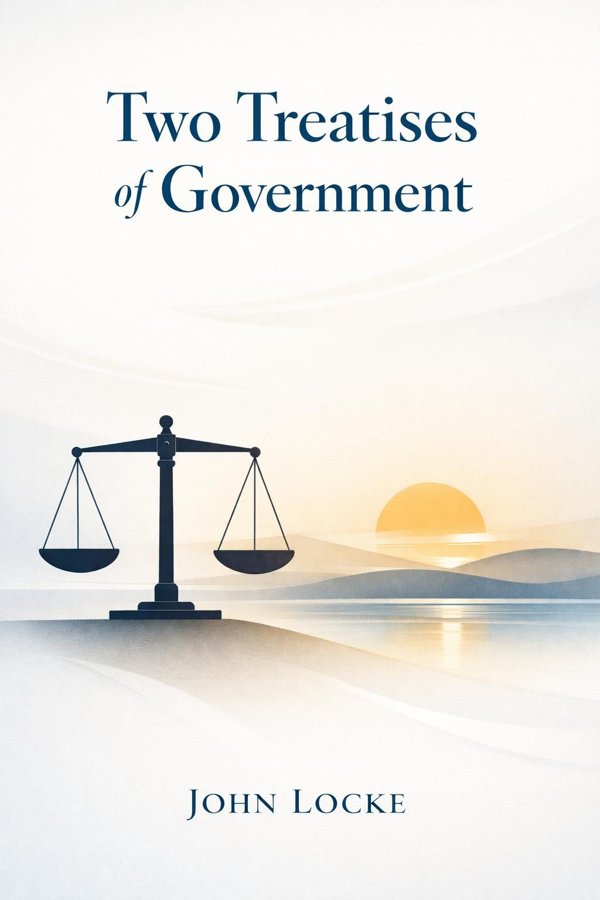
Two Treatises of Government: Summary & Key Insights
by John Locke
 10 min9 chaptersAudio available
Key Takeaways from Two Treatises of Government
A government’s deepest test is not whether it is strong, but whether it is justified.
The most radical political idea is often the simplest one: people matter before institutions do.
Ownership becomes morally meaningful when it connects to human effort.
The state is not an end in itself; it is an instrument for human security.
People do not enter society to become less free; they do so to make freedom more secure.
What Is Two Treatises of Government About?
Two Treatises of Government by John Locke is a western_phil book. John Locke’s Two Treatises of Government is one of the most influential books ever written about political power, individual freedom, and the legitimate purpose of the state. Written in the turmoil of seventeenth-century England, the work challenges the idea that kings rule by divine right and instead argues that political authority must rest on the consent of the governed. Locke asks a question that remains urgent today: what gives any government the right to command, tax, punish, or even exist? The book matters because it helped shape the moral language of modern democracy. Its ideas about natural rights, property, limited government, law, and the right to resist tyranny influenced constitutional government in Britain, America, and far beyond. Many later debates about liberty, equality, revolution, and civil society begin with Locke. Locke wrote not as a distant theorist but as a philosopher deeply engaged with the political crises of his age. His arguments combine moral reasoning, historical critique, and practical political insight. Reading Two Treatises of Government means encountering a foundational defense of human freedom and discovering why legitimate government must serve people rather than rule over them.
This FizzRead summary covers all 9 key chapters of Two Treatises of Government in approximately 10 minutes, distilling the most important ideas, arguments, and takeaways from John Locke's work. Also available as an audio summary and Key Quotes Podcast.
Two Treatises of Government
John Locke’s Two Treatises of Government is one of the most influential books ever written about political power, individual freedom, and the legitimate purpose of the state. Written in the turmoil of seventeenth-century England, the work challenges the idea that kings rule by divine right and instead argues that political authority must rest on the consent of the governed. Locke asks a question that remains urgent today: what gives any government the right to command, tax, punish, or even exist?
The book matters because it helped shape the moral language of modern democracy. Its ideas about natural rights, property, limited government, law, and the right to resist tyranny influenced constitutional government in Britain, America, and far beyond. Many later debates about liberty, equality, revolution, and civil society begin with Locke.
Locke wrote not as a distant theorist but as a philosopher deeply engaged with the political crises of his age. His arguments combine moral reasoning, historical critique, and practical political insight. Reading Two Treatises of Government means encountering a foundational defense of human freedom and discovering why legitimate government must serve people rather than rule over them.
Who Should Read Two Treatises of Government?
This book is perfect for anyone interested in western_phil and looking to gain actionable insights in a short read. Whether you're a student, professional, or lifelong learner, the key ideas from Two Treatises of Government by John Locke will help you think differently.
- ✓Readers who enjoy western_phil and want practical takeaways
- ✓Professionals looking to apply new ideas to their work and life
- ✓Anyone who wants the core insights of Two Treatises of Government in just 10 minutes
Want the full summary?
Get instant access to this book summary and 100K+ more with Fizz Moment.
Get Free SummaryAvailable on App Store • Free to download
Key Chapters
A government’s deepest test is not whether it is strong, but whether it is justified. Locke begins from this striking premise: no person is born with a natural right to rule over another. This directly rejects the old doctrine of divine-right monarchy, which claimed that kings inherited authority from God through patriarchal lines. In the First Treatise, Locke patiently dismantles that argument, especially as presented by Sir Robert Filmer. For Locke, political power cannot be defended by myth, ancestry, or sacred symbolism. It must be explained in terms of ordinary human beings who are naturally free and equal.
This insight transforms politics. If no one is born a ruler, then legitimate authority must come from some act that people can reasonably accept. That act is consent. Locke does not mean that every person signs a literal contract at birth. He means that political society is justified only when it can be understood as arising from the agreement of free individuals seeking mutual security. Government is not a family enlarged, and citizens are not children obeying a father. Political authority is a trust created for public purposes.
You can see the relevance today whenever leaders claim that tradition alone entitles them to obedience. A long history, famous family name, or overwhelming power may explain who governs, but not why they should govern. In workplaces, schools, and civic institutions, legitimacy still depends on transparent rules and the voluntary acceptance of authority within fair limits.
Actionable takeaway: whenever you evaluate a leader or institution, ask not just who holds power, but what consent-based justification gives that power legitimacy.
The most radical political idea is often the simplest one: people matter before institutions do. Locke’s state of nature is not a fantasy paradise, nor merely a brutal war zone. It is a condition in which human beings exist without a common earthly ruler, yet still live under a moral law. In that state, all are naturally free and equal, and no one has an inherent right to dominate another. Freedom, for Locke, is not lawlessness. It is independence from arbitrary human rule while remaining bound by reason and moral duty.
This matters because it means rights do not come from governments. Governments are created later, for the better protection of rights people already possess. Locke identifies core natural rights in life, liberty, and estate, often later summarized as life, liberty, and property. These are not gifts from the state. They are moral claims rooted in human nature and in the fact that individuals belong neither to a monarch nor to one another.
Locke also insists that reason teaches limits. Since all are equal, no one should harm another in life, health, liberty, or possessions. This principle undercuts tyranny but also restrains selfishness. Natural freedom is not permission to injure others; it is freedom ordered by justice.
In modern terms, this idea shapes human rights discourse, constitutional limits, and skepticism toward governments that act as though they create dignity rather than recognize it. It also influences personal ethics: even outside formal law, we still judge actions by standards of fairness, respect, and non-harm.
Actionable takeaway: treat rights as prior to convenience or power, and judge institutions by how well they protect the equal moral standing of every person.
Ownership becomes morally meaningful when it connects to human effort. Locke’s theory of property is one of the most famous parts of the Second Treatise. He begins with the claim that the earth is given in common, yet individuals can rightfully make parts of it their own. How? By mixing their labor with things found in nature. When someone cultivates unused land, gathers fruit, or creates something through work, that labor establishes a special claim. Labor turns common resources into private property.
Locke’s argument does more than defend ownership; it ties property to personhood. Since each person owns his own labor, the products of that labor are not morally detached objects. They are extensions of effort, planning, discipline, and survival. This helps explain why property rights become central to liberty. A person with no secure control over the fruits of labor is vulnerable to domination.
Still, Locke does not offer an unlimited license to accumulate. He introduces important boundaries: one should take only what one can use before it spoils, and one must leave “enough and as good” for others. Later, with the introduction of money by common consent, accumulation expands, but the moral tension remains. This is why Locke’s theory continues to provoke debate about inequality, land use, colonialism, and economic justice.
Today, the labor principle appears in discussions about entrepreneurship, wages, intellectual work, and creative ownership. If someone spends years building a business or writing software, we instinctively see a moral claim in that effort. Yet Locke also reminds us to ask whether systems of ownership leave others with genuine opportunity.
Actionable takeaway: defend property where it protects human effort and independence, but also examine whether patterns of ownership remain consistent with fairness and shared access to opportunity.
The state is not an end in itself; it is an instrument for human security. Locke argues that people leave the state of nature and form political society for a practical reason: the enjoyment of natural rights is insecure without settled law and impartial enforcement. In the state of nature, individuals may know the moral law, but each person acts as judge in his own case. This invites bias, conflict, and escalating retaliation. Government is created to remedy these inconveniences.
Its job, then, is specific and limited. A legitimate political community establishes known laws, neutral judges, and executive power to enforce them for the common good. These are not decorative features. They are the very reasons government exists. When rulers go beyond them and treat power as private property, they betray the trust placed in them.
Locke’s limited-government vision does not mean weak government in every sense. The state must be strong enough to secure peace, defend rights, and resolve disputes. But its strength must remain bounded by purpose. It cannot rightfully invade life, liberty, or property arbitrarily, because those are the very interests it was formed to protect.
This framework still organizes modern constitutional thought. Citizens expect governments to provide courts, police, defense, and public order, but they also expect rules, oversight, and legal limits. When emergency powers, surveillance, or executive action expand too far, Locke’s question returns: is this truly for the public good, or has government forgotten its reason for being?
Actionable takeaway: when assessing laws or public policies, ask whether they genuinely protect rights and the common good, or whether they extend power beyond the state’s rightful mission.
People do not enter society to become less free; they do so to make freedom more secure. Locke therefore gives law a paradoxical but essential role. Good laws do not destroy liberty. They protect it by replacing arbitrary will with stable rules. Freedom under government is not the absence of all restraint; it is living under known laws made for the public good, not under the unpredictable desires of another person.
This is a profound shift in how power is understood. Tyranny is not simply harsh government. It is the exercise of power beyond right, especially when rulers use force for private advantage rather than public benefit. A king, minister, parliament, or majority can all become tyrannical if they treat authority as unrestricted. The problem is arbitrariness, not merely rank.
Locke’s defense of the legislative power must be read alongside its limits. The legislature is supreme in the sense that it makes general rules for society, but it is not absolute. It cannot govern by sudden decrees, seize property without consent, or transfer lawmaking power to others arbitrarily. Law is legitimate only when it is general, established, and oriented toward preservation rather than domination.
The modern rule of law grows from this insight. We value published laws, due process, independent courts, and regular procedures because these prevent public life from depending on moods, favoritism, or fear. Even in organizations or families, trust grows when rules are clear and consistently applied.
Actionable takeaway: support systems that replace personal discretion with transparent, stable rules, because liberty depends less on the goodwill of rulers than on the restraint of lawful institutions.
A society cannot act as one body unless some recognized mechanism lets it decide. Locke’s answer is majority rule. Once individuals consent to form a political community, they must accept that the body politic can move only according to the will of the majority. Otherwise, the community would be permanently paralyzed. Consent creates the whole; majority decision allows the whole to function.
This is a practical and philosophical point. Locke knows that unanimous agreement on every issue is impossible. If every citizen retained a veto, no law could pass and no conflict could be resolved. Majority rule therefore becomes the operational form of collective consent. Yet it is not limitless. Majorities govern within the ends for which society was formed: the preservation of rights and the common good. They cannot justly use their numbers to destroy the basic liberties that make political society legitimate in the first place.
This balanced view remains crucial today. Democratic systems often celebrate majorities as if winning elections settles every moral question. Locke offers a correction: a majority may authorize government action, but it cannot erase the principles that justify government. Constitutional rights, legal procedures, and institutional checks exist to keep democratic power from becoming collective arbitrariness.
We see this in debates over civil liberties, minority protections, and constitutional review. A policy may be popular and still be unjust. Democracy requires both decision and restraint.
Actionable takeaway: respect majority decisions as necessary for public action, but always test them against deeper principles of rights, fairness, and the legitimate ends of political society.
Money reveals whether government sees citizens as partners or subjects. Locke argues that property cannot be taken from people without their own consent, given directly or through representatives. This principle later became central to constitutional government and revolutionary politics. Taxation is not merely an economic measure; it is a test of political legitimacy.
Why does Locke emphasize this so strongly? Because property is part of what government exists to protect. If rulers can seize wealth at will, then the social contract is hollow. Citizens would have entered society to secure their possessions only to place them at the mercy of officials. Consent to taxation, therefore, is an expression of the broader idea that public power must operate through accountable institutions rather than arbitrary demands.
Representation makes large political communities possible. People cannot all gather continuously to legislate, so they authorize lawmakers to act on their behalf. But representation is not blank permission. It is fiduciary, a trust held for the public good. When representatives use office for private enrichment or treat public resources as spoils, they violate the moral structure of government itself.
This remains intensely relevant. Debates over taxation, public spending, corruption, debt, and budget priorities still concern the same issue: are citizens being governed through accountable consent, or merely managed by distant power? The Lockean standard does not require everyone to agree with every tax policy. It requires that such policies arise from lawful, representative institutions answerable to the people.
Actionable takeaway: evaluate fiscal policy not only by what it funds, but by whether it is imposed through transparent, representative, and accountable processes.
The boldest claim in Locke’s political philosophy is that obedience has limits. Governments are formed by trust, and when that trust is fundamentally broken, people may resist. Locke does not glorify rebellion for minor grievances or personal frustration. His argument is more disciplined: when rulers systematically violate rights, subvert laws, bypass representative institutions, or place themselves above the constitutional order, they put themselves into a state of war against the people.
This idea turns the usual accusation upside down. On Locke’s view, it is not the resisting people who first dissolve political order, but the rulers who betray its foundational purpose. Resistance becomes justified not because people dislike authority, but because authority has ceased to be legitimate. The right of revolution is thus a safeguard against entrenched tyranny.
Locke also tries to answer a common fear: won’t this encourage endless instability? He thinks not. Most people tolerate much before risking upheaval. Revolution is difficult, dangerous, and uncertain. Ordinary populations do not revolt over trivial matters. They are driven to it by long patterns of abuse. In this sense, the right to resist is less a recipe for chaos than a warning to rulers: govern within law, or forfeit your claim to obedience.
Modern constitutional democracies often channel this principle through elections, impeachment, judicial review, protest, and civil resistance rather than violent uprising. Yet the core idea remains: no officeholder is above the public trust.
Actionable takeaway: take abuses of power seriously, and support lawful mechanisms of accountability before corruption hardens into tyranny.
The most enduring insight in Locke is that power is fiduciary. Government is not the owner of a nation; it is a trustee charged with preserving the lives, liberties, and property of the people. This idea quietly unifies the whole book. Consent establishes authority, law structures it, rights limit it, and public good directs it. Political office, then, is never morally private. It is held on behalf of others.
Thinking of government as trust changes how we understand citizenship as well. Citizens are not merely subjects receiving commands or consumers demanding services. They are participants in a moral and political order whose institutions must remain answerable to shared purposes. This fosters a vision of politics centered on responsibility. Legislators, judges, executives, and citizens all occupy roles within a framework of obligations.
The trust model also sharpens our sense of betrayal. Corruption, self-dealing, censorship for personal power, manipulation of elections, and attacks on lawful succession are not just policy errors. They are breaches of fiduciary duty. Locke gives us a language for seeing such acts as violations of the very basis of rule.
Beyond formal politics, this concept applies wherever authority is delegated: managers, trustees, teachers, parents, and professionals all hold power conditionally and for defined ends. Their legitimacy depends on serving those ends faithfully rather than exploiting dependence.
Actionable takeaway: view every position of authority, public or private, as a trust with clear purposes and limits, and hold both leaders and yourself accountable to that standard.
All Chapters in Two Treatises of Government
About the Author
John Locke was an English philosopher born in 1632 in Wrington, Somerset, and became one of the defining thinkers of the Enlightenment. Educated at Oxford, he studied classics, medicine, and philosophy, later working with influential political figures including Anthony Ashley Cooper, the Earl of Shaftesbury. Locke lived through periods of intense political conflict in England, and those events deeply shaped his views on liberty, government, and toleration. His major works include Two Treatises of Government, An Essay Concerning Human Understanding, and A Letter Concerning Toleration. Across these writings, he helped define modern ideas of natural rights, consent, religious toleration, and limited government. Locke died in 1704, but his influence remains central to political philosophy, constitutional thought, and democratic ideals.
Get This Summary in Your Preferred Format
Read or listen to the Two Treatises of Government summary by John Locke anytime, anywhere. FizzRead offers multiple formats so you can learn on your terms — all free.
Available formats: App · Audio · PDF · EPUB — All included free with FizzRead
Download Two Treatises of Government PDF and EPUB Summary
Key Quotes from Two Treatises of Government
“A government’s deepest test is not whether it is strong, but whether it is justified.”
“The most radical political idea is often the simplest one: people matter before institutions do.”
“Ownership becomes morally meaningful when it connects to human effort.”
“The state is not an end in itself; it is an instrument for human security.”
“People do not enter society to become less free; they do so to make freedom more secure.”
Frequently Asked Questions about Two Treatises of Government
Two Treatises of Government by John Locke is a western_phil book that explores key ideas across 9 chapters. John Locke’s Two Treatises of Government is one of the most influential books ever written about political power, individual freedom, and the legitimate purpose of the state. Written in the turmoil of seventeenth-century England, the work challenges the idea that kings rule by divine right and instead argues that political authority must rest on the consent of the governed. Locke asks a question that remains urgent today: what gives any government the right to command, tax, punish, or even exist? The book matters because it helped shape the moral language of modern democracy. Its ideas about natural rights, property, limited government, law, and the right to resist tyranny influenced constitutional government in Britain, America, and far beyond. Many later debates about liberty, equality, revolution, and civil society begin with Locke. Locke wrote not as a distant theorist but as a philosopher deeply engaged with the political crises of his age. His arguments combine moral reasoning, historical critique, and practical political insight. Reading Two Treatises of Government means encountering a foundational defense of human freedom and discovering why legitimate government must serve people rather than rule over them.
More by John Locke
You Might Also Like
A Little History of Philosophy
Nigel Warburton
10 min
Areopagitica
John Milton
10 min
How To Think Like A Philosopher: Essential Principles For Clear Thinking
Peter Cave
10 min
Language, Truth and Logic
A. J. Ayer
10 min
The Age of Reason
Thomas Paine
10 min
The Essays
Michel De Montaigne
10 minBrowse by Category
Ready to read Two Treatises of Government?
Get the full summary and 100K+ more books with Fizz Moment.