
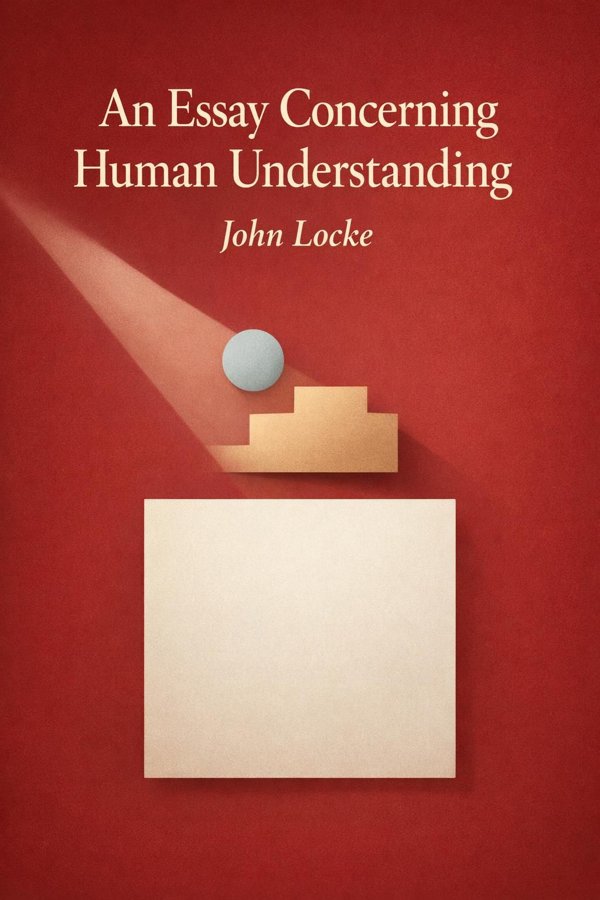
An Essay Concerning Human Understanding: Summary & Key Insights
by John Locke
 10 min4 chaptersAudio available
What Is An Essay Concerning Human Understanding About?
An Essay Concerning Human Understanding by John Locke is a western_phil book spanning 4 pages. An Essay Concerning Human Understanding is a foundational work of modern philosophy in which John Locke explores the nature and limits of human knowledge. He argues that the mind at birth is a tabula rasa, or blank slate, and that all knowledge arises from experience through sensation and reflection. The essay examines ideas, language, identity, and the distinction between primary and secondary qualities, laying the groundwork for empiricism and influencing later thinkers such as Hume and Kant.
This FizzRead summary covers all 4 key chapters of An Essay Concerning Human Understanding in approximately 10 minutes, distilling the most important ideas, arguments, and takeaways from John Locke's work. Also available as an audio summary and Key Quotes Podcast.
An Essay Concerning Human Understanding
An Essay Concerning Human Understanding is a foundational work of modern philosophy in which John Locke explores the nature and limits of human knowledge. He argues that the mind at birth is a tabula rasa, or blank slate, and that all knowledge arises from experience through sensation and reflection. The essay examines ideas, language, identity, and the distinction between primary and secondary qualities, laying the groundwork for empiricism and influencing later thinkers such as Hume and Kant.
Who Should Read An Essay Concerning Human Understanding?
This book is perfect for anyone interested in western_phil and looking to gain actionable insights in a short read. Whether you're a student, professional, or lifelong learner, the key ideas from An Essay Concerning Human Understanding by John Locke will help you think differently.
- ✓Readers who enjoy western_phil and want practical takeaways
- ✓Professionals looking to apply new ideas to their work and life
- ✓Anyone who wants the core insights of An Essay Concerning Human Understanding in just 10 minutes
Want the full summary?
Get instant access to this book summary and 100K+ more with Fizz Moment.
Get Free SummaryAvailable on App Store • Free to download
Key Chapters
Locke begins by confronting one of philosophy’s most persistent obstacles—the claim of innate ideas. Many thinkers, particularly Descartes and his followers, believed that humans are born with certain self-evident truths already impressed upon their minds: an idea of God, moral distinctions, or mathematical principles. Yet when Locke examined the workings of thought, he found no proof of such innate content. If these ideas truly existed from birth, why are children and uneducated people unaware of them? Why do notions of God and justice vary so widely across cultures? He concludes that what philosophers have called 'innate' are merely products of experience misunderstood as original imprints of the mind.
The model Locke proposes is strikingly simple yet profound: the mind is a blank sheet, and experience alone writes upon it. Experience comes in two forms. The first is *sensation*—our perception of the external world through color, sound, shape, and other qualities. The second is *reflection*—our awareness of inner mental activity, such as thinking, doubting, wanting, or suffering. Sensation reveals the outer world; reflection reveals our own. Together they form the complete origin of human knowledge.
This theory does more than explain where ideas come from—it lays the groundwork for modern science. By rooting knowledge in experience, Locke opened the door to experimental and observational inquiry. Reason, he insists, is not a substitute for experience but its instrument. Humanity’s capacity to understand grows from the interplay between sensory input and rational thought. Learning, therefore, is not the passive accumulation of data but the active engagement of mind and world. To deny experience is to deny the possibility of human growth itself.
Once the foundation of experience is in place, Locke turns to the structure of ideas themselves. If the mind is the canvas and experience the paint, then ideas are the images that emerge upon it. All ideas, he argues, fall into two categories: simple and complex. Simple ideas come directly from sensation or reflection—the color red, the feeling of cold, the act of thinking, the pain of hunger. These are the raw materials of thought, indivisible and basic. Complex ideas, on the other hand, are the mind’s creations, formed by combining, comparing, and abstracting simple ones. From these combinations arise concepts like 'apple,' 'justice,' and 'power.'
In forming complex ideas, the mind is not passive. It acts as an artist, weaving imagination and association into new forms. Through this activity we not only perceive objects but construct abstract concepts such as space, time, causation, and force. Though invisible, these ideas allow us to understand patterns in nature and formulate scientific principles.
Yet Locke underscores the limits of human knowledge. Whether dealing with material or spiritual entities, we cannot penetrate their ultimate essence. We perceive only their attributes or effects through experience. Our ideas connect us to reality, but they never capture it completely. Philosophy, therefore, should not invent fanciful theories about the world’s hidden foundations but clarify how the human mind comes to know.
Recognizing how ideas form is to understand the workings of thought itself. When we realize that each complex idea springs from the union of simpler experiences, we learn to trace our reasoning back to its origin—and avoid the confusion caused by careless abstraction. This is more than good philosophy; it is a habit of sound thinking. For in daily life, as in metaphysics, clarity begins when we return to experience.
+ 2 more chapters — available in the FizzRead app
All Chapters in An Essay Concerning Human Understanding
About the Author
John Locke (1632–1704) was an English philosopher and physician, widely regarded as one of the most influential Enlightenment thinkers. Known as the 'Father of Liberalism,' his writings on government, epistemology, and education profoundly shaped modern political philosophy and theories of knowledge.
Get This Summary in Your Preferred Format
Read or listen to the An Essay Concerning Human Understanding summary by John Locke anytime, anywhere. FizzRead offers multiple formats so you can learn on your terms — all free.
Available formats: App · Audio · PDF · EPUB — All included free with FizzRead
Download An Essay Concerning Human Understanding PDF and EPUB Summary
Key Quotes from An Essay Concerning Human Understanding
“Locke begins by confronting one of philosophy’s most persistent obstacles—the claim of innate ideas.”
“Once the foundation of experience is in place, Locke turns to the structure of ideas themselves.”
Frequently Asked Questions about An Essay Concerning Human Understanding
An Essay Concerning Human Understanding by John Locke is a western_phil book that explores key ideas across 4 chapters. An Essay Concerning Human Understanding is a foundational work of modern philosophy in which John Locke explores the nature and limits of human knowledge. He argues that the mind at birth is a tabula rasa, or blank slate, and that all knowledge arises from experience through sensation and reflection. The essay examines ideas, language, identity, and the distinction between primary and secondary qualities, laying the groundwork for empiricism and influencing later thinkers such as Hume and Kant.
More by John Locke
You Might Also Like
A Little History of Philosophy
Nigel Warburton
10 min
Areopagitica
John Milton
10 min
How To Think Like A Philosopher: Essential Principles For Clear Thinking
Peter Cave
10 min
Language, Truth and Logic
A. J. Ayer
10 min
The Age of Reason
Thomas Paine
10 min
The Essays
Michel De Montaigne
10 minBrowse by Category
Ready to read An Essay Concerning Human Understanding?
Get the full summary and 100K+ more books with Fizz Moment.