
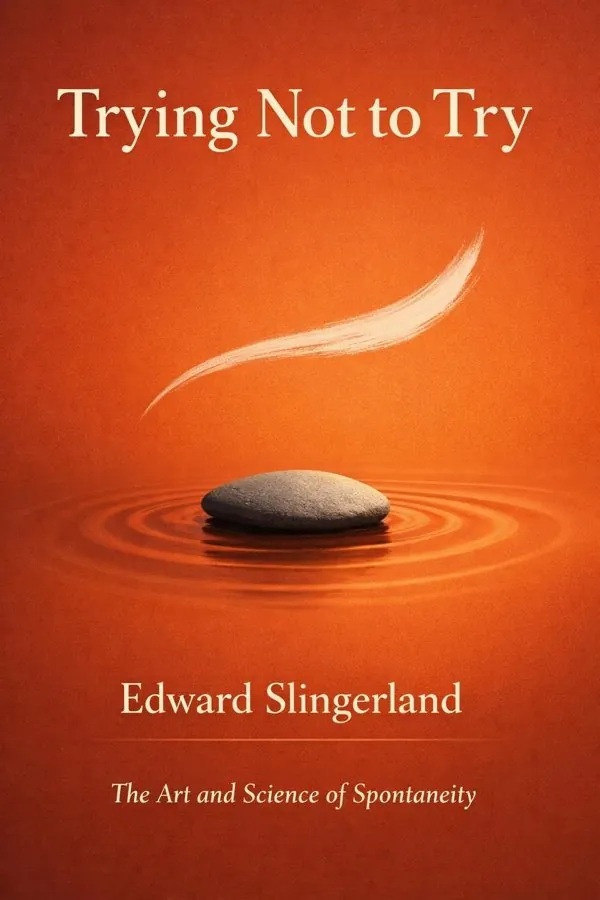
Trying Not to Try: The Art and Science of Spontaneity: Summary & Key Insights
 10 min5 chaptersAudio available
What Is Trying Not to Try: The Art and Science of Spontaneity About?
Trying Not to Try: The Art and Science of Spontaneity by Edward Slingerland is a eastern_wisdom book spanning 5 pages. In this book, Edward Slingerland explores the ancient Chinese concept of wu-wei, or effortless action, and its relevance to modern life. Drawing on insights from philosophy, cognitive science, and psychology, he examines how spontaneity and flow can lead to greater success, happiness, and authenticity. The work bridges Eastern wisdom and Western scientific understanding, offering practical guidance on how to cultivate a state of natural ease in everyday activities.
This FizzRead summary covers all 5 key chapters of Trying Not to Try: The Art and Science of Spontaneity in approximately 10 minutes, distilling the most important ideas, arguments, and takeaways from Edward Slingerland's work. Also available as an audio summary and Key Quotes Podcast.
Trying Not to Try: The Art and Science of Spontaneity
In this book, Edward Slingerland explores the ancient Chinese concept of wu-wei, or effortless action, and its relevance to modern life. Drawing on insights from philosophy, cognitive science, and psychology, he examines how spontaneity and flow can lead to greater success, happiness, and authenticity. The work bridges Eastern wisdom and Western scientific understanding, offering practical guidance on how to cultivate a state of natural ease in everyday activities.
Who Should Read Trying Not to Try: The Art and Science of Spontaneity?
This book is perfect for anyone interested in eastern_wisdom and looking to gain actionable insights in a short read. Whether you're a student, professional, or lifelong learner, the key ideas from Trying Not to Try: The Art and Science of Spontaneity by Edward Slingerland will help you think differently.
- ✓Readers who enjoy eastern_wisdom and want practical takeaways
- ✓Professionals looking to apply new ideas to their work and life
- ✓Anyone who wants the core insights of Trying Not to Try: The Art and Science of Spontaneity in just 10 minutes
Want the full summary?
Get instant access to this book summary and 100K+ more with Fizz Moment.
Get Free SummaryAvailable on App Store • Free to download
Key Chapters
Let me start by acknowledging the paradox directly. We value spontaneity, yet we routinely strive for it. We want to be genuine yet fear being judged; we want to perform well yet worry that thinking too much will sabotage us. Classical Chinese thinkers confronted the same dilemma over 2,000 years ago. They called the effortless state wu-wei, and they saw it not as laziness but as dynamic harmony between self and world.
This tension between effort and ease is no small matter—it defines much of human life. Confucius spoke about becoming virtuous naturally, not through constant self-correction but through the deep internalization of moral habits. The goal, he said, was that a person eventually does the right thing without having to choose it consciously. Laozi and Zhuangzi, the Daoists, viewed the same state from another angle: they saw control itself as the obstacle. The more we strain to master the world, the further we drift from its spontaneous order.
Modern psychology mirrors these insights. We know now that conscious control consumes tremendous cognitive energy. When we over-monitor or overthink, we disrupt automatic processes that have evolved to handle complexity quickly and smoothly. The paradox of trying not to try is universal: the moment we focus on relaxing, our relaxation turns forced. The path to genuine spontaneity must therefore bypass conscious striving—it requires trust in something deeper than the analytical mind.
Throughout this book, I map out how that paradox has been handled by sages, scientists, and moral philosophers alike. We’ll see that the resolution lies not in abandoning effort but in transforming its structure—from deliberate control into embodied confidence.
At the heart of Chinese philosophy lies wu-wei. Both Confucianism and Daoism treat it as an ideal of personal and social harmony. For Confucius, wu-wei was the crown of moral cultivation. The true gentleman, shaped through years of ritual and empathy, reaches a stage where ethical behavior flows from him naturally. In that state, deliberate action becomes spontaneous—in moral terms, one acts rightly without calculation.
Daoists approached it differently. Laozi saw wu-wei as cosmic alignment, a return to the Dao’s effortless rhythm. Trying too hard violates the world’s order; letting go restores it. Zhuangzi went further, teasing us with stories of butchers and craftsmen who act in perfect harmony with their tools. Their mastery isn’t deliberate—it is born of deep familiarity and surrender to the moment.
In my reading of these traditions, I show how they represent distinct yet complementary strategies. The Confucian path is gradual, the Daoist path instinctive. One polishes the self until it becomes mirror-like; the other dissolves the self until it merges with nature. Both understand that real spontaneity cannot be faked. Moral sincerity and natural grace must arise from within.
What fascinates me as a scholar of both philosophy and cognitive science is how these ancient models prefigure modern psychological ideas. Confucius’s gradual habituation anticipates modern theories of implicit learning. Zhuangzi’s effortless skill evokes the neuroscience of flow states and procedural memory. Across centuries and cultures, wu-wei describes the same phenomenon: the harmony that occurs when moral clarity, skill, and emotional trust synchronize below conscious control.
+ 3 more chapters — available in the FizzRead app
All Chapters in Trying Not to Try: The Art and Science of Spontaneity
About the Author
Edward Slingerland is a professor of philosophy and Asian studies at the University of British Columbia. His research focuses on early Chinese thought, cognitive science, and the relationship between science and the humanities. He is known for his interdisciplinary approach to understanding human behavior and cultural evolution.
Get This Summary in Your Preferred Format
Read or listen to the Trying Not to Try: The Art and Science of Spontaneity summary by Edward Slingerland anytime, anywhere. FizzRead offers multiple formats so you can learn on your terms — all free.
Available formats: App · Audio · PDF · EPUB — All included free with FizzRead
Download Trying Not to Try: The Art and Science of Spontaneity PDF and EPUB Summary
Key Quotes from Trying Not to Try: The Art and Science of Spontaneity
“Let me start by acknowledging the paradox directly.”
“At the heart of Chinese philosophy lies wu-wei.”
Frequently Asked Questions about Trying Not to Try: The Art and Science of Spontaneity
Trying Not to Try: The Art and Science of Spontaneity by Edward Slingerland is a eastern_wisdom book that explores key ideas across 5 chapters. In this book, Edward Slingerland explores the ancient Chinese concept of wu-wei, or effortless action, and its relevance to modern life. Drawing on insights from philosophy, cognitive science, and psychology, he examines how spontaneity and flow can lead to greater success, happiness, and authenticity. The work bridges Eastern wisdom and Western scientific understanding, offering practical guidance on how to cultivate a state of natural ease in everyday activities.
You Might Also Like
A New Earth
Eckhart Tolle
10 min
The Daily Stoic
Ryan Holiday, Stephen Hanselman
10 min
Buddhism: Plain and Simple
Steve Hagen
10 min
Enchiridion
Epictetus
10 min
The Book of Tea
Kakuzō Okakura
10 min
The Light We Give: How Sikh Wisdom Can Transform Your Life
Simran Jeet Singh
10 minBrowse by Category
Ready to read Trying Not to Try: The Art and Science of Spontaneity?
Get the full summary and 100K+ more books with Fizz Moment.