
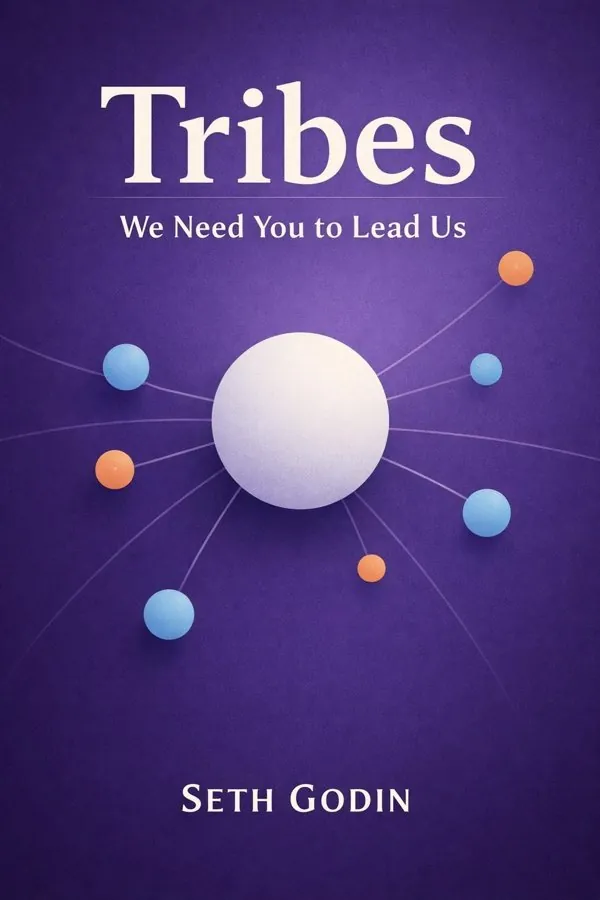
Tribes: Summary & Key Insights
by Seth Godin
 10 min9 chaptersAudio available
Key Takeaways from Tribes
The most important leaders today are often the ones with the fewest formal credentials.
Comfort is often the greatest enemy of progress.
People do not join tribes only because of products, plans, or incentives—they join because they believe.
A tribe does not become powerful because one person broadcasts instructions.
The greatest obstacle to leadership is rarely a lack of resources.
What Is Tribes About?
Tribes by Seth Godin is a leadership book published in 2008 spanning 7 pages. Tribes by Seth Godin is a sharp, motivating book about a new kind of leadership—one that has less to do with titles, status, or formal authority, and everything to do with connection, courage, and shared purpose. Godin argues that human beings naturally gather in groups around ideas, identities, and causes. In the past, organizing those groups required institutions, money, or media power. Today, the internet makes it possible for almost anyone to unite people, spread a message, and start a movement. That shift changes what leadership looks like. Rather than waiting to be chosen, promoted, or given permission, Godin urges readers to step forward and lead. A leader, in his view, is simply someone who helps people connect to one another and move toward something meaningful. The book matters because it reframes leadership as accessible, urgent, and deeply human. It is especially relevant in a world shaped by online communities, niche audiences, and rapid change. Godin’s authority comes from decades of work in marketing, entrepreneurship, and idea-spreading, making Tribes both a practical guide and a call to action for anyone who wants to make a difference.
This FizzRead summary covers all 9 key chapters of Tribes in approximately 10 minutes, distilling the most important ideas, arguments, and takeaways from Seth Godin's work. Also available as an audio summary and Key Quotes Podcast.
Tribes
Tribes by Seth Godin is a sharp, motivating book about a new kind of leadership—one that has less to do with titles, status, or formal authority, and everything to do with connection, courage, and shared purpose. Godin argues that human beings naturally gather in groups around ideas, identities, and causes. In the past, organizing those groups required institutions, money, or media power. Today, the internet makes it possible for almost anyone to unite people, spread a message, and start a movement. That shift changes what leadership looks like.
Rather than waiting to be chosen, promoted, or given permission, Godin urges readers to step forward and lead. A leader, in his view, is simply someone who helps people connect to one another and move toward something meaningful. The book matters because it reframes leadership as accessible, urgent, and deeply human. It is especially relevant in a world shaped by online communities, niche audiences, and rapid change. Godin’s authority comes from decades of work in marketing, entrepreneurship, and idea-spreading, making Tribes both a practical guide and a call to action for anyone who wants to make a difference.
Who Should Read Tribes?
This book is perfect for anyone interested in leadership and looking to gain actionable insights in a short read. Whether you're a student, professional, or lifelong learner, the key ideas from Tribes by Seth Godin will help you think differently.
- ✓Readers who enjoy leadership and want practical takeaways
- ✓Professionals looking to apply new ideas to their work and life
- ✓Anyone who wants the core insights of Tribes in just 10 minutes
Want the full summary?
Get instant access to this book summary and 100K+ more with Fizz Moment.
Get Free SummaryAvailable on App Store • Free to download
Key Chapters
Comfort is often the greatest enemy of progress. Godin argues that tribes do not form around maintenance; they form around transformation. People follow leaders who are willing to question assumptions, reject stale systems, and imagine a better path forward. The status quo survives not because it is always effective, but because it feels familiar. Institutions reward compliance, and many people learn early that fitting in is safer than speaking up. Yet meaningful change almost always begins with someone who is willing to be uncomfortable.
In Tribes, leadership is closely tied to dissent—not rebellion for its own sake, but thoughtful refusal to accept what no longer works. A leader says, “There is another way,” and then invites others to believe it too. This can happen in business, education, social causes, or creative work. A manager who redesigns a broken customer experience, a doctor who advocates for a more humane system, or a community organizer who rethinks local engagement is challenging the status quo in a constructive way.
What makes this powerful is that opposition often reveals hidden tribes. Many people privately feel frustrated by inefficient, outdated, or uninspiring systems, but they remain silent until someone names the truth. Once that happens, a scattered group becomes a community. The leader gives them language, focus, and permission to act.
Still, challenging the norm requires care. Not every disruption is wise. Godin’s point is that leaders challenge for the sake of progress and belonging, not ego. They offer an alternative that others can rally around.
Actionable takeaway: identify one default assumption in your work or community that everyone accepts without question. Test it. Ask what would happen if it changed, then share a specific, credible alternative with the people most affected.
People do not join tribes only because of products, plans, or incentives—they join because they believe. Godin emphasizes that belief is the emotional glue of any movement. Shared belief turns a collection of individuals into a committed group with identity, purpose, and energy. Without belief, people may pay attention briefly, but they will not stay loyal, contribute effort, or help spread the message.
This is why great leaders do more than communicate information. They articulate meaning. They help people see what the tribe stands for, what it rejects, and why membership matters. Belief gives people a sense of belonging and significance. Think of brands that become communities, nonprofits that mobilize volunteers, or creators who build devoted audiences. Their followers are not just consuming; they are participating in a story they care about.
Belief also simplifies decision-making. When a tribe shares clear values, members know how to act even when the leader is absent. A company that truly believes in customer delight behaves differently from one that merely posts slogans. A fitness community built on discipline and mutual support creates very different habits than one focused only on appearance. In each case, belief shapes culture.
To build belief, leaders must be authentic and specific. Vague inspiration rarely lasts. People need a real point of view. What do you stand for? Why does it matter now? What kind of people belong here? The stronger and clearer the answers, the stronger the tribe becomes.
Actionable takeaway: write a short belief statement for your team, project, or community. Keep it concrete: what you believe, what you refuse to accept, and what members are invited to help create. Then repeat it consistently until it becomes part of the group’s identity.
A tribe does not become powerful because one person broadcasts instructions. It becomes powerful because members connect with one another. Godin highlights a major shift in modern leadership: the leader’s job is not merely to communicate to the group, but to create conditions where the group communicates among itself. That is what turns an audience into a tribe.
In older systems, organizations relied on one-way messaging. Companies advertised, bosses instructed, institutions announced. But tribes thrive on interaction. Members share experiences, reinforce norms, solve problems, and deepen commitment when they can talk to each other. This is why communities built around discussion boards, group chats, events, and social media can become so resilient. The leader starts the conversation, but the tribe grows when members feel seen and connected.
This matters for anyone building a movement. If you run a business, don’t just market to customers—give them ways to engage with each other. If you lead inside an organization, create spaces for colleagues to collaborate across silos. If you teach, let students learn from peers rather than depending only on lectures. Every strong tribe has networks, not just followers.
Godin’s insight also warns against overcontrol. Leaders who micromanage every message may preserve consistency, but they often suppress real energy. People support what they help shape. A healthy tribe gives members room to contribute, adapt, and strengthen the culture themselves.
Actionable takeaway: build one channel where members of your audience, team, or community can connect directly with each other. Then nurture participation by asking questions, highlighting contributions, and rewarding meaningful interaction rather than only top-down compliance.
The greatest obstacle to leadership is rarely a lack of resources. More often, it is fear. Godin repeatedly points to the internal resistance that keeps people from stepping forward: fear of criticism, fear of failure, fear of standing out, and fear of not being ready. Many people wait for certainty, authority, or universal approval before acting. But tribes are not built by people who feel perfectly safe. They are built by people who move despite discomfort.
This resistance is deeply human. We are wired to seek belonging, and leading often risks rejection. Starting a movement means making a claim in public. It means saying, “This matters,” before everyone agrees. That can feel vulnerable. In workplaces, people fear being labeled difficult. In creative fields, they fear judgment. In communities, they fear indifference. Godin’s point is not that fear disappears, but that leadership begins when fear stops making decisions.
Understanding resistance is useful because it helps you interpret hesitation correctly. If you find yourself endlessly refining a plan, waiting for better timing, or hiding behind busyness, the issue may not be strategy—it may be avoidance. Likewise, when others resist your idea, they may not be disagreeing with the mission itself. They may simply be attached to comfort and routine.
The practical response is to lower the threshold for action. Instead of launching a perfect revolution, start with a small act of visible leadership: a post, a meeting, a prototype, a conversation, an invitation. Small acts build confidence and attract others.
Actionable takeaway: name one fear that is currently delaying your leadership. Then choose a small, public step you can take within 48 hours that moves your idea forward before resistance can talk you out of it.
An idea may be brilliant, but until people act on it, it is only potential. Godin insists that tribes are built through motion. Leaders do not simply think differently; they create momentum by encouraging concrete participation. This is one reason many smart people never become influential: they remain commentators rather than catalysts.
Action matters because it changes identity. Once someone contributes, attends, shares, volunteers, buys in, or publicly aligns with a cause, they begin to see themselves as part of the tribe. Participation creates investment. That is why effective leaders ask for meaningful, manageable actions early. They do not just say, “Believe this.” They say, “Join us here, sign up now, share your story, bring a friend, start today.”
This principle applies broadly. In a company, a leader trying to shift culture should not only present values in a slide deck; they should create rituals, responsibilities, and behaviors that make the change visible. In a community project, don’t just raise awareness—schedule the volunteer day, assign roles, and celebrate completions. In personal branding or content creation, don’t just post ideas—invite subscribers, host discussion sessions, or launch a challenge that gets people involved.
Godin’s insight is that action is contagious. When people see others doing something, uncertainty decreases and belonging increases. The tribe starts to feel real. Leaders create this momentum by reducing friction and making the next step obvious.
Actionable takeaway: for the tribe you want to build, define one simple action a new member can take within five minutes. Make it easy, visible, and meaningful so people move from passive interest to active participation immediately.
You do not need millions of followers to lead a tribe. One of the most empowering ideas in Tribes is that leadership can begin with a small group of committed people. In fact, many influential movements start at the edges, not the center. Godin argues that the internet has made it radically easier to find scattered individuals who care about the same thing, connect them, and help them grow into a community.
This changes the economics of influence. In the past, reaching people often required gatekeepers such as publishers, broadcasters, political machines, or large companies. Now a niche newsletter, online community, local meetup, or podcast can gather people around highly specific interests and values. A tribe of 100 engaged members can be more powerful than an audience of 10,000 passive observers because commitment matters more than scale in the early stages.
Expansion happens when members feel ownership and pride. If your tribe gives people identity, purpose, and a way to contribute, they naturally invite others. This is why niche movements often grow faster than generic ones. They speak directly to a real need or belief. A sustainable fashion community, a remote-work network, or a local parents’ advocacy group can expand quickly because the mission is clear and personal.
Godin also reminds us that tribes are universal. Every field, organization, and cause contains potential tribes waiting to be activated. The question is not whether people want to belong; they do. The question is whether someone will lead.
Actionable takeaway: stop waiting for a massive audience. Gather a small core group around a specific purpose, create a regular rhythm of communication, and help early members connect deeply enough that growth becomes organic.
Technology did not create tribes, but it dramatically changed how they form, spread, and sustain themselves. Godin’s book is rooted in the idea that the internet removed barriers that once kept ordinary people from leading. Communication used to be expensive and centralized. Now it is instant, global, and often free. This means movements can emerge from anywhere, often faster than traditional institutions can respond.
The deeper point is not just about tools, but about leverage. A blog post, video, email list, or online group can connect people who would never meet otherwise. Someone with a strong idea can gather supporters across geography, profession, age, or background. That makes modern leadership less dependent on permission and more dependent on clarity and consistency.
But the internet also creates noise. Because anyone can publish, attention is scarce. That means tribes do not grow simply because content exists. They grow when communication is purposeful, human, and repeated over time. People need to know what the tribe stands for, what participation looks like, and why the mission matters. Leaders who use digital tools well are not necessarily the loudest; they are the ones who create trust and belonging.
For practical application, this means choosing platforms intentionally. An email list may be better than a crowded social feed for deeper engagement. A private community may build stronger relationships than public broadcasting alone. The best channel depends on the tribe’s behavior and goals.
Actionable takeaway: audit your current communication tools and choose one primary digital channel that best supports trust, dialogue, and repeated contact. Use it consistently to unite people around a clear idea rather than trying to be everywhere at once.
At its best, leadership is not self-promotion—it is service. Although Tribes is often remembered as a book about influence, Godin’s deeper message is that genuine leaders give more than they take. They create possibility for others. They make people feel seen, connected, and capable of contributing to something larger than themselves. A tribe follows because the leader serves the mission and the members, not because the leader wants attention.
This matters because charisma alone is fragile. If leadership is built only on personal image, the tribe weakens when the spotlight shifts. But when leadership is built on generosity—sharing ideas, making introductions, opening doors, creating opportunities—the community becomes stronger and more durable. Members trust the leader because they feel the relationship is real.
Service also changes how decisions are made. A generous leader asks, “What does the tribe need to grow?” rather than “How do I protect my status?” This could mean highlighting other voices, handing off responsibility, listening closely to feedback, or designing structures that let the group thrive independently. In companies, service-oriented leaders remove obstacles so teams can do meaningful work. In communities, they create spaces where people feel welcome and useful.
Godin’s version of leadership is not passive kindness; it is active contribution. Service gives moral weight to influence. It keeps the mission from becoming manipulation.
Actionable takeaway: identify one way you can serve your tribe this week without direct personal gain—share a resource, connect two members, spotlight someone else’s work, or remove a barrier that makes participation harder. Leadership grows stronger when people feel helped, not handled.
All Chapters in Tribes
About the Author
Seth Godin is an American author, entrepreneur, marketer, and speaker known for reshaping how people think about ideas, influence, and leadership. He founded Yoyodyne, an early internet marketing company later acquired by Yahoo, and has launched several other ventures, including Squidoo. Godin became one of the most influential voices in modern business writing through bestselling books such as Purple Cow, Tribes, Linchpin, The Dip, and This Is Marketing. His work often focuses on creativity, remarkability, audience-building, and the courage to challenge conventional systems. Known for his clear style and bold insights, Godin has helped entrepreneurs, leaders, and creators understand how to build meaningful connections and spread ideas that matter. He is also widely followed for his daily writing, workshops, and long-standing contributions to business and leadership thinking.
Get This Summary in Your Preferred Format
Read or listen to the Tribes summary by Seth Godin anytime, anywhere. FizzRead offers multiple formats so you can learn on your terms — all free.
Available formats: App · Audio · PDF · EPUB — All included free with FizzRead
Download Tribes PDF and EPUB Summary
Key Quotes from Tribes
“The most important leaders today are often the ones with the fewest formal credentials.”
“Comfort is often the greatest enemy of progress.”
“People do not join tribes only because of products, plans, or incentives—they join because they believe.”
“A tribe does not become powerful because one person broadcasts instructions.”
“The greatest obstacle to leadership is rarely a lack of resources.”
Frequently Asked Questions about Tribes
Tribes by Seth Godin is a leadership book that explores key ideas across 9 chapters. Tribes by Seth Godin is a sharp, motivating book about a new kind of leadership—one that has less to do with titles, status, or formal authority, and everything to do with connection, courage, and shared purpose. Godin argues that human beings naturally gather in groups around ideas, identities, and causes. In the past, organizing those groups required institutions, money, or media power. Today, the internet makes it possible for almost anyone to unite people, spread a message, and start a movement. That shift changes what leadership looks like. Rather than waiting to be chosen, promoted, or given permission, Godin urges readers to step forward and lead. A leader, in his view, is simply someone who helps people connect to one another and move toward something meaningful. The book matters because it reframes leadership as accessible, urgent, and deeply human. It is especially relevant in a world shaped by online communities, niche audiences, and rapid change. Godin’s authority comes from decades of work in marketing, entrepreneurship, and idea-spreading, making Tribes both a practical guide and a call to action for anyone who wants to make a difference.
More by Seth Godin




You Might Also Like

Extreme Ownership
Jocko Willink
10 min
Dare to Lead
Brene Brown
10 min
Leaders Eat Last
Simon Sinek
10 min
The 21 Irrefutable Laws of Leadership
John Maxwell
10 min
Start With Why
Simon Sinek
10 min
How to Lead When You're Not in Charge
Clay Scroggins
10 minBrowse by Category
Ready to read Tribes?
Get the full summary and 100K+ more books with Fizz Moment.