
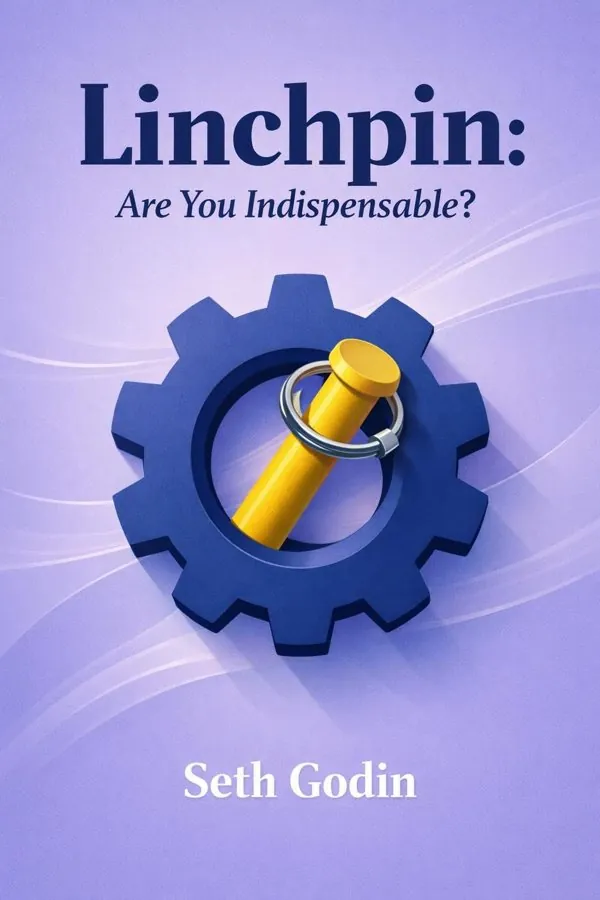
Linchpin: Summary & Key Insights
by Seth Godin
 10 min9 chaptersAudio available
Key Takeaways from Linchpin
Most people do not fail to become indispensable because they lack talent; they fail because fear convinces them to stay small.
A linchpin is not simply a high performer.
Godin expands the meaning of art far beyond painting, music, or design.
One of Godin’s most memorable ideas is the “lizard brain,” his term for the primitive part of the mind that seeks safety, status preservation, and avoidance of risk.
A linchpin does not hoard value; a linchpin creates value by giving it away.
What Is Linchpin About?
Linchpin by Seth Godin is a career book published in 2010 spanning 8 pages. In Linchpin: Are You Indispensable?, Seth Godin argues that the most valuable people at work are no longer the ones who simply follow instructions well—they are the ones who bring originality, courage, and humanity to what they do. In a world where routine tasks can be outsourced, automated, or standardized, the true competitive advantage belongs to people who solve interesting problems, connect others, and contribute emotional energy that cannot be replaced by a manual. Godin calls these people “linchpins”: individuals whose judgment, initiative, and generosity make them essential. This book matters because it reframes career success. Instead of chasing security through obedience, Godin urges readers to create security by becoming remarkable. He explores why fear holds people back, how industrial-era thinking still shapes modern workplaces, and why art—meaning emotional labor and meaningful contribution—has become central to professional life. Known for influential books such as Purple Cow and Tribes, Godin brings his signature mix of marketing insight, cultural observation, and practical provocation. Linchpin is both a critique of outdated work habits and a call to do work that matters.
This FizzRead summary covers all 9 key chapters of Linchpin in approximately 10 minutes, distilling the most important ideas, arguments, and takeaways from Seth Godin's work. Also available as an audio summary and Key Quotes Podcast.
Linchpin
In Linchpin: Are You Indispensable?, Seth Godin argues that the most valuable people at work are no longer the ones who simply follow instructions well—they are the ones who bring originality, courage, and humanity to what they do. In a world where routine tasks can be outsourced, automated, or standardized, the true competitive advantage belongs to people who solve interesting problems, connect others, and contribute emotional energy that cannot be replaced by a manual. Godin calls these people “linchpins”: individuals whose judgment, initiative, and generosity make them essential.
This book matters because it reframes career success. Instead of chasing security through obedience, Godin urges readers to create security by becoming remarkable. He explores why fear holds people back, how industrial-era thinking still shapes modern workplaces, and why art—meaning emotional labor and meaningful contribution—has become central to professional life. Known for influential books such as Purple Cow and Tribes, Godin brings his signature mix of marketing insight, cultural observation, and practical provocation. Linchpin is both a critique of outdated work habits and a call to do work that matters.
Who Should Read Linchpin?
This book is perfect for anyone interested in career and looking to gain actionable insights in a short read. Whether you're a student, professional, or lifelong learner, the key ideas from Linchpin by Seth Godin will help you think differently.
- ✓Readers who enjoy career and want practical takeaways
- ✓Professionals looking to apply new ideas to their work and life
- ✓Anyone who wants the core insights of Linchpin in just 10 minutes
Want the full summary?
Get instant access to this book summary and 100K+ more with Fizz Moment.
Get Free SummaryAvailable on App Store • Free to download
Key Chapters
Most people do not fail to become indispensable because they lack talent; they fail because fear convinces them to stay small. Godin begins with a blunt truth: the biggest barrier to meaningful work is not external competition but internal hesitation. We hold back ideas, avoid responsibility, and choose safe tasks because we fear criticism, rejection, and the possibility of being wrong. In traditional workplaces, that fear often masquerades as professionalism. We call it being realistic, staying in our lane, or waiting for permission.
Godin argues that this fear is deeply connected to the old industrial model of work. For generations, workers were rewarded for compliance, consistency, and not making trouble. But in today’s economy, those traits no longer guarantee safety. If your role is purely to follow instructions, someone cheaper, faster, or automated can likely do it too. Ironically, the attempt to avoid risk becomes the greatest risk.
Consider a team member who notices a flaw in a customer experience but says nothing because it is “not my department.” Compare that with someone who speaks up, proposes a fix, and coordinates others to solve it. The second person may feel more exposed, but they also become more valuable. The same applies to freelancers, managers, teachers, designers, and entrepreneurs. The people who advance are not always the most credentialed; they are often the ones willing to contribute before certainty arrives.
Godin’s point is not that fear disappears. It is that fear becomes manageable once you recognize it as a predictable force, not a command. Action builds courage faster than analysis does.
Actionable takeaway: Identify one place where fear is making you play small this week, and contribute visibly anyway—share the idea, volunteer for the problem, or make the generous move before you feel fully ready.
A linchpin is not simply a high performer. A linchpin is someone whose presence changes what is possible for a team, a project, or an organization. Godin uses the term to describe people who create unique value through judgment, initiative, trust, and connection. They are not indispensable because of title or authority alone. They matter because they make things better in ways that cannot be fully scripted.
This is an important distinction. Many employees complete tasks efficiently, but linchpins interpret situations, solve problems others avoid, and bring emotional intelligence into the room. They connect departments, calm difficult clients, spot opportunities, and elevate the standard of work. In other words, they do not merely execute the system; they improve it. They also often act without waiting to be told, which is why they are remembered.
You can see this in every industry. In healthcare, it might be a nurse who notices a patient’s unspoken anxiety and coordinates a better experience. In retail, it could be an employee who turns an ordinary customer interaction into loyalty through empathy and initiative. In software, it may be a developer who not only writes code but translates user pain into better product decisions. Their role may be ordinary on paper, but their contribution is not.
Godin emphasizes that becoming a linchpin is available to almost anyone. It is not reserved for artists, founders, or extroverts. It begins when you stop asking, “What is the minimum required?” and start asking, “What can I uniquely contribute here?” That shift transforms work from compliance into contribution.
Actionable takeaway: Write down three ways your work affects other people beyond your task list, then choose one area where you can add initiative, clarity, or generosity that no checklist currently requires.
Godin expands the meaning of art far beyond painting, music, or design. In Linchpin, art is any work infused with judgment, creativity, and emotional labor that changes another person. Art happens when a teacher truly reaches a student, when a customer support rep turns frustration into trust, or when a manager creates conditions for people to do their best work. The point is not self-expression for its own sake. The point is contribution that carries human intent.
This idea challenges a major workplace assumption: that value comes mainly from flawless execution. Godin argues that execution matters, but what organizations need most now is work that cannot be reduced to a procedure. Art lives in ambiguity. It appears when there is no map, no script, and no guaranteed reward. That is why it is difficult—and why it matters.
Emotional labor is central here. It means doing the interpersonal and psychological work required to lead, connect, reassure, empathize, and create meaning. A barista who remembers a regular customer’s difficult week is doing emotional labor. A project lead who absorbs tension and helps a team regain focus is doing emotional labor. A consultant who tells a client a difficult truth with care is making art. These acts are easy to dismiss because they are hard to measure, yet they often determine whether work becomes memorable and effective.
For many people, the challenge is permission. They assume art belongs to “creative types” and that their real job is simply to be efficient. Godin rejects that false divide. If your work touches people, you have opportunities to make art.
Actionable takeaway: In your next interaction at work, ask not just “How do I complete this?” but “How can I make this more thoughtful, human, or transformative for the person on the other side?”
One of Godin’s most memorable ideas is the “lizard brain,” his term for the primitive part of the mind that seeks safety, status preservation, and avoidance of risk. The lizard brain is not evil; it is protective. But in modern creative work, its advice is often destructive. It whispers that you should delay the launch, avoid the bold idea, keep the draft hidden, and never risk embarrassment. It interprets visibility as danger and originality as threat.
This inner resistance becomes especially powerful when the work matters. Routine tasks rarely trigger it strongly. But the moment you create something that exposes your taste, your judgment, or your vulnerability, resistance intensifies. That is why a person can answer emails all day yet freeze when it is time to pitch a proposal, publish a piece of writing, or have a hard conversation. The issue is not laziness. It is psychological self-protection.
Godin encourages readers to name this pattern rather than confuse it with truth. The lizard brain often sounds rational: “It’s not ready.” “Now isn’t the time.” “Someone more qualified should do it.” Yet many of these thoughts are simply fear dressed as prudence. The solution is not endless confidence-building. It is developing the discipline to act despite the noise.
Practical methods help. Break important work into smaller public commitments. Set deadlines that force shipping. Use rituals to begin before your emotions agree. Notice which tasks you mysteriously postpone, because they often point toward work that matters most. Over time, the goal is not to eliminate resistance but to stop obeying it.
Actionable takeaway: Choose one meaningful task you have been postponing, label the resistance behind the delay, and complete the smallest visible version of it within the next 24 hours.
A linchpin does not hoard value; a linchpin creates value by giving it away. Godin draws on the idea of a gift economy to show that some of the most powerful professional contributions are made without immediate calculation. Gifts at work are not about being naive or underpricing yourself. They are acts of generosity that deepen trust, strengthen relationships, and make your contribution memorable.
Examples of gifts include sharing insight freely, making a thoughtful introduction, improving a process no one asked you to fix, or bringing care to an interaction that could have remained transactional. When done sincerely, these gestures create goodwill and expand your influence. People remember those who consistently make things easier, clearer, or more meaningful.
This runs against a narrow, transactional view of career advancement. Many people are trained to ask, “What do I get if I do this?” Godin argues that this mindset limits possibility. Linchpins often lead through generosity because generosity demonstrates abundance, confidence, and commitment. It signals that your identity is larger than your job description.
That does not mean saying yes to everything or allowing exploitation. Strategic generosity still requires boundaries. A gift is powerful because it is freely offered, not resentfully extracted. The healthiest version of this principle is to give where you can create genuine impact and where the act reflects who you want to be.
A consultant might send a client a useful idea that is not billable. A team member might help a colleague prepare for a presentation without needing credit. A creator might publish work that educates others before asking for a sale. These acts compound reputation.
Actionable takeaway: Give one professional gift this week—an insight, a connection, a refinement, or a thoughtful act—that creates real value without demanding an immediate return.
In hierarchical workplaces, power traditionally came from position. In Godin’s view, modern influence increasingly comes from connection. Linchpins become central not because they command people, but because they link ideas, departments, clients, communities, and opportunities. They act as bridges in systems that are often fragmented. This ability to connect is a form of leadership even when no formal authority exists.
Organizations desperately need such people. Silos create delays, misunderstandings, and missed opportunities. Someone who can translate between technical and nontechnical teams, align stakeholders around a shared purpose, or spot the human issue beneath the operational issue creates immense value. These connectors reduce friction. They help information move, trust grow, and decisions improve.
The rise of networks makes this skill even more important. Careers are no longer built solely inside a single company ladder. Reputation travels through communities, social platforms, partnerships, and peer circles. People who contribute meaningfully to networks often gain opportunities that job titles alone cannot produce. They become known as people who help, organize, interpret, and catalyze.
This does not require constant socializing or personal branding theater. Godin’s point is deeper: connection is about caring enough to create meaningful relationships and shared movement. A quiet analyst who clarifies cross-functional confusion may be just as much a connector as an outspoken community leader. The common trait is relational usefulness.
To develop this capability, pay attention to where disconnects exist. Who needs to know each other? What perspective is missing? Where is tension caused by misunderstanding rather than disagreement? People who consistently answer those questions become indispensable.
Actionable takeaway: Map one important network around your work—team, clients, partners, peers—and make one deliberate move to strengthen it by introducing, clarifying, or aligning people who would benefit from being better connected.
One of Godin’s sharpest critiques is aimed at the educational and cultural systems that prepared many people for a world that no longer exists. The industrial era needed compliant workers who could show up on time, follow instructions, and perform standardized tasks. Schools were designed accordingly: sit still, memorize the material, avoid mistakes, and wait to be evaluated. That training shaped not only what people know, but how they think about work itself.
The problem is that modern work increasingly rewards the opposite qualities. Today, many of the most valuable contributions come from initiative, experimentation, problem-solving, and independent judgment. Yet countless adults still carry a factory mindset into offices, studios, classrooms, and startups. They wait to be told what matters. They avoid ambiguity. They assume the correct path is the approved one.
Godin does not dismiss discipline or skill. Rather, he argues that these traits are insufficient when detached from creativity and responsibility. A person may be highly educated and still professionally passive. Conversely, someone with less formal prestige may thrive by seeing opportunities others overlook and acting on them.
This idea is liberating because it reveals that career reinvention is not always about acquiring another credential. Sometimes it begins by unlearning obedience. That might mean asking better questions, proposing improvements instead of reporting problems, or treating your role as a platform for contribution rather than a set of instructions.
For managers and educators, the implication is profound: if you want linchpins, do not merely reward compliance. Reward initiative, thoughtful risk-taking, and useful originality.
Actionable takeaway: Notice one “school habit” you still bring to work—waiting for permission, fearing mistakes, optimizing for approval—and replace it with one act of self-directed contribution this week.
Many people seek career safety by becoming more compliant, more agreeable, and easier to manage. Godin argues that this strategy is outdated. In a world of automation, outsourcing, and intense competition, replaceability is not security. If your value lies mainly in doing standardized tasks at an acceptable level, you are vulnerable precisely because your work is easy to compare, measure, and substitute.
Real security comes from being difficult to replace. That does not mean becoming arrogant or indispensable through gatekeeping. It means cultivating a combination of trust, creativity, adaptability, and emotional intelligence that makes your contribution unique. Linchpins create stability not by hiding from change, but by becoming the kind of person who can navigate change.
Imagine two employees during a reorganization. One has done assigned tasks reliably but has little visibility beyond them. The other has built relationships across teams, improved processes, supported clients through uncertainty, and become known for solving ambiguous problems. When disruption arrives, the second person is more likely to remain valuable because their contribution is broader than their title.
This principle also applies outside corporations. Freelancers who merely deliver commoditized work compete mainly on price. Those who bring insight, strategic thinking, and trusted partnership create stronger demand. Entrepreneurs who sell a generic service struggle; those who create a distinctive experience build loyalty.
Godin’s argument is ultimately empowering. You cannot control every market shift or company decision, but you can increase your resilience by becoming someone whose judgment and presence matter.
Actionable takeaway: List the parts of your work that are easily automated, outsourced, or copied, then deliberately invest more energy in the human, relational, and creative contributions that make your value harder to replace.
A surprising number of talented people remain unknown not because they lack ideas, but because they do not ship. They endlessly improve, hesitate, overthink, and wait for ideal conditions. Godin insists that contribution only becomes real when it is delivered. The presentation must be given, the proposal sent, the prototype launched, the conversation had. Without shipping, creativity remains private comfort.
Shipping matters because it turns possibility into impact. It invites feedback, creates momentum, and teaches lessons that perfectionism never can. It also strengthens identity. Each time you finish and release meaningful work, you become a person who trusts yourself more. Each time you hide behind preparation, the habit of hesitation grows.
Godin is not arguing for careless output. Quality matters. But he sees perfectionism as one of resistance’s favorite disguises. In many professional settings, “I’m still refining it” really means “I’m protecting myself from judgment.” Linchpins understand that meaningful work is always a little vulnerable. They ship anyway.
Think of a manager who finally addresses a chronic cultural problem instead of drafting another private note. Think of a writer who publishes a useful article rather than endlessly adjusting the introduction. Think of a product team that releases a test version to learn from real users instead of debating in isolation. Progress comes from contact with reality.
Shipping also creates opportunities. Visible work attracts collaborators, clients, advocates, and growth. Hidden potential does not. The market rewards those who contribute in public.
Actionable takeaway: Pick one important piece of unfinished work, define what “good enough to help” looks like, and commit to delivering it by a specific date rather than perfecting it indefinitely.
All Chapters in Linchpin
About the Author
Seth Godin is an American author, entrepreneur, speaker, and former dot-com executive widely known for his ideas on marketing, leadership, creativity, and the future of work. He rose to prominence through bestselling books such as Purple Cow, Tribes, The Dip, and This Is Marketing, each of which challenged conventional business thinking and encouraged people to stand out by being remarkable. Godin is especially admired for translating complex shifts in culture and commerce into clear, memorable concepts that professionals can apply immediately. Through his books, blog, workshops, and talks, he has influenced entrepreneurs, executives, marketers, and creators around the world. In Linchpin, he extends his core message: in a changing economy, the most valuable people are those who combine initiative, generosity, and emotional intelligence to do work that truly matters.
Get This Summary in Your Preferred Format
Read or listen to the Linchpin summary by Seth Godin anytime, anywhere. FizzRead offers multiple formats so you can learn on your terms — all free.
Available formats: App · Audio · PDF · EPUB — All included free with FizzRead
Download Linchpin PDF and EPUB Summary
Key Quotes from Linchpin
“Most people do not fail to become indispensable because they lack talent; they fail because fear convinces them to stay small.”
“A linchpin is not simply a high performer.”
“Godin expands the meaning of art far beyond painting, music, or design.”
“One of Godin’s most memorable ideas is the “lizard brain,” his term for the primitive part of the mind that seeks safety, status preservation, and avoidance of risk.”
“A linchpin does not hoard value; a linchpin creates value by giving it away.”
Frequently Asked Questions about Linchpin
Linchpin by Seth Godin is a career book that explores key ideas across 9 chapters. In Linchpin: Are You Indispensable?, Seth Godin argues that the most valuable people at work are no longer the ones who simply follow instructions well—they are the ones who bring originality, courage, and humanity to what they do. In a world where routine tasks can be outsourced, automated, or standardized, the true competitive advantage belongs to people who solve interesting problems, connect others, and contribute emotional energy that cannot be replaced by a manual. Godin calls these people “linchpins”: individuals whose judgment, initiative, and generosity make them essential. This book matters because it reframes career success. Instead of chasing security through obedience, Godin urges readers to create security by becoming remarkable. He explores why fear holds people back, how industrial-era thinking still shapes modern workplaces, and why art—meaning emotional labor and meaningful contribution—has become central to professional life. Known for influential books such as Purple Cow and Tribes, Godin brings his signature mix of marketing insight, cultural observation, and practical provocation. Linchpin is both a critique of outdated work habits and a call to do work that matters.
More by Seth Godin



You Might Also Like

60 Seconds & You're Hired!
Robin Ryan
10 min
A New Way for Mothers: A Revolutionary Approach for Mothers to Use Their Skills and Talents While Their Children Are at School
Louise Webster
10 min
Betting on You: How to Put Yourself First and (Finally) Take Control of Your Career
Laurie Ruettimann
10 min
Born for This: How to Find the Work You Were Meant to Do
Chris Guillebeau
10 min
Brag Better: Master the Art of Fearless Self-Promotion
Meredith Fineman
10 min
Build for Tomorrow: An Action Plan for Embracing Change, Adapting Fast, and Future-Proofing Your Career
Jason Feifer
10 minBrowse by Category
Ready to read Linchpin?
Get the full summary and 100K+ more books with Fizz Moment.