
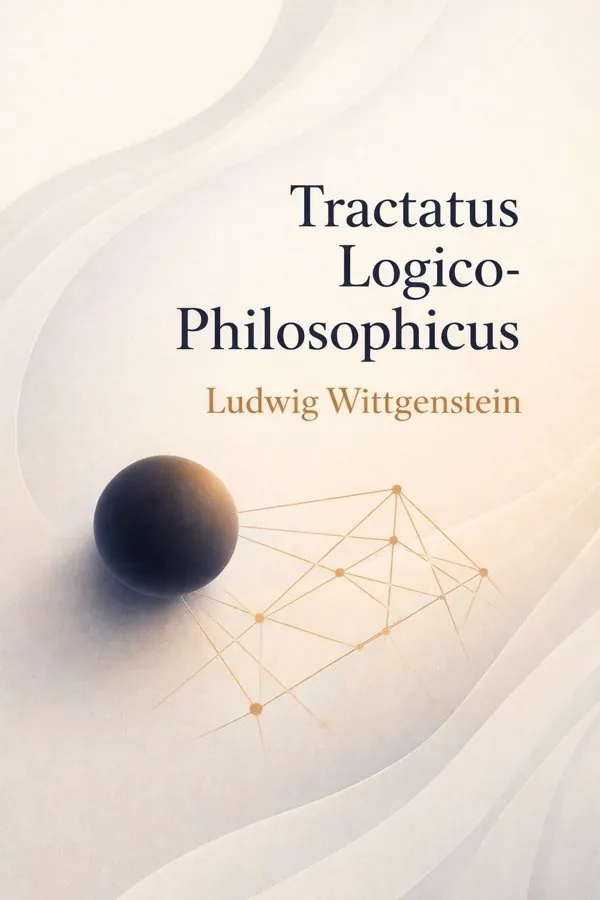
Tractatus Logico-Philosophicus: Summary & Key Insights
 10 min10 chaptersAudio available
Key Takeaways from Tractatus Logico-Philosophicus
What if reality is not fundamentally a collection of things, but a pattern of facts?
Meaning begins when separate elements are connected in a specific way.
A sentence is powerful because it does more than label the world—it models it.
The deepest structure of meaning is often invisible.
To understand a proposition is to know what the world would have to be like for it to be true.
What Is Tractatus Logico-Philosophicus About?
Tractatus Logico-Philosophicus by Ludwig Wittgenstein is a western_phil book spanning 8 pages. Originally published in 1921 in German and later given its famous Latin title, Tractatus Logico-Philosophicus is Ludwig Wittgenstein’s bold attempt to define what can be meaningfully said—and what lies beyond language altogether. In a series of compressed, numbered propositions, Wittgenstein investigates the relationship between language, thought, logic, and reality. His central claim is striking: language represents the world because propositions share a logical structure with the facts they describe. From this foundation, he develops the influential “picture theory” of meaning, a rigorous view of logic, and a radical account of philosophy as clarification rather than theory-building. The book ends with one of the most quoted lines in philosophy: whereof one cannot speak, thereof one must remain silent. The Tractatus matters because it helped shape analytic philosophy, modern logic, and debates about meaning, truth, and the limits of thought. Wittgenstein’s authority rests not only on originality but on impact: this short, difficult work transformed twentieth-century philosophy and still challenges readers to ask whether many philosophical problems are genuine problems at all—or only confusions of language.
This FizzRead summary covers all 10 key chapters of Tractatus Logico-Philosophicus in approximately 10 minutes, distilling the most important ideas, arguments, and takeaways from Ludwig Wittgenstein's work. Also available as an audio summary and Key Quotes Podcast.
Tractatus Logico-Philosophicus
Originally published in 1921 in German and later given its famous Latin title, Tractatus Logico-Philosophicus is Ludwig Wittgenstein’s bold attempt to define what can be meaningfully said—and what lies beyond language altogether. In a series of compressed, numbered propositions, Wittgenstein investigates the relationship between language, thought, logic, and reality. His central claim is striking: language represents the world because propositions share a logical structure with the facts they describe. From this foundation, he develops the influential “picture theory” of meaning, a rigorous view of logic, and a radical account of philosophy as clarification rather than theory-building. The book ends with one of the most quoted lines in philosophy: whereof one cannot speak, thereof one must remain silent. The Tractatus matters because it helped shape analytic philosophy, modern logic, and debates about meaning, truth, and the limits of thought. Wittgenstein’s authority rests not only on originality but on impact: this short, difficult work transformed twentieth-century philosophy and still challenges readers to ask whether many philosophical problems are genuine problems at all—or only confusions of language.
Who Should Read Tractatus Logico-Philosophicus?
This book is perfect for anyone interested in western_phil and looking to gain actionable insights in a short read. Whether you're a student, professional, or lifelong learner, the key ideas from Tractatus Logico-Philosophicus by Ludwig Wittgenstein will help you think differently.
- ✓Readers who enjoy western_phil and want practical takeaways
- ✓Professionals looking to apply new ideas to their work and life
- ✓Anyone who wants the core insights of Tractatus Logico-Philosophicus in just 10 minutes
Want the full summary?
Get instant access to this book summary and 100K+ more with Fizz Moment.
Get Free SummaryAvailable on App Store • Free to download
Key Chapters
What if reality is not fundamentally a collection of things, but a pattern of facts? Wittgenstein opens the Tractatus with this startling claim: the world is the totality of facts, not of things. A fact is not merely an object existing in isolation; it is a state of affairs, a way things are arranged. A cup, a table, and a book are “things,” but the fact that the cup is on the table beside the book is what belongs to the world in the philosophically important sense. This shift matters because language does not simply name isolated objects. It describes how things stand in relation to one another.
By emphasizing facts over things, Wittgenstein reframes how we think about meaning. A useful sentence is not just a string of names but an articulation of a possible situation. When we say, “The meeting starts at nine,” we are not merely pointing to “meeting” and “nine”; we are representing a fact about how events are ordered. This also explains why bare lists of words feel incomplete. “Rain, street, umbrella” is not yet meaningful in the full sense. “Rain is falling on the street, so people open umbrellas” presents a possible arrangement of reality.
In everyday life, this insight improves precision. In conflict, for instance, arguments often arise because people focus on things rather than facts. Saying “You ignored me” is a claim about a fact; saying “You are selfish” leaps too quickly to a broad judgment. Facts are more specific, testable, and shareable.
Actionable takeaway: When analyzing a problem, describe the exact facts of the situation rather than jumping to labels, identities, or vague generalizations.
Meaning begins when separate elements are connected in a specific way. Wittgenstein distinguishes between objects and states of affairs: objects are the basic constituents of reality, while states of affairs are combinations of those objects. A fact exists when such a combination obtains. This distinction allows him to explain how the world can be both structured and variable. The same objects may exist, but different arrangements yield different facts.
Imagine chess pieces on a board. The pieces themselves are like objects; the positions they occupy relative to one another are like states of affairs. A white queen on d5 threatening a black king is not just a list of pieces but a meaningful configuration. In the same way, reality is made intelligible through combinations. This is also how possibility works in Wittgenstein’s system: if objects can combine in various ways, then different states of affairs are possible, whether or not they actually obtain.
This idea helps explain why some sentences are informative and others are empty. “The red folder is inside the cabinet” represents a possible state of affairs. It can be true or false depending on whether the arrangement exists. By contrast, a jumble of words that does not specify a coherent combination fails to represent anything at all.
Practically, this matters in fields from law to science to project management. A scientist asks not only what entities exist, but how they interact. A manager needs not just a list of team members, but a clear account of responsibilities, dependencies, and timelines. Reality becomes understandable when relations are mapped.
Actionable takeaway: When you need clarity, identify the elements involved and then map the exact relations among them. Most confusion comes not from missing objects, but from unclear arrangements.
A sentence is powerful because it does more than label the world—it models it. Wittgenstein’s picture theory of language is one of the Tractatus’s most famous ideas. According to this theory, a proposition represents reality by sharing a structure with the state of affairs it depicts. Just as a map represents a city through a patterned relation among symbols, a sentence represents a possible fact through a patterned relation among names and terms.
Think of a transit map. The colored lines and station dots are not trains or platforms, yet they can guide you because their arrangement corresponds in a usable way to the transport system. Likewise, the proposition “The glass is on the desk” works because its elements stand in a form that can match the arrangement of glass and desk in the world. The proposition is a picture—not visually, but logically.
This theory highlights why some language succeeds and some fails. A useful instruction manual, a floor plan, a weather forecast, and a courtroom testimony all function because they present structured representations that can be checked against reality. When the structure breaks down, meaning breaks down with it. Vague slogans, contradictory statements, or emotionally loaded abstractions may stir feeling without clearly picturing anything.
In modern life, this has practical relevance in communication design. A dashboard, a spreadsheet, or an organizational chart is effective when its internal structure mirrors the system it tracks. The same principle applies to writing: a sentence should reflect the situation you want a reader to grasp.
Actionable takeaway: Ask of any statement you make, “What situation does this actually picture?” If you cannot specify the reality it represents, revise the statement until you can.
The deepest structure of meaning is often invisible. Wittgenstein argues that propositions can picture reality only because both proposition and fact share a logical form. Logical form is not another object in the world; it is the underlying possibility of arrangement that allows representation to occur. We do not usually see logical form directly, just as we do not notice the grammar enabling ordinary conversation until something goes wrong.
Consider architectural blueprints and finished buildings. The blueprint and the building are made of different materials, but they correspond because they share a structural order. A wall on the drawing stands in a relation to rooms and doors that parallels the relation of those elements in the actual building. In language, logical form is what makes a proposition capable of corresponding to a fact at all.
This helps explain why logic is not merely one topic among others for Wittgenstein. Logic is the scaffolding of meaningful representation. Yet it cannot itself be straightforwardly stated as one more fact. It is shown in the use of propositions. This is a subtle but crucial point: the most basic conditions of sense are not usually describable from outside; they are displayed in our meaningful practices.
In practical terms, paying attention to form improves reasoning. A business report may contain accurate data but still mislead if the categories are mismatched. A personal argument may feel intense but remain insoluble because two people are using the same words within different logical structures. Clarifying form often resolves what feels like disagreement about substance.
Actionable takeaway: When communication breaks down, look beneath the words to the structure. Check whether the categories, relations, and assumptions on both sides actually match.
To understand a proposition is to know what the world would have to be like for it to be true. This is the practical core of Wittgenstein’s account of propositions. A meaningful proposition sets out a possible state of affairs and therefore has truth conditions. It can succeed or fail depending on reality. Meaning is tied not to emotional intensity or rhetorical force, but to the possibility of verification or falsification.
Wittgenstein also develops the idea that complex propositions are truth-functions of simpler ones. This means many statements can be understood by seeing how their truth depends on the truth or falsity of more basic propositions. For example, “If it rains, the game will be canceled” gains its meaning through a logical relation between the proposition about rain and the proposition about cancellation. Logic here is not decorative; it is the engine of clarity.
This insight is enormously useful outside philosophy. In journalism, a good claim can be checked. In science, a valid hypothesis implies conditions under which it would be confirmed or disconfirmed. In everyday conversation, confusion often comes from assertions that cannot be pinned down. “Things are bad” may express a feeling, but “Sales declined 12 percent over three months” sets explicit truth conditions.
Wittgenstein’s view encourages discipline in thought. Before debating a claim, ask what would make it true and what would make it false. If no answer is available, the statement may be too vague to do serious work.
Actionable takeaway: For important claims, write down the observable or conceptual conditions under which they would count as true or false. Clear thinking begins with clear truth conditions.
Some of the most important features of thought are not additional facts we can report. Wittgenstein insists that logic is not a body of truths about mysterious logical objects. Rather, logic is shown in the structure of meaningful language itself. Tautologies, for example, say nothing about the world because they are true under all possible conditions. Contradictions likewise say nothing because they are false under all conditions. They reveal the limits and form of logical space, but they do not describe facts.
This distinction between saying and showing is central to the Tractatus. We can say that “the lamp is on the desk” because this proposition pictures a possible fact. But the logical form that allows this proposition to function cannot be represented in the same way as a fact among facts. It is exhibited by the proposition’s very capacity to mean. Trying to state logical form as though it were one more thing in the world leads philosophy into confusion.
A modern analogy is software code and the operating rules of a system. A user can enter data into a form, but the rules governing which entries count as valid are built into the system’s operation. Those rules are not usually presented as one more data field. They are manifested in what the system permits.
Practically, this idea teaches intellectual humility. Not every foundational condition can be turned into an ordinary statement. In design, law, and organizational culture, some rules are shown in practice more clearly than they are articulated in policy. Paying attention to patterns of use can reveal structure better than abstract explanation.
Actionable takeaway: Notice what is demonstrated by practice rather than explicitly stated. Often the deepest rules of a system are shown in how it works, not in what people say about it.
Many philosophical problems may be less like deep mysteries and more like knots in language. Wittgenstein sees philosophy not as a discipline that discovers hidden metaphysical facts, but as an activity of clarification. The philosopher’s task is to analyze propositions, distinguish sense from nonsense, and dissolve confusion produced by misusing language. On this view, philosophy resembles therapy for the intellect.
This was a revolutionary redefinition of philosophy’s purpose. Instead of constructing grand systems about the soul, the universe, or ultimate substances, Wittgenstein asks whether the very questions being posed are meaningful. When someone asks, “What is the essence of time outside all possible experience?” the first task is not to speculate wildly but to examine how the language of “time,” “essence,” and “outside” is functioning. Perhaps the question appears profound only because grammar misleads us.
The practical value of this method is immense. In workplace disputes, policy debates, and personal relationships, people often fight over sentences whose terms have never been clarified. One person uses “freedom” to mean lack of restraint; another means legal protection; a third means inner autonomy. Without clarification, debate hardens into confusion.
Wittgenstein’s method invites a disciplined pause before argument. What exactly is being claimed? How are the words functioning? Does the sentence represent a possible fact, or does it merely imitate meaningful speech? This approach does not solve every problem, but it prevents many fake problems from wasting our attention.
Actionable takeaway: Before trying to answer a difficult question, first clarify the language in which it is asked. A precise reformulation often does more than a rushed solution.
The boundary of meaningful language is also, in an important sense, the boundary of meaningful thought. Wittgenstein does not deny that humans experience wonder, value, or transcendence. Rather, he argues that not everything significant can be put into factual propositions. Language can represent how the world is, but it cannot straightforwardly state what lies beyond the world of facts—its ultimate meaning, value, or metaphysical ground.
This is why the Tractatus is often described as both austere and strangely spiritual. Wittgenstein sharply limits meaningful discourse, yet in doing so he opens space for recognizing that some matters are too deep to be captured as information. We can describe the chemical composition of a piece of music’s air vibrations, but that does not capture the experience of beauty. We can list biological facts about a loved one, but not reduce love itself to those facts without losing something essential.
This does not mean we should become anti-intellectual. Rather, Wittgenstein distinguishes between what can be clearly said and what can only be shown, lived, or encountered. In practical life, this cautions us against forcing every value-laden experience into technical language. Data matters, but not all meaning is data.
In leadership, teaching, and parenting, some truths are embodied more than stated. Integrity, reverence, and courage are often taught through example. Their significance appears in life, not merely in definitions.
Actionable takeaway: Respect the limits of explicit explanation. When language reaches its edge, turn to example, practice, and attentive experience rather than pretending words can do everything.
What matters most may be precisely what cannot be reduced to factual description. Near the end of the Tractatus, Wittgenstein turns toward ethics, aesthetics, and what he calls the mystical. These are not dismissed as unreal or unimportant. On the contrary, they are elevated by being placed outside the domain of ordinary factual language. Facts can tell us what is the case, but not what has absolute value. No inventory of events can by itself yield the meaning of life, the essence of beauty, or the command of the good.
This is a difficult but powerful claim. Suppose you catalog every physical detail of a charitable act: the time, place, gestures, and outcomes. You still have not captured its moral worth in the same way that a factual report captures weather conditions. Likewise, you can analyze a painting’s dimensions, pigments, and market value without expressing its beauty. For Wittgenstein, value is not another object among objects.
This perspective can deepen everyday life. It reminds us that over-analysis can flatten experience. Not every important question is answered by measurement alone. A meaningful life includes dimensions of silence, reverence, art, and moral seriousness that resist complete verbal capture.
At the same time, Wittgenstein warns against pretending to formulate these dimensions as if they were scientific statements. The result is often grand-sounding nonsense. Better to acknowledge the special status of value than to distort it with pseudo-theory.
Actionable takeaway: Treat ethical and aesthetic experience with seriousness, but resist the urge to force them into crude formulas. Let some values be clarified through action, attention, and judgment rather than abstract declaration.
The Tractatus ends with one of philosophy’s most memorable images: Wittgenstein says his propositions are like a ladder that must be climbed and then thrown away. This is more than a dramatic flourish. It means the book’s own statements aim to lead the reader to a perspective from which many of those very statements are recognized as attempts to show the limits of language rather than as ordinary factual doctrines.
This self-undermining quality is part of the book’s genius and its difficulty. Wittgenstein is not simply presenting a new theory to add to the shelf of philosophical systems. He is trying to cure the urge for certain kinds of theory altogether. Once the reader sees how language works, where its limits lie, and why many metaphysical claims fail to achieve sense, the propositions of the Tractatus have done their job. They are instruments, not final dogmas.
The practical importance of the ladder metaphor reaches far beyond philosophy. Many frameworks are useful precisely because they help us see more clearly and then recede. A training checklist, a beginner’s business model, or a therapy exercise may be essential at one stage but restrictive if treated as eternal truth. Wisdom often involves knowing when a tool has completed its task.
This idea also encourages flexibility. People frequently become attached to methods that once helped them and then mistake the method for reality itself. Wittgenstein’s ladder reminds us that clarity may require both discipline and release.
Actionable takeaway: Use intellectual frameworks as tools for insight, not idols for worship. Ask regularly whether a model is still helping you see clearly—or whether it is time to set it aside.
All Chapters in Tractatus Logico-Philosophicus
About the Author
Ludwig Wittgenstein (1889–1951) was an Austrian-born philosopher who later became a British citizen and one of the defining intellectual figures of the twentieth century. Born into a wealthy Viennese family, he first studied engineering before turning to logic and philosophy under Bertrand Russell at Cambridge. His early masterpiece, Tractatus Logico-Philosophicus, sought to identify the logical structure of language and the limits of meaningful speech. After a period away from academic life, he returned to philosophy and developed a very different later approach, most famously expressed in Philosophical Investigations. Across both phases of his work, Wittgenstein transformed debates about meaning, logic, mind, and method. His influence remains profound in analytic philosophy, linguistics, and contemporary thought more broadly.
Get This Summary in Your Preferred Format
Read or listen to the Tractatus Logico-Philosophicus summary by Ludwig Wittgenstein anytime, anywhere. FizzRead offers multiple formats so you can learn on your terms — all free.
Available formats: App · Audio · PDF · EPUB — All included free with FizzRead
Download Tractatus Logico-Philosophicus PDF and EPUB Summary
Key Quotes from Tractatus Logico-Philosophicus
“What if reality is not fundamentally a collection of things, but a pattern of facts?”
“Meaning begins when separate elements are connected in a specific way.”
“A sentence is powerful because it does more than label the world—it models it.”
“The deepest structure of meaning is often invisible.”
“To understand a proposition is to know what the world would have to be like for it to be true.”
Frequently Asked Questions about Tractatus Logico-Philosophicus
Tractatus Logico-Philosophicus by Ludwig Wittgenstein is a western_phil book that explores key ideas across 10 chapters. Originally published in 1921 in German and later given its famous Latin title, Tractatus Logico-Philosophicus is Ludwig Wittgenstein’s bold attempt to define what can be meaningfully said—and what lies beyond language altogether. In a series of compressed, numbered propositions, Wittgenstein investigates the relationship between language, thought, logic, and reality. His central claim is striking: language represents the world because propositions share a logical structure with the facts they describe. From this foundation, he develops the influential “picture theory” of meaning, a rigorous view of logic, and a radical account of philosophy as clarification rather than theory-building. The book ends with one of the most quoted lines in philosophy: whereof one cannot speak, thereof one must remain silent. The Tractatus matters because it helped shape analytic philosophy, modern logic, and debates about meaning, truth, and the limits of thought. Wittgenstein’s authority rests not only on originality but on impact: this short, difficult work transformed twentieth-century philosophy and still challenges readers to ask whether many philosophical problems are genuine problems at all—or only confusions of language.
More by Ludwig Wittgenstein
You Might Also Like
A Little History of Philosophy
Nigel Warburton
10 min
Areopagitica
John Milton
10 min
How To Think Like A Philosopher: Essential Principles For Clear Thinking
Peter Cave
10 min
Language, Truth and Logic
A. J. Ayer
10 min
The Age of Reason
Thomas Paine
10 min
The Essays
Michel De Montaigne
10 minBrowse by Category
Ready to read Tractatus Logico-Philosophicus?
Get the full summary and 100K+ more books with Fizz Moment.