
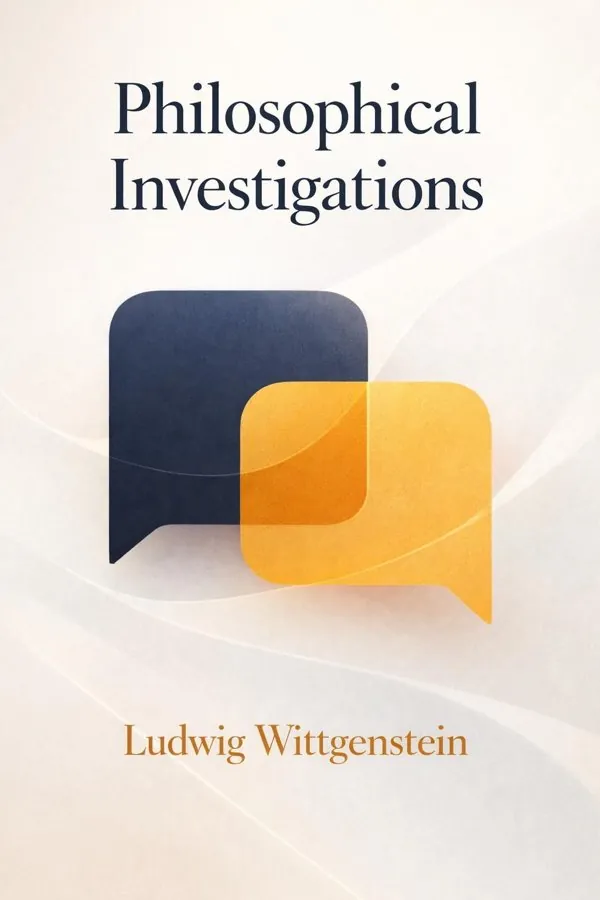
Philosophical Investigations: Summary & Key Insights
 10 min10 chaptersAudio available
Key Takeaways from Philosophical Investigations
A word does not carry its meaning around like a suitcase; its meaning appears in the work it does.
Speaking is less like naming objects and more like participating in many different games.
Language works because human life has patterns.
What if you invented a language that only you could understand, referring entirely to your own inner sensations?
A rule does not contain its own application like a machine contains its output.
What Is Philosophical Investigations About?
Philosophical Investigations by Ludwig Wittgenstein is a western_phil book spanning 13 pages. Philosophical Investigations is Ludwig Wittgenstein’s revolutionary later masterpiece, published posthumously in 1953, and widely regarded as one of the most important works in modern philosophy. In this book, Wittgenstein turns away from the rigid logical framework of his earlier thought and asks a deceptively simple question: how does language actually work in ordinary life? His answer reshaped philosophy. Rather than treating words as labels attached to fixed essences or private mental objects, he argues that meaning emerges from use, context, and shared human practices. Language is not a single system with one hidden structure; it is a vast collection of activities woven into everyday life. What makes the book endure is not only its ideas but its method. Wittgenstein does not build a grand theory. He diagnoses philosophical confusion by examining how we speak, how we follow rules, how we understand others, and how words function across different situations. His reflections transformed the philosophy of language, mind, psychology, and logic. For anyone interested in meaning, consciousness, communication, or the limits of abstract thinking, Philosophical Investigations remains essential reading.
This FizzRead summary covers all 10 key chapters of Philosophical Investigations in approximately 10 minutes, distilling the most important ideas, arguments, and takeaways from Ludwig Wittgenstein's work. Also available as an audio summary and Key Quotes Podcast.
Philosophical Investigations
Philosophical Investigations is Ludwig Wittgenstein’s revolutionary later masterpiece, published posthumously in 1953, and widely regarded as one of the most important works in modern philosophy. In this book, Wittgenstein turns away from the rigid logical framework of his earlier thought and asks a deceptively simple question: how does language actually work in ordinary life? His answer reshaped philosophy. Rather than treating words as labels attached to fixed essences or private mental objects, he argues that meaning emerges from use, context, and shared human practices. Language is not a single system with one hidden structure; it is a vast collection of activities woven into everyday life.
What makes the book endure is not only its ideas but its method. Wittgenstein does not build a grand theory. He diagnoses philosophical confusion by examining how we speak, how we follow rules, how we understand others, and how words function across different situations. His reflections transformed the philosophy of language, mind, psychology, and logic. For anyone interested in meaning, consciousness, communication, or the limits of abstract thinking, Philosophical Investigations remains essential reading.
Who Should Read Philosophical Investigations?
This book is perfect for anyone interested in western_phil and looking to gain actionable insights in a short read. Whether you're a student, professional, or lifelong learner, the key ideas from Philosophical Investigations by Ludwig Wittgenstein will help you think differently.
- ✓Readers who enjoy western_phil and want practical takeaways
- ✓Professionals looking to apply new ideas to their work and life
- ✓Anyone who wants the core insights of Philosophical Investigations in just 10 minutes
Want the full summary?
Get instant access to this book summary and 100K+ more with Fizz Moment.
Get Free SummaryAvailable on App Store • Free to download
Key Chapters
A word does not carry its meaning around like a suitcase; its meaning appears in the work it does. This is one of Wittgenstein’s most famous and disruptive insights. Philosophers often search for the essence of a word by asking what object, image, or definition lies behind it. Wittgenstein invites us to stop looking behind language and start looking at language in action. What does a word mean? Look at how people use it.
Consider the word “game.” We can use it to describe chess, football, tag, video games, and Olympic competitions. There may be no single feature shared by all games, yet we understand the word perfectly well because we know how it functions in life. Or think about the word “promise.” Its meaning is not a hidden mental event. It is embedded in a practice: saying certain words under certain conditions creates expectations, obligations, and social consequences.
This idea matters because it dissolves many philosophical puzzles. If we assume every word must correspond to a fixed object or essence, we become confused by abstract words like “knowledge,” “mind,” or “justice.” But if meaning depends on use, then understanding a concept often means understanding the role it plays in our forms of interaction.
In daily life, this changes how we communicate. When misunderstanding arises, it is often more useful to ask “How are you using that word here?” than “What does that word really mean?” In workplaces, relationships, and public debate, many conflicts are verbal confusions disguised as deep disagreements.
Actionable takeaway: when a concept feels obscure, stop hunting for a perfect definition and examine how the word is actually used across real situations.
Speaking is less like naming objects and more like participating in many different games. Wittgenstein uses the term “language-games” to show that language is not one uniform thing. We speak to order, joke, pray, calculate, apologize, describe, ask, command, flirt, warn, and comfort. Each activity has its own logic, standards, and expectations.
The brilliance of this idea is that it makes language concrete. Imagine a builder shouting “Brick!” to an assistant. In that setting, the word functions as an order, not a detached label. Now compare that with saying “brick” in an art class, a poetry reading, or a hardware store. The same word can play different roles depending on the activity surrounding it.
This helps explain why philosophical confusion arises when we rip words out of their natural settings and demand that they behave the same way everywhere. For instance, the word “know” works differently in science, law, casual conversation, and religion. Problems emerge when we assume there must be one pure logical structure beneath all these uses.
Language-games also remind us that understanding language means mastering a practice, not merely memorizing vocabulary. Children learn words by joining activities: pointing, asking, responding, correcting, and imitating. Adults do the same when entering new professional or cultural contexts. Legal language, medical language, and online slang all function as specialized games with rules learned through participation.
This insight has practical value far beyond philosophy. In leadership, teaching, negotiation, and relationships, miscommunication often comes from people playing different language-games without realizing it. One person may be exploring possibilities, while another hears a commitment.
Actionable takeaway: before reacting to what someone says, ask what language-game is being played—are they informing, speculating, persuading, joking, or requesting?
Language works because human life has patterns. Wittgenstein calls these shared human backgrounds “forms of life.” We understand one another not because we secretly compare mental images, but because our words are rooted in common practices, natural reactions, institutions, habits, and ways of living.
If someone says, “Bring me the red book,” that instruction succeeds because speaker and listener already share a world: they know what books are, how requests work, what counts as red, and why fetching objects matters. This background is so familiar that it usually disappears from view. Wittgenstein’s genius lies in making us notice it.
Forms of life explain why language cannot be reduced to abstract logic alone. Meaning is sustained by customs and activities. Even mathematics, which seems purely formal, is taught, checked, and applied within communal practices. Likewise, expressions of pain, belief, doubt, or intention are intelligible because they belong to recognizable human behavior.
This idea also carries a subtle warning. Philosophers often imagine language functioning in isolation from lived experience, as if meanings could exist in a vacuum. Wittgenstein resists this fantasy. A language detached from all social life would not be a language in any recognizable sense.
In practical terms, forms of life help explain cross-cultural misunderstanding. People may use the same words while operating within different assumptions about politeness, authority, time, or identity. Real understanding requires attention to the broader human context, not just dictionary definitions.
The concept also matters for technology and AI. Systems can process symbols, but genuine understanding becomes much more complex when language depends on participation in practices and worldly contexts. Wittgenstein’s insight remains highly relevant to debates about whether machines truly understand language.
Actionable takeaway: when communication breaks down, look beyond the words themselves and examine the shared assumptions, habits, and social practices that give those words meaning.
What if you invented a language that only you could understand, referring entirely to your own inner sensations? Wittgenstein argues that such a language would collapse under scrutiny. This is the famous private language argument, and it challenges the idea that meaning can be grounded in a person’s completely private inner experience.
Suppose you decide to mark the sensation you feel today with the symbol “S,” intending it to refer to a particular inner feeling that only you can know directly. The problem is not that you cannot have the sensation. The problem is that there would be no reliable distinction between using “S” correctly and merely thinking you are using it correctly. Without public criteria, shared training, or standards for correction, the notion of “following the rule” becomes empty.
Wittgenstein is not denying inner life. He is challenging a picture of it. We do not give meaning to words for pain, joy, belief, or remembering by attaching them to private objects hidden in consciousness. Instead, these words have meaning because they are woven into public practices: crying out, reporting, comforting, diagnosing, doubting, responding, and learning how such expressions are used.
This has major implications for philosophy of mind. It weakens the idea that the mind is a sealed inner theater that language merely points toward. It also helps explain why psychological vocabulary depends on outward criteria and social life.
In everyday settings, this insight reminds us that self-understanding is not purely inward. We learn to describe our emotions through interaction with others. Children learn what “pain,” “afraid,” or “excited” mean in human contexts, not by conducting private introspective experiments.
Actionable takeaway: when reflecting on feelings or thoughts, remember that clarity often comes not from turning inward alone but from learning the shared language and practices through which inner life becomes expressible.
Many philosophical puzzles feel profound because language has led us into confusion. Wittgenstein believes that philosophy frequently mistakes grammatical features of language for metaphysical discoveries. We become bewitched by the forms of our expressions and start asking questions that look deep but arise from misuse or overextension of words.
Consider the question, “What is time, really?” or “Where is the mind located?” Such questions may seem to demand hidden entities or essences. But often the trouble begins when we assume that because a noun exists—“time,” “mind,” “meaning”—there must be a corresponding object behind it. Grammar tempts us into reification.
Wittgenstein uses “grammar” in a broad philosophical sense: the rules governing the use of words. To investigate the grammar of a concept is to examine how it operates in language. Once we do that, many traditional puzzles lose their grip. The problem was not lack of information about a mysterious object; it was confusion about how language functions.
This idea transforms philosophy’s task. Instead of constructing explanatory theories about hidden metaphysical realities, philosophy should clarify our concepts, describe their use, and untangle knots in our thinking. Wittgenstein compares this to therapy: philosophy treats the illnesses caused by language.
This has obvious practical applications. People often turn verbal confusion into emotional conflict. In relationships, workplaces, and politics, disagreements can escalate because different grammars are being applied to the same term—“respect,” “freedom,” “fairness,” “commitment.” Clarifying use can dissolve pseudo-problems before they harden into real ones.
For students and thinkers, Wittgenstein’s lesson is humbling. Not every difficult question is deep in the same way. Some are difficult because we are trapped by a misleading picture.
Actionable takeaway: when a question seems impossibly abstract, inspect the language itself—ask how the key words are actually used before assuming the problem points to a hidden metaphysical mystery.
To understand something is not always to possess an inner mental object; often it is to know how to go on. Wittgenstein challenges the assumption that understanding must be a special experience occurring behind the scenes. We are tempted to think that if someone truly understands a word, a rule, or a sentence, there must be an accompanying inner state that explains their success. But in many cases, understanding is visible in competent participation.
If a student understands the instruction “continue the pattern,” we see it in what they do next. If someone understands a joke, they respond appropriately. If a musician understands a score, they can play it. Interpretation may sometimes be involved, but endless interpretation cannot be what understanding fundamentally consists in, because at some point the person simply acts, responds, or proceeds.
Wittgenstein’s point matters because it resists over-mentalizing human capacities. Not every act of comprehension requires a private inner movie. Language is often more like skill than hidden representation. To grasp a concept is often to have learned a technique.
This insight applies widely. In education, students may be able to recite definitions without genuine understanding; real understanding appears in use, transfer, and judgment. In management, employees may nod at instructions while misunderstanding them; competence is shown in performance. In relationships, understanding another person is not merely paraphrasing their words but responding fittingly to their needs, tone, and context.
Wittgenstein also complicates modern assumptions about interpretation. We often think more interpretation means more depth. Sometimes the opposite is true: interpretation becomes endless because we are refusing to acknowledge that understanding already lives in practice.
This perspective encourages a shift from introspective certainty to outward criteria. We do not always need to inspect mental states to determine understanding; we can look at how a person speaks and acts within a practice.
Actionable takeaway: test understanding by use—ask whether you or others can apply, perform, explain, or continue appropriately, not just repeat a definition.
The inner life is real, but our picture of it is often misleading. In Philosophical Investigations, Wittgenstein explores sensations, pain, intention, thinking, and perception in order to show that psychological concepts do not function as names for hidden inner objects. Instead, they belong to complex patterns of expression, behavior, criteria, and context.
Take pain. When someone says “I am in pain,” they are not typically reporting the results of an inner observation in the way one reports a weather reading. The expression of pain is tied to groaning, recoiling, asking for help, and learning how such language is used. This does not make pain unreal; it changes how we understand the grammar of pain-talk.
Wittgenstein extends this exploration to aspect perception, especially the phenomenon of “seeing-as.” A familiar image can suddenly be seen as a duck, then as a rabbit. Nothing on the page changes, but our perception shifts. This shows that seeing is not always passive reception; meaning and perception can be intertwined. We do not merely see lines—we can see them as something.
These reflections have influenced philosophy of mind, psychology, aesthetics, and cognitive science. They challenge simplistic views in which mental life is either purely private or reducible to external behavior. Wittgenstein’s account is subtler: our psychological concepts operate within human life, where inner and outer are not cleanly separable.
Practically, this helps us become better observers of ourselves and others. We should avoid both extremes: dismissing inner experience and treating it as an inaccessible secret realm. In therapy, education, and everyday conversation, understanding another person often means attending to expression, context, and patterns rather than searching for hidden essences.
Actionable takeaway: when thinking about emotions, intentions, or perception, ask how these concepts function in lived situations instead of imagining them as mysterious inner objects detached from human behavior.
The deepest philosophical progress may come not from discovering new theories, but from freeing ourselves from confusion. Wittgenstein’s later method is deliberately anti-systematic. He does not offer one grand doctrine about language, mind, or reality. Instead, he presents reminders, examples, contrasts, and questions designed to loosen the grip of misleading pictures.
This method can frustrate readers expecting a conventional argument. Philosophical Investigations is composed of short numbered remarks rather than a linear treatise. But that form is part of the philosophy. Wittgenstein thinks our confusions are multiple and local. They arise from different temptations, so they must be treated case by case. Philosophy resembles therapy more than science.
The role of philosophy, on this view, is not to compete with physics, psychology, or linguistics by producing explanatory theories of hidden mechanisms. It is to bring words back from their metaphysical use to their everyday use. When we see clearly how our concepts work, many pseudo-problems dissolve.
This does not make philosophy trivial. On the contrary, it demands discipline, patience, and honesty. It asks us to give up the craving for total explanation when that craving itself generates confusion. Wittgenstein’s contribution is not a new metaphysics but a transformed philosophical temperament.
In practical life, this attitude is profoundly useful. Not every problem is solved by adding more abstraction. Often what is needed is description, clarification, and attention to ordinary cases. In strategy, counseling, and conflict resolution, confusion often decreases when people stop chasing grand theories and return to concrete examples.
For readers, Wittgenstein offers a lasting intellectual virtue: sobriety. He teaches us to distrust the seduction of language when it outruns the practices that give it sense.
Actionable takeaway: when facing a conceptual problem, resist the urge to build a sweeping theory too quickly; begin by clarifying examples, usage, and the specific confusion at hand.
All Chapters in Philosophical Investigations
About the Author
Ludwig Wittgenstein (1889–1951) was an Austrian-British philosopher whose work transformed 20th-century philosophy. Born into a wealthy Viennese family, he first studied engineering before turning to philosophy at Cambridge, where he worked with Bertrand Russell. His early masterpiece, Tractatus Logico-Philosophicus, argued that language mirrors the logical structure of reality, but he later came to reject many of its assumptions. This dramatic shift led to his later philosophy, most famously expressed in Philosophical Investigations, where he emphasized ordinary language, use, and shared human practices. Wittgenstein taught intermittently at Cambridge and was known for his intense personality, uncompromising standards, and unusual life, which included periods as a schoolteacher and gardener. He remains one of the most influential figures in philosophy of language, mind, and logic.
Get This Summary in Your Preferred Format
Read or listen to the Philosophical Investigations summary by Ludwig Wittgenstein anytime, anywhere. FizzRead offers multiple formats so you can learn on your terms — all free.
Available formats: App · Audio · PDF · EPUB — All included free with FizzRead
Download Philosophical Investigations PDF and EPUB Summary
Key Quotes from Philosophical Investigations
“A word does not carry its meaning around like a suitcase; its meaning appears in the work it does.”
“Speaking is less like naming objects and more like participating in many different games.”
“Language works because human life has patterns.”
“What if you invented a language that only you could understand, referring entirely to your own inner sensations?”
“A rule does not contain its own application like a machine contains its output.”
Frequently Asked Questions about Philosophical Investigations
Philosophical Investigations by Ludwig Wittgenstein is a western_phil book that explores key ideas across 10 chapters. Philosophical Investigations is Ludwig Wittgenstein’s revolutionary later masterpiece, published posthumously in 1953, and widely regarded as one of the most important works in modern philosophy. In this book, Wittgenstein turns away from the rigid logical framework of his earlier thought and asks a deceptively simple question: how does language actually work in ordinary life? His answer reshaped philosophy. Rather than treating words as labels attached to fixed essences or private mental objects, he argues that meaning emerges from use, context, and shared human practices. Language is not a single system with one hidden structure; it is a vast collection of activities woven into everyday life. What makes the book endure is not only its ideas but its method. Wittgenstein does not build a grand theory. He diagnoses philosophical confusion by examining how we speak, how we follow rules, how we understand others, and how words function across different situations. His reflections transformed the philosophy of language, mind, psychology, and logic. For anyone interested in meaning, consciousness, communication, or the limits of abstract thinking, Philosophical Investigations remains essential reading.
More by Ludwig Wittgenstein
You Might Also Like
A Little History of Philosophy
Nigel Warburton
10 min
Areopagitica
John Milton
10 min
How To Think Like A Philosopher: Essential Principles For Clear Thinking
Peter Cave
10 min
Language, Truth and Logic
A. J. Ayer
10 min
The Age of Reason
Thomas Paine
10 min
The Essays
Michel De Montaigne
10 minBrowse by Category
Ready to read Philosophical Investigations?
Get the full summary and 100K+ more books with Fizz Moment.