
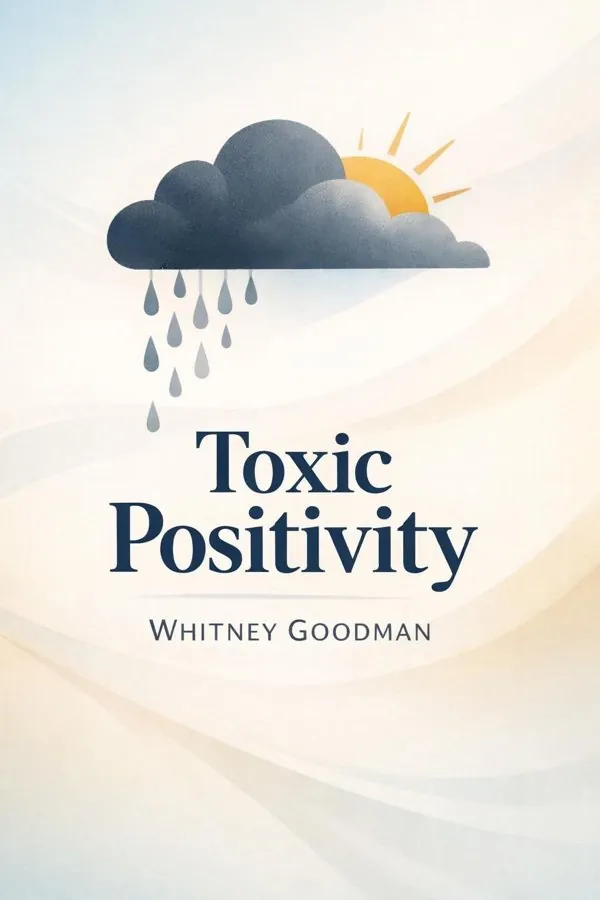
Toxic Positivity: Keeping It Real in a World Obsessed with Being Happy: Summary & Key Insights
 10 min9 chaptersAudio available
Key Takeaways from Toxic Positivity: Keeping It Real in a World Obsessed with Being Happy
One of the most damaging cultural stories we inherit is that happiness is not only desirable, but morally superior.
Avoidance often disguises itself as strength.
Many people think support means fixing.
Toxic positivity is not only a cultural phenomenon; it is a relational habit.
There is a common misunderstanding that rejecting toxic positivity means simply expressing everything immediately and intensely.
What Is Toxic Positivity: Keeping It Real in a World Obsessed with Being Happy About?
Toxic Positivity: Keeping It Real in a World Obsessed with Being Happy by Whitney Goodman is a mental_health book spanning 5 pages. In Toxic Positivity, psychotherapist Whitney Goodman takes aim at one of modern culture’s most polished myths: that a good life is built by staying upbeat no matter what. Beneath slogans like “good vibes only,” “everything happens for a reason,” and “just be grateful,” Goodman sees a subtler harm. These messages often silence pain, shame people for struggling, and make honest emotional life feel like failure. Instead of helping us heal, forced positivity can leave us feeling unseen, disconnected, and even more alone. Drawing from therapy practice, psychological insight, and the emotional patterns she has observed in clients and online culture, Goodman argues that mental health is not about eliminating difficult feelings. It is about learning how to acknowledge them, tolerate them, and respond to them with honesty and care. The book matters because it challenges a deeply normalized habit many people barely notice in themselves, their families, and their workplaces. Goodman offers a more grounded alternative: emotional validation, realistic coping, and resilience rooted in truth rather than performance. Her message is both corrective and liberating: real well-being begins when we stop pretending to be fine.
This FizzRead summary covers all 9 key chapters of Toxic Positivity: Keeping It Real in a World Obsessed with Being Happy in approximately 10 minutes, distilling the most important ideas, arguments, and takeaways from Whitney Goodman's work. Also available as an audio summary and Key Quotes Podcast.
Toxic Positivity: Keeping It Real in a World Obsessed with Being Happy
In Toxic Positivity, psychotherapist Whitney Goodman takes aim at one of modern culture’s most polished myths: that a good life is built by staying upbeat no matter what. Beneath slogans like “good vibes only,” “everything happens for a reason,” and “just be grateful,” Goodman sees a subtler harm. These messages often silence pain, shame people for struggling, and make honest emotional life feel like failure. Instead of helping us heal, forced positivity can leave us feeling unseen, disconnected, and even more alone.
Drawing from therapy practice, psychological insight, and the emotional patterns she has observed in clients and online culture, Goodman argues that mental health is not about eliminating difficult feelings. It is about learning how to acknowledge them, tolerate them, and respond to them with honesty and care. The book matters because it challenges a deeply normalized habit many people barely notice in themselves, their families, and their workplaces. Goodman offers a more grounded alternative: emotional validation, realistic coping, and resilience rooted in truth rather than performance. Her message is both corrective and liberating: real well-being begins when we stop pretending to be fine.
Who Should Read Toxic Positivity: Keeping It Real in a World Obsessed with Being Happy?
This book is perfect for anyone interested in mental_health and looking to gain actionable insights in a short read. Whether you're a student, professional, or lifelong learner, the key ideas from Toxic Positivity: Keeping It Real in a World Obsessed with Being Happy by Whitney Goodman will help you think differently.
- ✓Readers who enjoy mental_health and want practical takeaways
- ✓Professionals looking to apply new ideas to their work and life
- ✓Anyone who wants the core insights of Toxic Positivity: Keeping It Real in a World Obsessed with Being Happy in just 10 minutes
Want the full summary?
Get instant access to this book summary and 100K+ more with Fizz Moment.
Get Free SummaryAvailable on App Store • Free to download
Key Chapters
One of the most damaging cultural stories we inherit is that happiness is not only desirable, but morally superior. Goodman shows that toxic positivity did not begin with Instagram captions or self-help posters. It has deeper roots in Western ideals that equate emotional control, optimism, and productivity with virtue. Over time, happiness became something people felt responsible for producing, and distress became something to hide, fix quickly, or judge.
This matters because once positivity is moralized, painful emotions start to look like personal failure. If you are grieving, anxious, burned out, or angry, the surrounding culture may subtly tell you that you are doing life wrong. In families, this can sound like “focus on the bright side.” In workplaces, it appears as pressure to stay motivated despite exhaustion. In wellness culture, it becomes a message that mindset alone can overcome all suffering.
Goodman does not argue against hope or joy. She argues against the idea that only pleasant emotions are acceptable. Human experience is wider than that. Fear can warn us. Anger can reveal violated boundaries. Sadness can signal loss and help us process change. When a culture treats these emotions as defects, people become disconnected from their own inner reality.
A practical example is how we respond when someone shares hard news. Instead of saying, “At least…” and rushing toward silver linings, we can pause and acknowledge what is true: “That sounds painful,” or “I can see why you feel overwhelmed.” This small shift resists the cultural impulse to sanitize discomfort.
Actionable takeaway: Notice where you have absorbed the belief that happiness equals goodness. Replace the question “How do I feel better immediately?” with “What is this emotion telling me?”
Avoidance often disguises itself as strength. Goodman explains that many people believe they are coping well when they suppress sadness, bypass anger, or distract themselves from fear. In the short term, this can feel efficient. You keep functioning, stay productive, and avoid vulnerability. But emotionally, what is buried rarely disappears. It tends to resurface as irritability, numbness, anxiety, resentment, or a chronic sense of disconnection.
This is one of the book’s key psychological insights: refusing to feel an emotion is not the same as resolving it. The nervous system still registers stress, even when the conscious mind insists everything is fine. When people repeatedly deny their internal state, they lose emotional clarity. They may stop knowing what they need, why they are exhausted, or why relationships feel strained.
Imagine someone going through a breakup who immediately says, “I’m okay, it’s for the best,” and throws themselves into work. For a while, this may look admirable. But if grief is never allowed space, it may later show up as insomnia, cynicism, emotional shutdown, or difficulty trusting others. The issue is not that the person stayed functional. The issue is that function replaced processing.
Goodman encourages emotional exposure in manageable doses. That may mean journaling honestly for ten minutes, naming feelings out loud, crying without apologizing, or discussing painful experiences with a trusted person or therapist. These practices are not indulgent. They help the mind and body metabolize experience.
Actionable takeaway: The next time you feel tempted to immediately minimize a painful emotion, try asking yourself, “What am I avoiding right now?” Then give that feeling a small, safe amount of attention instead of pushing it away.
Many people think support means fixing. Goodman argues that in real life, support often begins somewhere far simpler and far more powerful: validation. When someone is struggling, they usually do not need instant solutions, motivational speeches, or comparisons to people who have it worse. They need their experience recognized as real.
Validation does not mean agreeing with every interpretation or encouraging helplessness. It means communicating that a person’s emotional response makes sense in context. If a friend says they are devastated after losing a job, the validating response is not “This is a blessing in disguise.” It is “Of course this hurts. That is a huge loss.” Validation reduces shame and creates the emotional safety needed for problem-solving later.
Toxic positivity often enters relationships through language that sounds supportive but dismisses reality. Phrases like “just think positive,” “don’t be so negative,” or “everything happens for a reason” can leave people feeling more isolated. They learn that only edited emotions are welcome. Over time, this damages trust. People stop sharing honestly because they expect to be corrected instead of understood.
Goodman’s framework is practical. In conversations, slow down. Reflect back what you heard. Ask open questions such as “Do you want support, ideas, or just someone to listen?” In parenting, validate before redirecting. In romantic relationships, resist the urge to manage your partner’s emotions to make yourself more comfortable.
A useful application is to replace advice-first responses with presence-first ones. For example: “I’m here with you,” “That sounds really hard,” or “Tell me more about what this has been like.” This does not solve the problem instantly, but it strengthens connection and makes honest coping possible.
Actionable takeaway: For one week, whenever someone shares a difficult feeling, respond with validation before offering reassurance or advice.
Toxic positivity is not only a cultural phenomenon; it is a relational habit. Goodman shows how it can quietly shape marriages, friendships, families, and workplaces. Often, people use positivity not because they are cruel, but because they are uncomfortable with distress. They want suffering to end quickly, so they rush toward optimism. Yet in doing so, they may communicate that difficult emotions are inconvenient, excessive, or unwelcome.
In families, this may appear when children are told not to cry, not to be dramatic, or to be grateful instead of upset. The child learns that emotional expression threatens belonging. In adult friendships, it can sound like constant reframing instead of listening. In romantic relationships, one partner may insist on staying upbeat while the other feels increasingly unseen. In workplaces, leaders may celebrate resilience while ignoring burnout, grief, or unrealistic demands.
The cost is cumulative. When people cannot bring their full emotional reality into relationships, intimacy weakens. Conversations become polished performances. Resentment builds because honesty feels unsafe. Even well-meant encouragement starts to feel lonely.
Goodman’s solution is not endless venting or emotional chaos. It is creating room for complexity. A healthy relationship can hold both encouragement and pain, both hope and realism. You can love someone and admit they are struggling. You can support a team and acknowledge harmful conditions. You can want your child to cope well and still welcome tears.
A practical shift is to observe your reflexive phrases. If you often say “look on the bright side,” pause and ask what you are trying to avoid. Then try a more grounded response: “I can see this really matters to you.”
Actionable takeaway: Identify one relationship where positivity is replacing honesty, and practice one conversation this week that prioritizes truth over reassurance.
There is a common misunderstanding that rejecting toxic positivity means simply expressing everything immediately and intensely. Goodman offers a more nuanced view. Authenticity is not emotional dumping, and emotional regulation is not emotional denial. The real goal is learning to experience feelings honestly without becoming ruled by them.
Emotional regulation begins with awareness. You cannot regulate what you do not acknowledge. If you are angry but insist you are fine, you lose the chance to respond wisely. If you admit, “I am angry and activated,” you can choose what to do next. That might mean taking a walk, writing down your thoughts, delaying a difficult conversation, or using grounding techniques before reacting.
Goodman encourages readers to distinguish between feeling and behavior. All emotions are acceptable; not all actions are helpful. You are allowed to feel rage, jealousy, or despair. But authenticity does not require impulsive texts, cruel comments, or shutting others out. It requires honesty paired with responsibility.
Practical tools include naming emotions specifically rather than vaguely saying “stressed,” tracking body sensations, setting boundaries before resentment escalates, and building routines that support nervous system regulation such as sleep, movement, rest, and reduced overstimulation. Therapy, journaling, and mindfulness can also help people widen their capacity to stay with difficult emotions without escaping into denial.
A useful example is someone who feels overwhelmed at work. Suppression says, “I’m lucky to have a job, I shouldn’t complain.” Dysregulation says, “I quit, I can’t do this anymore.” Regulation says, “I’m overloaded, and I need to reassess my workload, ask for help, and recover.”
Actionable takeaway: The next time a strong emotion appears, name it precisely, notice it in your body, and delay major reactions until you have regulated enough to respond intentionally.
A powerful thread in Goodman’s book is that happiness becomes distorted when it is treated as a permanent state or the purpose of every moment. Human well-being is not built by eliminating discomfort. It is built by developing the ability to move through life’s shifting emotional landscape with honesty, flexibility, and self-trust.
This reframing matters because many people exhaust themselves chasing a version of happiness that no human can sustain. They interpret normal emotional fluctuation as evidence that something is wrong. A bad day becomes a failure. Grief feels like weakness. Ambivalence feels like dysfunction. Goodman challenges this unrealistic benchmark. A meaningful life includes loss, frustration, boredom, fear, joy, tenderness, uncertainty, and hope.
When happiness is redefined as wholeness rather than constant positivity, resilience becomes more realistic. Instead of asking, “How do I stay positive through this?” the better question is, “How do I stay present and supported through this?” That shift invites coping rather than performance.
In practice, this might mean allowing a joyful event to exist alongside sadness, such as celebrating a promotion while still grieving a recent loss. It might mean accepting that healing is uneven. You can be grateful and still angry. You can love your family and still need distance. Emotional complexity is not hypocrisy; it is maturity.
Goodman’s version of resilience is not emotional invulnerability. It is the capacity to tell the truth about what is happening and still keep going in sustainable ways. That includes asking for help, adjusting expectations, and making room for imperfection.
Actionable takeaway: Stop measuring well-being by how consistently happy you feel. Measure it by how honestly you can face your emotions without abandoning yourself.
A less obvious but important insight in Goodman’s work is that emotional authenticity often depends on boundaries. People frequently resort to toxic positivity when they do not feel allowed to have limits. If saying “I’m overwhelmed,” “I can’t do that,” or “I need space” feels unsafe, positivity becomes a socially acceptable disguise. You smile, reassure, overcommit, and tell yourself to be grateful while resentment quietly grows.
Boundaries help interrupt this pattern. They make it possible to tell the truth before emotions intensify into burnout or collapse. This is especially relevant for people who have learned to prioritize being easy, helpful, or cheerful. Goodman suggests that constant positivity can function as self-protection. If you never disappoint anyone, maybe you will stay liked. But the long-term cost is self-betrayal.
Healthy boundaries are not punishments. They are clear statements about capacity, needs, and consequences. At work, this may mean refusing unreasonable availability. In family life, it may mean ending conversations that become invalidating. In friendships, it may mean saying, “I want support, not solutions right now.” Boundaries create conditions where authentic emotion has room to exist.
A practical application is to connect recurring emotional distress to a missing limit. If you regularly feel dread before answering messages, perhaps your communication expectations are unsustainable. If every family visit leaves you depleted, perhaps you need shorter visits or firmer topic boundaries.
Goodman’s broader point is that honesty without boundaries is fragile. People cannot keep telling the truth if truth is consistently punished.
Actionable takeaway: Choose one situation where forced positivity is covering resentment, and state one clear boundary that reflects your actual capacity.
At the heart of Goodman’s argument is a simple but radical idea: people heal more through compassion than correction. Toxic positivity tries to improve emotional pain by replacing it quickly. Compassion responds differently. It stays near the pain without denying it. It allows discomfort to be real while offering care, patience, and dignity.
This shift is important not only in how we treat others, but in how we talk to ourselves. Many people internalize invalidating messages so deeply that their inner voice becomes relentlessly cheerful in a punitive way: “You should be over this,” “Other people have it worse,” “Stop being negative.” Goodman encourages a more humane self-relationship. Self-compassion does not mean passivity or self-pity. It means acknowledging suffering accurately and responding as you would to someone you truly love.
Compassion also changes what recovery looks like. Instead of demanding emotional progress on a fixed timeline, it recognizes that healing is uneven. Some days you cope well. Other days you regress. That does not mean you are failing. It means you are human.
In practical terms, compassion can look like resting before you earn it, speaking to yourself without contempt, asking for company when you are lonely, or recognizing that difficult emotions may need witnessing before they can shift. With others, it means listening without rushing, resisting the urge to brighten every moment, and tolerating the fact that some situations are genuinely hard.
Cheerfulness has its place, but when it is used defensively, it blocks depth. Compassion builds trust, emotional safety, and real resilience.
Actionable takeaway: When you notice yourself reaching for a forced positive statement, replace it with a compassionate truth: “This is hard, and I can care for myself through it.”
All Chapters in Toxic Positivity: Keeping It Real in a World Obsessed with Being Happy
About the Author
Whitney Goodman is a licensed marriage and family therapist based in Miami, Florida, and a prominent voice in contemporary mental health conversations. She is best known for challenging oversimplified self-help advice and encouraging a more honest, compassionate relationship with difficult emotions. Through her widely followed platform @sitwithwhit, Goodman shares accessible insights on therapy, relationships, boundaries, and emotional well-being, helping broad audiences understand how validation and authenticity support real healing. Her work often focuses on the hidden costs of emotional avoidance and the cultural pressure to appear happy, resilient, and unbothered at all times. In Toxic Positivity, she brings together her clinical experience, psychological perspective, and public mental health advocacy to offer readers a grounded alternative to “good vibes only” culture.
Get This Summary in Your Preferred Format
Read or listen to the Toxic Positivity: Keeping It Real in a World Obsessed with Being Happy summary by Whitney Goodman anytime, anywhere. FizzRead offers multiple formats so you can learn on your terms — all free.
Available formats: App · Audio · PDF · EPUB — All included free with FizzRead
Download Toxic Positivity: Keeping It Real in a World Obsessed with Being Happy PDF and EPUB Summary
Key Quotes from Toxic Positivity: Keeping It Real in a World Obsessed with Being Happy
“One of the most damaging cultural stories we inherit is that happiness is not only desirable, but morally superior.”
“Avoidance often disguises itself as strength.”
“Goodman argues that in real life, support often begins somewhere far simpler and far more powerful: validation.”
“Toxic positivity is not only a cultural phenomenon; it is a relational habit.”
“There is a common misunderstanding that rejecting toxic positivity means simply expressing everything immediately and intensely.”
Frequently Asked Questions about Toxic Positivity: Keeping It Real in a World Obsessed with Being Happy
Toxic Positivity: Keeping It Real in a World Obsessed with Being Happy by Whitney Goodman is a mental_health book that explores key ideas across 9 chapters. In Toxic Positivity, psychotherapist Whitney Goodman takes aim at one of modern culture’s most polished myths: that a good life is built by staying upbeat no matter what. Beneath slogans like “good vibes only,” “everything happens for a reason,” and “just be grateful,” Goodman sees a subtler harm. These messages often silence pain, shame people for struggling, and make honest emotional life feel like failure. Instead of helping us heal, forced positivity can leave us feeling unseen, disconnected, and even more alone. Drawing from therapy practice, psychological insight, and the emotional patterns she has observed in clients and online culture, Goodman argues that mental health is not about eliminating difficult feelings. It is about learning how to acknowledge them, tolerate them, and respond to them with honesty and care. The book matters because it challenges a deeply normalized habit many people barely notice in themselves, their families, and their workplaces. Goodman offers a more grounded alternative: emotional validation, realistic coping, and resilience rooted in truth rather than performance. Her message is both corrective and liberating: real well-being begins when we stop pretending to be fine.
You Might Also Like
Big Feelings: How to Be Okay When Things Are Not Okay
Liz Fosslien, Mollie West Duffy
10 min
Creative Arts Therapies Handbook: Art, Music and Dance Therapy Practices for Wellbeing
Susan I. Buchalter
10 min
Emotional First Aid: Healing Rejection, Guilt, Failure, and Other Everyday Hurts
Guy Winch
10 min
Lost Connections: Why You're Depressed and How to Find Hope
Johann Hari
10 min
No Time to Panic: How to Stop Worrying and Embrace Life
Matt Gutman
10 min
Overcoming Mobbing: A Recovery Guide for Workplace Aggression and Bullying
Maureen Duffy, Len Sperry
10 minBrowse by Category
Ready to read Toxic Positivity: Keeping It Real in a World Obsessed with Being Happy?
Get the full summary and 100K+ more books with Fizz Moment.