
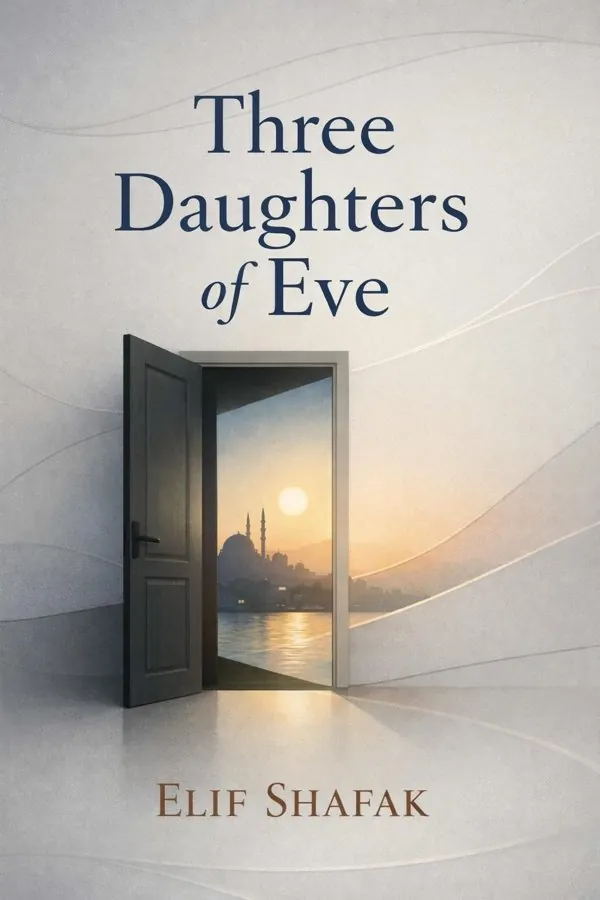
Three Daughters of Eve: Summary & Key Insights
by Elif Shafak
 10 min8 chaptersAudio available
Key Takeaways from Three Daughters of Eve
A city can hold a person’s contradictions more honestly than that person can.
The deepest conflicts of adulthood often begin as the ordinary atmosphere of childhood.
We understand ourselves more clearly when we stand beside people who embody the paths we fear or desire.
Ideas become dangerous when they are delivered by someone who knows how to turn thought into enchantment.
One of the novel’s boldest claims is that doubt does not necessarily destroy faith; sometimes it deepens it.
What Is Three Daughters of Eve About?
Three Daughters of Eve by Elif Shafak is a bestsellers book spanning 7 pages. Some novels ask what happened; Elif Shafak’s Three Daughters of Eve asks who we become when we can no longer separate belief from doubt, memory from identity, or East from West. Set between the charged streets of Istanbul and the intellectual corridors of Oxford, the novel follows Peri, a wealthy Turkish woman whose apparently settled life is disrupted by a violent incident that awakens long-buried memories. Those memories pull her back to a childhood shaped by a devout mother and a secular father, and to her university years under the influence of the charismatic Professor Azur. Alongside two fellow students—one fervently religious, the other unapologetically rebellious—Peri is forced to confront the deepest questions of faith, freedom, shame, and belonging. What makes the novel matter is not only its story, but its refusal to accept easy binaries. Shafak, one of the most internationally respected contemporary novelists, writes with unusual authority about identity, religion, gender, and cultural conflict. Her gift lies in turning philosophical debate into intimate human drama, making this novel both emotionally gripping and intellectually resonant.
This FizzRead summary covers all 8 key chapters of Three Daughters of Eve in approximately 10 minutes, distilling the most important ideas, arguments, and takeaways from Elif Shafak's work. Also available as an audio summary and Key Quotes Podcast.
Three Daughters of Eve
Some novels ask what happened; Elif Shafak’s Three Daughters of Eve asks who we become when we can no longer separate belief from doubt, memory from identity, or East from West. Set between the charged streets of Istanbul and the intellectual corridors of Oxford, the novel follows Peri, a wealthy Turkish woman whose apparently settled life is disrupted by a violent incident that awakens long-buried memories. Those memories pull her back to a childhood shaped by a devout mother and a secular father, and to her university years under the influence of the charismatic Professor Azur. Alongside two fellow students—one fervently religious, the other unapologetically rebellious—Peri is forced to confront the deepest questions of faith, freedom, shame, and belonging. What makes the novel matter is not only its story, but its refusal to accept easy binaries. Shafak, one of the most internationally respected contemporary novelists, writes with unusual authority about identity, religion, gender, and cultural conflict. Her gift lies in turning philosophical debate into intimate human drama, making this novel both emotionally gripping and intellectually resonant.
Who Should Read Three Daughters of Eve?
This book is perfect for anyone interested in bestsellers and looking to gain actionable insights in a short read. Whether you're a student, professional, or lifelong learner, the key ideas from Three Daughters of Eve by Elif Shafak will help you think differently.
- ✓Readers who enjoy bestsellers and want practical takeaways
- ✓Professionals looking to apply new ideas to their work and life
- ✓Anyone who wants the core insights of Three Daughters of Eve in just 10 minutes
Want the full summary?
Get instant access to this book summary and 100K+ more with Fizz Moment.
Get Free SummaryAvailable on App Store • Free to download
Key Chapters
A city can hold a person’s contradictions more honestly than that person can. Three Daughters of Eve opens in contemporary Istanbul, where Peri is on her way to an elegant dinner party among the city’s wealthy elite. On the surface, she appears comfortable, privileged, and composed. Yet the city around her tells another story. Istanbul is not merely a backdrop in this novel; it is a living symbol of overlap and fracture, of empire and modernity, of religion and secular aspiration. It reflects the same divided inner life Peri carries within herself.
The opening disruption—a mugging that results in the loss of a Polaroid photograph—acts like a trapdoor beneath Peri’s polished existence. A single image, once gone, releases years of unresolved memory. Shafak uses this moment to show how the past rarely stays buried. It lives inside ordinary routines, waiting for some small shock to surface. The city intensifies that sensation. In Istanbul, the call to prayer can coexist with luxury shopping, ancient mosques with cosmopolitan parties, and political anxiety with domestic performance. Peri moves through all of it while feeling fully at home nowhere.
This idea has practical resonance beyond the novel. Many people live between incompatible worlds: family expectations and personal convictions, inherited identity and chosen values, public roles and private uncertainty. Like Istanbul, modern life often asks us to hold contradictions without resolving them neatly.
A useful way to apply this insight is to treat your environment as a clue to your inner state. Notice which spaces make you feel divided, nostalgic, performative, or calm. Ask what tensions they awaken. Peri’s journey begins when she can no longer ignore what her surroundings are telling her.
Actionable takeaway: Pay attention to the places that trigger strong memory or discomfort; they may reveal the unresolved conflicts shaping your choices today.
The deepest conflicts of adulthood often begin as the ordinary atmosphere of childhood. Peri grows up in a household sharply divided by ideology. Her mother is deeply pious, morally strict, and anchored in religious certainty. Her father, by contrast, is secular, intellectual, and dismissive of religious dogma. Their marriage is not simply unhappy; it is philosophically incompatible. For Peri, this means that home never becomes a place of stable truth. Instead, it becomes a training ground in contradiction.
Shafak shows how children absorb not only what parents say, but the emotional cost of what they believe. Peri learns that faith can feel suffocating when weaponized, but she also sees that secularism can become arrogant and emotionally careless. Neither parent offers her a complete model for living. She is left to assemble herself from fragments, trying to please both sides and belonging fully to neither. This early fragmentation explains much of her later hesitation. Peri does not merely doubt religion or resist authority; she fears choosing, because choice feels like betrayal.
The novel also explores gender within this family divide. Peri experiences the pressures placed on daughters in a culture where family honor, respectability, and obedience are loaded expectations. Her mother’s religiosity is tied not only to faith, but to fear, social judgment, and the need to control. Her father’s freedom, meanwhile, comes with privilege that women in the same environment do not equally possess.
In practical terms, the book reminds us that intellectual confusion is often emotional inheritance. People may think they are debating ideas when they are actually reliving family wounds. If someone has a complicated relationship with religion, politics, ambition, or love, the roots may lie less in abstract theory and more in childhood atmosphere.
Actionable takeaway: When you feel torn between two worldviews, ask which parts are truly yours and which parts are inherited loyalties from your family.
We understand ourselves more clearly when we stand beside people who embody the paths we fear or desire. At Oxford, Peri’s inner struggle becomes more visible through her relationships with two other young women: Shirin and Mona. Together, they are the novel’s “three daughters of Eve,” but they are not simple symbols. Each represents a distinct way of inhabiting womanhood, faith, freedom, and cultural identity in a globalized world.
Mona, an Egyptian-American Muslim, is outspoken, principled, and visibly religious. She wears her faith publicly yet refuses to let others reduce her to stereotype. She challenges the false assumption that devotion must mean passivity or oppression. Shirin, by contrast, is Iranian, glamorous, provocative, and defiantly anti-religious. She embraces pleasure, irreverence, and rebellion, often using irony as both shield and weapon. Between them stands Peri, uncertain and searching, intellectually alert but emotionally hesitant. She is neither secure in belief nor comfortable in disbelief.
What makes this trio powerful is that the novel resists crowning one woman as the correct answer. Mona’s conviction can inspire, but it can also be rigid. Shirin’s freedom is exhilarating, but it can become avoidance. Peri’s openness is thoughtful, but it often slips into paralysis. Their friendship reveals that identity is not a static label but an ongoing negotiation among culture, politics, desire, trauma, and choice.
This dynamic applies widely in real life. We often define ourselves by contrast. A friend’s certainty may expose our confusion; another’s boldness may highlight our fear. The people around us can function as living mirrors, helping us see values we had never fully named.
The novel encourages readers to move past caricatures. Religious women are not automatically submissive. Secular women are not automatically liberated. Doubt is not weakness. Certainty is not always strength.
Actionable takeaway: Identify the people in your life who represent different ways of living, and ask what each one reveals about the path you are currently choosing by default.
Ideas become dangerous when they are delivered by someone who knows how to turn thought into enchantment. Professor Azur, Peri’s charismatic Oxford mentor, teaches a seminar on God that becomes the philosophical and emotional center of the novel. He is brilliant, theatrical, unsettling, and magnetic. Students are drawn not only to his intellect but to his aura. In his presence, religion is no longer a private inheritance or a social rule; it becomes an open, intoxicating question.
Azur’s seminar examines faith, doubt, mysticism, atheism, and theology without settling into a single doctrine. For Peri, this is both liberating and destabilizing. She has spent her life surrounded by people who speak in certainties. Azur offers a space where uncertainty itself appears sophisticated, even sacred. Yet Shafak does not romanticize this freedom completely. Intellectual power can blur boundaries. A teacher who invites vulnerability may also manipulate it. A space of inquiry can become a stage for ego.
This is one of the novel’s most important insights: not every liberating voice is trustworthy simply because it challenges dogma. People leaving one rigid system are often vulnerable to another form of dependency, especially when it arrives dressed as sophistication, rebellion, or depth. Peri’s fascination with Azur is therefore not only intellectual; it exposes her hunger for guidance from a figure who seems capable of reconciling her divided self.
In everyday life, the lesson extends beyond academia. Charismatic leaders, experts, influencers, and mentors can shape our beliefs profoundly. Their confidence can make their worldview feel larger, more coherent, and more urgent than our own half-formed thoughts. That influence can be constructive, but it demands vigilance.
Actionable takeaway: When someone’s brilliance captivates you, separate the value of their ideas from the power of their personality before surrendering your judgment.
One of the novel’s boldest claims is that doubt does not necessarily destroy faith; sometimes it deepens it. Peri’s central struggle is not deciding whether she believes in God in a simple yes-or-no sense. Her conflict is learning how to live with questions that never disappear. She is haunted by competing impulses: the desire to surrender, the urge to examine, the fear of hypocrisy, and the shame of uncertainty. Shafak treats this not as a defect in Peri’s character but as a profoundly human condition.
Many religious and secular cultures alike reward certainty. Believers may be expected to trust without wavering, while skeptics may feel pressure to dismiss faith entirely. Peri fits into neither camp. She is too questioning for comfort within orthodoxy, yet too spiritually sensitive to embrace easy disbelief. In this way, she represents a large but often underrepresented group: people whose inner lives are shaped by reverence and skepticism at once.
The novel suggests that rigid binaries can impoverish us. Faith without reflection may become obedience or fear. Doubt without humility may become cynicism or emptiness. What matters is not reaching a permanent final answer, but developing the courage to remain in honest conversation with the unknown. This gives the story philosophical depth beyond its plot.
There is practical value here for readers wrestling with identity, morality, or meaning. Not every unanswered question demands immediate resolution. Some questions must be lived, revisited, and allowed to mature. The pressure to define yourself too quickly can produce borrowed certainty rather than genuine conviction.
Peri’s discomfort becomes meaningful when she stops treating ambiguity as failure. Her inner conflict, though painful, is evidence of an active moral and spiritual life.
Actionable takeaway: Instead of forcing yourself into rigid certainty, create space to explore the questions that keep returning; recurring doubt may be guiding you toward a more honest form of belief.
A single crisis can reveal how much of our identity depends on performance. As tensions rise around Professor Azur and his seminar, what once felt like liberating inquiry turns into conflict, scandal, and exposure. The precise events matter less than what they reveal: beneath the intellectual glamour of Oxford lies insecurity, prejudice, power imbalance, and the volatility of people who are all trying to prove something—to each other and to themselves.
Peri, Mona, and Shirin are each tested under pressure. Their convictions, loyalties, and vulnerabilities become harder to conceal. Shafak shows that moments of public controversy do not create character from nowhere; they expose what has been quietly building all along. Ideas about God, freedom, gender, and identity stop being abstract and become embodied in choices with consequences.
This part of the novel also examines shame. Shame thrives where private uncertainty collides with public exposure. Peri, who has long hidden behind indecision and passivity, cannot avoid the fact that not choosing is also a choice. Silence has consequences. Deferral can wound as surely as action. The scandal therefore becomes a moral turning point, not just a plot twist.
In contemporary life, many people maintain carefully managed versions of themselves—competent professional, dutiful child, tolerant thinker, enlightened skeptic. Crisis can strip those identities down quickly. A conflict at work, a family rupture, a public misunderstanding, or a relationship breakdown may show us whether our values are truly lived or merely performed.
The novel’s warning is subtle but sharp: if you postpone self-knowledge for too long, reality may force it upon you in harsher form. Peri’s tragedy is not that she is conflicted, but that she waits too long to claim an honest position within her own life.
Actionable takeaway: Before a crisis exposes your deepest values, ask yourself what you are currently pretending not to know about your beliefs, loyalties, and responsibilities.
We do not outgrow unresolved experiences; we organize our lives around them. After the opening incident in Istanbul, Peri’s polished adult world begins to crack. Her marriage, social circle, and domestic routines appear stable, yet they are built over a past she has never fully processed. The lost photograph becomes a symbol of this unfinished emotional history. It captures not just a memory, but a version of herself she has tried to lock away.
Shafak carefully links Peri’s present unease with her earlier failures of clarity and courage. The return to Istanbul is therefore not a homecoming in any comforting sense. It is a confrontation. Peri must face the gap between who she became and who she might have been had she acted differently. She must also reconsider the stories she has told herself about family, faith, class, and femininity.
An important practical insight emerges here: success and comfort do not automatically produce inner peace. Many people build impressive lives while carrying unexamined grief, shame, or confusion. They may function well for years until a small event—a photograph, song, encounter, or accident—collapses the barrier between present and past. Healing begins not when the past disappears, but when we stop demanding that it stay silent.
The novel also highlights the emotional cost of social performance. Peri has learned how to appear appropriate in elite settings, but composure is not the same as integration. The life she presents outwardly does not answer the deeper questions she abandoned.
For readers, this is a strong reminder that unresolved inner conflicts rarely remain private. They affect intimacy, parenting, ethical choices, and self-respect. Looking backward is not indulgence if it helps us live more truthfully in the present.
Actionable takeaway: Notice the memories or objects that trigger disproportionate emotion; they often point to unfinished parts of your story that need acknowledgment rather than avoidance.
Becoming a mother does not erase the daughter within us. One of the novel’s quietest but most affecting dimensions is Peri’s relationship to womanhood across generations. As she reflects on her mother and on her own role as a parent, she begins to see how fear, love, silence, and expectation travel from one generation to the next. The novel is not only about faith in God; it is also about faith in women’s ability to break inherited patterns.
Peri’s mother shaped her through control, anxiety, and religious rigidity, but also through vulnerability born of her own social limitations. As Peri matures, she is forced to confront a difficult truth: understanding a parent is not the same as excusing them, yet without understanding, forgiveness remains shallow. Shafak resists sentimental reconciliation. Instead, she presents repair as gradual, imperfect, and rooted in honesty.
This matters because family wounds often persist through repetition rather than intention. A parent may pass on shame while believing they are teaching morality, or encourage silence while believing they are preserving safety. Peri’s story suggests that true adulthood requires examining what we unconsciously transmit to the next generation.
Readers can apply this idea beyond parenting. Any close relationship—mentoring, friendship, partnership—can become a site where inherited emotional patterns are repeated or transformed. The question is whether we are acting from conscious values or recycled fear.
By the novel’s end, motherhood becomes linked with humility. Peri cannot offer her children perfect certainty because she does not possess it herself. But she may be able to offer something more humane: openness, tenderness, and the permission to ask difficult questions without shame.
Actionable takeaway: Reflect on one belief or fear you inherited from your family, and decide whether you want to pass it on, revise it, or end it with you.
All Chapters in Three Daughters of Eve
About the Author
Elif Shafak is a Turkish-British novelist, essayist, and speaker widely recognized for her exploration of identity, memory, spirituality, feminism, and cultural conflict. Born in Strasbourg and shaped by a transnational upbringing, she brings a rare sensitivity to questions of belonging and displacement. Shafak writes in both Turkish and English, and her fiction often bridges Eastern and Western traditions while challenging rigid political and social binaries. She is the author of internationally acclaimed works including The Bastard of Istanbul, The Forty Rules of Love, Honour, and 10 Minutes 38 Seconds in This Strange World, which was shortlisted for the Booker Prize. Beyond fiction, she is known for essays and public commentary on democracy, women’s rights, freedom of expression, and pluralism. Her work is admired for combining lyrical storytelling with intellectual depth and emotional intelligence.
Get This Summary in Your Preferred Format
Read or listen to the Three Daughters of Eve summary by Elif Shafak anytime, anywhere. FizzRead offers multiple formats so you can learn on your terms — all free.
Available formats: App · Audio · PDF · EPUB — All included free with FizzRead
Download Three Daughters of Eve PDF and EPUB Summary
Key Quotes from Three Daughters of Eve
“A city can hold a person’s contradictions more honestly than that person can.”
“The deepest conflicts of adulthood often begin as the ordinary atmosphere of childhood.”
“We understand ourselves more clearly when we stand beside people who embody the paths we fear or desire.”
“Ideas become dangerous when they are delivered by someone who knows how to turn thought into enchantment.”
“One of the novel’s boldest claims is that doubt does not necessarily destroy faith; sometimes it deepens it.”
Frequently Asked Questions about Three Daughters of Eve
Three Daughters of Eve by Elif Shafak is a bestsellers book that explores key ideas across 8 chapters. Some novels ask what happened; Elif Shafak’s Three Daughters of Eve asks who we become when we can no longer separate belief from doubt, memory from identity, or East from West. Set between the charged streets of Istanbul and the intellectual corridors of Oxford, the novel follows Peri, a wealthy Turkish woman whose apparently settled life is disrupted by a violent incident that awakens long-buried memories. Those memories pull her back to a childhood shaped by a devout mother and a secular father, and to her university years under the influence of the charismatic Professor Azur. Alongside two fellow students—one fervently religious, the other unapologetically rebellious—Peri is forced to confront the deepest questions of faith, freedom, shame, and belonging. What makes the novel matter is not only its story, but its refusal to accept easy binaries. Shafak, one of the most internationally respected contemporary novelists, writes with unusual authority about identity, religion, gender, and cultural conflict. Her gift lies in turning philosophical debate into intimate human drama, making this novel both emotionally gripping and intellectually resonant.
More by Elif Shafak



You Might Also Like

The Godfather
Mario Puzo
10 min
The Handmaid's Tale
Margaret Atwood
10 min
The Hunger Games
Suzanne Collins
10 min
The Nightingale
Kristin Hannah
10 min
The Seven Husbands of Evelyn Hugo
Taylor Jenkins Reid
10 min
Backwater Justice
Fern Michaels
10 minBrowse by Category
Ready to read Three Daughters of Eve?
Get the full summary and 100K+ more books with Fizz Moment.