
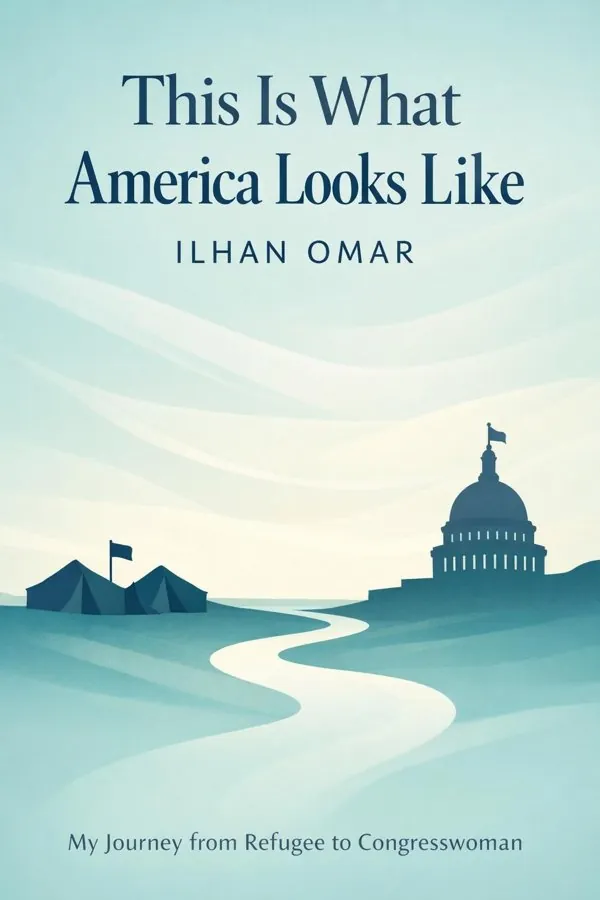
This Is What America Looks Like: My Journey from Refugee to Congresswoman: Summary & Key Insights
by Ilhan Omar
 10 min6 chaptersAudio available
What Is This Is What America Looks Like: My Journey from Refugee to Congresswoman About?
This Is What America Looks Like: My Journey from Refugee to Congresswoman by Ilhan Omar is a biographies book spanning 6 pages. In this memoir, Ilhan Omar recounts her journey from a childhood in war-torn Somalia and a refugee camp in Kenya to becoming one of the first Muslim women elected to the United States Congress. She reflects on her experiences as an immigrant, her advocacy for justice and equality, and her vision for a more inclusive America.
This FizzRead summary covers all 6 key chapters of This Is What America Looks Like: My Journey from Refugee to Congresswoman in approximately 10 minutes, distilling the most important ideas, arguments, and takeaways from Ilhan Omar's work. Also available as an audio summary and Key Quotes Podcast.
This Is What America Looks Like: My Journey from Refugee to Congresswoman
In this memoir, Ilhan Omar recounts her journey from a childhood in war-torn Somalia and a refugee camp in Kenya to becoming one of the first Muslim women elected to the United States Congress. She reflects on her experiences as an immigrant, her advocacy for justice and equality, and her vision for a more inclusive America.
Who Should Read This Is What America Looks Like: My Journey from Refugee to Congresswoman?
This book is perfect for anyone interested in biographies and looking to gain actionable insights in a short read. Whether you're a student, professional, or lifelong learner, the key ideas from This Is What America Looks Like: My Journey from Refugee to Congresswoman by Ilhan Omar will help you think differently.
- ✓Readers who enjoy biographies and want practical takeaways
- ✓Professionals looking to apply new ideas to their work and life
- ✓Anyone who wants the core insights of This Is What America Looks Like: My Journey from Refugee to Congresswoman in just 10 minutes
Want the full summary?
Get instant access to this book summary and 100K+ more with Fizz Moment.
Get Free SummaryAvailable on App Store • Free to download
Key Chapters
My earliest memories are filled with warmth: my grandfather reciting poetry about justice, my father teaching me to question everything, and our home in Mogadishu alive with music, scents, and debates about history and faith. But the peace of that childhood shattered when civil war broke across Somalia. Overnight, neighbors became enemies, and familiar streets turned into zones of fear. One day we were children running to school; the next, we were fugitives searching for shelter.
In those early days of conflict, my family had to make unimaginable choices. We left behind our home, our possessions, and even relatives whose fates we never discovered. For months we lived on roads, moving wherever rumor promised safety. Eventually we reached Dadaab, a refugee camp across the Kenyan border. There, surrounded by fences and dust, we learned to live again.
Refugee life taught me lessons that would later shape every decision I made. I understood what it meant to depend entirely on community for survival, to share even when you have almost nothing. More importantly, I discovered the dignity in persistence. My mother was gone by then, but my father and grandfather held our family together through steadiness and humor, teaching us to dream even in scarcity. They taught me that education was the most radical form of defiance available to us. Books became my sanctuary; words were the only things no one could confiscate.
Years in the camp etched in me a sense of responsibility beyond self. When I later raised my hand in Congress, I would still hear the echoes of those dusty days, the belief that no system—no matter how powerful—could define our humanity unless we allowed it to. That belief began among tents and ration lines, in a girl’s stubborn refusal to accept invisibility.
When my family arrived in Arlington, Virginia, after four long years in Kenya, the United States appeared almost unreal. The streets were quiet, the air clean, the grocery stores overflowing. It was both miraculous and disorienting. We had escaped war, but we had also entered another kind of unknown—a country that promised refuge yet required translation in every sense of the word.
I was twelve when I started school there, and English quickly became both my greatest challenge and my greatest tool. I learned words from cartoons, mimicking accents from sitcoms, absorbing idioms with fascination. Still, even when my vocabulary grew, my sense of belonging lagged behind. Classmates asked where I came from, and when I answered “Somalia,” they often didn’t know where that was. Some looked at my hijab and assumed everything they had seen on the news.
Over time my family moved to Minneapolis, where a growing Somali community provided a fragile sense of home. Yet adolescence came with new conflicts: wanting to fit in but also wanting to stay true to my faith; trying to honor my father’s values while testing my own boundaries. These years taught me empathy—the understanding that identity is negotiation, not a fixed state. America was shaping me, but I was also shaping my version of America.
At Roosevelt High School, I found language for my frustrations through debate and student government. Speaking up was a way to reclaim space, to declare that someone like me could be both immigrant and American, Muslim and feminist, grateful and critical. Every report, every speech, every argument was practice for the woman I would someday become—a woman who sees protest not as rejection, but as patriotism in its purest form.
+ 4 more chapters — available in the FizzRead app
All Chapters in This Is What America Looks Like: My Journey from Refugee to Congresswoman
About the Author
Ilhan Omar is a Somali American politician serving as the U.S. Representative for Minnesota’s 5th congressional district. Born in Mogadishu, Somalia, she immigrated to the United States as a refugee and became one of the first Muslim women elected to Congress. Her work focuses on social justice, immigration reform, and human rights.
Get This Summary in Your Preferred Format
Read or listen to the This Is What America Looks Like: My Journey from Refugee to Congresswoman summary by Ilhan Omar anytime, anywhere. FizzRead offers multiple formats so you can learn on your terms — all free.
Available formats: App · Audio · PDF · EPUB — All included free with FizzRead
Download This Is What America Looks Like: My Journey from Refugee to Congresswoman PDF and EPUB Summary
Key Quotes from This Is What America Looks Like: My Journey from Refugee to Congresswoman
“But the peace of that childhood shattered when civil war broke across Somalia.”
“When my family arrived in Arlington, Virginia, after four long years in Kenya, the United States appeared almost unreal.”
Frequently Asked Questions about This Is What America Looks Like: My Journey from Refugee to Congresswoman
This Is What America Looks Like: My Journey from Refugee to Congresswoman by Ilhan Omar is a biographies book that explores key ideas across 6 chapters. In this memoir, Ilhan Omar recounts her journey from a childhood in war-torn Somalia and a refugee camp in Kenya to becoming one of the first Muslim women elected to the United States Congress. She reflects on her experiences as an immigrant, her advocacy for justice and equality, and her vision for a more inclusive America.
You Might Also Like

An American Marriage
Tayari Jones
10 min
Benjamin Franklin: An American Life
Walter Isaacson
10 min
I Know Why The Caged Bird Sings
Maya Angelou
10 min
Long Walk to Freedom
Nelson Mandela
10 min
Persepolis
Marjane Satrapi
10 min
Surely You're Joking, Mr. Feynman!
Richard P. Feynman
10 minBrowse by Category
Ready to read This Is What America Looks Like: My Journey from Refugee to Congresswoman?
Get the full summary and 100K+ more books with Fizz Moment.