
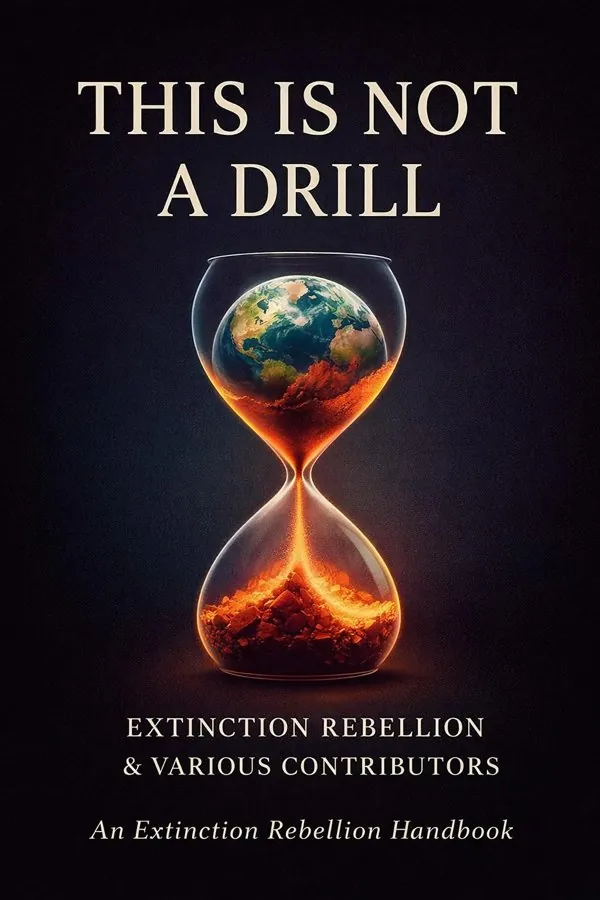
This Is Not a Drill: An Extinction Rebellion Handbook: Summary & Key Insights
by Extinction Rebellion, Various Contributors
 10 min10 chaptersAudio available
Key Takeaways from This Is Not a Drill: An Extinction Rebellion Handbook
Real action begins when denial ends.
Facts alone rarely change societies; the stories institutions tell about those facts matter just as much.
A society reveals its values by what it treats as urgent.
Movements do not grow on fear alone; they need a believable, desirable vision of what could replace the present order.
Power rarely concedes simply because it has been politely informed.
What Is This Is Not a Drill: An Extinction Rebellion Handbook About?
This Is Not a Drill: An Extinction Rebellion Handbook by Extinction Rebellion & Various Contributors is a environment book spanning 10 pages. This Is Not a Drill: An Extinction Rebellion Handbook is both a warning and an invitation. Created by Extinction Rebellion with contributions from activists, scientists, writers, legal thinkers, and organizers, the book argues that the climate and ecological crisis is no longer a future threat but a present emergency demanding immediate, collective action. Rather than offering a detached analysis, it combines hard scientific evidence, political critique, moral reflection, and practical guidance for nonviolent resistance. Its core claim is simple but unsettling: conventional politics has failed to respond at the scale and speed required, so ordinary people must step into history and help force change. What makes the book matter is its fusion of urgency and agency. It does not stop at diagnosing planetary breakdown; it explains why societies remain paralyzed and how mass movements can break that paralysis. The contributors write from lived experience inside one of the most visible climate movements of recent years, giving the handbook both intellectual credibility and practical authority. For readers who feel overwhelmed, angry, guilty, or unsure what to do next, this book turns climate anxiety into a framework for meaningful action.
This FizzRead summary covers all 10 key chapters of This Is Not a Drill: An Extinction Rebellion Handbook in approximately 10 minutes, distilling the most important ideas, arguments, and takeaways from Extinction Rebellion & Various Contributors's work. Also available as an audio summary and Key Quotes Podcast.
This Is Not a Drill: An Extinction Rebellion Handbook
This Is Not a Drill: An Extinction Rebellion Handbook is both a warning and an invitation. Created by Extinction Rebellion with contributions from activists, scientists, writers, legal thinkers, and organizers, the book argues that the climate and ecological crisis is no longer a future threat but a present emergency demanding immediate, collective action. Rather than offering a detached analysis, it combines hard scientific evidence, political critique, moral reflection, and practical guidance for nonviolent resistance. Its core claim is simple but unsettling: conventional politics has failed to respond at the scale and speed required, so ordinary people must step into history and help force change.
What makes the book matter is its fusion of urgency and agency. It does not stop at diagnosing planetary breakdown; it explains why societies remain paralyzed and how mass movements can break that paralysis. The contributors write from lived experience inside one of the most visible climate movements of recent years, giving the handbook both intellectual credibility and practical authority. For readers who feel overwhelmed, angry, guilty, or unsure what to do next, this book turns climate anxiety into a framework for meaningful action.
Who Should Read This Is Not a Drill: An Extinction Rebellion Handbook?
This book is perfect for anyone interested in environment and looking to gain actionable insights in a short read. Whether you're a student, professional, or lifelong learner, the key ideas from This Is Not a Drill: An Extinction Rebellion Handbook by Extinction Rebellion & Various Contributors will help you think differently.
- ✓Readers who enjoy environment and want practical takeaways
- ✓Professionals looking to apply new ideas to their work and life
- ✓Anyone who wants the core insights of This Is Not a Drill: An Extinction Rebellion Handbook in just 10 minutes
Want the full summary?
Get instant access to this book summary and 100K+ more with Fizz Moment.
Get Free SummaryAvailable on App Store • Free to download
Key Chapters
Real action begins when denial ends. One of the handbook’s foundational ideas is that the climate and ecological crisis must be understood in scientific, not sentimental, terms. The contributors stress that global heating, biodiversity collapse, soil depletion, ocean acidification, and mass extinction are not isolated issues but interlocking symptoms of a system pushing beyond planetary boundaries. The problem is not merely that temperatures are rising; it is that the web of life that supports human civilization is being destabilized.
The book insists that the science is already strong enough to justify emergency action. We do not need perfect certainty before changing course. In fact, waiting for complete precision in a rapidly worsening crisis becomes a form of moral and political delay. This argument challenges a common public habit: treating climate change as one policy issue among many rather than as a condition that affects food systems, migration, health, infrastructure, and democracy itself.
Practical application begins with becoming scientifically literate enough to communicate the crisis honestly. That might mean learning the basics of carbon budgets, understanding tipping points, or discussing local impacts such as floods, fires, heatwaves, crop failures, or polluted air. A parent can use this knowledge to advocate at school. A worker can bring it into union conversations. A voter can evaluate whether elected officials are matching policy to physical reality.
The book’s point is not to turn everyone into a climate scientist. It is to remove the excuse of ignorance and replace vague concern with informed urgency. Actionable takeaway: choose one reliable source of climate science, study it consistently, and begin speaking about the crisis as a present emergency rather than a distant possibility.
Facts alone rarely change societies; the stories institutions tell about those facts matter just as much. This section argues that the ecological crisis persists not because humanity lacks information, but because dominant political and economic systems are structured to ignore inconvenient truths. Endless growth, extractive capitalism, fossil-fuel dependency, consumer culture, and short electoral cycles all reward delay. The result is a profound mismatch between what science demands and what institutions are willing to do.
The handbook goes beyond blaming individual greed or apathy. It shows how systemic incentives normalize destruction. Governments subsidize fossil fuels while speaking of sustainability. Corporations market green lifestyles while maintaining destructive supply chains. Media organizations frame climate breakdown as a debate rather than an emergency. Citizens are encouraged to think of themselves as consumers making lifestyle choices instead of political actors capable of transforming public priorities.
This perspective matters because it shifts responsibility. Personal choices still matter, but they are not enough. Recycling, driving less, or eating less meat can be positive steps, yet the book warns that private virtue cannot substitute for structural change. Real progress requires confronting the institutions that profit from ecological harm and the ideologies that make this harm seem normal.
In daily life, telling the truth can mean refusing euphemisms. Instead of saying “environmental challenge,” say “climate emergency.” Instead of asking only how to reduce your own footprint, ask why your city still funds road expansion, why pension funds back fossil extraction, or why food systems depend on wasteful, destructive practices.
The handbook calls for moral clarity: societies cannot solve a crisis they refuse to name. Actionable takeaway: identify one institution in your life—workplace, school, local government, bank, or media outlet—and ask how its incentives contribute to ecological breakdown, then raise that question publicly and persistently.
A society reveals its values by what it treats as urgent. The handbook argues that climate and ecological breakdown must be approached with the same seriousness reserved for wartime mobilization or public health emergencies. This does not mean panic for panic’s sake. It means aligning our response with the scale, speed, and irreversibility of the threat.
An emergency frame changes priorities. If a house is on fire, we do not hold endless meetings about whether flames are aesthetically concerning. We evacuate, call for help, and reorganize every available resource toward survival. Extinction Rebellion uses this logic to criticize the slow rhythms of conventional policymaking. Incrementalism may feel responsible, but in an emergency it becomes dangerous. Delayed action locks in more warming, more habitat loss, and more suffering for vulnerable communities.
The handbook also highlights a psychological obstacle: people often avoid emergency thinking because it is frightening. Yet pretending things are manageable does not make them manageable. Mature courage means allowing the gravity of the situation to register without collapsing into despair. In practical terms, an emergency mindset can reshape local campaigns. Citizens can push councils to declare climate emergencies, demand rapid home insulation programs, support public transport expansion, and oppose new fossil fuel infrastructure. Institutions can apply emergency standards to procurement, pensions, land use, and energy planning.
The book does not claim that declarations alone solve anything. Symbolic recognition matters only if followed by emergency-level policies and timelines. The value of the frame is that it removes complacency and clarifies proportion.
When people begin to see the crisis as immediate, they also begin to ask different questions: What would we do if we truly believed this mattered most? What would responsible leadership look like now, not in 2050? Actionable takeaway: review one local climate plan or government target and ask whether it reflects an actual emergency response; if not, organize with others to demand stronger timelines and accountability.
Movements do not grow on fear alone; they need a believable, desirable vision of what could replace the present order. The handbook emphasizes that climate activism must offer more than warnings about collapse. It must help people imagine a society organized around care, fairness, resilience, and ecological limits. Without that positive horizon, urgency can harden into fatalism.
This vision is not presented as utopian fantasy. Rather, it emerges from practical principles: cleaner energy, restored ecosystems, democratic participation, reduced inequality, stronger local communities, less waste, and economies designed for wellbeing rather than endless extraction. The book suggests that many people cling to destructive systems because they fear what comes next. If climate action is framed only as sacrifice, restriction, and loss, it becomes politically fragile. If it is also framed as cleaner air, warmer homes, better public spaces, healthier food, and deeper community, it gains emotional force.
Examples make this tangible. A city designed around public transport and cycling offers lower emissions and less noise. Regenerative agriculture can rebuild soil while improving food security. Citizen assemblies can produce more legitimate climate decisions than polarized party politics. Community energy projects can reduce dependence on centralized fossil-fuel systems while building local ownership.
The deeper point is that ecological survival and social justice belong together. A livable future cannot be built on austerity for the poor and indulgence for the powerful. People are more likely to join transformative change when they can see dignity, meaning, and possibility within it.
The book invites readers to become authors of that future rather than passive witnesses to decline. Actionable takeaway: when discussing climate action, pair every warning with a concrete example of a better alternative so that urgency is matched by hope.
Power rarely concedes simply because it has been politely informed. One of the handbook’s central arguments is that nonviolent civil disobedience is necessary when normal channels fail to produce action proportionate to the crisis. Voting, petitions, and polite lobbying have a role, but when institutions remain captured by short-term interests, mass disruption can force issues onto the political agenda.
The book places Extinction Rebellion within a longer tradition of nonviolent struggle, echoing lessons from civil rights campaigns, anti-colonial movements, suffrage activism, and labor organizing. Disruption works not because inconvenience is inherently virtuous, but because it interrupts business as usual and exposes a moral contradiction: governments that claim to protect the public are permitting escalating ecological harm. By creating visible tension, protesters make inaction harder to ignore.
Importantly, the handbook distinguishes nonviolence from passivity. Effective nonviolent action requires strategy, discipline, preparation, and sacrifice. It may involve roadblocks, sit-ins, symbolic occupations, mass arrests, or creative public rituals that dramatize the stakes. These actions are designed to generate attention, recruit supporters, and reveal the gap between official rhetoric and real priorities.
For ordinary readers, the practical lesson is not that everyone must immediately risk arrest. Movements need many roles: planners, legal observers, medics, artists, communicators, cooks, donors, trainers, and people willing to speak with family, neighbors, and colleagues. Nonviolent disruption is an ecosystem, not a single tactic.
The handbook also implies that disruption must be tied to clear demands. Spectacle without strategy fades quickly. Actionable takeaway: if you want to engage in climate activism, study the principles of nonviolent discipline, identify your risk level, and join or support actions that connect visible disruption to specific political goals.
People do not burn out because they care too much; they burn out because they try to carry unbearable realities without enough support. The handbook gives unusual attention to the emotional dimension of climate activism. Grief, fear, guilt, anger, and helplessness are not signs of weakness. They are rational responses to ecological breakdown. The challenge is to metabolize these feelings in ways that deepen commitment rather than produce paralysis.
This is why community matters. The book portrays activism as both political intervention and collective holding space. Shared meals, debriefs after actions, peer support, reflective practices, and honest conversations about trauma are presented as essential to sustaining long-term engagement. A movement that ignores the inner lives of its members may mobilize quickly, but it will struggle to endure.
This insight extends beyond activist circles. Teachers discussing climate with students, parents raising children in an unstable world, healthcare workers confronting heat-related illness, or local leaders preparing for disasters all need emotional resilience alongside technical planning. The handbook implicitly rejects the false choice between feeling deeply and acting effectively. In fact, the two often reinforce one another when grounded in solidarity.
Practical application can be simple. A group planning a demonstration might begin with a check-in and end with a debrief. A climate club might create buddy systems for new members. Families might schedule regular conversations about climate news rather than letting anxiety remain private and shapeless. Workplaces can support eco-anxiety discussions while connecting them to concrete sustainability efforts.
The handbook’s deeper message is that courage is communal. Few people can face the truth alone for long, but many can face it together. Actionable takeaway: pair every climate action you join with a practice of mutual care—check-ins, debriefs, peer support, or rest planning—so commitment becomes sustainable rather than exhausting.
Climate breakdown is planetary, but its causes and consequences are profoundly unequal. The handbook insists that any serious response must center justice: between rich and poor nations, between those who caused most emissions and those now suffering first, and between present populations and future generations. Without this lens, climate politics risks becoming morally shallow and politically ineffective.
The contributors point out that vulnerable communities often face the harshest impacts despite contributing least to the problem. Small island states, drought-prone regions, Indigenous peoples defending ecosystems, and low-income communities exposed to pollution are on the front lines of a crisis shaped by colonial histories, extractive economics, and concentrated wealth. A movement that talks only about carbon while ignoring power can reproduce the very inequities it claims to oppose.
This justice framework also complicates easy narratives of national self-interest. No country can insulate itself from ecological instability forever. Food shocks, migration pressures, conflict risks, supply-chain disruption, and public health threats travel across borders. Fairness is therefore not separate from realism; it is part of any workable global response.
Practical implications include supporting climate finance for vulnerable nations, defending Indigenous land rights, opposing false solutions that sacrifice poor communities, and demanding transition policies that protect workers and households. Locally, it means asking who benefits and who bears the burden in every environmental policy. Does a green redevelopment displace residents? Do clean-energy plans create accessible jobs? Are adaptation measures reaching those most at risk?
The handbook frames justice not as an optional add-on but as the foundation of legitimacy. People are more likely to support transformation when it is visibly fair. Actionable takeaway: whenever evaluating a climate policy or campaign, ask two questions first: who is protected, and who is being asked to pay the price?
One of the book’s most striking claims is that the ecological emergency is also a democratic crisis. If governments know the scale of the threat yet repeatedly fail to act, then the issue is not only policy design but the quality of representation itself. The handbook therefore highlights democratic innovations—especially citizens’ assemblies—as a way to break political deadlock.
The reasoning is straightforward. Party politics often rewards short-term calculation, media management, and deference to powerful interests. Climate policy, by contrast, requires long-term thinking, fair burden-sharing, and informed public deliberation. Citizens’ assemblies offer one possible remedy by bringing together ordinary people, selected to reflect the wider population, to learn from experts, deliberate, and recommend action. The process can reduce polarization and increase legitimacy around difficult decisions.
This proposal reflects a broader theme in the book: people should not be treated merely as audiences for elite decision-making but as participants in shaping the response. Democratic deepening can take many forms beyond assemblies, including participatory budgeting, local transition planning, stronger community consultation, and more transparent accountability for climate targets.
Examples already exist. Cities have convened public panels on transport or housing. Local councils have invited residents into adaptation planning. Community groups have shaped neighborhood energy and food strategies. None of these methods is perfect, but they can create more trust and better decisions than top-down declarations disconnected from public experience.
The handbook’s deeper insight is that ecological transition will be socially disruptive no matter what; democratic participation helps determine whether that disruption becomes authoritarian, chaotic, or just. Actionable takeaway: support democratic processes that give ordinary people real influence over climate decisions, and advocate for citizens’ assemblies or similar forums where you live.
Perhaps the book’s most important emotional lesson is that hope should not be confused with optimism. Optimism assumes things will likely turn out well. Hope, as the handbook presents it, is the decision to act meaningfully even when outcomes are uncertain. In a crisis this large, waiting to feel reassured before acting becomes another form of surrender.
This distinction matters because many readers approach climate literature carrying despair. They have seen failed summits, rising emissions, corporate greenwashing, and repeated disasters. The handbook does not ask them to deny any of that. Instead, it proposes a tougher, more grounded form of hope rooted in responsibility, solidarity, and action. You may not know whether your efforts will be enough, but that uncertainty does not release you from the duty to try.
Practical examples make this idea usable. A local group planting flood-resistant green spaces cannot solve planetary warming alone, but it can reduce harm and build community capacity. A campaign against a fossil fuel project may not win immediately, but it can educate the public and alter the political landscape. A teacher introducing climate literacy into the classroom may influence hundreds of future decisions. Hope grows through participation because action restores agency.
The handbook therefore rejects both naive positivity and cynical resignation. It asks readers to cultivate a disciplined willingness to stay engaged, to celebrate partial victories without pretending they are final, and to persist through setbacks. In movement terms, this is what keeps people organizing after media attention fades.
The future remains open, though not indefinitely. Actionable takeaway: define hope as the practice of showing up—regularly, concretely, and with others—rather than as the expectation of guaranteed success.
All Chapters in This Is Not a Drill: An Extinction Rebellion Handbook
About the Authors
Extinction Rebellion is a decentralized international movement founded in the United Kingdom in 2018 to demand urgent action on the climate and ecological emergency. It became widely known for its use of nonviolent direct action, mass protest, and civil disobedience to pressure governments into telling the truth, cutting emissions rapidly, and creating more democratic decision-making processes. This handbook also includes various contributors from across activism, science, journalism, law, philosophy, and public life. Together, they bring a mix of frontline organizing experience and analytical depth. Their collective perspective gives the book its distinctive character: part manifesto, part practical guide, and part moral appeal. Rather than speaking as detached observers, the contributors write as people trying to mobilize society in the face of escalating planetary crisis.
Get This Summary in Your Preferred Format
Read or listen to the This Is Not a Drill: An Extinction Rebellion Handbook summary by Extinction Rebellion & Various Contributors anytime, anywhere. FizzRead offers multiple formats so you can learn on your terms — all free.
Available formats: App · Audio · PDF · EPUB — All included free with FizzRead
Download This Is Not a Drill: An Extinction Rebellion Handbook PDF and EPUB Summary
Key Quotes from This Is Not a Drill: An Extinction Rebellion Handbook
“One of the handbook’s foundational ideas is that the climate and ecological crisis must be understood in scientific, not sentimental, terms.”
“Facts alone rarely change societies; the stories institutions tell about those facts matter just as much.”
“A society reveals its values by what it treats as urgent.”
“Movements do not grow on fear alone; they need a believable, desirable vision of what could replace the present order.”
“Power rarely concedes simply because it has been politely informed.”
Frequently Asked Questions about This Is Not a Drill: An Extinction Rebellion Handbook
This Is Not a Drill: An Extinction Rebellion Handbook by Extinction Rebellion & Various Contributors is a environment book that explores key ideas across 10 chapters. This Is Not a Drill: An Extinction Rebellion Handbook is both a warning and an invitation. Created by Extinction Rebellion with contributions from activists, scientists, writers, legal thinkers, and organizers, the book argues that the climate and ecological crisis is no longer a future threat but a present emergency demanding immediate, collective action. Rather than offering a detached analysis, it combines hard scientific evidence, political critique, moral reflection, and practical guidance for nonviolent resistance. Its core claim is simple but unsettling: conventional politics has failed to respond at the scale and speed required, so ordinary people must step into history and help force change. What makes the book matter is its fusion of urgency and agency. It does not stop at diagnosing planetary breakdown; it explains why societies remain paralyzed and how mass movements can break that paralysis. The contributors write from lived experience inside one of the most visible climate movements of recent years, giving the handbook both intellectual credibility and practical authority. For readers who feel overwhelmed, angry, guilty, or unsure what to do next, this book turns climate anxiety into a framework for meaningful action.
You Might Also Like

A Life on Our Planet: My Witness Statement and a Vision for the Future
David Attenborough
10 min
A Sky Full Of Birds
Matt Merritt
10 min
Carbon Zero: Imagining Cities That Can Save the Planet
Alex Steffen
10 min
Eaarth: Making a Life on a Tough New Planet
Bill McKibben
10 min
The Social Contract and Environmental Governance
Various Editors
10 min
The Wild Places
Robert Macfarlane
10 minBrowse by Category
Ready to read This Is Not a Drill: An Extinction Rebellion Handbook?
Get the full summary and 100K+ more books with Fizz Moment.