
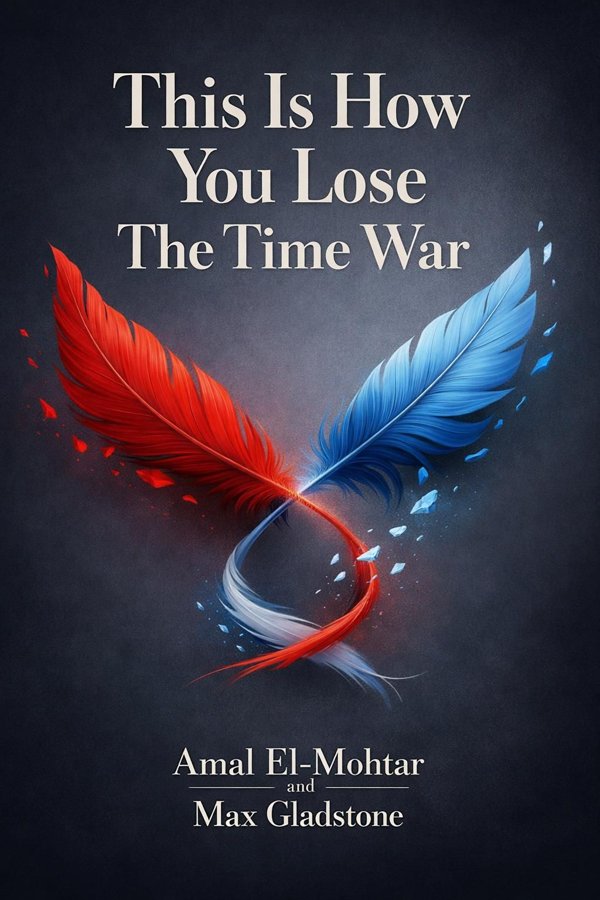
This Is How You Lose The Time War: Summary & Key Insights
by Amal El-Mohtar, Max Gladstone
 10 min9 chaptersAudio available
Key Takeaways from This Is How You Lose The Time War
A war becomes most terrifying when it is fought not on battlefields, but inside reality itself.
Discipline can look like strength until it leaves no room for a self.
Sometimes the most subversive act is to remain vividly, unapologetically alive.
Conversation can become a territory that power cannot fully control.
The most dangerous idea in the novel is not rebellion, but love that makes old certainties impossible.
What Is This Is How You Lose The Time War About?
This Is How You Lose The Time War by Amal El-Mohtar, Max Gladstone is a scifi_fantasy book spanning 5 pages. What if the fiercest battle in history were undone not by a weapon, but by a letter? This Is How You Lose The Time War by Amal El-Mohtar and Max Gladstone is a dazzling science fiction novella that turns espionage, time travel, and interdimensional warfare into an intimate story of connection. It follows Red and Blue, elite agents on opposite sides of a sprawling conflict fought across timelines, civilizations, and possible futures. Their task is to manipulate history for their respective factions. Instead, through secret messages hidden in seeds, tea leaves, lava flows, and coded moments, they begin a correspondence that transforms rivalry into understanding, and understanding into love. What makes this book matter is not only its originality, but its emotional precision. It asks whether identity is chosen or engineered, whether loyalty can survive self-discovery, and whether love can become a force of resistance against systems built on control. El-Mohtar, an acclaimed poet and critic, and Gladstone, an inventive fantasy and science fiction novelist, combine lyrical language with structural brilliance. The result is a small book with enormous imaginative reach: romantic, philosophical, strange, and unforgettable.
This FizzRead summary covers all 9 key chapters of This Is How You Lose The Time War in approximately 10 minutes, distilling the most important ideas, arguments, and takeaways from Amal El-Mohtar, Max Gladstone's work. Also available as an audio summary and Key Quotes Podcast.
This Is How You Lose The Time War
What if the fiercest battle in history were undone not by a weapon, but by a letter? This Is How You Lose The Time War by Amal El-Mohtar and Max Gladstone is a dazzling science fiction novella that turns espionage, time travel, and interdimensional warfare into an intimate story of connection. It follows Red and Blue, elite agents on opposite sides of a sprawling conflict fought across timelines, civilizations, and possible futures. Their task is to manipulate history for their respective factions. Instead, through secret messages hidden in seeds, tea leaves, lava flows, and coded moments, they begin a correspondence that transforms rivalry into understanding, and understanding into love.
What makes this book matter is not only its originality, but its emotional precision. It asks whether identity is chosen or engineered, whether loyalty can survive self-discovery, and whether love can become a force of resistance against systems built on control. El-Mohtar, an acclaimed poet and critic, and Gladstone, an inventive fantasy and science fiction novelist, combine lyrical language with structural brilliance. The result is a small book with enormous imaginative reach: romantic, philosophical, strange, and unforgettable.
Who Should Read This Is How You Lose The Time War?
This book is perfect for anyone interested in scifi_fantasy and looking to gain actionable insights in a short read. Whether you're a student, professional, or lifelong learner, the key ideas from This Is How You Lose The Time War by Amal El-Mohtar, Max Gladstone will help you think differently.
- ✓Readers who enjoy scifi_fantasy and want practical takeaways
- ✓Professionals looking to apply new ideas to their work and life
- ✓Anyone who wants the core insights of This Is How You Lose The Time War in just 10 minutes
Want the full summary?
Get instant access to this book summary and 100K+ more with Fizz Moment.
Get Free SummaryAvailable on App Store • Free to download
Key Chapters
A war becomes most terrifying when it is fought not on battlefields, but inside reality itself. In This Is How You Lose The Time War, the central conflict between the Agency and the Garden is less a conventional war than a struggle over what kind of universe deserves to exist. Both factions travel across eras and timelines, nudging events, toppling civilizations, preserving certain lives, and erasing others. Entire histories are treated like tactical terrain. The scale is cosmic, yet the consequences are deeply personal because every intervention affects human lives, memories, and possibilities.
The Agency represents mechanized efficiency, command, optimization, and engineered order. The Garden embodies organic intelligence, adaptation, growth, and ecological interconnection. Importantly, the novel refuses to present either side as purely good or evil. Each believes it is shaping a better future, and each commits acts of manipulation in the name of that belief. This ambiguity gives the war its power. It mirrors ideological conflicts in our own world, where institutions often justify harm by claiming necessity, progress, or survival.
One practical way to understand this idea is to think about modern systems that shape lives indirectly: algorithms deciding visibility, governments crafting policy, companies designing environments that influence behavior. We may not be traveling through time, but we do live amid forces trying to engineer outcomes. The novel sharpens our awareness of how abstract systems can override individual experience.
The deeper insight is that when history becomes a tool, people become pieces. The book asks readers to notice what gets lost when strategy outranks compassion. Actionable takeaway: examine any system, ideology, or organization by asking not only what future it promises, but what human complexity it sacrifices to get there.
Discipline can look like strength until it leaves no room for a self. Red enters the novel as the ideal operative of the Agency: sharp, efficient, controlled, and ruthlessly competent. She is a being shaped by a civilization that prizes calculation over feeling. Her identity is inseparable from performance. She succeeds because she can adapt, deceive, and eliminate obstacles with precision. In many stories, such a character would remain the cool professional. Here, however, Red becomes far more interesting because competence is only the shell around a hidden vulnerability.
Red’s evolution shows what happens when a person built for utility encounters intimacy. At first, her exchanges with Blue are strategic, almost sporting. But as the letters deepen, Red begins to develop language for experiences her world never encouraged her to name. Curiosity becomes anticipation. Anticipation becomes attachment. Attachment becomes a crisis, because once she values something beyond mission success, she can no longer fit neatly into the role she was made to play.
This arc has practical resonance far beyond science fiction. Many people are rewarded for being productive, resilient, and emotionally self-contained. They learn to derive worth from achievement rather than authenticity. Red’s story reflects the burnout, loneliness, and fragmentation that can follow when identity is built entirely around function. Her transformation suggests that tenderness is not a flaw in a hardened life; it may be the beginning of personhood.
The key lesson is that mastery without inner freedom is a refined form of captivity. Red does not become weaker when she opens herself to connection. She becomes more fully alive. Actionable takeaway: notice where your identity depends on being useful, impressive, or invulnerable, and make space for one relationship or practice that lets you exist without performing.
Sometimes the most subversive act is to remain vividly, unapologetically alive. Blue, aligned with the Garden, initially appears to be Red’s opposite: lyrical where Red is severe, playful where Red is disciplined, intuitive where Red is analytic. Yet Blue is no less dangerous. She is a brilliant agent, a tactician of ecosystems and emotions, capable of intricate manipulations across strands of time. Her power lies not merely in force, but in fluency with life’s complexity. She understands that growth is not disorder; it is intelligence expressed through relation, adaptation, and surprise.
What makes Blue so compelling is the way her wit and curiosity become forms of resistance. She refuses to reduce herself to a soldier alone. Even while operating within a militant structure, she preserves room for delight, artfulness, and ambiguity. Her letters are flirtatious, challenging, and inventive. In speaking to Red, she does more than communicate information. She creates a shared imaginative world, one that exists outside the narratives imposed by both factions.
In practical terms, Blue’s character offers a model for surviving dehumanizing environments. Institutions often reward predictability and discourage complexity. Yet creativity, humor, and emotional nuance can protect inner freedom. A teacher in a rigid school system, a worker in a metrics-driven company, or anyone living under heavy expectations can recognize this dynamic. Blue demonstrates that style is not superficial when it preserves agency. How we speak, notice, and imagine can become a way of refusing reduction.
Blue’s greatest contribution is showing that softness and intelligence are not opposites. Her receptivity is a strength, not a weakness. She meets Red not by overpowering her, but by inviting her into greater depth. Actionable takeaway: use creativity deliberately in one constrained area of your life, whether through language, ritual, humor, or art, to reclaim a sense of personhood beyond your assigned role.
Conversation can become a territory that power cannot fully control. The letters between Red and Blue begin as taunts, trophies exchanged between rival operatives who admire each other’s skill. But the correspondence gradually becomes the true center of the novel. Hidden in impossible places and encoded through elaborate means, these messages are acts of intimacy disguised as espionage. The medium matters: a letter is slower than a command, more reflective than a report, and more vulnerable than an order. In writing to one another, Red and Blue make room for thought, confession, and transformation.
The novel uses the epistolary form brilliantly. Each letter reveals not just information, but voice. We hear how these characters think when they are no longer performing for their superiors. Their rivalry sharpens into recognition because writing allows them to witness each other’s interiority. They become real to one another before they become safe to one another. This sequence matters. Genuine intimacy often begins not with agreement, but with sustained attention.
This idea has clear relevance in ordinary life. In a fast, reactive culture, meaningful communication is often replaced by efficiency. We text to coordinate, email to solve, post to signal. The novel reminds us that deliberate, expressive communication can create depth where none seemed possible. A thoughtful note, a candid message, or a recurring written exchange can build trust across distance, misunderstanding, or conflict.
The letters also show that language does not merely describe feeling; it can generate it. Through metaphor, teasing, memory, and risk, Red and Blue write themselves into a bond neither faction could predict. Actionable takeaway: if a relationship matters, communicate in a way that invites depth rather than speed—write something intentional, specific, and honest instead of relying only on quick exchanges.
The most dangerous idea in the novel is not rebellion, but love that makes old certainties impossible. Red and Blue are trained to see each other as enemies, abstractions, threats in opposing uniforms of reality. Their growing attachment destabilizes that framework. Once each begins to care for the other as an irreducible person, the logic of the war begins to fail. Systems depend on simplification: us and them, mission and obstacle, future and target. Love disrupts simplification by insisting on singularity.
This does not mean the book presents love as naive escape. Their bond is costly, risky, and often painful. It exposes them to surveillance, punishment, and betrayal. Yet that cost is precisely why it matters. In a universe shaped by control, choosing devotion becomes a radical assertion of freedom. Love here is not merely emotion; it is a reordering of values. It asks what becomes possible when a person no longer accepts inherited definitions of duty.
In real life, this theme applies to any relationship that changes our moral imagination. Friendships, romances, mentorships, and communities can challenge inherited prejudice, rigid identities, or loyalty to harmful systems. Many people begin to question institutions only after meeting someone those institutions taught them to ignore, fear, or objectify. The novel captures that turning point with unusual intensity.
At its heart, the story suggests that fate is not simply what happens to us. It is also what we consent to continue. Red and Blue do not erase the structures around them overnight, but their love creates a crack in inevitability. Actionable takeaway: pay attention to relationships that make your worldview more humane, and let those relationships reshape your loyalties rather than treating them as distractions from your “real” obligations.
Authoritarian systems often fail to understand love until they can exploit it. As Red and Blue’s correspondence deepens, the danger surrounding them escalates. The novel’s trap and revelation sequence delivers its emotional and structural payoff by showing how closely both women are watched, how thoroughly their factions monitor deviation, and how quickly intimacy can be weaponized. What seemed like a private exchange becomes evidence, bait, and vulnerability. The book’s title itself gains fuller meaning here: losing the time war is not only about military defeat, but about how one can be undone through attachment in a world that punishes feeling.
This section matters because it shifts the story from lyrical exchange to existential threat. The suspense clarifies the stakes of everything that came before. Their letters were not harmless indulgences; they were acts of treason against reduction. Once discovered, those acts trigger the predictable cruelty of institutions defending themselves. The trap demonstrates that systems built on obedience do not merely oppose dissent. They consume what they cannot control and turn trust into leverage.
Readers can connect this idea to workplaces, political movements, families, or social groups where vulnerability is unsafe because information may be used manipulatively. When environments are governed by fear, people learn to conceal the very parts of themselves that make genuine connection possible. The novel dramatizes that dynamic at a grand scale.
Yet the revelation is not only dark. It also proves the depth of what Red and Blue have built. Their bond survives exposure because it has already transformed them internally. Even under pressure, they act from chosen commitment, not imposed script. Actionable takeaway: be cautious about where you disclose your deepest self, and invest in relationships and communities where vulnerability is protected rather than punished.
Some books tell a story; this one makes language itself part of the event. This Is How You Lose The Time War is famous for its lush, poetic prose, and that style is not decorative excess. It is essential to the novel’s meaning. The war spans impossible worlds, altered histories, and metaphysical technologies, but the emotional reality depends on precision of feeling. El-Mohtar and Gladstone use metaphor, rhythm, image, and tonal contrast to make the unfamiliar feel intimate. The result is a reading experience in which language becomes the bridge between vast ideas and private sensation.
This matters because the novel asks readers to slow down. It is not written for skimming. Many lines reward rereading because they carry multiple layers: flirtation, philosophical reflection, worldbuilding, and emotional revelation at once. The ornate style mirrors the letters themselves. Red and Blue are not merely exchanging data; they are performing care through the form their words take. Beauty becomes part of the bond.
In practical terms, the book offers a reminder that form affects meaning in all communication. A rushed apology differs from a thoughtful one. A bland mission statement differs from a vivid shared vision. The way something is said can influence whether people feel seen, moved, or persuaded. In work, leadership, teaching, or personal relationships, attention to language can deepen impact.
For readers, the challenge is to approach the novella less like a puzzle to solve immediately and more like music to inhabit. Confusion at first is normal; the texture carries understanding as much as the plot does. Actionable takeaway: when something important must be communicated, spend extra time shaping the language—clarity matters, but so does resonance.
We often imagine identity as something fixed, but the novel suggests it is something awakened in contact with another mind. Red and Blue begin as products of their factions. Their loyalties, reflexes, aesthetics, and assumptions have all been cultivated by larger systems. Yet neither fully knows herself at the start. It is through correspondence that each becomes legible to herself. Being seen by an intelligent other gives shape to possibilities that had no room to emerge before.
This is one of the book’s most subtle achievements. It does not simply portray love as emotional fulfillment. It portrays recognition as a creative act. Red and Blue challenge each other’s language, tease out hidden thoughts, and witness traits their worlds ignore or suppress. Through that process, identity shifts from assignment to authorship. They are no longer only what the Agency or Garden made them. They become people who can choose.
There is a practical lesson here for anyone undergoing transition, reinvention, or self-discovery. Personal growth rarely happens in isolation. Often, we become more ourselves through relationships that invite honesty rather than performance. A trusted friend, therapist, collaborator, or partner can reflect dimensions of us we could not access alone. Healthy connection does not erase individuality; it clarifies it.
The novel also warns that if all your mirrors are institutional, you may only see what serves the institution. Red and Blue escape this partly because they become mirrors for one another, and those mirrors reflect personhood instead of utility. Actionable takeaway: seek out relationships where curiosity replaces judgment, and ask yourself which people in your life help you become more deliberate, more truthful, and more fully yourself.
The book’s final power lies in its insistence that inevitability is often just a story told by the powerful. Despite the scale of the Time War and the apparent totalizing reach of both factions, This Is How You Lose The Time War never fully surrenders to fatalism. Its characters move through futures that seem predetermined by strategy, hierarchy, and surveillance. Yet the novella argues that imagination itself is a form of resistance. To envision a life outside inherited conflict is already to weaken that conflict’s hold.
Red and Blue do not defeat the war through overwhelming force. What they accomplish is more delicate and, in some ways, more profound. They preserve the possibility of another kind of existence. This is one reason the novella resonates emotionally long after it ends. It offers hope without simplification. The systems remain vast; the dangers remain real. But the story insists that love, artful communication, memory, and courage can create openings even inside oppressive structures.
This theme is practical because many readers face circumstances that feel too entrenched to change: polarized politics, rigid workplaces, family histories, social expectations, or personal patterns. The novel does not promise easy escape. Instead, it encourages the first crucial move: imagine that a different arrangement of life is possible. From there, language, alliance, and action can begin.
Hope in this book is not optimism. It is disciplined refusal to accept that the current script is the only one available. That distinction matters. Actionable takeaway: when facing a system or pattern that feels inevitable, write down one alternative future you can imagine, no matter how small, and take one concrete step that aligns your life with that possibility.
All Chapters in This Is How You Lose The Time War
About the Authors
Amal El-Mohtar is a Canadian author, poet, editor, and critic whose work is celebrated for its lyrical beauty and emotional intelligence. She has written widely in speculative fiction and is especially admired for prose that blends mythic resonance with intimate feeling. Max Gladstone is an American novelist known for ambitious, genre-defying fantasy and science fiction, particularly The Craft Sequence, which combines legal intrigue, theology, economics, and magic. Together, El-Mohtar and Gladstone co-authored This Is How You Lose The Time War, a novella that showcases the strengths of both writers: poetic precision, bold imagination, and structural inventiveness. Their collaboration resulted in one of the most acclaimed speculative novellas of its era, praised for its originality, queer romance, and dazzling language.
Get This Summary in Your Preferred Format
Read or listen to the This Is How You Lose The Time War summary by Amal El-Mohtar, Max Gladstone anytime, anywhere. FizzRead offers multiple formats so you can learn on your terms — all free.
Available formats: App · Audio · PDF · EPUB — All included free with FizzRead
Download This Is How You Lose The Time War PDF and EPUB Summary
Key Quotes from This Is How You Lose The Time War
“A war becomes most terrifying when it is fought not on battlefields, but inside reality itself.”
“Discipline can look like strength until it leaves no room for a self.”
“Sometimes the most subversive act is to remain vividly, unapologetically alive.”
“Conversation can become a territory that power cannot fully control.”
“The most dangerous idea in the novel is not rebellion, but love that makes old certainties impossible.”
Frequently Asked Questions about This Is How You Lose The Time War
This Is How You Lose The Time War by Amal El-Mohtar, Max Gladstone is a scifi_fantasy book that explores key ideas across 9 chapters. What if the fiercest battle in history were undone not by a weapon, but by a letter? This Is How You Lose The Time War by Amal El-Mohtar and Max Gladstone is a dazzling science fiction novella that turns espionage, time travel, and interdimensional warfare into an intimate story of connection. It follows Red and Blue, elite agents on opposite sides of a sprawling conflict fought across timelines, civilizations, and possible futures. Their task is to manipulate history for their respective factions. Instead, through secret messages hidden in seeds, tea leaves, lava flows, and coded moments, they begin a correspondence that transforms rivalry into understanding, and understanding into love. What makes this book matter is not only its originality, but its emotional precision. It asks whether identity is chosen or engineered, whether loyalty can survive self-discovery, and whether love can become a force of resistance against systems built on control. El-Mohtar, an acclaimed poet and critic, and Gladstone, an inventive fantasy and science fiction novelist, combine lyrical language with structural brilliance. The result is a small book with enormous imaginative reach: romantic, philosophical, strange, and unforgettable.
You Might Also Like
Red Rising
Pierce Brown
10 min
Stranger in a Strange Land
Robert A. Heinlein
10 min
AI Valley
Chen Qiufan
10 min
Bloodchild
Octavia E. Butler
10 min
Do Androids Dream of Electric Sheep?
Philip K. Dick
10 min
Jujutsu Kaisen, Vol. 24
Gege Akutami
10 minBrowse by Category
Ready to read This Is How You Lose The Time War?
Get the full summary and 100K+ more books with Fizz Moment.