
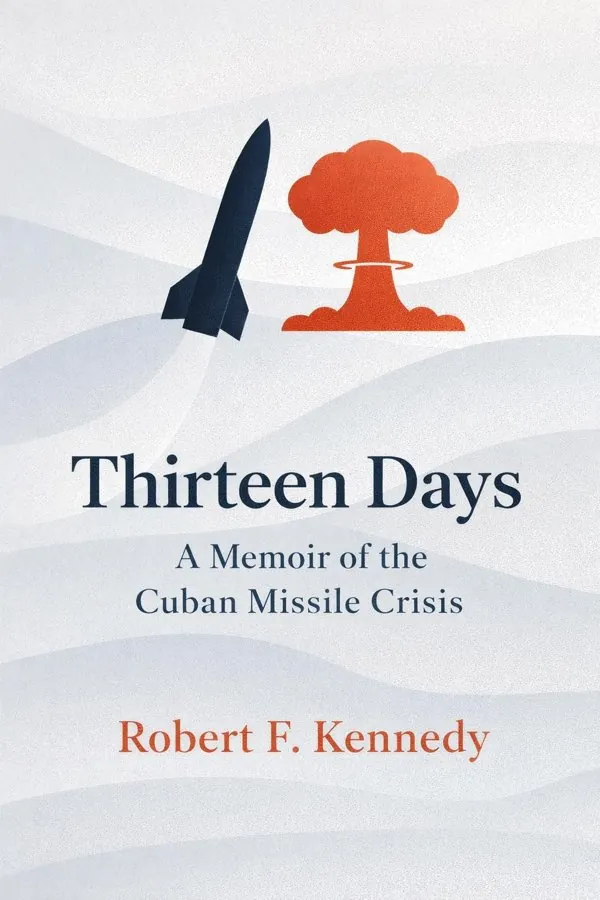
Thirteen Days: A Memoir of the Cuban Missile Crisis: Summary & Key Insights
 10 min10 chaptersAudio available
What Is Thirteen Days: A Memoir of the Cuban Missile Crisis About?
Thirteen Days: A Memoir of the Cuban Missile Crisis by Robert F. Kennedy is a world_history book spanning 10 pages. Robert F. Kennedy ofrece un relato de primera mano de la crisis de los misiles en Cuba de 1962, describiendo los trece días de tensión en los que Estados Unidos y la Unión Soviética llevaron al mundo al borde de la guerra nuclear. El libro revela las deliberaciones internas del gobierno estadounidense y las decisiones críticas tomadas por el presidente John F. Kennedy y su equipo.
This FizzRead summary covers all 10 key chapters of Thirteen Days: A Memoir of the Cuban Missile Crisis in approximately 10 minutes, distilling the most important ideas, arguments, and takeaways from Robert F. Kennedy's work. Also available as an audio summary and Key Quotes Podcast.
Thirteen Days: A Memoir of the Cuban Missile Crisis
Robert F. Kennedy ofrece un relato de primera mano de la crisis de los misiles en Cuba de 1962, describiendo los trece días de tensión en los que Estados Unidos y la Unión Soviética llevaron al mundo al borde de la guerra nuclear. El libro revela las deliberaciones internas del gobierno estadounidense y las decisiones críticas tomadas por el presidente John F. Kennedy y su equipo.
Who Should Read Thirteen Days: A Memoir of the Cuban Missile Crisis?
This book is perfect for anyone interested in world_history and looking to gain actionable insights in a short read. Whether you're a student, professional, or lifelong learner, the key ideas from Thirteen Days: A Memoir of the Cuban Missile Crisis by Robert F. Kennedy will help you think differently.
- ✓Readers who enjoy world_history and want practical takeaways
- ✓Professionals looking to apply new ideas to their work and life
- ✓Anyone who wants the core insights of Thirteen Days: A Memoir of the Cuban Missile Crisis in just 10 minutes
Want the full summary?
Get instant access to this book summary and 100K+ more with Fizz Moment.
Get Free SummaryAvailable on App Store • Free to download
Key Chapters
As the 1950s gave way to the 1960s, the relationship between the United States and the Soviet Union had grown increasingly brittle. The Cold War brought the constant shadow of nuclear annihilation. The confrontations over Berlin, the U-2 incident, and ideological battles across the globe had eroded mutual trust. Each side viewed the other not merely as a rival, but as an existential threat. The arms race was escalating, and both nations clung to a belief in deterrence through fear.
By 1962, the Soviet Union, under Premier Nikita Khrushchev, faced domestic and international pressures to reassert its strength. The United States had recently placed medium-range nuclear missiles in Turkey and Italy, capable of striking Soviet cities in minutes. Castro’s Cuba, suffering isolation and invasion threats after the failed Bay of Pigs operation, turned increasingly toward Moscow for security. In that environment, Khrushchev saw in Cuba an opportunity—to safeguard his ally and to redress the strategic imbalance.
Against this backdrop, the crisis began. American reconnaissance flights soon revealed a shocking development: the presence of Soviet nuclear missile installations being constructed in Cuba. Their range covered almost the entire continental United States. For us, this was not merely a military challenge; it was a political and moral one. The discovery pierced the illusion of safety and threw us into the most dangerous confrontation in modern history.
It began with intelligence photographs on October 16, 1962. Reconnaissance flights over Cuba revealed unmistakable evidence of Soviet medium-range ballistic missile sites under construction. When these were presented to my brother, it was clear we faced something unprecedented. The Soviet Union had secretly and directly challenged American security on our doorstep.
That morning, the President summoned his principal advisers, and from that session was formed the Executive Committee of the National Security Council—ExComm. It included the Secretaries of State and Defense, the Chiefs of Staff, the CIA, and close advisers. We would meet daily, often multiple times, to weigh our options. What course could protect national security without triggering nuclear war? In those first forty-eight hours, secrecy was absolute. Only a handful of men even knew the danger that now existed.
The atmosphere was thick with intensity. Some favored immediate military action—a devastating air strike on the missile sites before they became operational, perhaps followed by invasion. Others urged caution, fearing that such an attack might prompt Soviet retaliation, leading to uncontrollable escalation. My brother listened more than he spoke. He understood that any move, once taken, could not be undone. We were walking the razor’s edge between cowardice and catastrophe.
+ 8 more chapters — available in the FizzRead app
All Chapters in Thirteen Days: A Memoir of the Cuban Missile Crisis
About the Author
Robert Francis Kennedy (1925–1968) fue senador de los Estados Unidos por Nueva York y fiscal general durante la administración de su hermano, el presidente John F. Kennedy. Conocido por su compromiso con los derechos civiles y la justicia social, fue una figura destacada en la política estadounidense de los años sesenta.
Get This Summary in Your Preferred Format
Read or listen to the Thirteen Days: A Memoir of the Cuban Missile Crisis summary by Robert F. Kennedy anytime, anywhere. FizzRead offers multiple formats so you can learn on your terms — all free.
Available formats: App · Audio · PDF · EPUB — All included free with FizzRead
Download Thirteen Days: A Memoir of the Cuban Missile Crisis PDF and EPUB Summary
Key Quotes from Thirteen Days: A Memoir of the Cuban Missile Crisis
“As the 1950s gave way to the 1960s, the relationship between the United States and the Soviet Union had grown increasingly brittle.”
“It began with intelligence photographs on October 16, 1962.”
Frequently Asked Questions about Thirteen Days: A Memoir of the Cuban Missile Crisis
Thirteen Days: A Memoir of the Cuban Missile Crisis by Robert F. Kennedy is a world_history book that explores key ideas across 10 chapters. Robert F. Kennedy ofrece un relato de primera mano de la crisis de los misiles en Cuba de 1962, describiendo los trece días de tensión en los que Estados Unidos y la Unión Soviética llevaron al mundo al borde de la guerra nuclear. El libro revela las deliberaciones internas del gobierno estadounidense y las decisiones críticas tomadas por el presidente John F. Kennedy y su equipo.
You Might Also Like
The Age of Capital
Eric Hobsbawm
10 min
The Gulag Archipelago
Aleksandr Solzhenitsyn
10 min
Jerusalem: The Biography
Simon Sebag Montefiore
10 min
The Anglo-Saxons
James Campbell
10 min
The Boer War
Thomas Pakenham
10 min
The Industrial Revolutionaries: The Making of the Modern World 1776–1914
Gavin Weightman
10 minBrowse by Category
Ready to read Thirteen Days: A Memoir of the Cuban Missile Crisis?
Get the full summary and 100K+ more books with Fizz Moment.