
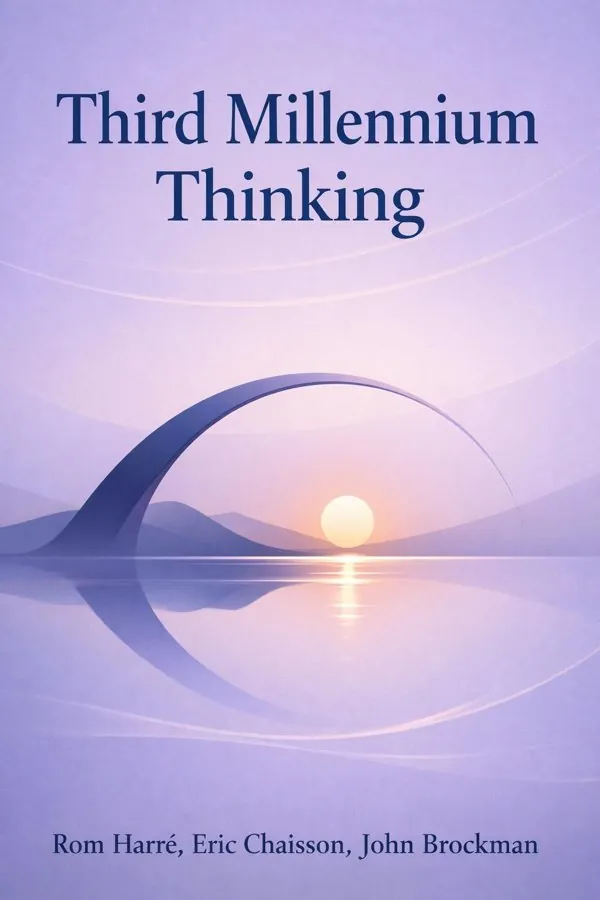
Third Millennium Thinking: Creating the World We Want: Summary & Key Insights
by Rom Harré, Eric Chaisson, John Brockman
 10 min9 chaptersAudio available
What Is Third Millennium Thinking: Creating the World We Want About?
Third Millennium Thinking: Creating the World We Want by Rom Harré, Eric Chaisson, John Brockman is a civilization book spanning 9 pages. Third Millennium Thinking explores how humanity can apply scientific reasoning, systems thinking, and moral imagination to address the global challenges of the 21st century. The authors argue for a new synthesis of knowledge that integrates science, philosophy, and ethics to guide civilization toward a sustainable and meaningful future.
This FizzRead summary covers all 9 key chapters of Third Millennium Thinking: Creating the World We Want in approximately 10 minutes, distilling the most important ideas, arguments, and takeaways from Rom Harré, Eric Chaisson, John Brockman's work. Also available as an audio summary and Key Quotes Podcast.
Third Millennium Thinking: Creating the World We Want
Third Millennium Thinking explores how humanity can apply scientific reasoning, systems thinking, and moral imagination to address the global challenges of the 21st century. The authors argue for a new synthesis of knowledge that integrates science, philosophy, and ethics to guide civilization toward a sustainable and meaningful future.
Who Should Read Third Millennium Thinking: Creating the World We Want?
This book is perfect for anyone interested in civilization and looking to gain actionable insights in a short read. Whether you're a student, professional, or lifelong learner, the key ideas from Third Millennium Thinking: Creating the World We Want by Rom Harré, Eric Chaisson, John Brockman will help you think differently.
- ✓Readers who enjoy civilization and want practical takeaways
- ✓Professionals looking to apply new ideas to their work and life
- ✓Anyone who wants the core insights of Third Millennium Thinking: Creating the World We Want in just 10 minutes
Want the full summary?
Get instant access to this book summary and 100K+ more with Fizz Moment.
Get Free SummaryAvailable on App Store • Free to download
Key Chapters
To begin thinking for the third millennium, we must first situate ourselves within the grand narrative of cosmic evolution. From stars condensing out of primordial matter to cells forming in ancient oceans, to minds reflecting upon the cosmos that birthed them—this is the continuous story of increasing complexity that Eric Chaisson calls ‘cosmic evolution.’ Each phase—physical, biological, and cultural—builds upon and transcends the previous. In this sense, humanity is neither an accident nor an apex but a transitional expression of the universe’s creative process.
When we trace this continuum, a profound realization emerges: human intelligence is the latest—and perhaps the most self-aware—manifestation of the same dynamic that shapes galaxies and ecosystems. This connection dissolves any narrow dualism between nature and culture. Our creativity, our technologies, our capacity for symbolic thought are evolutionary phenomena; they continue the work of the stars in a different key. To see ourselves as co‑participants in a cosmic unfolding fosters not arrogance but humility. It reminds us that the energies that sustain civilization are borrowed from the same thermodynamic gradients that drive stellar and biological organization. Sustainability, therefore, is not merely an ethical aspiration; it is a physical necessity.
When we frame humanity in this evolutionary context, the global crises of our time become transformation thresholds rather than terminal catastrophes. The third millennium invites us to advance evolution consciously—not by reshaping genes or matter for profit, but by shaping minds and institutions in harmony with the universal principles of complexity, adaptation, and balance.
Science remains one of humanity’s greatest achievements, yet it is not a complete worldview. Its methods reveal the structure of reality with unmatched precision, but they do not tell us what to value, how to live, or what kind of civilization to build. Rom Harré and I have long argued that the scientific narrative must expand beyond its traditional mechanistic boundaries. The empirical method, valuable as it is, cannot substitute for moral reasoning or social wisdom.
In the twentieth century, the scientific worldview often portrayed the universe as indifferent and purposeless. This picture fueled both intellectual liberation and spiritual disenchantment. We contend that science, properly understood, does not strip life of meaning—it situates meaning in a larger, more inclusive framework. By embracing uncertainty, probability, and systemic interdependence, contemporary science already gestures toward a world that is relational, dynamic, and creative.
The challenge, therefore, is cultural and philosophical. We must learn to use science as a bridge rather than a barrier: a bridge between knowledge and wisdom, between precision and compassion. In education, in policy, even in personal life, scientific literacy must be allied with ethical literacy. Only then can the facts we uncover become instruments of human flourishing rather than domination.
+ 7 more chapters — available in the FizzRead app
All Chapters in Third Millennium Thinking: Creating the World We Want
About the Authors
Rom Harré was a British philosopher known for his work in philosophy of science and psychology. Eric Chaisson is an astrophysicist recognized for his research on cosmic evolution. John Brockman is a literary agent and founder of the Edge Foundation, known for promoting intellectual discourse among leading thinkers.
Get This Summary in Your Preferred Format
Read or listen to the Third Millennium Thinking: Creating the World We Want summary by Rom Harré, Eric Chaisson, John Brockman anytime, anywhere. FizzRead offers multiple formats so you can learn on your terms — all free.
Available formats: App · Audio · PDF · EPUB — All included free with FizzRead
Download Third Millennium Thinking: Creating the World We Want PDF and EPUB Summary
Key Quotes from Third Millennium Thinking: Creating the World We Want
“To begin thinking for the third millennium, we must first situate ourselves within the grand narrative of cosmic evolution.”
“Science remains one of humanity’s greatest achievements, yet it is not a complete worldview.”
Frequently Asked Questions about Third Millennium Thinking: Creating the World We Want
Third Millennium Thinking: Creating the World We Want by Rom Harré, Eric Chaisson, John Brockman is a civilization book that explores key ideas across 9 chapters. Third Millennium Thinking explores how humanity can apply scientific reasoning, systems thinking, and moral imagination to address the global challenges of the 21st century. The authors argue for a new synthesis of knowledge that integrates science, philosophy, and ethics to guide civilization toward a sustainable and meaningful future.
You Might Also Like
The Structure of Scientific Revolutions
Thomas S. Kuhn
10 min
Genius
Harold Bloom
10 min
A Cultural History of the Medieval Age
Various Editors
10 min
A History of God: The 4,000-Year Quest of Judaism, Christianity and Islam
Karen Armstrong
10 min
A History of the World in 10½ Chapters
Julian Barnes
10 min
A Short History of Progress
Ronald Wright
10 minBrowse by Category
Ready to read Third Millennium Thinking: Creating the World We Want?
Get the full summary and 100K+ more books with Fizz Moment.