
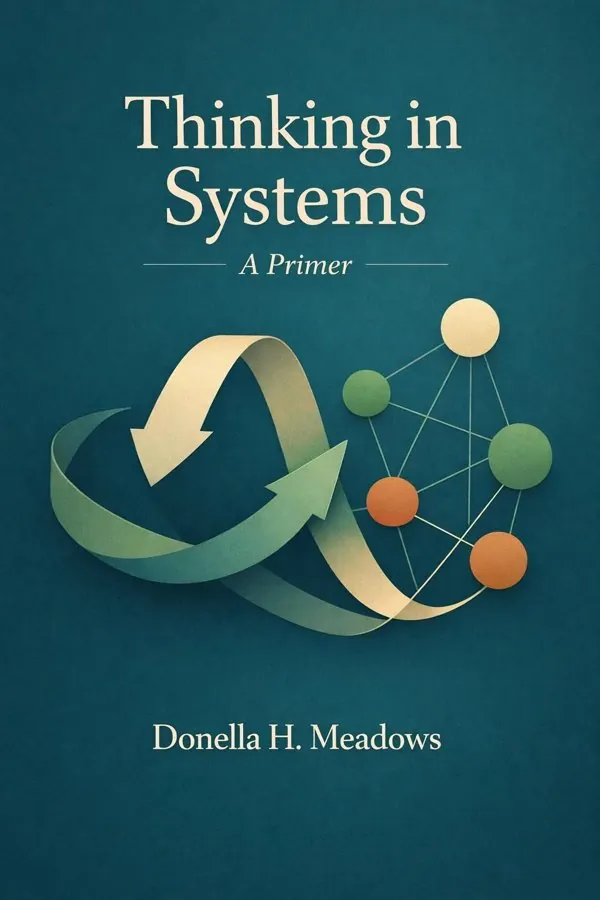
Thinking in Systems: A Primer: Summary & Key Insights
 10 min5 chaptersAudio available
What Is Thinking in Systems: A Primer About?
Thinking in Systems: A Primer by Donella H. Meadows is a popular_sci book spanning 5 pages. Thinking in Systems: A Primer es una introducción accesible y fundamental al pensamiento sistémico, escrita por la científica ambiental Donella H. Meadows. El libro explica cómo los sistemas complejos funcionan y cómo las interacciones entre sus componentes pueden generar comportamientos inesperados. A través de ejemplos claros y prácticos, Meadows enseña a los lectores a comprender los patrones subyacentes en los sistemas sociales, económicos y ecológicos, ofreciendo herramientas para abordar problemas globales con una perspectiva más integral y sostenible.
This FizzRead summary covers all 5 key chapters of Thinking in Systems: A Primer in approximately 10 minutes, distilling the most important ideas, arguments, and takeaways from Donella H. Meadows's work. Also available as an audio summary and Key Quotes Podcast.
Thinking in Systems: A Primer
Thinking in Systems: A Primer es una introducción accesible y fundamental al pensamiento sistémico, escrita por la científica ambiental Donella H. Meadows. El libro explica cómo los sistemas complejos funcionan y cómo las interacciones entre sus componentes pueden generar comportamientos inesperados. A través de ejemplos claros y prácticos, Meadows enseña a los lectores a comprender los patrones subyacentes en los sistemas sociales, económicos y ecológicos, ofreciendo herramientas para abordar problemas globales con una perspectiva más integral y sostenible.
Who Should Read Thinking in Systems: A Primer?
This book is perfect for anyone interested in popular_sci and looking to gain actionable insights in a short read. Whether you're a student, professional, or lifelong learner, the key ideas from Thinking in Systems: A Primer by Donella H. Meadows will help you think differently.
- ✓Readers who enjoy popular_sci and want practical takeaways
- ✓Professionals looking to apply new ideas to their work and life
- ✓Anyone who wants the core insights of Thinking in Systems: A Primer in just 10 minutes
Want the full summary?
Get instant access to this book summary and 100K+ more with Fizz Moment.
Get Free SummaryAvailable on App Store • Free to download
Key Chapters
When we talk about a system, we are referring to something complete—not just a collection of parts. A forest, a company, a community, or even the human body—all are systems composed of elements, connected through relationships, functioning toward a purpose. The three components—elements, interconnections, and purpose—define the identity of a system.
Elements are the tangible parts: trees and soil in a forest, employees and machines in a factory. But elements alone do not create behavior. It is their interconnections—the flows of nutrients, communication, or money—that generate dynamic patterns. Purpose, though less visible, is the guiding force. It determines what the system strives for: survival, profit, harmony, or growth.
Understanding these aspects clarifies why changing one element often alters little unless deeper connections or objectives change as well. Replacing a manager in an organization or planting new trees in a degraded forest won’t fundamentally alter systemic behavior if the underlying rules or goals remain unchanged. Systems are holistic; their essence lies not in parts, but in relationships and intent.
From my perspective, to truly know a system, you must observe not only what it does but why it does it. What flows through its networks? What feedback influences its actions? What purpose keeps it functioning as a whole? Once you begin to ask these questions, the world transforms from a collection of incidents into an interconnected web of meaning.
The heartbeat of every system is feedback—those circular flows of information that link an action to its consequences. There are two fundamental kinds: reinforcing and balancing loops. Reinforcing loops amplify change, driving exponential growth or collapse. A population that breeds faster as numbers rise or a rumor that spreads more widely the more people repeat it—these are reinforcing dynamics. Balancing loops, in contrast, counteract change, promoting stability. When supply grows and prices drop, demand adjusts; when you feel cold, you shiver to restore temperature.
Systems rarely contain just one kind of feedback; they are interlaced with both. Their behavior emerges from the interplay between growth and restraint. For example, an economic boom may contain reinforcing feedback as investment encourages profit, but hidden balancing loops—resource limitations, market saturation—eventually slow expansion. Recognizing these feedbacks helps you anticipate turning points and design interventions that align with natural tendencies instead of resisting them.
Learning to see feedback changes the way you approach problems. You stop blaming isolated factors and begin tracing loops of cause and effect. You realize that solutions which ignore feedbacks—like subsidies that encourage overuse or controls that inhibit adaptation—often create more problems later. Systems thinking thus brings humility, reminding us that our actions reverberate through networks we may not fully perceive. The key is not to dominate feedback but to learn to dance with it.
+ 3 more chapters — available in the FizzRead app
All Chapters in Thinking in Systems: A Primer
About the Author
Donella H. Meadows (1941–2001) fue una científica ambiental, profesora y escritora estadounidense. Se formó en química en la Universidad de Harvard y obtuvo su doctorado en biofísica en el MIT. Fue una de las autoras principales del influyente informe 'The Limits to Growth' y fundadora del Sustainability Institute. Su trabajo se centró en la dinámica de sistemas y la sostenibilidad global.
Get This Summary in Your Preferred Format
Read or listen to the Thinking in Systems: A Primer summary by Donella H. Meadows anytime, anywhere. FizzRead offers multiple formats so you can learn on your terms — all free.
Available formats: App · Audio · PDF · EPUB — All included free with FizzRead
Download Thinking in Systems: A Primer PDF and EPUB Summary
Key Quotes from Thinking in Systems: A Primer
“When we talk about a system, we are referring to something complete—not just a collection of parts.”
“The heartbeat of every system is feedback—those circular flows of information that link an action to its consequences.”
Frequently Asked Questions about Thinking in Systems: A Primer
Thinking in Systems: A Primer by Donella H. Meadows is a popular_sci book that explores key ideas across 5 chapters. Thinking in Systems: A Primer es una introducción accesible y fundamental al pensamiento sistémico, escrita por la científica ambiental Donella H. Meadows. El libro explica cómo los sistemas complejos funcionan y cómo las interacciones entre sus componentes pueden generar comportamientos inesperados. A través de ejemplos claros y prácticos, Meadows enseña a los lectores a comprender los patrones subyacentes en los sistemas sociales, económicos y ecológicos, ofreciendo herramientas para abordar problemas globales con una perspectiva más integral y sostenible.
More by Donella H. Meadows

You Might Also Like

Structures: Or Why Things Don"t Fall Down
J.E. Gordon
10 min
The Road to Wigan Pier
George Orwell
10 min
Bonk: The Curious Coupling of Science and Sex
Mary Roach
10 min
First Bite: How We Learn to Eat
Bee Wilson
10 min
In Pursuit Of The Unknown: 17 Equations That Changed The World
Ian Stewart
10 min
Napoleon's Buttons: 17 Molecules That Changed History
Penny Le Couteur and Jay Burreson
10 minBrowse by Category
Ready to read Thinking in Systems: A Primer?
Get the full summary and 100K+ more books with Fizz Moment.