
Thinking in Pictures: My Life with Autism: Summary & Key Insights
 10 min11 chaptersAudio available
What Is Thinking in Pictures: My Life with Autism About?
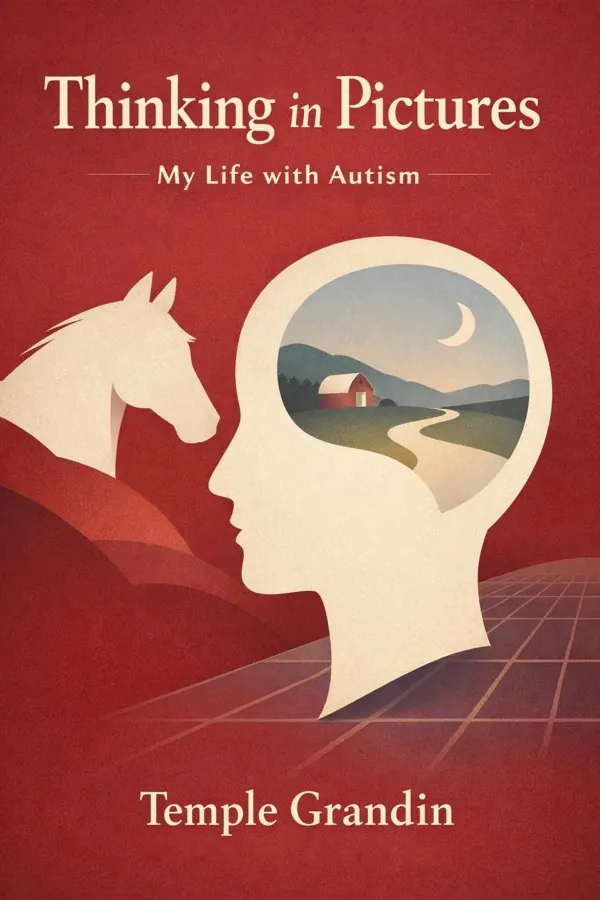
Thinking in Pictures: My Life with Autism by Temple Grandin is a biographies book spanning 11 pages. Temple Grandin offers an extraordinary view into the mind of an autistic person, describing how she thinks in visual images rather than words. Through personal stories and scientific insights, she explains how her unique cognitive style has shaped her understanding of animals, design, and human behavior. The book bridges the gap between the autistic and neurotypical worlds, providing both a memoir and a guide to understanding different ways of thinking.
This FizzRead summary covers all 11 key chapters of Thinking in Pictures: My Life with Autism in approximately 10 minutes, distilling the most important ideas, arguments, and takeaways from Temple Grandin's work. Also available as an audio summary and Key Quotes Podcast.
Thinking in Pictures: My Life with Autism
Temple Grandin offers an extraordinary view into the mind of an autistic person, describing how she thinks in visual images rather than words. Through personal stories and scientific insights, she explains how her unique cognitive style has shaped her understanding of animals, design, and human behavior. The book bridges the gap between the autistic and neurotypical worlds, providing both a memoir and a guide to understanding different ways of thinking.
Who Should Read Thinking in Pictures: My Life with Autism?
This book is perfect for anyone interested in biographies and looking to gain actionable insights in a short read. Whether you're a student, professional, or lifelong learner, the key ideas from Thinking in Pictures: My Life with Autism by Temple Grandin will help you think differently.
- ✓Readers who enjoy biographies and want practical takeaways
- ✓Professionals looking to apply new ideas to their work and life
- ✓Anyone who wants the core insights of Thinking in Pictures: My Life with Autism in just 10 minutes
Want the full summary?
Get instant access to this book summary and 100K+ more with Fizz Moment.
Get Free SummaryAvailable on App Store • Free to download
Key Chapters
I was diagnosed with autism in the 1950s, at a time when few people understood the condition. Doctors told my parents that I might never speak, and certainly not function normally in society. My mother refused to accept that verdict. She pushed for speech therapy, for structure, for opportunities to learn. Eventually, with enormous patience and persistence, I began speaking at age four.
Those early years were filled with challenges. Ordinary sensations could overwhelm me—the sound of a vacuum cleaner, the touch of a wool sweater, the texture of certain foods. I lived in a world that was too intense, too loud, and too confusing. I found safety in routines and patterns, and I learned to communicate more through pictures than words. Looking back, I see that my mind was wired for detail and spatial understanding right from the start; it just took time and effort for others to reach me on my level.
Social interaction was a puzzle. I could memorize words and gestures, but their meaning was elusive. I watched people carefully to decode them, yet I couldn’t always get their intentions right. It wasn’t that I didn’t want connection—I simply processed the world differently. From my mother’s tireless advocacy to dedicated teachers and a few mentors who saw potential where others saw defects, my childhood became a foundation for later breakthroughs. Those early lessons—structure, repetition, and visual learning—were keys to unlocking communication and creativity.
Visual thinking changed my life because it explained how I think. Most people think in words, their minds filled with internal dialogue and abstract reasoning. Mine is filled with pictures—still images and movies that I can manipulate, expand, and connect. When I hear a phrase like "the big picture," I literally see one. When someone describes a barn, I don’t just imagine a general barn; I see specific ones I’ve encountered. That internal slide projector is both my language and my logic.
Understanding this was liberating. It meant I wasn’t deficient; I was different. Thinking in pictures allowed me to design, solve problems, and empathize with animals in ways that verbal thinkers might overlook. It also explained some of autism’s challenges. Because I perceive the world visually, abstract concepts without a clear image can confuse me. Emotions, metaphors, and spoken instructions often require translation into mental images before I can grasp them. Once that translation happens, however, I can think about them deeply and practically.
When I design cattle-handling systems, for instance, I run visual simulations in my mind—like virtual reality before the technology existed. I watch the cattle move through gates and corridors, anticipate their reactions to shadows or noises, and adjust the design accordingly. Visual thinking makes my work as an engineer richer and more intuitive. I’ve come to realize that it’s not just a trait of autism but a source of creative power—one that connects perception with empathy and turns imagination into concrete solutions.
+ 9 more chapters — available in the FizzRead app
All Chapters in Thinking in Pictures: My Life with Autism
About the Author
Temple Grandin is an American professor of animal science at Colorado State University, a prominent author, and an advocate for the humane treatment of livestock. Diagnosed with autism at a young age, she has become one of the most well-known individuals with autism, using her experiences to educate others about neurodiversity and animal behavior.
Get This Summary in Your Preferred Format
Read or listen to the Thinking in Pictures: My Life with Autism summary by Temple Grandin anytime, anywhere. FizzRead offers multiple formats so you can learn on your terms — all free.
Available formats: App · Audio · PDF · EPUB — All included free with FizzRead
Download Thinking in Pictures: My Life with Autism PDF and EPUB Summary
Key Quotes from Thinking in Pictures: My Life with Autism
“I was diagnosed with autism in the 1950s, at a time when few people understood the condition.”
“Visual thinking changed my life because it explained how I think.”
Frequently Asked Questions about Thinking in Pictures: My Life with Autism
Thinking in Pictures: My Life with Autism by Temple Grandin is a biographies book that explores key ideas across 11 chapters. Temple Grandin offers an extraordinary view into the mind of an autistic person, describing how she thinks in visual images rather than words. Through personal stories and scientific insights, she explains how her unique cognitive style has shaped her understanding of animals, design, and human behavior. The book bridges the gap between the autistic and neurotypical worlds, providing both a memoir and a guide to understanding different ways of thinking.
You Might Also Like

An American Marriage
Tayari Jones
10 min
Benjamin Franklin: An American Life
Walter Isaacson
10 min
I Know Why The Caged Bird Sings
Maya Angelou
10 min
Long Walk to Freedom
Nelson Mandela
10 min
Persepolis
Marjane Satrapi
10 min
Surely You're Joking, Mr. Feynman!
Richard P. Feynman
10 minBrowse by Category
Ready to read Thinking in Pictures: My Life with Autism?
Get the full summary and 100K+ more books with Fizz Moment.