
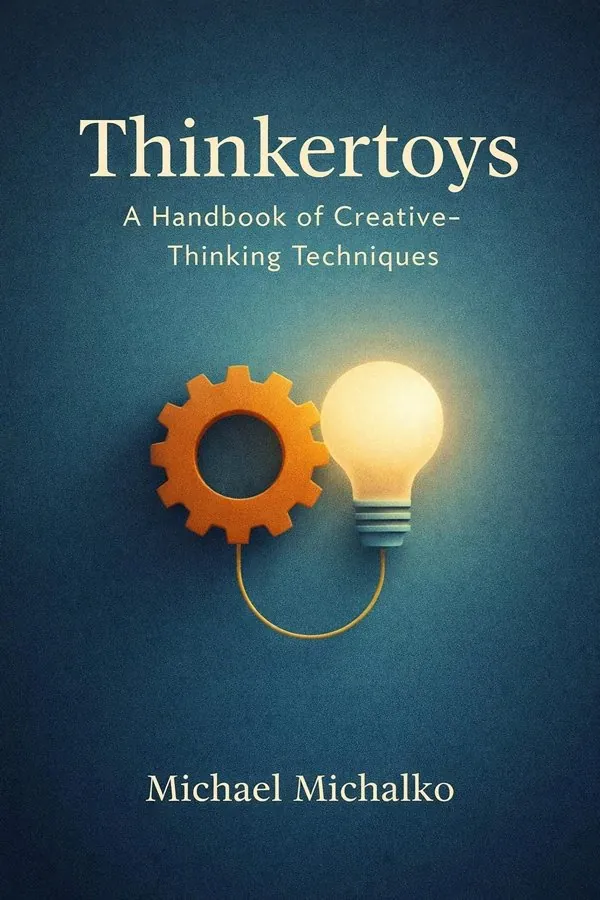
Thinkertoys: A Handbook of Creative-Thinking Techniques: Summary & Key Insights
 10 min10 chaptersAudio available
Key Takeaways from Thinkertoys: A Handbook of Creative-Thinking Techniques
Great ideas rarely come from logic alone or intuition alone; they emerge when both modes of thought work together.
Creativity feels unpredictable, but Michalko shows that it can be guided by reliable procedures.
Some of the most original ideas surface when the mind stops trying to be sensible.
Innovation often looks like invention from scratch, but Michalko reminds us that many breakthroughs are combinations of existing elements arranged in a new way.
The greatest obstacle to originality is often not ignorance but familiarity.
What Is Thinkertoys: A Handbook of Creative-Thinking Techniques About?
Thinkertoys: A Handbook of Creative-Thinking Techniques by Michael Michalko is a creativity book spanning 10 pages. What if creativity were not a mysterious gift, but a practical skill you could train on demand? That is the central promise of Thinkertoys, Michael Michalko’s influential guide to generating original ideas, solving stubborn problems, and thinking beyond habitual patterns. Rather than treating innovation as a matter of inspiration alone, Michalko presents creativity as a toolkit: a collection of repeatable methods that help individuals and teams produce more possibilities, make unexpected connections, and turn vague challenges into workable solutions. The book matters because most people do not lack intelligence; they lack strategies for escaping routine thought. In business, education, design, leadership, and everyday life, the ability to reframe a problem often matters more than raw knowledge. Michalko shows how to do exactly that through structured exercises, mental prompts, visual techniques, and imaginative experiments. His authority comes from years of work in creative problem-solving, including consulting for major organizations and helping develop programs that teach innovation systematically. Thinkertoys remains valuable because it bridges imagination and discipline, proving that better ideas do not happen by accident. They can be deliberately produced.
This FizzRead summary covers all 10 key chapters of Thinkertoys: A Handbook of Creative-Thinking Techniques in approximately 10 minutes, distilling the most important ideas, arguments, and takeaways from Michael Michalko's work. Also available as an audio summary and Key Quotes Podcast.
Thinkertoys: A Handbook of Creative-Thinking Techniques
What if creativity were not a mysterious gift, but a practical skill you could train on demand? That is the central promise of Thinkertoys, Michael Michalko’s influential guide to generating original ideas, solving stubborn problems, and thinking beyond habitual patterns. Rather than treating innovation as a matter of inspiration alone, Michalko presents creativity as a toolkit: a collection of repeatable methods that help individuals and teams produce more possibilities, make unexpected connections, and turn vague challenges into workable solutions.
The book matters because most people do not lack intelligence; they lack strategies for escaping routine thought. In business, education, design, leadership, and everyday life, the ability to reframe a problem often matters more than raw knowledge. Michalko shows how to do exactly that through structured exercises, mental prompts, visual techniques, and imaginative experiments.
His authority comes from years of work in creative problem-solving, including consulting for major organizations and helping develop programs that teach innovation systematically. Thinkertoys remains valuable because it bridges imagination and discipline, proving that better ideas do not happen by accident. They can be deliberately produced.
Who Should Read Thinkertoys: A Handbook of Creative-Thinking Techniques?
This book is perfect for anyone interested in creativity and looking to gain actionable insights in a short read. Whether you're a student, professional, or lifelong learner, the key ideas from Thinkertoys: A Handbook of Creative-Thinking Techniques by Michael Michalko will help you think differently.
- ✓Readers who enjoy creativity and want practical takeaways
- ✓Professionals looking to apply new ideas to their work and life
- ✓Anyone who wants the core insights of Thinkertoys: A Handbook of Creative-Thinking Techniques in just 10 minutes
Want the full summary?
Get instant access to this book summary and 100K+ more with Fizz Moment.
Get Free SummaryAvailable on App Store • Free to download
Key Chapters
Great ideas rarely come from logic alone or intuition alone; they emerge when both modes of thought work together. Michalko argues that creative thinking has two complementary wings: linear thinking, which analyzes facts step by step, and intuitive thinking, which leaps, associates, and imagines beyond the obvious. Many people overuse one and neglect the other. Businesses often reward analysis, forecasts, and efficiency, while undervaluing hunches, metaphors, and playful speculation. Yet innovation depends on combining disciplined reasoning with mental freedom.
Linear thinking helps define a problem clearly, identify constraints, and test whether an idea can actually work. Intuitive thinking helps break assumptions, spot hidden patterns, and generate surprising alternatives. If you rely only on linear thought, you may become efficient at improving what already exists but weak at inventing what does not. If you rely only on intuition, you may produce exciting concepts that never become practical.
Imagine a team trying to improve customer service. Linear thinking might reveal long wait times, frequent complaint categories, and process bottlenecks. Intuitive thinking might ask, “What if customer support worked like a hotel concierge?” or “How would a theater host welcome a guest?” These imaginative jumps can inspire new service models that data alone would not suggest.
Michalko’s larger point is that creativity is not irrational. It is a disciplined dance between structure and surprise. The strongest thinkers learn when to analyze, when to imagine, and when to alternate between the two.
Actionable takeaway: For any problem, spend one round defining it analytically, then a second round exploring it with wild analogies, images, and speculative questions.
Creativity feels unpredictable, but Michalko shows that it can be guided by reliable procedures. Analytical Thinkertoys are structured methods that force the mind to examine a challenge from multiple angles instead of settling for the first acceptable answer. One of the best-known examples is SCAMPER: Substitute, Combine, Adapt, Modify, Put to other uses, Eliminate, and Reverse. These prompts turn idea generation into an active process rather than a waiting game.
The power of these tools lies in how they challenge hidden assumptions. If you ask what can be substituted, you begin questioning materials, people, rules, or processes you previously treated as fixed. If you ask what can be combined, new hybrids appear. If you ask what can be eliminated, simplicity itself becomes a source of innovation. Each prompt opens a door that ordinary thinking leaves closed.
Suppose you run a café with slowing sales. Substitute: Could table service replace counter ordering during busy hours? Combine: Could coffee purchases be bundled with mini workshops or community events? Adapt: Could loyalty systems from airlines inspire tiered rewards? Modify: Could the space become more flexible for remote workers? Put to other uses: Could unused evening hours support local clubs? Eliminate: Could menu options be reduced to speed service? Reverse: Could customers customize the base drink instead of choosing from preset options?
These methods matter because they replace vague brainstorming with concrete operations. They also make creativity more democratic. You do not need to be a genius to ask productive questions; you need a process.
Actionable takeaway: Take one current challenge and run it through all seven SCAMPER prompts, writing at least three answers for each before judging any idea.
Some of the most original ideas surface when the mind stops trying to be sensible. Michalko emphasizes that intuition is not magical nonsense; it is the mind’s ability to draw on patterns, images, memories, and impressions that lie outside immediate awareness. Intuitive Thinkertoys are designed to tap this reservoir by loosening control, suspending judgment, and inviting unexpected associations.
These tools may involve free association, random words, daydreaming, fantasy, visual imagery, or metaphor. Their aim is to bypass the rigid filters that keep thought efficient but also predictable. When you introduce a random stimulus, for example, your mind is forced to connect unrelated domains. Those connections often produce novel perspectives that analytical thinking would never generate on its own.
Consider a product team stuck on designing a better backpack. A random-word method yields the word “nest.” Suddenly the team thinks about softness, layered protection, modular compartments, warmth, and portability. Those associations might inspire padded customizable interiors, collapsible sections, or materials that better protect electronics. The random word did not provide the answer directly; it disrupted habitual thought patterns enough for new answers to emerge.
Michalko’s intuition-based methods are especially useful when a problem feels stale or when everyone keeps repeating the same ideas in different language. They create psychological permission to explore the absurd, the symbolic, and the incomplete. Later, analytical thinking can refine what intuition uncovers.
Actionable takeaway: When you are stuck, choose a random word, image, or object and list ten ways it might relate to your problem before returning to practical evaluation.
Innovation often looks like invention from scratch, but Michalko reminds us that many breakthroughs are combinations of existing elements arranged in a new way. Creative thinkers act like mental alchemists: they merge concepts, transfer principles from one field to another, and transform familiar pieces into something that feels original. The goal is not merely to have more ideas, but to synthesize better ones.
This principle matters because people frequently dismiss partial or ordinary ideas too quickly. One concept may seem weak, another incomplete, and a third impractical. But when combined, they can form a powerful solution. A delivery app merged mapping technology, mobile payments, logistics systems, and restaurant ordering. Streaming platforms combined media libraries, recommendation algorithms, and subscription models. In each case, the innovation came not from one isolated insight, but from creative recombination.
Michalko encourages readers to ask what would happen if two seemingly unrelated ideas were fused. What if a classroom borrowed techniques from game design? What if a hospital waiting room borrowed cues from hospitality? What if a budgeting app borrowed the motivational structure of fitness trackers? This way of thinking turns the world into a catalog of transferable possibilities.
The book also highlights transformation, not just combination. An idea may need to be enlarged, miniaturized, sequenced differently, personalized, or moved into a different context. A concept that fails in one form may succeed after a creative shift in scale, audience, timing, or medium.
Actionable takeaway: Take two ideas from different industries or domains and ask how combining their key features could improve your current product, project, or personal challenge.
The greatest obstacle to originality is often not ignorance but familiarity. Michalko argues that people get trapped in mental ruts because the brain naturally prefers patterns that are known, efficient, and comfortable. We stop seeing options because we unconsciously assume that the current way is the natural way. Creative thinking begins when those assumptions are exposed and challenged.
Pattern breaking can be as simple as reversing expectations, changing the sequence of actions, redefining the user, or questioning the purpose of the thing itself. Why must meetings happen in conference rooms? Why must a store organize products by category instead of by problem solved? Why must learning happen through lectures instead of simulations? Once these assumptions are surfaced, alternatives become imaginable.
A classic example is the shift from selling music by album to selling it by individual track, and later to offering access rather than ownership through streaming. The old model persisted partly because it felt normal. Innovation required someone to ask whether the underlying assumptions about packaging and distribution were still necessary.
Michalko’s techniques help readers notice the invisible rules shaping their thinking. Listing assumptions explicitly can be revealing. Many are not facts at all; they are inherited conventions. Once identified, each assumption becomes a lever. You can keep it, modify it, invert it, or eliminate it.
This idea is powerful in personal life as well. If you believe productivity means doing more alone, you may never consider delegation. If you believe career growth must be linear, you may miss lateral opportunities that better fit your strengths.
Actionable takeaway: Write down five assumptions about your problem, then deliberately invert each one and explore what new options the reversal creates.
Before many ideas can be built, they must first be seen. Michalko treats visualization as more than imagination for its own sake; it is a practical way to discover possibilities that words alone may conceal. Images, sketches, diagrams, symbols, and mental movies can reveal relationships, tensions, and opportunities that remain invisible in purely verbal analysis.
Visualization works because the mind often processes spatial and sensory information differently from abstract language. When you draw a system, map a customer journey, or imagine a scenario vividly, you notice gaps, friction points, and new combinations. A designer sketching variations can rapidly test forms that would take paragraphs to describe. A manager mapping workflow visually may discover that delays come not from effort but from handoff complexity. A student imagining a concept as a picture can understand it more deeply than through memorization alone.
Michalko also encourages guided imagery and mental rehearsal. If you picture a problem solved, what does the solution look like? What changes in the environment, behavior, sequence, or emotion? This future-focused imagery can uncover practical design requirements. An entrepreneur imagining a seamless buying experience may realize the checkout process needs fewer steps. A teacher imagining full classroom engagement may redesign how lessons begin.
Visualization is especially useful when teams talk past each other. Drawings, sticky-note maps, and simple prototypes create shared reference points. They move discussion from vague opinion to visible possibility.
Actionable takeaway: Translate your current challenge into a visual form by sketching the process, desired outcome, or user experience, then ask what the image reveals that the words did not.
Putting people in a room does not automatically create better ideas. Michalko stresses that group creativity succeeds only when the environment supports openness, diversity, and constructive interplay. Many meetings fail because they invite premature criticism, reward dominant voices, or confuse idea generation with idea evaluation. The result is conformity rather than creativity.
Effective group thinking separates phases. First, the group expands possibilities without judging them too soon. Later, it narrows options using clear criteria. This prevents fragile ideas from being crushed before they can develop. Michalko also highlights the value of varied perspectives. Teams with different backgrounds, experiences, and cognitive styles are more likely to produce unconventional combinations, provided psychological safety exists.
Practical techniques include brainwriting instead of only verbal brainstorming, rotating roles, using prompts or analogies, and deliberately inviting outsider viewpoints. In brainwriting, participants write ideas independently before sharing them. This reduces the influence of hierarchy and helps quieter members contribute. Another useful practice is to have one person defend unusual ideas rather than letting the group dismiss them instantly.
Imagine a nonprofit trying to increase volunteer engagement. A poorly run meeting might produce the same familiar suggestions from the same outspoken people. A better process might begin with silent idea generation, then use categories such as technology, community rituals, partnerships, and recognition systems. The discussion becomes richer because the structure widens participation.
Michalko’s message is that collaboration is not naturally creative; it must be designed to be so.
Actionable takeaway: In your next team session, separate idea generation from evaluation and begin with five minutes of silent written ideation before any discussion starts.
A common mistake in creative work is assuming that generating ideas is the hard part and evaluation is straightforward. Michalko shows that selecting the right ideas requires as much skill as producing them. If evaluation happens too early, originality dies. If it happens too late or too loosely, energy is wasted on weak concepts. Creative effectiveness depends on knowing how to move from abundance to judgment without losing what is promising.
The first principle is timing. During idea generation, suspend criticism long enough for unconventional options to surface. During evaluation, shift deliberately into a different mindset. Ask not only whether an idea is perfect now, but whether it contains value that can be improved. Many breakthrough concepts begin as awkward, incomplete, or impractical versions of something stronger.
Michalko encourages using criteria such as novelty, usefulness, feasibility, cost, alignment with goals, and potential impact. Scoring ideas against explicit standards helps prevent teams from choosing whatever feels most familiar or politically safe. He also suggests developing ideas before rejecting them. Instead of saying, “This won’t work,” ask, “What would make it work?” That question often converts rough ideas into viable ones.
For example, a company considering a subscription model may initially reject it as too complex. But if the idea scores high on recurring revenue and customer loyalty, the team can explore pilot versions, limited segments, or simplified offerings. Evaluation becomes a process of refinement, not just elimination.
Actionable takeaway: Create a short evaluation grid with 4-6 criteria and score your top ideas after ideation, asking how each could be strengthened before deciding to discard it.
People often think creativity is mainly a personal trait, but Michalko emphasizes that environment strongly influences whether ideas appear, survive, and grow. A rigid atmosphere filled with fear, hurry, and constant judgment narrows thought. A supportive environment that allows curiosity, experimentation, and temporary ambiguity expands it. If you want more innovation, you must design conditions that make creative behavior easier.
This environment is partly external and partly internal. Externally, it includes physical space, time, resources, incentives, leadership style, and cultural norms. Are people allowed to ask naive questions? Is experimentation rewarded or punished? Do schedules leave room for exploration, or does every task demand immediate efficiency? Internally, environment refers to habits of mind: openness, playfulness, tolerance for uncertainty, and willingness to be wrong.
A workplace that celebrates only flawless execution may get consistency but little novelty. A classroom that punishes unusual answers may produce compliance but not imagination. By contrast, a setting that treats mistakes as information invites exploration. This does not mean abandoning standards; it means giving ideas room to evolve before demanding perfection.
Michalko’s insight applies personally as well. If your routine leaves no time for reflection, your creative capacity will shrink. If your inputs are narrow, your outputs will be repetitive. Reading widely, changing surroundings, capturing stray thoughts, and protecting uninterrupted thinking time all strengthen the conditions for originality.
Actionable takeaway: Improve one element of your creative environment this week by adding idea-capture tools, protected thinking time, broader input sources, or a rule that postpones criticism during exploration.
The final test of creative thinking is not whether an idea sounds clever, but whether it changes something in the real world. Michalko grounds his techniques in application, showing that creative thinking is valuable precisely because it helps solve actual problems in business, leadership, education, product development, communication, and everyday decision-making. Creativity is not decoration; it is practical transformation.
This is why the book includes exercises, scenarios, and case-based thinking. Techniques become meaningful when applied to specific challenges: increasing sales, redesigning a service, improving teamwork, inventing a product, resolving conflict, or approaching a life transition differently. The same method can often be transferred across domains. A strategy used to rethink marketing may also help redesign a family routine or improve a classroom lesson.
Consider someone facing career stagnation. An analytical method can identify constraints, an intuitive method can reveal hidden interests, and a pattern-breaking exercise can challenge the assumption that advancement must mean promotion within the same field. The result may be a new role, freelance path, or entrepreneurial experiment. Similarly, a school administrator can use visualization and group creativity tools to redesign parent communication or student engagement.
Michalko’s broader contribution is making creativity usable. He demystifies the process and gives readers ways to turn abstract potential into repeated action. The value of Thinkertoys is not merely in understanding the techniques, but in practicing them until creative response becomes habitual.
Actionable takeaway: Choose one real problem you care about and apply two different Thinkertoys to it this week, treating creativity as a tool for action rather than a theory to admire.
All Chapters in Thinkertoys: A Handbook of Creative-Thinking Techniques
About the Author
Michael Michalko is an internationally respected author, speaker, and consultant in the fields of creativity, innovation, and creative problem-solving. He is best known for transforming creativity from an abstract ideal into a practical discipline that individuals and organizations can apply systematically. Over the course of his career, he has worked with businesses, institutions, and government-related programs to develop methods for generating original ideas and solving complex challenges. His writing combines psychological insight, structured exercises, and real-world application, making his books especially useful for professionals who want actionable tools rather than theory alone. Through works such as Thinkertoys, Michalko has become one of the most influential popularizers of deliberate creative thinking, helping readers see imagination as a trainable skill rather than a rare gift.
Get This Summary in Your Preferred Format
Read or listen to the Thinkertoys: A Handbook of Creative-Thinking Techniques summary by Michael Michalko anytime, anywhere. FizzRead offers multiple formats so you can learn on your terms — all free.
Available formats: App · Audio · PDF · EPUB — All included free with FizzRead
Download Thinkertoys: A Handbook of Creative-Thinking Techniques PDF and EPUB Summary
Key Quotes from Thinkertoys: A Handbook of Creative-Thinking Techniques
“Great ideas rarely come from logic alone or intuition alone; they emerge when both modes of thought work together.”
“Creativity feels unpredictable, but Michalko shows that it can be guided by reliable procedures.”
“Some of the most original ideas surface when the mind stops trying to be sensible.”
“Innovation often looks like invention from scratch, but Michalko reminds us that many breakthroughs are combinations of existing elements arranged in a new way.”
“The greatest obstacle to originality is often not ignorance but familiarity.”
Frequently Asked Questions about Thinkertoys: A Handbook of Creative-Thinking Techniques
Thinkertoys: A Handbook of Creative-Thinking Techniques by Michael Michalko is a creativity book that explores key ideas across 10 chapters. What if creativity were not a mysterious gift, but a practical skill you could train on demand? That is the central promise of Thinkertoys, Michael Michalko’s influential guide to generating original ideas, solving stubborn problems, and thinking beyond habitual patterns. Rather than treating innovation as a matter of inspiration alone, Michalko presents creativity as a toolkit: a collection of repeatable methods that help individuals and teams produce more possibilities, make unexpected connections, and turn vague challenges into workable solutions. The book matters because most people do not lack intelligence; they lack strategies for escaping routine thought. In business, education, design, leadership, and everyday life, the ability to reframe a problem often matters more than raw knowledge. Michalko shows how to do exactly that through structured exercises, mental prompts, visual techniques, and imaginative experiments. His authority comes from years of work in creative problem-solving, including consulting for major organizations and helping develop programs that teach innovation systematically. Thinkertoys remains valuable because it bridges imagination and discipline, proving that better ideas do not happen by accident. They can be deliberately produced.
You Might Also Like
Dimensions Of Creativity
Margaret A. Boden
10 min
How to Fly a Horse: The Secret History of Creation, Invention, and Discovery
Kevin Ashton
10 min
Imagine: How Creativity Works
Jonah Lehrer
10 min
The Accidental Creative: How to Be Brilliant at a Moment's Notice
Todd Henry
10 min
The Origins of Creativity
Edward O. Wilson
10 min
Wired to Create: Unraveling the Mysteries of the Creative Mind
Scott Barry Kaufman, Carolyn Gregoire
10 minBrowse by Category
Ready to read Thinkertoys: A Handbook of Creative-Thinking Techniques?
Get the full summary and 100K+ more books with Fizz Moment.