
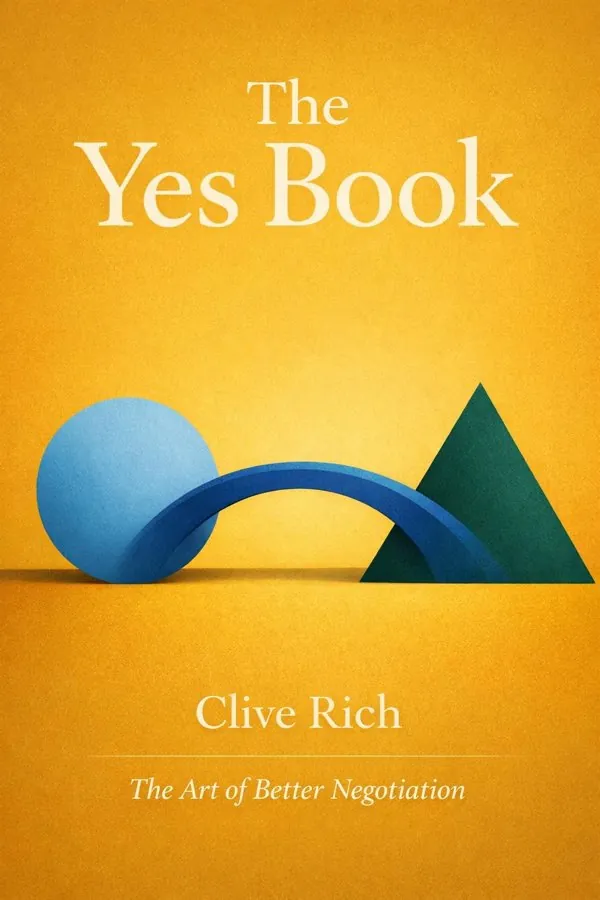
The Yes Book: The Art of Better Negotiation: Summary & Key Insights
by Clive Rich
 10 min8 chaptersAudio available
What Is The Yes Book: The Art of Better Negotiation About?
The Yes Book: The Art of Better Negotiation by Clive Rich is a communication book spanning 8 pages. The Yes Book is a practical guide to mastering negotiation skills in both professional and personal contexts. Drawing on psychology, communication, and business strategy, Clive Rich provides readers with tools to build rapport, manage conflict, and achieve win-win outcomes. The book emphasizes understanding others’ motivations and using positive influence to reach agreements that benefit all parties.
This FizzRead summary covers all 8 key chapters of The Yes Book: The Art of Better Negotiation in approximately 10 minutes, distilling the most important ideas, arguments, and takeaways from Clive Rich's work. Also available as an audio summary and Key Quotes Podcast.
The Yes Book: The Art of Better Negotiation
The Yes Book is a practical guide to mastering negotiation skills in both professional and personal contexts. Drawing on psychology, communication, and business strategy, Clive Rich provides readers with tools to build rapport, manage conflict, and achieve win-win outcomes. The book emphasizes understanding others’ motivations and using positive influence to reach agreements that benefit all parties.
Who Should Read The Yes Book: The Art of Better Negotiation?
This book is perfect for anyone interested in communication and looking to gain actionable insights in a short read. Whether you're a student, professional, or lifelong learner, the key ideas from The Yes Book: The Art of Better Negotiation by Clive Rich will help you think differently.
- ✓Readers who enjoy communication and want practical takeaways
- ✓Professionals looking to apply new ideas to their work and life
- ✓Anyone who wants the core insights of The Yes Book: The Art of Better Negotiation in just 10 minutes
Want the full summary?
Get instant access to this book summary and 100K+ more with Fizz Moment.
Get Free SummaryAvailable on App Store • Free to download
Key Chapters
Negotiation begins long before anyone opens their mouth—it starts in the mind. To effectively reach 'yes,' one must first understand the psychological forces that shape decisions. Emotions, perceptions, and the desire for respect or safety drive every human interaction. My experience has shown me that recognition of these forces is far more powerful than any set of clever arguments.
Emotional intelligence forms the backbone of effective negotiation. The ability to manage one’s emotions, read the emotions of others, and express empathy sets the tone for collaboration. When we feel heard, we open up; when we feel dismissed, we resist. Thus, the first step towards 'yes' is to value the emotional landscape of the room. I often tell negotiators: what people think they want is less important than why they want it. Discover that 'why,' and you discover the path forward.
Negotiation psychology also includes understanding cognitive biases—the shortcuts our minds take that can cloud judgment. For example, the anchoring effect causes people to latch onto the first figure mentioned, while confirmation bias makes us search for information that supports our expectations. By becoming aware of these tendencies—both in ourselves and in others—we can diffuse hidden resistance and guide conversations toward rational, positive outcomes.
Understanding motivation is also essential. Many negotiations stall not because the parties disagree fundamentally, but because their deeper needs remain unacknowledged. A supplier might push hard on price not out of greed, but because of fear of market uncertainty. A parent arguing with a teenager might not truly be fighting about curfew, but about trust. When we listen for the story behind the stance, we negotiate not at the surface, but at the soul.
The Yes System emerged from my years mediating deals across industries—from music to telecoms, from politics to personal disputes. It is built on three phases: Preparation, Engagement, and Agreement. Each represents a stage of both psychological and strategic alignment.
Preparation is where most negotiations are won or lost. It’s not simply about gathering facts, but about building empathy and clarity. I ask myself before every negotiation: what do I want? What does the other side want? What pressures, constraints, and fears might they be operating under? This curiosity transforms preparation into insight. One prepares not to overpower the other, but to align intentions.
Engagement is the dance—the active interaction where trust and rapport must be cultivated. I encourage negotiators to focus less on their speaking and more on their listening. Simple behavioral adjustments—tone of voice, pacing, open body language—can shift perception dramatically. Engagement thrives on empathy. When you genuinely seek to understand, people feel it, and resistance softens.
Finally, Agreement is not merely the signing of a contract; it is the culmination of mutual understanding. A 'yes' that is extracted under pressure is fragile. A 'yes' that grows from shared recognition endures. Therefore, sustainable agreements never ignore emotions—they include them. The Yes System aligns both logic and feeling, ensuring that every outcome leaves participants not only satisfied but respected.
+ 6 more chapters — available in the FizzRead app
All Chapters in The Yes Book: The Art of Better Negotiation
About the Author
Clive Rich is a British lawyer, mediator, and negotiation expert. He has advised major corporations and individuals on deal-making and conflict resolution, and is known for his accessible approach to negotiation psychology and communication.
Get This Summary in Your Preferred Format
Read or listen to the The Yes Book: The Art of Better Negotiation summary by Clive Rich anytime, anywhere. FizzRead offers multiple formats so you can learn on your terms — all free.
Available formats: App · Audio · PDF · EPUB — All included free with FizzRead
Download The Yes Book: The Art of Better Negotiation PDF and EPUB Summary
Key Quotes from The Yes Book: The Art of Better Negotiation
“Negotiation begins long before anyone opens their mouth—it starts in the mind.”
“The Yes System emerged from my years mediating deals across industries—from music to telecoms, from politics to personal disputes.”
Frequently Asked Questions about The Yes Book: The Art of Better Negotiation
The Yes Book: The Art of Better Negotiation by Clive Rich is a communication book that explores key ideas across 8 chapters. The Yes Book is a practical guide to mastering negotiation skills in both professional and personal contexts. Drawing on psychology, communication, and business strategy, Clive Rich provides readers with tools to build rapport, manage conflict, and achieve win-win outcomes. The book emphasizes understanding others’ motivations and using positive influence to reach agreements that benefit all parties.
You Might Also Like
Magic Words: The Science and Secrets Behind Seven Words That Motivate, Engage, and Influence
Tim David
10 min
Talking Across The Divide: How to Communicate with People You Disagree with and Maybe Even Change the World
Justin Lee
10 min
The Exceptional Presenter: A Proven Formula to Open Up! and Own the Room
Timothy J. Koegel
10 min
4 Essential Keys to Effective Communication in Love, Life, Work--Anywhere!: Including the 12-Day Communication Challenge!
Bento C. Leal III
10 min
Active Listening Techniques: 30 Practical Tools to Hone Your Communication Skills
Nisha Gupta
10 min
Bargaining for Advantage: Negotiation Strategies for Reasonable People
G. Richard Shell
10 minBrowse by Category
Ready to read The Yes Book: The Art of Better Negotiation?
Get the full summary and 100K+ more books with Fizz Moment.