
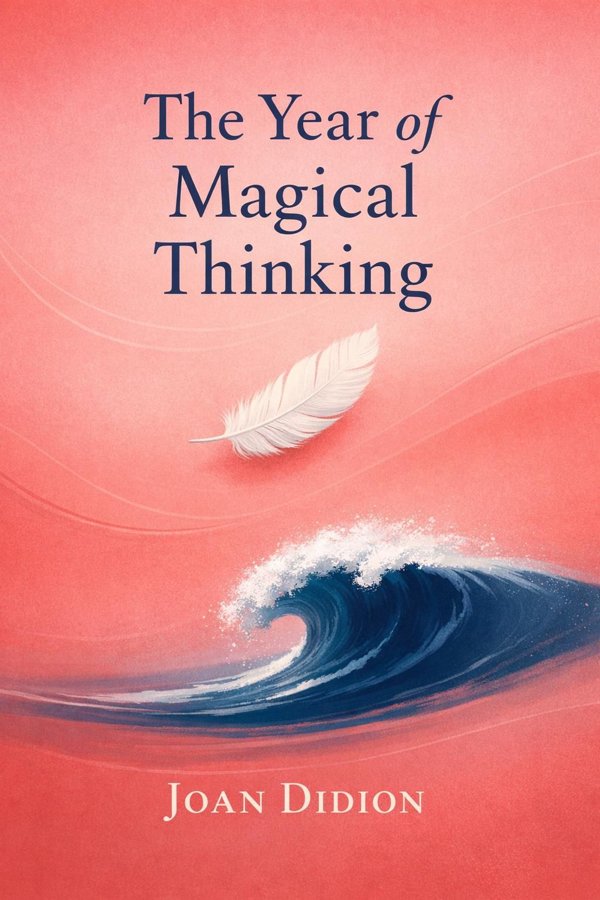
The Year of Magical Thinking: Summary & Key Insights
by Joan Didion
 10 min10 chaptersAudio available
What Is The Year of Magical Thinking About?
The Year of Magical Thinking by Joan Didion is a biographies book spanning 10 pages. A memoir by Joan Didion that explores her experiences of grief following the sudden death of her husband, John Gregory Dunne, and the severe illness of their daughter. The book reflects on memory, mourning, and the process of coming to terms with loss, blending personal narrative with psychological insight and literary reflection.
This FizzRead summary covers all 10 key chapters of The Year of Magical Thinking in approximately 10 minutes, distilling the most important ideas, arguments, and takeaways from Joan Didion's work. Also available as an audio summary and Key Quotes Podcast.
The Year of Magical Thinking
A memoir by Joan Didion that explores her experiences of grief following the sudden death of her husband, John Gregory Dunne, and the severe illness of their daughter. The book reflects on memory, mourning, and the process of coming to terms with loss, blending personal narrative with psychological insight and literary reflection.
Who Should Read The Year of Magical Thinking?
This book is perfect for anyone interested in biographies and looking to gain actionable insights in a short read. Whether you're a student, professional, or lifelong learner, the key ideas from The Year of Magical Thinking by Joan Didion will help you think differently.
- ✓Readers who enjoy biographies and want practical takeaways
- ✓Professionals looking to apply new ideas to their work and life
- ✓Anyone who wants the core insights of The Year of Magical Thinking in just 10 minutes
Want the full summary?
Get instant access to this book summary and 100K+ more with Fizz Moment.
Get Free SummaryAvailable on App Store • Free to download
Key Chapters
That night at the dinner table I entered a different world, though it took months before I could articulate the passage. John’s sudden death was both immediate and incomprehensible. The stillness after his heart stopped seemed unreal—the body was there, the life had vanished. I moved through the motions: calling 911, following the ambulance to the hospital, answering routine questions. Yet none of it seemed connected to the fact itself. I remember speaking as if I could reverse it through coherence, as if clear articulation might restore the missing beat.
From the beginning, loss arrived as disorientation. Our home became an unfamiliar place. The objects gathered from decades of shared living—the books we worked on, his glasses on the table, his shoes by the door—no longer represented continuity. I returned to them as though they were clues to a mystery that could be solved. In those moments, the line between memory and the present dissolved. I supposed that grief would be quiet, but it was not; it was a constant mental noise filled with questions.
Writing about that night, I understood that the texture of ordinary life shields us from the awareness of mortality. One moment I believed in the stability of our evening routine; the next, I stood in its wreckage. This fracture—not only of love, but of the structure of experience—became the foundation for everything that followed. To convey grief truthfully, I had to begin with this collapse, the instant in which the narrative of the self breaks open.
The hours and days after John’s death were governed by a peculiar clarity. I answered the phone, arranged the autopsy, spoke with doctors, notified friends. I was effective, as if functioning on borrowed logic. But beneath that surface was disbelief so complete it rendered emotion impossible. I did not cry at first; instead, I calculated.
This numbness was deceptive. Grief often begins not with visible mourning but with detached procedures, as though the body protects itself through administration. I found myself rereading medical explanations of cardiac arrest, noting times, researching medications, convinced that if I understood the mechanism I might undo it. This was not denial in a conscious sense—it was an altered cognition, what I later called magical thinking. I maintained the belief that understanding might equal reversal.
In remembering that phase, I see how the mind preserves its illusions as a kind of survival instinct. To accept immediacy is to accept annihilation; the brain therefore rewrites the event, inserts possibility where none exists. The tragedy becomes a problem to be solved, not a state to be endured. Only later, as the administrative rituals concluded, did silence settle into its reality. Then grief presented itself not as sadness but as the impossibility of comprehension.
+ 8 more chapters — available in the FizzRead app
All Chapters in The Year of Magical Thinking
About the Author
Joan Didion (1934–2021) was an American author, essayist, and journalist known for her sharp observations of American culture and politics. Her works include 'Slouching Towards Bethlehem', 'Play It As It Lays', and 'The White Album'. Didion’s writing is celebrated for its clarity, precision, and emotional depth.
Get This Summary in Your Preferred Format
Read or listen to the The Year of Magical Thinking summary by Joan Didion anytime, anywhere. FizzRead offers multiple formats so you can learn on your terms — all free.
Available formats: App · Audio · PDF · EPUB — All included free with FizzRead
Download The Year of Magical Thinking PDF and EPUB Summary
Key Quotes from The Year of Magical Thinking
“That night at the dinner table I entered a different world, though it took months before I could articulate the passage.”
“The hours and days after John’s death were governed by a peculiar clarity.”
Frequently Asked Questions about The Year of Magical Thinking
The Year of Magical Thinking by Joan Didion is a biographies book that explores key ideas across 10 chapters. A memoir by Joan Didion that explores her experiences of grief following the sudden death of her husband, John Gregory Dunne, and the severe illness of their daughter. The book reflects on memory, mourning, and the process of coming to terms with loss, blending personal narrative with psychological insight and literary reflection.
You Might Also Like

An American Marriage
Tayari Jones
10 min
Benjamin Franklin: An American Life
Walter Isaacson
10 min
I Know Why The Caged Bird Sings
Maya Angelou
10 min
Long Walk to Freedom
Nelson Mandela
10 min
Persepolis
Marjane Satrapi
10 min
Surely You're Joking, Mr. Feynman!
Richard P. Feynman
10 minBrowse by Category
Ready to read The Year of Magical Thinking?
Get the full summary and 100K+ more books with Fizz Moment.