
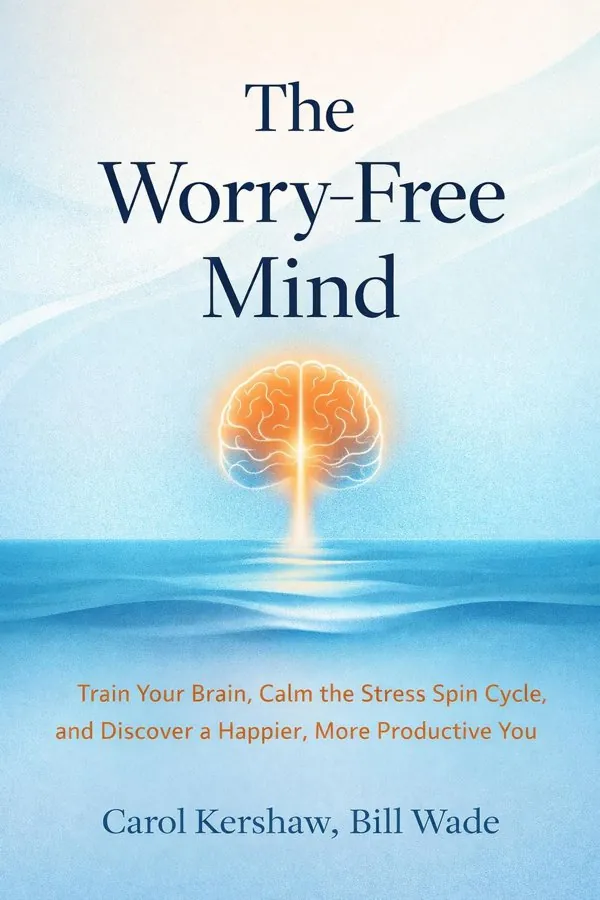
The Worry-Free Mind: Train Your Brain, Calm the Stress Spin Cycle, and Discover a Happier, More Productive You: Summary & Key Insights
 10 min5 chaptersAudio available
What Is The Worry-Free Mind: Train Your Brain, Calm the Stress Spin Cycle, and Discover a Happier, More Productive You About?
The Worry-Free Mind: Train Your Brain, Calm the Stress Spin Cycle, and Discover a Happier, More Productive You by Carol Kershaw, Bill Wade is a mental_health book spanning 5 pages. The Worry-Free Mind offers practical neuroscience-based techniques to help readers reduce anxiety, manage stress, and improve focus. Drawing on brain training and mindfulness strategies, the authors explain how to interrupt the brain’s stress response and cultivate a calmer, more resilient mindset for everyday life.
This FizzRead summary covers all 5 key chapters of The Worry-Free Mind: Train Your Brain, Calm the Stress Spin Cycle, and Discover a Happier, More Productive You in approximately 10 minutes, distilling the most important ideas, arguments, and takeaways from Carol Kershaw, Bill Wade's work. Also available as an audio summary and Key Quotes Podcast.
The Worry-Free Mind: Train Your Brain, Calm the Stress Spin Cycle, and Discover a Happier, More Productive You
The Worry-Free Mind offers practical neuroscience-based techniques to help readers reduce anxiety, manage stress, and improve focus. Drawing on brain training and mindfulness strategies, the authors explain how to interrupt the brain’s stress response and cultivate a calmer, more resilient mindset for everyday life.
Who Should Read The Worry-Free Mind: Train Your Brain, Calm the Stress Spin Cycle, and Discover a Happier, More Productive You?
This book is perfect for anyone interested in mental_health and looking to gain actionable insights in a short read. Whether you're a student, professional, or lifelong learner, the key ideas from The Worry-Free Mind: Train Your Brain, Calm the Stress Spin Cycle, and Discover a Happier, More Productive You by Carol Kershaw, Bill Wade will help you think differently.
- ✓Readers who enjoy mental_health and want practical takeaways
- ✓Professionals looking to apply new ideas to their work and life
- ✓Anyone who wants the core insights of The Worry-Free Mind: Train Your Brain, Calm the Stress Spin Cycle, and Discover a Happier, More Productive You in just 10 minutes
Want the full summary?
Get instant access to this book summary and 100K+ more with Fizz Moment.
Get Free SummaryAvailable on App Store • Free to download
Key Chapters
Let’s begin by exploring how the worry-driven brain operates. The central player here is the amygdala, a small almond-shaped structure buried deep within the limbic system. Its job is to detect threat—real or imagined—and trigger an immediate response. When your amygdala senses potential danger, it floods your body with stress hormones like cortisol and adrenaline. These chemicals enable fight, flight, or freeze reactions, but they also narrow the scope of your thinking. In moments of anxiety, your brain moves away from creativity and reason, into survival-focused patterns.
Meanwhile, your prefrontal cortex—the rational, planning part of your brain—starts to lose influence. This is why during worry, logical thinking feels impossible. You can’t reason your way out of panic, because the biological mechanisms of fear are louder than logic. In our work as clinicians, we’ve seen how this over-activation of the amygdala forms the foundation of the stress spin cycle: the repetitive, uncontrollable flow of fearful thoughts that loop in your mind.
The good news is that this system isn’t broken. It’s simply overtrained. For generations, human brains evolved to survive in environments full of real threats. Today, those same systems respond not only to external dangers but to imagined ones—social tensions, financial uncertainty, self-criticism. The body doesn’t distinguish between a tiger and a traffic jam; both ignite the same circuitry. Through deliberate training, you can teach your brain to recognize these false alarms and recalibrate its response.
In this chapter, we introduce ways to engage the prefrontal cortex so it re-establishes its leadership over the amygdala. This begins with awareness—simply noticing when your mind has been hijacked by stress. From there, you can employ techniques like deep breathing, reframing, and sensory grounding. These methods work not because they are mystical, but because they physically change your brain’s chemistry. Each time you interrupt the stress reaction, you reinforce neural pathways of calm, resilience, and executive control.
The stress spin cycle is one of the most exhausting mental patterns we encounter as therapists. It begins innocently: a single anxious thought triggers a cascade of physiological responses—your heart rate increases, muscles tense, and negative imagery floods the mind. This reaction feeds the amygdala, which interprets these sensations as proof that danger is near. The loop tightens: worry causes tension, tension confirms danger, and your mind spins faster. Over time, these circuits become automatic.
To break the cycle, we first teach awareness. You must learn to see the worry response not as who you are, but as neural activity playing out in real time. When you watch your worry, you rob it of power. The observation itself activates your medial prefrontal cortex, which dampens amygdala reactivity. Then we use attention training to redirect focus. The brain cannot sustain worry and focused calm simultaneously—one diminishes the other.
One practical way to intervene is the 90-second rule of emotional storms. When you become aware of a stress reaction, simply breathe, stay still, and wait for a minute and a half. Neuroscientifically, that’s about how long it takes for stress chemicals like adrenaline to peak and subside. During that window, resist feeding the emotion with new thoughts. This small act builds self-mastery and breaks the chemical momentum of the spin cycle.
Over time, consistent practice of awareness, grounding, and redirection begins to rewire your brain’s pathways. You’ll notice more moments of quiet observation and fewer of automatic reaction. The stress spin weakens because you are no longer fueling it with engagement. You become the observer rather than the prisoner of your thoughts.
+ 3 more chapters — available in the FizzRead app
All Chapters in The Worry-Free Mind: Train Your Brain, Calm the Stress Spin Cycle, and Discover a Happier, More Productive You
About the Authors
Dr. Carol Kershaw and Dr. Bill Wade are licensed psychologists and directors of the Milton H. Erickson Institute of Houston. They specialize in clinical hypnosis, neuroscience, and psychotherapy, and have co-authored several books on mental resilience and personal transformation.
Get This Summary in Your Preferred Format
Read or listen to the The Worry-Free Mind: Train Your Brain, Calm the Stress Spin Cycle, and Discover a Happier, More Productive You summary by Carol Kershaw, Bill Wade anytime, anywhere. FizzRead offers multiple formats so you can learn on your terms — all free.
Available formats: App · Audio · PDF · EPUB — All included free with FizzRead
Download The Worry-Free Mind: Train Your Brain, Calm the Stress Spin Cycle, and Discover a Happier, More Productive You PDF and EPUB Summary
Key Quotes from The Worry-Free Mind: Train Your Brain, Calm the Stress Spin Cycle, and Discover a Happier, More Productive You
“Let’s begin by exploring how the worry-driven brain operates.”
“The stress spin cycle is one of the most exhausting mental patterns we encounter as therapists.”
Frequently Asked Questions about The Worry-Free Mind: Train Your Brain, Calm the Stress Spin Cycle, and Discover a Happier, More Productive You
The Worry-Free Mind: Train Your Brain, Calm the Stress Spin Cycle, and Discover a Happier, More Productive You by Carol Kershaw, Bill Wade is a mental_health book that explores key ideas across 5 chapters. The Worry-Free Mind offers practical neuroscience-based techniques to help readers reduce anxiety, manage stress, and improve focus. Drawing on brain training and mindfulness strategies, the authors explain how to interrupt the brain’s stress response and cultivate a calmer, more resilient mindset for everyday life.
You Might Also Like

Big Feelings: How to Be Okay When Things Are Not Okay
Liz Fosslien, Mollie West Duffy
10 min
Creative Arts Therapies Handbook: Art, Music and Dance Therapy Practices for Wellbeing
Susan I. Buchalter
10 min
Emotional First Aid: Healing Rejection, Guilt, Failure, and Other Everyday Hurts
Guy Winch
10 min
Lost Connections: Why You're Depressed and How to Find Hope
Johann Hari
10 min
No Time to Panic: How to Stop Worrying and Embrace Life
Matt Gutman
10 min
Overcoming Mobbing: A Recovery Guide for Workplace Aggression and Bullying
Maureen Duffy, Len Sperry
10 minBrowse by Category
Ready to read The Worry-Free Mind: Train Your Brain, Calm the Stress Spin Cycle, and Discover a Happier, More Productive You?
Get the full summary and 100K+ more books with Fizz Moment.