
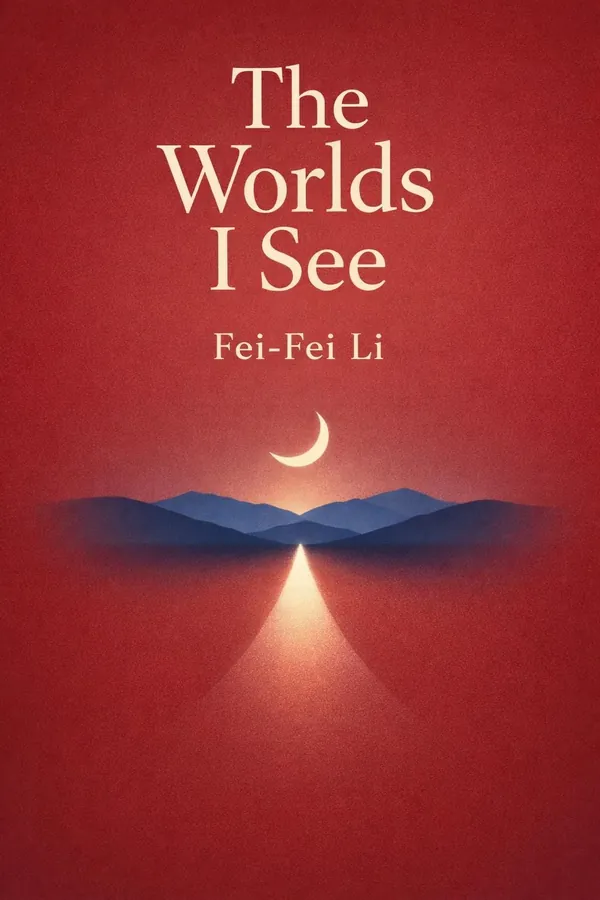
The Worlds I See: Curiosity, Exploration, and Discovery at the Dawn of AI: Summary & Key Insights
by Fei-Fei Li
 10 min10 chaptersAudio available
Key Takeaways from The Worlds I See: Curiosity, Exploration, and Discovery at the Dawn of AI
Every scientific revolution begins long before the lab, often in the mind of a child who cannot stop asking why.
A new country can feel less like a destination and more like a complete rewriting of the self.
Education matters most when it changes not just what you know but how you notice reality.
Talent opens doors, but discipline determines whether you can stay in the room.
No one becomes exceptional alone, and no one remains unchanged by struggle.
What Is The Worlds I See: Curiosity, Exploration, and Discovery at the Dawn of AI About?
The Worlds I See: Curiosity, Exploration, and Discovery at the Dawn of AI by Fei-Fei Li is a biographies book spanning 10 pages. The Worlds I See is both a scientific memoir and a deeply human story about how one of the most influential researchers in artificial intelligence came to understand intelligence itself. In this book, Fei-Fei Li traces her path from a curious child in Beijing to an immigrant teenager in America, and then to a pioneering computer scientist whose work helped transform AI through computer vision and the creation of ImageNet. But this is not just a story about technical breakthroughs. It is also about family sacrifice, cultural displacement, mentorship, ambition, and the ethical responsibility that comes with building powerful technologies. What makes the book especially compelling is Li’s rare authority: she has stood at the center of AI’s modern rise while also reflecting critically on its limits and consequences. Her perspective bridges science, policy, education, and lived experience. The result is a memoir that explains how AI developed, why it matters, and why the future of the field must remain grounded in human dignity, empathy, and shared responsibility.
This FizzRead summary covers all 10 key chapters of The Worlds I See: Curiosity, Exploration, and Discovery at the Dawn of AI in approximately 10 minutes, distilling the most important ideas, arguments, and takeaways from Fei-Fei Li's work. Also available as an audio summary and Key Quotes Podcast.
The Worlds I See: Curiosity, Exploration, and Discovery at the Dawn of AI
The Worlds I See is both a scientific memoir and a deeply human story about how one of the most influential researchers in artificial intelligence came to understand intelligence itself. In this book, Fei-Fei Li traces her path from a curious child in Beijing to an immigrant teenager in America, and then to a pioneering computer scientist whose work helped transform AI through computer vision and the creation of ImageNet. But this is not just a story about technical breakthroughs. It is also about family sacrifice, cultural displacement, mentorship, ambition, and the ethical responsibility that comes with building powerful technologies. What makes the book especially compelling is Li’s rare authority: she has stood at the center of AI’s modern rise while also reflecting critically on its limits and consequences. Her perspective bridges science, policy, education, and lived experience. The result is a memoir that explains how AI developed, why it matters, and why the future of the field must remain grounded in human dignity, empathy, and shared responsibility.
Who Should Read The Worlds I See: Curiosity, Exploration, and Discovery at the Dawn of AI?
This book is perfect for anyone interested in biographies and looking to gain actionable insights in a short read. Whether you're a student, professional, or lifelong learner, the key ideas from The Worlds I See: Curiosity, Exploration, and Discovery at the Dawn of AI by Fei-Fei Li will help you think differently.
- ✓Readers who enjoy biographies and want practical takeaways
- ✓Professionals looking to apply new ideas to their work and life
- ✓Anyone who wants the core insights of The Worlds I See: Curiosity, Exploration, and Discovery at the Dawn of AI in just 10 minutes
Want the full summary?
Get instant access to this book summary and 100K+ more with Fizz Moment.
Get Free SummaryAvailable on App Store • Free to download
Key Chapters
Every scientific revolution begins long before the lab, often in the mind of a child who cannot stop asking why. Fei-Fei Li opens her story by returning to her early years in Beijing, where curiosity was not yet a career path but a way of being in the world. She remembers small, vivid details of ordinary life and shows how careful observation shaped her imagination long before she knew the language of science. These scenes matter because they reveal a core idea that runs through the entire book: discovery is less about sudden genius than sustained attention. To see deeply is to care enough to notice what others overlook.
Li’s early experiences remind us that scientific thinking does not begin with equations. It begins with wonder, pattern recognition, and the habit of asking better questions. That same instinct later guided her work in computer vision, a field concerned with teaching machines to interpret images. Her childhood fascination with seeing the world became a professional effort to understand what perception really is.
This idea has practical relevance beyond research. Parents, teachers, managers, and creators all benefit when they protect curiosity instead of rushing to immediate answers. A child collecting leaves, a designer studying how people use objects, or a doctor observing subtle symptoms are all practicing the same discipline of careful attention.
The larger lesson is simple but powerful: curiosity is not a luxury. It is the engine of insight, resilience, and innovation. Actionable takeaway: create regular space in your life to observe without agenda, ask one deeper question than usual, and treat wonder as a skill worth training.
A new country can feel less like a destination and more like a complete rewriting of the self. When Li immigrates from China to the United States as a teenager, she is forced into a crash course in adaptation. Language barriers, unfamiliar customs, financial strain, and social uncertainty make everyday life feel unstable. Yet the memoir shows that immigration is not only a story of hardship. It is also a powerful education in flexibility, empathy, and perseverance.
Li’s family does not arrive into comfort. They work hard to survive, and she experiences firsthand how fragile opportunity can be. Her parents’ sacrifices, especially amid economic struggle and illness, shape her understanding of achievement. Success is never presented as individual brilliance alone. It is built on invisible labor, family loyalty, and the emotional cost of starting over.
This phase of her life also helps explain why she later resists narrow definitions of excellence. Being an outsider taught her that talent is widely distributed while opportunity is not. That insight becomes important in her academic leadership and her view of AI’s social impact. Systems, whether educational or technological, must be designed with inclusion in mind.
For readers, Li’s immigration story offers a practical framework for navigating any major transition. Whether starting a new job, entering a new culture, or learning a new field, adaptation begins with humility and endurance. You do not need immediate mastery to keep moving forward.
Actionable takeaway: when entering unfamiliar territory, focus on consistent small adaptations, seek support without shame, and remember that discomfort is often the price of growth rather than proof of failure.
Education matters most when it changes not just what you know but how you notice reality. At Princeton, Li begins to transform from a gifted student into a thinker with a research identity. Surrounded by rigorous ideas and intellectual freedom, she becomes increasingly interested in the nature of vision, perception, and intelligence. The question is deceptively simple: how do humans make sense of what they see so effortlessly? That question would later define her most influential work.
Princeton represents more than academic advancement. It is where Li learns how disciplines connect. Physics, neuroscience, cognition, and computer science are not isolated islands but overlapping attempts to explain mind and world. This broader intellectual environment helps her see that important problems often live at the boundaries between fields. Her eventual impact in AI comes partly from this interdisciplinary mindset.
The practical lesson here is that expertise grows stronger when paired with intellectual range. A software engineer who studies psychology, a doctor who learns statistics, or a business leader who reads history gains better tools for seeing complexity. Li’s training suggests that breakthrough thinking often emerges when we resist being trapped inside one narrow vocabulary.
Her Princeton years also emphasize the importance of asking foundational questions instead of chasing only fashionable ones. Rather than focusing solely on what was easiest to publish, she was drawn to what was hardest to understand.
Actionable takeaway: choose one important problem in your life or work and study it from at least two different disciplines. Expanding your lens may reveal patterns, assumptions, and opportunities that a single framework would miss.
Talent opens doors, but discipline determines whether you can stay in the room. At Caltech, Li deepens her research training and confronts the demanding reality of scientific work. Graduate study is not a smooth ascent. It involves ambiguity, repeated failure, self-doubt, and the long stretches where progress is invisible. In this environment, she begins to develop the habits that define serious inquiry: patience, rigor, persistence, and the willingness to be wrong.
This period is crucial because it reveals how scientific confidence is actually built. It does not come from always having answers. It comes from learning to work productively with uncertainty. Li’s evolving interest in computer vision requires her to engage problems that are conceptually rich and technically difficult. Human vision seems effortless, but replicating even parts of it computationally is extraordinarily hard. The gap between human perception and machine perception becomes a fertile space for research.
Li also shows how mentorship and institutional culture shape the scientist a person becomes. Research is often romanticized as solitary genius, but in practice it depends on laboratories, teachers, collaborators, and communities of challenge. Constructive criticism, when paired with belief in a student’s potential, becomes a tool for growth rather than discouragement.
This lesson applies widely. In any demanding field, real development comes when you stop treating confusion as an emergency. Instead, you learn to break large problems into smaller ones, test assumptions, and improve incrementally.
Actionable takeaway: when facing a complex challenge, replace the goal of immediate clarity with a process of disciplined iteration. Progress often begins the moment you become willing to stay with difficulty long enough for understanding to emerge.
No one becomes exceptional alone, and no one remains unchanged by struggle. One of the most moving currents in Li’s memoir is the interplay between personal hardship and the people who helped her continue. Financial pressures, family responsibilities, and the illness of her mother create emotional burdens that exist alongside academic ambition. Rather than presenting achievement as a clean narrative of ascent, Li shows how life’s most demanding seasons often occur in parallel.
At the same time, mentors play a decisive role. They offer guidance, standards, opportunity, and sometimes simply the crucial signal that a young researcher belongs. In Li’s story, mentorship is not mere networking. It is an act of recognition. Someone sees capability before the person herself fully trusts it. That recognition can redirect a life.
The practical application is profound. In education and leadership, technical instruction is not enough. People grow faster when they are challenged and supported at the same time. A manager who gives stretch assignments while offering honest feedback, or a professor who combines rigor with encouragement, can change a trajectory.
Li also demonstrates that adversity can sharpen purpose when it is integrated rather than denied. Caring for family while building a scientific career forced her to clarify what mattered. That emotional depth later influenced her insistence that AI remain connected to human realities rather than abstract metrics alone.
Actionable takeaway: identify one person you can actively mentor or one mentor you need to approach. Progress accelerates when guidance becomes intentional, and resilience grows when struggle is shared rather than hidden.
Sometimes a breakthrough comes not from a new theory but from building the infrastructure everyone else overlooked. Li’s creation of ImageNet is the defining achievement of the memoir and one of the most important contributions in modern AI. At the time, many researchers were trying to improve machine vision algorithms, but Li recognized a more fundamental bottleneck: computers could not learn to recognize the visual world well without massive, well-organized datasets. If human intelligence develops through exposure to countless examples, machine learning would require something similar.
ImageNet was an audacious response. It aimed to build a vast database of labeled images organized according to meaningful categories. The task was technically difficult and logistically immense. It required vision, persistence, annotation labor, and the ability to convince others that data curation was not secondary work but foundational science. Li had to push against skepticism from a field that did not yet grasp how transformative large-scale data could be.
The practical importance of ImageNet extends beyond AI history. It demonstrates that progress often depends on creating better systems for learning, not just smarter individual tools. In business, healthcare, education, and policy, decisions improve when data is structured, contextualized, and responsibly maintained. Bad inputs produce weak outcomes; rich inputs unlock new capability.
ImageNet’s legacy is also a reminder that foundational work is often less glamorous than final results. Building a durable platform can matter more than chasing a flashy short-term win.
Actionable takeaway: if progress feels stalled in your field, ask whether the real problem is not talent or ideas but missing infrastructure. Strengthen the quality of the inputs, and the outputs may improve dramatically.
History often celebrates the dramatic moment of breakthrough, but breakthroughs only matter when someone has prepared the ground for them. The rise of deep learning in computer vision did not happen in isolation. Li shows how ImageNet became the stage on which a new generation of neural network models could prove their power. When deep learning systems achieved striking performance gains on the ImageNet challenge, the field changed rapidly. What had seemed speculative became undeniable.
This moment is important because it reveals how innovation is cumulative. Algorithms, data, compute power, and scientific timing all had to align. Li’s memoir gives readers a front-row view of a turning point in technological history while also correcting a common misunderstanding: revolutions are rarely the product of one sudden idea. They emerge from years of groundwork, collaboration, and conditions that make latent possibilities visible.
The practical lesson is highly transferable. Organizations often seek transformation through one bold initiative, but durable change usually requires preparation. A company cannot become data-driven without clean data. A team cannot innovate without trust. A student cannot improvise brilliantly without fundamentals. The spectacular moment depends on invisible groundwork.
Li also remains balanced about deep learning’s success. Improved performance is not the same as full understanding. Machines may classify images with astonishing accuracy, yet still lack common sense, embodiment, and human meaning. That tension keeps the book intellectually honest.
Actionable takeaway: before chasing the next breakthrough in your own work, identify the enabling conditions it requires. Build the foundations first, because apparent leaps are usually the visible result of patient preparation.
The more powerful a technology becomes, the more dangerous it is to discuss it only in technical terms. As AI advances, Li increasingly argues that the central question is no longer just what machines can do, but what kind of human future their use will create. Her advocacy for human-centered AI emerges from both scientific realism and moral urgency. She understands the promise of AI in medicine, accessibility, climate modeling, and education. But she also sees the risks of bias, surveillance, exclusion, concentration of power, and dehumanizing design.
Human-centered AI does not mean being anti-technology. It means embedding technological development within human values, social context, and democratic accountability. Systems should be judged not only by efficiency or accuracy but by fairness, transparency, safety, and benefit to society. Li’s perspective is especially credible because it comes from someone who helped drive AI’s progress. Her caution is informed, not reactionary.
This idea has practical implications for builders and non-builders alike. Engineers should question training data and deployment contexts. Leaders should evaluate downstream harms, not just revenue upside. Citizens should resist treating AI as an unstoppable force beyond public influence. The design of technology is a series of choices, and choices can be guided by ethics.
Li’s broader point is that intelligence without empathy is insufficient. A tool that scales decision-making also scales the values embedded within it.
Actionable takeaway: whenever you use, build, or evaluate AI, ask three questions: who benefits, who may be harmed, and whose perspective is missing. Better systems begin with better moral inquiry.
True leadership is not measured by personal prominence but by the ability to create spaces where others can do meaningful work. In helping build Stanford’s Institute for Human-Centered Artificial Intelligence, Li expands from researcher to institution builder. This transition matters because scientific progress at scale requires more than individual brilliance. It requires organizations that connect disciplines, train future leaders, and create forums where technical, legal, philosophical, and social questions can be examined together.
Li’s leadership style in the memoir is notable for its breadth. She sees AI not as a siloed engineering domain but as a civilizational force that must be shaped through collaboration across academia, industry, and government. Building institutions becomes a way to slow down simplistic narratives. Instead of asking whether AI is good or bad in the abstract, a serious institution asks how specific systems should be researched, governed, and used.
There is a practical leadership lesson here for any field. Strong institutions align values with structure. They do not rely solely on charismatic individuals. They create processes, incentives, and cultures that outlast any one person. Whether you are leading a startup, school, nonprofit, or team, the deepest question is not just what you can achieve, but what kind of environment you are creating for others.
Li’s example also suggests that leadership and humility can coexist. It is possible to be ambitious about impact while remaining open, collaborative, and reflective.
Actionable takeaway: if you lead others, invest in systems that foster trust, interdisciplinary dialogue, and long-term responsibility. Sustainable impact grows when leadership becomes architectural rather than purely personal.
The most important future question is not whether AI will grow more capable, but whether humanity will grow wise enough to guide it. Li ends with a forward-looking vision shaped by both optimism and restraint. She believes AI can become a profound tool for human flourishing, but only if society approaches it with stewardship rather than fascination alone. Her vision rejects two extremes: techno-utopianism that assumes innovation automatically improves life, and fatalism that treats harmful outcomes as inevitable.
Stewardship implies care, responsibility, and long horizons. It asks researchers to think beyond publication cycles, companies to think beyond quarterly gains, and policymakers to think beyond reactive headlines. It also asks the public to remain engaged. AI should not be left only to engineers or executives, because its effects touch labor, health, education, justice, art, and identity.
Empathy is central to this future because intelligence is never purely computational in human life. We understand one another through context, vulnerability, memory, and relationships. Li’s memoir repeatedly returns to the idea of seeing, and by the end that word has widened. To see well is not merely to detect patterns. It is to recognize humanity.
This final perspective offers a practical orientation in a noisy technological age. We do not need to predict every future scenario to act responsibly now. We need values robust enough to guide uncertain change.
Actionable takeaway: approach emerging technology as a steward, not a spectator. Stay informed, participate in public conversation, and anchor your judgments in empathy, dignity, and long-term human well-being.
All Chapters in The Worlds I See: Curiosity, Exploration, and Discovery at the Dawn of AI
About the Author
Fei-Fei Li is a leading computer scientist, educator, and public thinker in artificial intelligence. Born in Beijing, she immigrated to the United States as a teenager and went on to study physics at Princeton before earning her doctorate at Caltech. She is best known for her groundbreaking work in computer vision and for creating ImageNet, the large-scale visual dataset that helped catalyze the deep learning revolution. Li is a professor at Stanford University and has been a prominent advocate for human-centered AI, emphasizing the need to align technological progress with ethics, fairness, and human well-being. Through her research, leadership, and writing, she has become one of the most influential voices shaping how the world understands AI and its future.
Get This Summary in Your Preferred Format
Read or listen to the The Worlds I See: Curiosity, Exploration, and Discovery at the Dawn of AI summary by Fei-Fei Li anytime, anywhere. FizzRead offers multiple formats so you can learn on your terms — all free.
Available formats: App · Audio · PDF · EPUB — All included free with FizzRead
Download The Worlds I See: Curiosity, Exploration, and Discovery at the Dawn of AI PDF and EPUB Summary
Key Quotes from The Worlds I See: Curiosity, Exploration, and Discovery at the Dawn of AI
“Every scientific revolution begins long before the lab, often in the mind of a child who cannot stop asking why.”
“A new country can feel less like a destination and more like a complete rewriting of the self.”
“Education matters most when it changes not just what you know but how you notice reality.”
“Talent opens doors, but discipline determines whether you can stay in the room.”
“No one becomes exceptional alone, and no one remains unchanged by struggle.”
Frequently Asked Questions about The Worlds I See: Curiosity, Exploration, and Discovery at the Dawn of AI
The Worlds I See: Curiosity, Exploration, and Discovery at the Dawn of AI by Fei-Fei Li is a biographies book that explores key ideas across 10 chapters. The Worlds I See is both a scientific memoir and a deeply human story about how one of the most influential researchers in artificial intelligence came to understand intelligence itself. In this book, Fei-Fei Li traces her path from a curious child in Beijing to an immigrant teenager in America, and then to a pioneering computer scientist whose work helped transform AI through computer vision and the creation of ImageNet. But this is not just a story about technical breakthroughs. It is also about family sacrifice, cultural displacement, mentorship, ambition, and the ethical responsibility that comes with building powerful technologies. What makes the book especially compelling is Li’s rare authority: she has stood at the center of AI’s modern rise while also reflecting critically on its limits and consequences. Her perspective bridges science, policy, education, and lived experience. The result is a memoir that explains how AI developed, why it matters, and why the future of the field must remain grounded in human dignity, empathy, and shared responsibility.
You Might Also Like

An American Marriage
Tayari Jones
10 min
Benjamin Franklin: An American Life
Walter Isaacson
10 min
I Know Why The Caged Bird Sings
Maya Angelou
10 min
Long Walk to Freedom
Nelson Mandela
10 min
Persepolis
Marjane Satrapi
10 min
Surely You're Joking, Mr. Feynman!
Richard P. Feynman
10 minBrowse by Category
Ready to read The Worlds I See: Curiosity, Exploration, and Discovery at the Dawn of AI?
Get the full summary and 100K+ more books with Fizz Moment.