
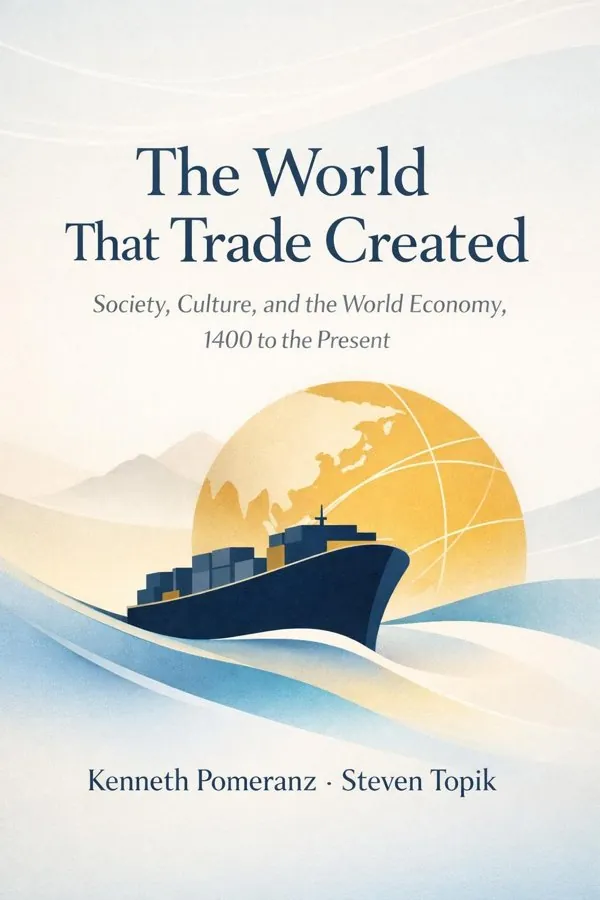
The World That Trade Created: Society, Culture, and the World Economy, 1400 to the Present: Summary & Key Insights
by Kenneth Pomeranz, Steven Topik
 10 min11 chaptersAudio available
What Is The World That Trade Created: Society, Culture, and the World Economy, 1400 to the Present About?
The World That Trade Created: Society, Culture, and the World Economy, 1400 to the Present by Kenneth Pomeranz, Steven Topik is a world_history book spanning 11 pages. This book explores how global trade shaped societies and cultures from 1400 to the present. Through a series of concise, engaging essays, Kenneth Pomeranz and Steven Topik examine the social and cultural dimensions of world economic history, revealing how commerce connected distant regions and influenced everyday life. The authors highlight the interplay between local practices and global networks, offering insights into the evolution of the modern world economy.
This FizzRead summary covers all 11 key chapters of The World That Trade Created: Society, Culture, and the World Economy, 1400 to the Present in approximately 10 minutes, distilling the most important ideas, arguments, and takeaways from Kenneth Pomeranz, Steven Topik's work. Also available as an audio summary and Key Quotes Podcast.
The World That Trade Created: Society, Culture, and the World Economy, 1400 to the Present
This book explores how global trade shaped societies and cultures from 1400 to the present. Through a series of concise, engaging essays, Kenneth Pomeranz and Steven Topik examine the social and cultural dimensions of world economic history, revealing how commerce connected distant regions and influenced everyday life. The authors highlight the interplay between local practices and global networks, offering insights into the evolution of the modern world economy.
Who Should Read The World That Trade Created: Society, Culture, and the World Economy, 1400 to the Present?
This book is perfect for anyone interested in world_history and looking to gain actionable insights in a short read. Whether you're a student, professional, or lifelong learner, the key ideas from The World That Trade Created: Society, Culture, and the World Economy, 1400 to the Present by Kenneth Pomeranz, Steven Topik will help you think differently.
- ✓Readers who enjoy world_history and want practical takeaways
- ✓Professionals looking to apply new ideas to their work and life
- ✓Anyone who wants the core insights of The World That Trade Created: Society, Culture, and the World Economy, 1400 to the Present in just 10 minutes
Want the full summary?
Get instant access to this book summary and 100K+ more with Fizz Moment.
Get Free SummaryAvailable on App Store • Free to download
Key Chapters
In these early centuries, global trade began to take recognizable shape as the great voyages of discovery opened new routes of connection. Prior to the sixteenth century, economic life was highly regional, but long-distance networks already linked parts of Asia, Africa, and Europe through spice routes and overland caravans. With the arrival of European seafarers in Asian, African, and American waters, those older circuits merged into a truly global system.
We explore how commodities like pepper, nutmeg, and textiles became the lifeblood of merchant empires. Asian and African traders were hardly passive recipients of European expansion; they were dynamic partners negotiating their own interests. The Indian Ocean basin in particular was a stage of cosmopolitan commerce long before European dominance, connecting Gujarati merchants, Arab traders, Javanese sailors, and Chinese junks. Europeans entered this world as newcomers seeking profit in a system that already thrived on diversity.
These exchanges were not merely economic—they were profoundly cultural. The arrival of new goods reshaped tastes and fashions across societies. Spices changed cuisines, fabrics signaled social rank, and the possession of foreign luxuries became a marker of distinction. The sixteenth century’s global awakening reflected a meeting of countless local desires, each woven into the emerging fabric of world trade.
Few commodities tell the story of early modern globalization as vividly as silver. Our book traces how the mines of Potosí in present-day Bolivia and Zacatecas in Mexico produced vast quantities of silver that flowed outward through Spanish fleets, crossing both the Atlantic and Pacific Oceans. The result was the first worldwide monetary circulation.
Silver acquired an extraordinary role because of China’s fiscal reforms. As the Ming dynasty transitioned to a silver-based tax system, Chinese demand effectively turned the Americas into its distant supplier. Each coin minted in Spanish workshops could travel over oceans, linking peasants in Asia to miners in the Andes. This was not abstract economics—it was a web of human labor and state ambition, expressed through metal.
Through these circuits, we show how European and Asian economies integrated in unforeseen ways. The price of silver in Seville or Canton reflected the productivity of American labor and the decisions of imperial bureaucrats. Global monetary exchange reshaped government revenues, introduced inflationary cycles, and powered the expansion of trade itself. In short, silver was the bloodstream of the eighteenth-century global economy, a tangible symbol of how commerce could bind worlds that seemed impossibly remote.
+ 9 more chapters — available in the FizzRead app
All Chapters in The World That Trade Created: Society, Culture, and the World Economy, 1400 to the Present
About the Authors
Kenneth Pomeranz is an American historian specializing in Chinese and world economic history. He is a professor at the University of Chicago and a leading scholar in global history. Steven Topik is a historian at the University of California, Irvine, known for his research on Latin American and global economic history.
Get This Summary in Your Preferred Format
Read or listen to the The World That Trade Created: Society, Culture, and the World Economy, 1400 to the Present summary by Kenneth Pomeranz, Steven Topik anytime, anywhere. FizzRead offers multiple formats so you can learn on your terms — all free.
Available formats: App · Audio · PDF · EPUB — All included free with FizzRead
Download The World That Trade Created: Society, Culture, and the World Economy, 1400 to the Present PDF and EPUB Summary
Key Quotes from The World That Trade Created: Society, Culture, and the World Economy, 1400 to the Present
“In these early centuries, global trade began to take recognizable shape as the great voyages of discovery opened new routes of connection.”
“Few commodities tell the story of early modern globalization as vividly as silver.”
Frequently Asked Questions about The World That Trade Created: Society, Culture, and the World Economy, 1400 to the Present
The World That Trade Created: Society, Culture, and the World Economy, 1400 to the Present by Kenneth Pomeranz, Steven Topik is a world_history book that explores key ideas across 11 chapters. This book explores how global trade shaped societies and cultures from 1400 to the present. Through a series of concise, engaging essays, Kenneth Pomeranz and Steven Topik examine the social and cultural dimensions of world economic history, revealing how commerce connected distant regions and influenced everyday life. The authors highlight the interplay between local practices and global networks, offering insights into the evolution of the modern world economy.
You Might Also Like
The Age of Capital
Eric Hobsbawm
10 min
The Gulag Archipelago
Aleksandr Solzhenitsyn
10 min
Jerusalem: The Biography
Simon Sebag Montefiore
10 min
The Anglo-Saxons
James Campbell
10 min
The Boer War
Thomas Pakenham
10 min
The Industrial Revolutionaries: The Making of the Modern World 1776–1914
Gavin Weightman
10 minBrowse by Category
Ready to read The World That Trade Created: Society, Culture, and the World Economy, 1400 to the Present?
Get the full summary and 100K+ more books with Fizz Moment.