
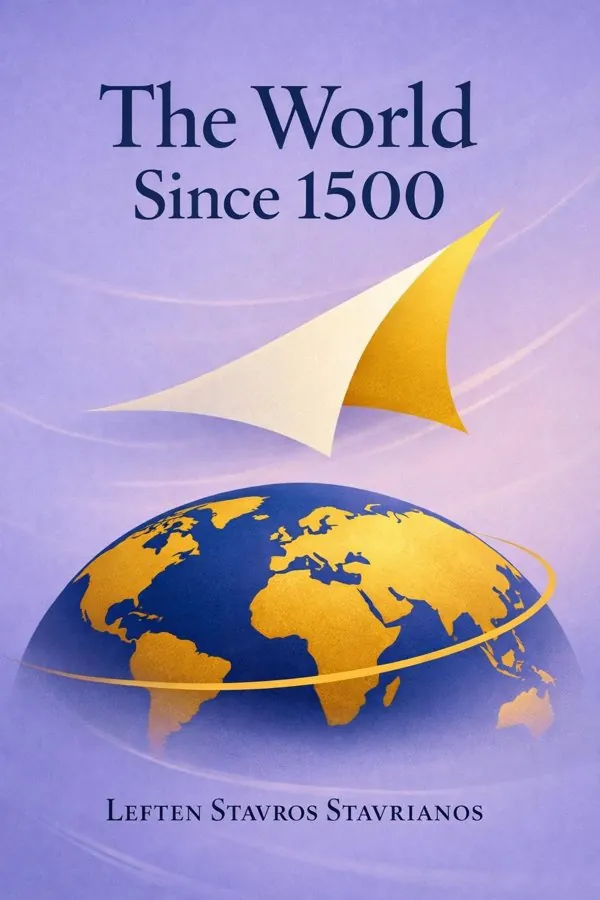
The World Since 1500: Summary & Key Insights
 10 min9 chaptersAudio available
Key Takeaways from The World Since 1500
A powerful way to rethink modern history is to stop seeing it as many separate national stories and start seeing it as one intensifying global process.
Empires rarely expand because they are simply stronger; they expand because circumstances align in ways that let power travel.
Trade connects people, but it does not connect them equally.
Machines do not just transform factories; they transform societies.
Political revolutions matter not only because they overthrow rulers, but because they redefine what people believe rulers owe them.
What Is The World Since 1500 About?
The World Since 1500 by Leften Stavros Stavrianos is a world_history book. The World Since 1500 is a sweeping interpretation of modern global history by historian Leften Stavros Stavrianos, a scholar known for challenging narrow, nation-centered views of the past. Rather than telling history as a simple parade of European achievements, Stavrianos places Europe, Asia, Africa, the Americas, and the Middle East within one interconnected story. He shows how exploration, trade, empire, industrialization, revolution, war, and decolonization reshaped the world after 1500, creating the foundations of modern life. What makes this book matter is its insistence that no region develops in isolation: wealth in one part of the world often depended on labor, resources, and political disruption elsewhere. The book helps readers understand how global inequality emerged, why Western dominance rose, and how resistance and adaptation from non-Western societies shaped world history too. Stavrianos writes with the authority of a major world historian and with a broad, comparative vision that remains strikingly relevant. For readers who want to understand the modern world as a connected system rather than a collection of separate national stories, this book is both illuminating and essential.
This FizzRead summary covers all 9 key chapters of The World Since 1500 in approximately 10 minutes, distilling the most important ideas, arguments, and takeaways from Leften Stavros Stavrianos's work. Also available as an audio summary and Key Quotes Podcast.
The World Since 1500
The World Since 1500 is a sweeping interpretation of modern global history by historian Leften Stavros Stavrianos, a scholar known for challenging narrow, nation-centered views of the past. Rather than telling history as a simple parade of European achievements, Stavrianos places Europe, Asia, Africa, the Americas, and the Middle East within one interconnected story. He shows how exploration, trade, empire, industrialization, revolution, war, and decolonization reshaped the world after 1500, creating the foundations of modern life. What makes this book matter is its insistence that no region develops in isolation: wealth in one part of the world often depended on labor, resources, and political disruption elsewhere. The book helps readers understand how global inequality emerged, why Western dominance rose, and how resistance and adaptation from non-Western societies shaped world history too. Stavrianos writes with the authority of a major world historian and with a broad, comparative vision that remains strikingly relevant. For readers who want to understand the modern world as a connected system rather than a collection of separate national stories, this book is both illuminating and essential.
Who Should Read The World Since 1500?
This book is perfect for anyone interested in world_history and looking to gain actionable insights in a short read. Whether you're a student, professional, or lifelong learner, the key ideas from The World Since 1500 by Leften Stavros Stavrianos will help you think differently.
- ✓Readers who enjoy world_history and want practical takeaways
- ✓Professionals looking to apply new ideas to their work and life
- ✓Anyone who wants the core insights of The World Since 1500 in just 10 minutes
Want the full summary?
Get instant access to this book summary and 100K+ more with Fizz Moment.
Get Free SummaryAvailable on App Store • Free to download
Key Chapters
A powerful way to rethink modern history is to stop seeing it as many separate national stories and start seeing it as one intensifying global process. That is one of the central insights of The World Since 1500. Stavrianos argues that after 1500, the world entered a new era of sustained interconnection. Oceans that once divided civilizations became highways for trade, conquest, migration, and cultural exchange. The result was not simply that regions met one another; it was that their futures became increasingly tied together.
This perspective changes how we interpret familiar events. The so-called Age of Exploration was not merely a tale of brave navigators. It was also the beginning of a world system that linked silver from the Americas, textile markets in Asia, enslaved labor in Africa and the Atlantic, and commercial expansion in Europe. A drought, a war, or a new trade route in one region could now shape livelihoods far away. Modern history, in Stavrianos's telling, is therefore about connection as much as competition.
This idea is especially useful today. When we study inflation, migration, climate stress, supply chains, or international conflict, we are still dealing with the logic of interdependence that accelerated after 1500. The book encourages readers to ask not only what happened in a given country, but what wider networks made that event possible.
A practical application is to examine any major historical event through three lenses: local causes, global connections, and long-term consequences. For example, the Industrial Revolution was not just British innovation; it also relied on colonial markets, imported raw materials, and global shipping networks.
Actionable takeaway: whenever you study a historical event, trace at least two international links behind it to better understand how modern world history actually works.
Empires rarely expand because they are simply stronger; they expand because circumstances align in ways that let power travel. Stavrianos treats European expansion after 1500 not as an inevitable triumph of civilization, but as a historical development shaped by technology, state competition, maritime ambition, and access to external wealth. Europe did not suddenly become superior in every sense. Instead, it learned to project military and commercial power across oceans and to exploit divisions, opportunities, and resources in other parts of the world.
This approach matters because it avoids simplistic narratives. European states gained influence through naval power, commercial organization, gunpowder warfare, and aggressive competition among themselves. But they also depended on non-European goods, knowledge, and labor. American silver fed global trade. Asian markets remained crucial. African societies were forced into devastating entanglements with the slave trade. Expansion was therefore both a European achievement in organization and a global tragedy in human cost.
Stavrianos shows that conquest and commerce often worked together. Trading companies became political powers. Missionary activity accompanied imperial claims. Colonization transformed land ownership, labor systems, and political authority. The balance of world power shifted not just because Europe advanced, but because expansion reorganized the lives of others.
A practical way to use this insight is to question any success story that ignores who paid the price. Modern wealth, infrastructure, and state power often have histories rooted in extraction. This applies not only to old empires but also to contemporary global business practices.
Actionable takeaway: when evaluating the rise of any powerful nation or institution, ask what external resources, labor, or unequal relationships helped make that rise possible.
Trade connects people, but it does not connect them equally. One of Stavrianos's most important arguments is that the growth of global commerce after 1500 integrated the world in ways that often deepened inequality. Regions were drawn into expanding networks of exchange, but they did not all benefit on the same terms. Some became centers of finance, manufacturing, and political coordination, while others were pushed into roles as suppliers of raw materials, plantation crops, precious metals, or cheap labor.
This unequal integration helps explain the emergence of a world economy divided between stronger and weaker positions. Colonies were often reorganized to serve external markets rather than local needs. Farmers shifted from food production to cash crops. Indigenous social systems were disrupted. Local industries in some regions declined when faced with imported manufactured goods backed by imperial power. Trade was not just exchange; it was a structure that shaped development.
The concept still resonates. Today, countries participate in global markets under different conditions of power. Some control capital, shipping, technology, and branding, while others remain dependent on commodity exports or foreign investment. Stavrianos's framework helps readers see that these patterns have deep historical roots.
A practical example is the history of sugar, cotton, or silver. Each commodity linked distant regions, generated enormous profits, and depended on systems of labor and coercion that enriched some while impoverishing others. Looking at a single commodity can reveal the architecture of global inequality.
Actionable takeaway: to understand any modern economic issue, identify where value is created, who captures the profits, and which groups or regions bear the hidden costs.
Machines do not just transform factories; they transform societies. Stavrianos presents industrialization as a turning point that altered economics, politics, class relations, warfare, and global hierarchy. The Industrial Revolution was not simply about invention. It marked the rise of a new social order centered on mechanized production, fossil energy, urban growth, wage labor, and intensified demand for raw materials and markets.
In Europe and later elsewhere, industrialization accelerated productivity and wealth creation. But it also brought harsh working conditions, crowded cities, labor conflict, and massive social dislocation. Traditional craft production declined. Families reorganized around wage work. New classes emerged, especially industrial capitalists and the urban working class. States became more involved in infrastructure, regulation, education, and military modernization.
Globally, industrialization widened the gap between industrial powers and nonindustrial societies. Countries that mastered mechanized production could manufacture goods more cheaply, arm their militaries more effectively, and dominate trade routes. This intensified imperialism in the nineteenth century, as industrial states sought resources such as cotton, coal, rubber, and metals, as well as captive markets for finished goods.
The lesson extends beyond the nineteenth century. Every major technological shift, from electrification to artificial intelligence, changes not only output but also labor patterns, politics, and inequality. Stavrianos encourages us to see technology within broader systems of power.
A useful application is to examine innovation with social questions in mind: Who benefits? Which jobs are displaced? What new dependencies emerge? This prevents us from treating technological change as neutral.
Actionable takeaway: whenever new technology appears, assess its effects on workers, institutions, and global power, not just its efficiency or novelty.
Political revolutions matter not only because they overthrow rulers, but because they redefine what people believe rulers owe them. In The World Since 1500, Stavrianos treats revolutions as moments when old systems of authority were challenged by new ideas about rights, citizenship, sovereignty, and social order. From the Atlantic revolutions to later nationalist and social revolutions, these upheavals did more than change governments. They changed the language of legitimacy itself.
The American and French Revolutions helped spread ideals of popular sovereignty and individual rights, even though those ideals were often applied selectively. The Haitian Revolution exposed the hypocrisy of liberty within slaveholding societies and remains one of the most radical assertions of universal emancipation in modern history. Later revolutions, including those tied to socialism or anti-colonial nationalism, expanded debates about equality, class, land, and economic justice.
Stavrianos encourages readers to notice both promise and contradiction. Revolutionary slogans often inspired oppressed peoples far beyond the place of origin, yet revolutionary states sometimes reproduced exclusion, violence, or authoritarianism. The significance of revolution lies partly in this tension between ideals and reality.
In practical terms, this helps us analyze modern politics more clearly. Whenever leaders invoke democracy, freedom, or national unity, we should ask how those principles are actually distributed. Who counts as part of the people? Whose rights are protected in law but denied in practice?
A useful example is comparing constitutions with lived reality. A country may proclaim equality while maintaining deep racial, class, or gender inequality. Revolutionary ideals remain powerful because they create standards by which institutions can be criticized.
Actionable takeaway: when evaluating any political movement, compare its stated ideals with the social groups that truly gain power, protection, and voice.
No empire rules unopposed, and no conquered society remains unchanged in only one direction. Stavrianos highlights that imperialism generated not just domination but also resistance, accommodation, reform, and creative adaptation across Asia, Africa, the Middle East, and Latin America. Colonized peoples were never passive spectators of history. They fought, negotiated, learned, reorganized, and reimagined their futures under immense pressure.
This is a crucial corrective to histories that focus only on imperial decision-makers. Some societies mounted military resistance. Others pursued state-led modernization to avoid colonization or reduce dependence. Intellectuals debated how to combine local traditions with imported institutions. Religious movements, peasant revolts, labor organizing, and nationalist campaigns all emerged as responses to foreign control and local disruption.
Stavrianos also shows that imperialism changed colonizers as well as colonized. Empire influenced European politics, culture, racial theories, and economic structures. The imperial relationship was asymmetrical, but it was still interactive. Ideas, goods, and people moved in multiple directions, often with unexpected consequences.
This insight remains practical because modern societies still navigate external pressure while trying to preserve autonomy. Smaller states, indigenous communities, and developing economies continue to adapt to more powerful systems without fully surrendering agency. The question is rarely whether outside influence exists; it is how people respond to it.
A concrete example is Meiji Japan, which selectively borrowed Western military and industrial methods while maintaining state cohesion. Other societies pursued different blends of reform and resistance, with varying results.
Actionable takeaway: when examining a society under outside pressure, look for local strategies of adaptation and resistance rather than assuming change was imposed from above alone.
The world wars were not just European catastrophes; they were global turning points that reordered power, economies, and political expectations across continents. Stavrianos presents the two world wars as crises produced by imperial rivalry, industrial militarization, nationalism, and unstable global systems. Their effects reached far beyond battlefields. They shattered old empires, mobilized colonial populations, transformed gender roles, expanded state power, and destabilized claims of European superiority.
World War I weakened dynastic empires and helped unleash revolutions, border disputes, and anti-colonial expectations. World War II went even further. It destroyed vast populations and infrastructure, exposed the horrors of fascism, accelerated the rise of the United States and the Soviet Union, and created conditions for rapid decolonization. Colonized soldiers and workers who had supported imperial war efforts increasingly demanded self-rule. The wars thus intensified contradictions within empire.
Stavrianos's global view is especially helpful because it reveals how wartime mobilization connected regions. Raw materials came from colonies, troops were recruited across empires, and wartime production altered labor relations worldwide. The wars were global in causes, participation, and consequences.
This perspective also clarifies contemporary geopolitics. Many current borders, institutions, and alliances were shaped directly by the world wars and their aftermath. The United Nations, Cold War blocs, and postwar development strategies all emerged from this era.
A practical application is to study major conflicts by asking how they transform civilian life, state institutions, and international hierarchy, not only military outcomes. War often reorganizes society long after peace treaties are signed.
Actionable takeaway: when analyzing any conflict, track its political and social aftereffects, since wars often reshape the world most deeply after the fighting ends.
Political independence can arrive long before economic freedom. Stavrianos emphasizes that decolonization in the twentieth century was a monumental achievement, but it did not automatically dismantle the unequal structures created by centuries of imperial rule. New nations won sovereignty, flags, and formal control over government, yet many remained tied to old patterns of trade, debt, military influence, and technological dependence.
This distinction between political liberation and structural independence is one of the book's most enduring insights. Colonial economies had often been designed around extraction and export. Infrastructure served ports and plantations rather than balanced domestic development. Education systems could be limited, industrial capacity weak, and borders artificial. After independence, leaders inherited states that were formally sovereign but often fragile.
Stavrianos suggests that the postcolonial world cannot be understood without recognizing these constraints. Development struggles were not simply failures of leadership, though leadership mattered. They were also the result of historical structures that favored former imperial centers and new superpowers. The Cold War further complicated matters, as newly independent states became arenas of ideological competition.
This framework remains highly relevant when discussing aid, debt, foreign investment, and development policy today. It reminds us that inequality between nations is not natural or recent; it is historically produced. A country may be independent on paper while constrained in finance, trade, technology, or security.
A practical example is comparing export dependence in former colonies. Nations reliant on one or two commodities often faced unstable prices and limited room for autonomous planning.
Actionable takeaway: when considering development challenges, distinguish between formal sovereignty and real control over economic priorities, resources, and long-term policy choices.
The present often looks confusing because we treat it as new when it is actually layered with history. One of the broad lessons of The World Since 1500 is that many modern problems, including inequality, racial hierarchies, uneven development, nationalism, and geopolitical rivalry, were shaped over centuries of global interaction. Stavrianos does not reduce the present to the past, but he insists that current crises become more understandable when viewed in historical depth.
For instance, racial ideologies did not emerge in a vacuum. They developed alongside slavery, conquest, and imperial administration. Global wealth disparities reflect long histories of extraction, industrial advantage, and unequal exchange. National borders in many regions reflect imperial decisions rather than cultural coherence. Even debates about modernization, identity, and Western influence are rooted in encounters that intensified after 1500.
This long-view method is practical because it improves judgment. It discourages simplistic explanations that blame current conditions on culture alone or on recent policy alone. Instead, it invites layered thinking: immediate events matter, but they operate within structures formed across generations.
A useful habit is to ask historical questions about contemporary issues. Why is this region economically vulnerable? Why does this conflict involve these boundaries? Why is this social division so persistent? The answers often reach far back into empire, trade systems, industrialization, or revolutionary change.
Stavrianos ultimately teaches readers to see history as a tool for orientation. Understanding how the modern world was made helps us think more clearly about how it might be remade.
Actionable takeaway: when confronting a current global issue, trace its origins across at least one century to uncover forces that short-term analysis might miss.
All Chapters in The World Since 1500
About the Author
Leften Stavros Stavrianos was an influential twentieth-century historian known for helping shape the field of world history. Born in Canada to Greek immigrant parents, he built an academic career that emphasized broad, comparative interpretations of the past rather than narrow national narratives. He taught at institutions including Northwestern University and became widely recognized for works that challenged Eurocentric historical frameworks. Stavrianos argued that modern history must be understood through global interconnections involving empire, trade, industrialization, and cultural exchange. His writing reached both academic and general audiences because he combined scholarly depth with clear, synthetic analysis. He remains best known for presenting world history as a dynamic, interconnected story in which non-Western societies played central roles alongside Europe.
Get This Summary in Your Preferred Format
Read or listen to the The World Since 1500 summary by Leften Stavros Stavrianos anytime, anywhere. FizzRead offers multiple formats so you can learn on your terms — all free.
Available formats: App · Audio · PDF · EPUB — All included free with FizzRead
Download The World Since 1500 PDF and EPUB Summary
Key Quotes from The World Since 1500
“A powerful way to rethink modern history is to stop seeing it as many separate national stories and start seeing it as one intensifying global process.”
“Empires rarely expand because they are simply stronger; they expand because circumstances align in ways that let power travel.”
“Trade connects people, but it does not connect them equally.”
“Machines do not just transform factories; they transform societies.”
“Political revolutions matter not only because they overthrow rulers, but because they redefine what people believe rulers owe them.”
Frequently Asked Questions about The World Since 1500
The World Since 1500 by Leften Stavros Stavrianos is a world_history book that explores key ideas across 9 chapters. The World Since 1500 is a sweeping interpretation of modern global history by historian Leften Stavros Stavrianos, a scholar known for challenging narrow, nation-centered views of the past. Rather than telling history as a simple parade of European achievements, Stavrianos places Europe, Asia, Africa, the Americas, and the Middle East within one interconnected story. He shows how exploration, trade, empire, industrialization, revolution, war, and decolonization reshaped the world after 1500, creating the foundations of modern life. What makes this book matter is its insistence that no region develops in isolation: wealth in one part of the world often depended on labor, resources, and political disruption elsewhere. The book helps readers understand how global inequality emerged, why Western dominance rose, and how resistance and adaptation from non-Western societies shaped world history too. Stavrianos writes with the authority of a major world historian and with a broad, comparative vision that remains strikingly relevant. For readers who want to understand the modern world as a connected system rather than a collection of separate national stories, this book is both illuminating and essential.
You Might Also Like
The Age of Capital
Eric Hobsbawm
10 min
The Gulag Archipelago
Aleksandr Solzhenitsyn
10 min
Jerusalem: The Biography
Simon Sebag Montefiore
10 min
The Anglo-Saxons
James Campbell
10 min
The Boer War
Thomas Pakenham
10 min
The Industrial Revolutionaries: The Making of the Modern World 1776–1914
Gavin Weightman
10 minBrowse by Category
Ready to read The World Since 1500?
Get the full summary and 100K+ more books with Fizz Moment.