
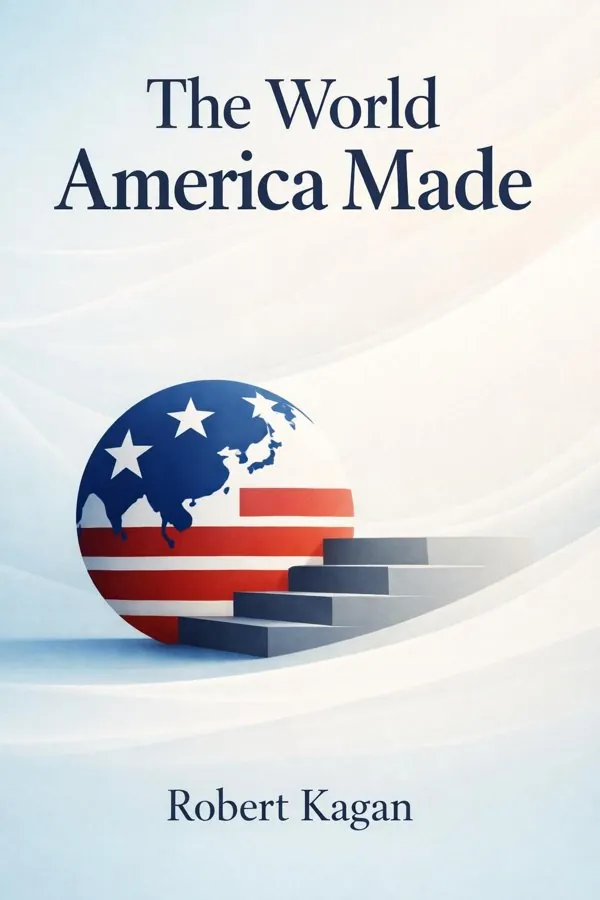
The World America Made: Summary & Key Insights
by Robert Kagan
 10 min11 chaptersAudio available
What Is The World America Made About?
The World America Made by Robert Kagan is a politics book spanning 11 pages. In this concise and influential work, Robert Kagan argues that the liberal world order established after World War II was not inevitable but rather the product of American power and leadership. He contends that the decline of U.S. influence could lead to a less free and more unstable world. The book explores the historical and philosophical foundations of American global engagement and challenges the notion of inevitable decline, urging readers to reconsider the role of the United States in maintaining international order.
This FizzRead summary covers all 11 key chapters of The World America Made in approximately 10 minutes, distilling the most important ideas, arguments, and takeaways from Robert Kagan's work. Also available as an audio summary and Key Quotes Podcast.
The World America Made
In this concise and influential work, Robert Kagan argues that the liberal world order established after World War II was not inevitable but rather the product of American power and leadership. He contends that the decline of U.S. influence could lead to a less free and more unstable world. The book explores the historical and philosophical foundations of American global engagement and challenges the notion of inevitable decline, urging readers to reconsider the role of the United States in maintaining international order.
Who Should Read The World America Made?
This book is perfect for anyone interested in politics and looking to gain actionable insights in a short read. Whether you're a student, professional, or lifelong learner, the key ideas from The World America Made by Robert Kagan will help you think differently.
- ✓Readers who enjoy politics and want practical takeaways
- ✓Professionals looking to apply new ideas to their work and life
- ✓Anyone who wants the core insights of The World America Made in just 10 minutes
Want the full summary?
Get instant access to this book summary and 100K+ more with Fizz Moment.
Get Free SummaryAvailable on App Store • Free to download
Key Chapters
In the aftermath of World War II, the world stood not at a crossroads, but at a vacuum. The old empires lay in ruin. Europe was devastated, Asia equally shattered. It was in this moment that the United States, uniquely strong both economically and militarily, chose to fill that vacuum—not by conquest, but by construction. Washington under Harry Truman set out to design institutions, from the United Nations to the Bretton Woods system, that would embed liberal principles into the architecture of global governance.
This was not altruism disguised as policy; it was political realism linked with moral vision. The United States, faced with the lessons of depression and fascism, understood that isolation breeds instability. The choice to intervene, to shape a world compatible with American values, was born of necessity and idealism intertwined.
Through the Marshall Plan, Western Europe was rebuilt as a zone of democratic stability. Through the North Atlantic Treaty Organization, collective defense replaced the precarious balance of powers that had previously led to catastrophe. In Asia, a similar logic unfolded—first with Japan’s reconstruction, later with the protection of democratic allies in Korea and Taiwan. What united these efforts was a consistent belief that open societies and free economies could form the backbone of a peaceful world.
That world took root. For decades, the United States served not as a benign overseer but as a constant presence, underwriting security, enforcing norms, and promoting liberalization. American leadership was not a chapter in the story of decline; it was the foundation upon which modern prosperity and democracy were built. Without that leadership, history—so given to regression toward chaos—might easily have rewritten itself.
The world order that emerged after 1945 did not float free from the gravity of power—it was shaped, defined, and maintained by it. Historically, every global order has reflected the preferences of the dominant power at the time. The Pax Britannica of the nineteenth century mirrored British commercial and maritime interests. The world of the Cold War mirrored American and Soviet ideologies locked in contest. But the liberal international order of the late twentieth century was singular because it embodied the values of liberal democracy.
The United States, through its military reach and economic capacity, created an environment where conflict was not inevitable. American alliances deterred aggression; American markets absorbed global goods; American culture broadcast ideals of individual liberty. None of these forces were inevitable—they were byproducts of deliberate choice backed by sustained capability.
Critics often imagine that ideology alone can sustain freedom. But without power, ideals wither. The ability to project influence—to deter enemies, reassure friends, and stabilize trade—was intrinsic to the system’s survival. When people speak of the “liberal international order,” they often forget the adjective hidden beneath its apparent neutrality: American. The institutions that govern trade, security, and diplomacy reflect American design. They function because the United States has been willing to bear the costs other nations could not.
In short, American power has not just protected freedom—it has produced it. The order we inhabit is both a moral achievement and a strategic reality, and it will endure only as long as the United States continues to believe that global stability and democratic openness are worth defending.
+ 9 more chapters — available in the FizzRead app
All Chapters in The World America Made
About the Author
Robert Kagan is an American historian, political commentator, and senior fellow at the Brookings Institution. Known for his writings on U.S. foreign policy and international relations, he has advised several U.S. administrations and authored influential works such as 'Of Paradise and Power' and 'Dangerous Nation.'
Get This Summary in Your Preferred Format
Read or listen to the The World America Made summary by Robert Kagan anytime, anywhere. FizzRead offers multiple formats so you can learn on your terms — all free.
Available formats: App · Audio · PDF · EPUB — All included free with FizzRead
Download The World America Made PDF and EPUB Summary
Key Quotes from The World America Made
“In the aftermath of World War II, the world stood not at a crossroads, but at a vacuum.”
“The world order that emerged after 1945 did not float free from the gravity of power—it was shaped, defined, and maintained by it.”
Frequently Asked Questions about The World America Made
The World America Made by Robert Kagan is a politics book that explores key ideas across 11 chapters. In this concise and influential work, Robert Kagan argues that the liberal world order established after World War II was not inevitable but rather the product of American power and leadership. He contends that the decline of U.S. influence could lead to a less free and more unstable world. The book explores the historical and philosophical foundations of American global engagement and challenges the notion of inevitable decline, urging readers to reconsider the role of the United States in maintaining international order.
More by Robert Kagan
You Might Also Like
Antifa: The Anti-Fascist Handbook
Mark Bray
10 min
Attack from Within: How Disinformation Is Sabotaging America
Barbara McQuade
10 min
Coercion, Capital, and European States, AD 990–1992
Charles Tilly
10 min
Digital Democracy: Concepts, Methodologies, Tools, and Applications
Various Authors
10 min
Fascism
Stanley G. Payne
10 min
Fire And Fury: Inside The Trump White House
Michael Wolff
10 minBrowse by Category
Ready to read The World America Made?
Get the full summary and 100K+ more books with Fizz Moment.