
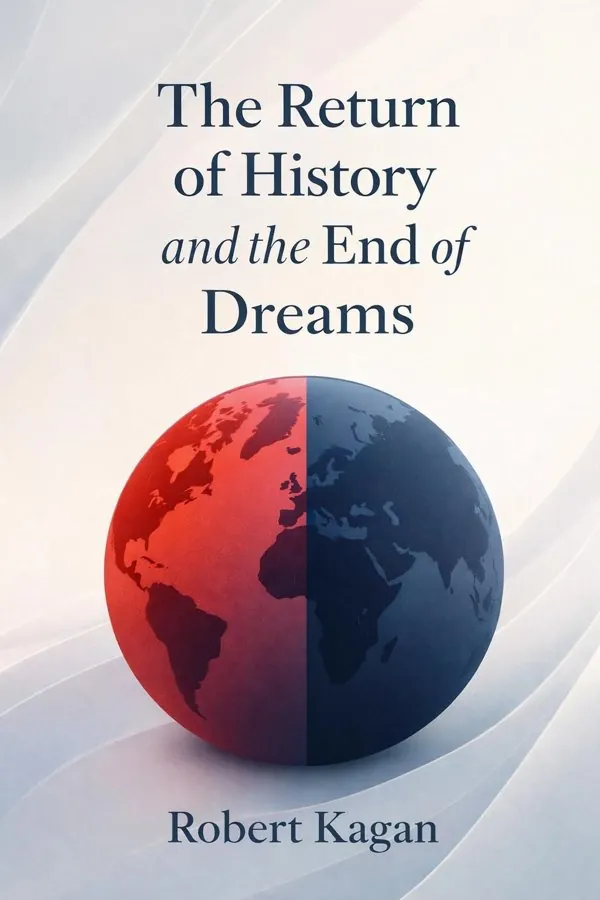
The Return of History and the End of Dreams: Summary & Key Insights
by Robert Kagan
 10 min9 chaptersAudio available
Key Takeaways from The Return of History and the End of Dreams
Victories in history often tempt societies into believing that struggle itself is over.
Political systems do not vanish just because they lose one great battle.
States rarely compete for power alone; they also compete over ideas about how societies should be organized.
Great powers rarely accept decline quietly.
Economic growth does not automatically produce political liberalization.
What Is The Return of History and the End of Dreams About?
The Return of History and the End of Dreams by Robert Kagan is a politics book spanning 9 pages. In The Return of History and the End of Dreams, Robert Kagan challenges one of the most comforting assumptions of the post-Cold War age: that liberal democracy had won the final argument in human politics. Instead of a world steadily converging toward freedom, markets, and peace, Kagan sees a harsher reality reemerging—one shaped by rivalry, nationalism, military power, and ideological conflict. Authoritarian states, far from fading away, have adapted, strengthened themselves, and begun contesting the influence of democratic powers on a global scale. What makes this book matter is not only its diagnosis of the early 21st century, but its warning against complacency. Kagan argues that history did not end when the Soviet Union collapsed. The old struggle between liberal and authoritarian systems continued, only under new conditions and with new players. His analysis helps readers make sense of Russia’s aggression, China’s rise, Europe’s uncertainty, and America’s central role in preserving a liberal international order. As a historian, policy thinker, and longtime commentator on U.S. foreign affairs, Kagan brings authority, clarity, and strategic urgency to this concise but influential work.
This FizzRead summary covers all 9 key chapters of The Return of History and the End of Dreams in approximately 10 minutes, distilling the most important ideas, arguments, and takeaways from Robert Kagan's work. Also available as an audio summary and Key Quotes Podcast.
The Return of History and the End of Dreams
In The Return of History and the End of Dreams, Robert Kagan challenges one of the most comforting assumptions of the post-Cold War age: that liberal democracy had won the final argument in human politics. Instead of a world steadily converging toward freedom, markets, and peace, Kagan sees a harsher reality reemerging—one shaped by rivalry, nationalism, military power, and ideological conflict. Authoritarian states, far from fading away, have adapted, strengthened themselves, and begun contesting the influence of democratic powers on a global scale.
What makes this book matter is not only its diagnosis of the early 21st century, but its warning against complacency. Kagan argues that history did not end when the Soviet Union collapsed. The old struggle between liberal and authoritarian systems continued, only under new conditions and with new players. His analysis helps readers make sense of Russia’s aggression, China’s rise, Europe’s uncertainty, and America’s central role in preserving a liberal international order.
As a historian, policy thinker, and longtime commentator on U.S. foreign affairs, Kagan brings authority, clarity, and strategic urgency to this concise but influential work.
Who Should Read The Return of History and the End of Dreams?
This book is perfect for anyone interested in politics and looking to gain actionable insights in a short read. Whether you're a student, professional, or lifelong learner, the key ideas from The Return of History and the End of Dreams by Robert Kagan will help you think differently.
- ✓Readers who enjoy politics and want practical takeaways
- ✓Professionals looking to apply new ideas to their work and life
- ✓Anyone who wants the core insights of The Return of History and the End of Dreams in just 10 minutes
Want the full summary?
Get instant access to this book summary and 100K+ more with Fizz Moment.
Get Free SummaryAvailable on App Store • Free to download
Key Chapters
Victories in history often tempt societies into believing that struggle itself is over. After the collapse of the Soviet Union, many Western thinkers concluded that liberal democracy had not merely defeated communism, but had proven itself the natural end point of political development. Free markets spread, democratic institutions expanded, and globalization appeared to bind states together in a shared interest in peace and prosperity. It was a hopeful vision, and for a time it seemed persuasive.
Kagan argues that this confidence was less a timeless truth than a brief historical mood. The apparent universal march toward liberalism depended on a specific balance of power, especially American strength and the weakness of rival systems after the Cold War. Many observers mistook a temporary geopolitical advantage for a permanent transformation in human affairs. They assumed that authoritarianism would slowly soften under the pressures of trade, modernization, and integration into the global economy.
But political systems are not erased so easily. Nations do not give up ambition, fear, pride, or the desire for control simply because markets expand. A government can adopt capitalist tools while remaining fiercely authoritarian. A society can become wealthier without becoming freer. Post-Cold War optimism overlooked how deeply power, identity, and ideology continue to shape international behavior.
A practical application of Kagan’s insight is to be skeptical of narratives that declare major political questions “settled.” Whether in foreign policy, business, or social life, today’s consensus can become tomorrow’s blind spot. Progress is real, but it is rarely irreversible.
Actionable takeaway: Treat periods of peace and convergence as achievements to be defended, not as permanent conditions guaranteed by history.
States rarely compete for power alone; they also compete over ideas about how societies should be organized. Kagan rejects the notion that the modern world is post-ideological. He argues that the rivalry between democracies and authoritarian regimes is not merely a clash of interests, but also a contest between political visions. Regimes that centralize power, suppress dissent, and subordinate law to rulers do not view liberal democracy as a neutral alternative. They often see it as a threat to their legitimacy.
This matters because ideology shapes how governments interpret events. A liberal democracy may believe international institutions can mediate conflict because it trusts rules and accountability. An authoritarian state may view those same institutions instrumentally, using them when convenient and disregarding them when they obstruct strategic goals. Likewise, democratic support for civil society or free media abroad may be viewed by authoritarian governments as hostile interference, because free institutions weaken centralized control.
Kagan’s insight helps explain why economic interdependence alone cannot erase strategic tension. Countries may trade heavily while still distrusting each other’s values and intentions. Shared prosperity does not eliminate ideological insecurity. In fact, prosperity can give regimes more resources to export influence, fund propaganda, and support allies who share their governing model.
In everyday terms, people often underestimate how deeply beliefs shape behavior. Two organizations may pursue the same market but operate by radically different norms. One values transparency and rules; the other rewards secrecy and personal loyalty. Conflict between them will reflect not only competition for resources but disagreement over how power should be used.
Actionable takeaway: In international affairs, never separate power from political ideas; understanding both is essential to understanding behavior.
Great powers rarely accept decline quietly. Kagan describes Russia’s resurgence as a reminder that national humiliation, strategic opportunity, and concentrated authority can revive a state that outsiders had written off. In the 1990s, Russia looked weak, unstable, and likely to integrate gradually into a Western-led order. But under new leadership, rising energy revenues, centralization of power, and resentment over lost status combined to produce a more assertive foreign policy.
Kagan emphasizes that Russia’s revival was not only material but psychological. The Kremlin drew on narratives of encirclement, betrayal, and historical greatness to justify a harder line at home and abroad. Democracy was portrayed as disorder; Western influence as manipulation; restored state power as national recovery. This fusion of grievance and ambition helped legitimize authoritarian rule while energizing external confrontation.
The broader point is that weakness can be temporary, but the desire for influence endures. States with long imperial histories often retain strategic memories and symbolic ambitions that survive even after military or economic decline. If favorable conditions return—resource wealth, elite cohesion, weakened rivals—they may seek to revise settlements they never fully accepted.
A practical example is the danger of assuming that a crisis-ridden country is no longer strategically relevant. Investors, policymakers, and citizens often focus on current dysfunction while ignoring long-term capabilities: geography, military assets, national identity, and leadership intent. Those factors can reassert themselves quickly.
Actionable takeaway: Evaluate rising threats not only by present weakness but by the historical ambitions, resources, and narratives that could fuel a rapid return to power.
Economic growth does not automatically produce political liberalization. Few developments illustrate Kagan’s warning more clearly than China’s rise. For years, many in the West believed that integrating China into global trade would gradually transform it into a more open, cooperative, and perhaps eventually democratic society. Instead, China demonstrated that a state could embrace markets selectively, become deeply embedded in the world economy, and still preserve tight political control.
Kagan sees this as a historic challenge to liberal expectations. China’s success offered an alternative model: prosperity without pluralism, modernization without democratization, global participation without political convergence with the West. That model had implications far beyond China itself. It suggested to other regimes that economic development need not require surrendering one-party rule or centralized authority.
At the same time, growing wealth enabled strategic ambition. Economic power translated into military modernization, diplomatic reach, technological influence, and greater confidence in shaping regional and global norms. A richer China could pursue long-term goals more effectively, whether in territorial disputes, international institutions, or influence operations abroad.
Kagan’s insight is useful for anyone analyzing large systems. When a model appears to succeed on its own terms, it attracts imitators—even if it carries deep internal contradictions. Organizations, governments, and leaders may adopt visible features of success while overlooking hidden costs.
The key lesson is to judge systems by more than their output. Growth rates and infrastructure projects matter, but so do accountability, freedom, resilience, and how power is constrained. A society’s strength cannot be measured only by its speed.
Actionable takeaway: Do not assume that economic integration makes political values converge; examine whether prosperity is reinforcing openness or empowering control.
Order in international politics does not sustain itself through goodwill alone. Kagan argues that the liberal world created after World War II depended heavily on American power—military, economic, and political. Many people came to enjoy the benefits of that order while forgetting its foundation. Open trade routes, stable alliances, deterrence against aggressors, and support for democratic norms were not spontaneous outcomes of progress. They were, in large part, underwritten by U.S. commitment.
This is one of Kagan’s most provocative claims because it challenges the idea that the United States is merely one nation among many in a self-regulating international system. He contends that when America retreats, rival powers do not politely preserve the status quo. They test boundaries, exploit divisions, and push for regional or global arrangements more favorable to their interests and values.
Kagan does not present American leadership as morally flawless or cost-free. Rather, he insists on its structural importance. A world without active U.S. engagement is not likely to become neutral; it is more likely to become contested. The question is not whether power will shape order, but whose power and to what ends.
The practical application is broader than foreign policy. In any institution, the absence of responsible leadership rarely creates harmony by itself. It often creates vacuums that others rush to fill. If you value a certain culture or set of rules, you cannot assume they will persist without active maintenance.
Actionable takeaway: If a stable order aligns with your values, support the leadership, alliances, and commitments required to preserve it rather than assuming it will endure on inertia alone.
Peace can reshape a continent’s psychology—but it can also produce dangerous illusions. Kagan highlights Europe’s dilemma as the tension between its admirable postwar success and its tendency to universalize its own experience. Having transformed a once-violent region into a zone of cooperation, law, and integration, many Europeans came to see history itself as moving in their direction. Military power appeared less central, sovereignty seemed increasingly negotiable, and economics looked more decisive than geopolitics.
Kagan suggests that this perspective, while understandable, became harder to sustain in a world where other powers had not internalized the same lessons. Europe could prefer negotiation, interdependence, and legal frameworks, but it still existed in a broader system where states such as Russia and China continued to think in traditional strategic terms. The European project reduced conflict internally, yet it did not eliminate external threats.
This creates a recurring problem: how to preserve a post-national ideal in a world that remains partly national and competitive. Europe often relies on American hard power while emphasizing civilian influence, diplomacy, and economic leverage. That division can work in favorable conditions, but it becomes strained when adversaries exploit military asymmetries, energy dependence, or political fragmentation.
The lesson applies to organizations and communities that become victims of their own success. When a group builds trust internally, it may underestimate actors outside that trust framework. Good norms are valuable, but they do not substitute for preparedness.
Actionable takeaway: Hold on to cooperative ideals, but pair them with realistic assessments of external power and the capabilities needed to protect what you have built.
History often changes costume before it changes character. Kagan’s broader argument is that the international system after the Cold War looked unusually calm not because competition had disappeared, but because one side temporarily lacked the strength to resist the prevailing order. As other powers regained confidence, strategic rivalry reemerged in familiar forms: military buildups, regional influence contests, ideological positioning, proxy relationships, and pressure on weaker states.
What makes modern competition different is not its disappearance but its expanded toolkit. States now compete through energy supplies, cyber operations, infrastructure finance, information campaigns, technological standards, and control over global institutions, as well as through armies and navies. This can make rivalry less visible to publics who expect conflict to look like formal war. Yet the struggle for influence is no less real.
Kagan warns against the seductive belief that commerce neutralizes power politics. Trade can raise the costs of conflict, but it can also create dependencies that stronger states exploit. Investments can build mutual benefit, but they can also create leverage. Institutions can coordinate cooperation, but they can also become arenas for competition over rules and legitimacy.
For readers, this idea is especially useful because it sharpens pattern recognition. If a supposedly peaceful era begins showing repeated coercion, intimidation, and strategic manipulation, it may not be an anomaly—it may be a sign that underlying competition was always present.
Actionable takeaway: Learn to recognize competition in its modern forms, especially where economics, technology, and information are being used as instruments of political power.
Hope is not a strategy, and Kagan’s title captures that truth with unsettling force. The “end of dreams” does not mean abandoning ideals like democracy, liberty, or international cooperation. It means abandoning the illusion that these ideals spread automatically or survive without defense. Kagan calls readers back to a more sober understanding of politics: free societies must be willing to recognize threats, make choices, bear costs, and defend the order they prefer.
The policy implications are significant. Democracies should strengthen alliances rather than neglect them. They should invest in deterrence rather than assuming trade alone will pacify rivals. They should support democratic resilience at home and abroad, recognizing that internal weakness invites external pressure. And they should stop treating authoritarian assertiveness as a temporary deviation from an inevitable liberal future.
Importantly, realism in Kagan’s sense is not cynicism. He does not argue that values are irrelevant; he argues that values require power. Liberal order is not self-executing. It survives when democratic societies combine moral confidence with strategic seriousness. Without that combination, authoritarian states gain room to shape the world in ways hostile to freedom.
This lesson applies personally as well. Whether in leadership, institutions, or civic life, good outcomes depend on active stewardship. If you care about a principle, you must organize around it, invest in it, and protect it under pressure.
Actionable takeaway: Replace passive optimism with disciplined vigilance—identify what you want to preserve, then build the capabilities and coalitions needed to defend it.
All Chapters in The Return of History and the End of Dreams
About the Author
Robert Kagan is an American historian, author, and foreign policy analyst known for his influential writing on international relations and U.S. global leadership. He has been a senior fellow at the Brookings Institution and has long contributed to debates about democracy, power, and the liberal international order. Kagan first gained broad attention for his arguments that military strength and strategic resolve remain essential in world politics, even in eras shaped by globalization and diplomacy. He has advised policymakers, written extensively for major publications, and played a prominent role in shaping discussions about American foreign policy after the Cold War. His work consistently explores the tension between liberal ideals and geopolitical realities, making him one of the most recognizable interpreters of modern power politics.
Get This Summary in Your Preferred Format
Read or listen to the The Return of History and the End of Dreams summary by Robert Kagan anytime, anywhere. FizzRead offers multiple formats so you can learn on your terms — all free.
Available formats: App · Audio · PDF · EPUB — All included free with FizzRead
Download The Return of History and the End of Dreams PDF and EPUB Summary
Key Quotes from The Return of History and the End of Dreams
“Victories in history often tempt societies into believing that struggle itself is over.”
“Political systems do not vanish just because they lose one great battle.”
“States rarely compete for power alone; they also compete over ideas about how societies should be organized.”
“Great powers rarely accept decline quietly.”
“Economic growth does not automatically produce political liberalization.”
Frequently Asked Questions about The Return of History and the End of Dreams
The Return of History and the End of Dreams by Robert Kagan is a politics book that explores key ideas across 9 chapters. In The Return of History and the End of Dreams, Robert Kagan challenges one of the most comforting assumptions of the post-Cold War age: that liberal democracy had won the final argument in human politics. Instead of a world steadily converging toward freedom, markets, and peace, Kagan sees a harsher reality reemerging—one shaped by rivalry, nationalism, military power, and ideological conflict. Authoritarian states, far from fading away, have adapted, strengthened themselves, and begun contesting the influence of democratic powers on a global scale. What makes this book matter is not only its diagnosis of the early 21st century, but its warning against complacency. Kagan argues that history did not end when the Soviet Union collapsed. The old struggle between liberal and authoritarian systems continued, only under new conditions and with new players. His analysis helps readers make sense of Russia’s aggression, China’s rise, Europe’s uncertainty, and America’s central role in preserving a liberal international order. As a historian, policy thinker, and longtime commentator on U.S. foreign affairs, Kagan brings authority, clarity, and strategic urgency to this concise but influential work.
More by Robert Kagan
You Might Also Like
Antifa: The Anti-Fascist Handbook
Mark Bray
10 min
Attack from Within: How Disinformation Is Sabotaging America
Barbara McQuade
10 min
Coercion, Capital, and European States, AD 990–1992
Charles Tilly
10 min
Digital Democracy: Concepts, Methodologies, Tools, and Applications
Various Authors
10 min
Fascism
Stanley G. Payne
10 min
Fire And Fury: Inside The Trump White House
Michael Wolff
10 minBrowse by Category
Ready to read The Return of History and the End of Dreams?
Get the full summary and 100K+ more books with Fizz Moment.