
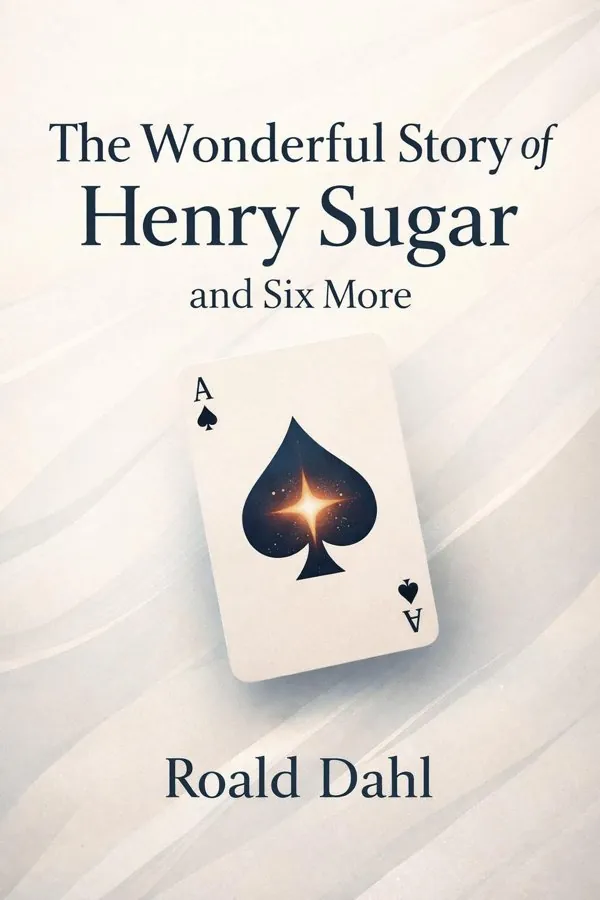
The Wonderful Story of Henry Sugar and Six More: Summary & Key Insights
by Roald Dahl
 10 min8 chapters
Key Takeaways from The Wonderful Story of Henry Sugar and Six More
A person’s character is often revealed in the moment they stand against what everyone else accepts.
Some of life’s most revealing encounters happen in motion, between strangers who owe each other nothing.
The past does not disappear; it waits for someone to uncover it and recognize its value.
One of Dahl’s darkest truths is that evil does not always arrive in grand, dramatic form.
The title story asks a question that reaches far beyond fantasy: what happens when a gifted but empty person discovers a power that demands real discipline?
What Is The Wonderful Story of Henry Sugar and Six More About?
The Wonderful Story of Henry Sugar and Six More by Roald Dahl is a classics book spanning 7 pages. The Wonderful Story of Henry Sugar and Six More is one of Roald Dahl’s richest collections: seven stories that mix wonder, cruelty, comedy, danger, memory, and moral surprise. At first glance, the pieces seem wildly different. One follows a rich bachelor who learns an impossible skill; another captures a boy’s desperate attempt to save a sea turtle; others revisit buried treasure, casual violence, wartime survival, and the strange accidents that shape a writer’s life. Yet together they reveal Dahl’s deepest gift: his ability to uncover the extraordinary lurking beneath everyday reality. What makes this collection endure is not only its inventiveness, but its emotional range. Dahl writes with the pace of an entertainer, the eye of a journalist, and the sharp instinct of a moral storyteller. He can be playful one moment and devastating the next. The result is a book that invites readers to ask difficult questions: What do we do with talent? How easily can cruelty become normal? When does luck become destiny? And can wonder make us better people? For readers who know Dahl only through his children’s novels, this collection offers a fuller picture of his power, precision, and humanity.
This FizzRead summary covers all 8 key chapters of The Wonderful Story of Henry Sugar and Six More in approximately 10 minutes, distilling the most important ideas, arguments, and takeaways from Roald Dahl's work.
The Wonderful Story of Henry Sugar and Six More
The Wonderful Story of Henry Sugar and Six More is one of Roald Dahl’s richest collections: seven stories that mix wonder, cruelty, comedy, danger, memory, and moral surprise. At first glance, the pieces seem wildly different. One follows a rich bachelor who learns an impossible skill; another captures a boy’s desperate attempt to save a sea turtle; others revisit buried treasure, casual violence, wartime survival, and the strange accidents that shape a writer’s life. Yet together they reveal Dahl’s deepest gift: his ability to uncover the extraordinary lurking beneath everyday reality.
What makes this collection endure is not only its inventiveness, but its emotional range. Dahl writes with the pace of an entertainer, the eye of a journalist, and the sharp instinct of a moral storyteller. He can be playful one moment and devastating the next. The result is a book that invites readers to ask difficult questions: What do we do with talent? How easily can cruelty become normal? When does luck become destiny? And can wonder make us better people? For readers who know Dahl only through his children’s novels, this collection offers a fuller picture of his power, precision, and humanity.
Who Should Read The Wonderful Story of Henry Sugar and Six More?
This book is perfect for anyone interested in classics and looking to gain actionable insights in a short read. Whether you're a student, professional, or lifelong learner, the key ideas from The Wonderful Story of Henry Sugar and Six More by Roald Dahl will help you think differently.
- ✓Readers who enjoy classics and want practical takeaways
- ✓Professionals looking to apply new ideas to their work and life
- ✓Anyone who wants the core insights of The Wonderful Story of Henry Sugar and Six More in just 10 minutes
Want the full summary?
Get instant access to this book summary and 100K+ more with Fizz Moment.
Get Free SummaryAvailable on App Store • Free to download
Key Chapters
A person’s character is often revealed in the moment they stand against what everyone else accepts. In “The Boy Who Talked with Animals,” Dahl places readers on a bright Caribbean beach where a sea turtle has been dragged ashore by fishermen and surrounded by spectators. What should be shocking has become entertainment. The cruelty is casual, public, and normalized. Against this backdrop stands David, a young boy whose horror is immediate and pure. He sees not a spectacle, but a living creature in pain.
The story works because Dahl contrasts childhood moral clarity with adult moral laziness. The adults are not cartoon villains; they are worse in a way, because they are ordinary people who have stopped noticing suffering. David’s response suggests that empathy is not weakness or naivete. It is a more truthful way of seeing. He senses the turtle’s dignity and, in the story’s suggestive magical undertone, may even communicate with it. Whether readers interpret this literally or symbolically, the point remains the same: compassion requires imagination. We must be able to enter another being’s vulnerability.
In practical life, this idea applies whenever harmful behavior is disguised as tradition, humor, efficiency, or business as usual. A child being bullied, an animal being mistreated, or a colleague being mocked in a meeting often draws passive witnesses rather than defenders. Dahl reminds us that conscience usually begins with discomfort: the feeling that something everyone else accepts is actually wrong.
The actionable takeaway is simple: when you see suffering being normalized, do not wait for the crowd to change first. Name what is happening, protect the vulnerable if you can, and trust the moral instinct that tells you cruelty is never harmless.
Some of life’s most revealing encounters happen in motion, between strangers who owe each other nothing. “The Hitchhiker” begins as a comic roadside episode: a driver picks up a chatty passenger, and the conversation gradually turns from ordinary small talk to something stranger and more impressive. The hitchhiker is not what he first appears to be. Underneath his rough manners and theatrical language lies extraordinary skill, quick perception, and a philosophy of survival shaped by the edges of society.
Dahl uses this setup to explore how easily we misjudge people by appearance, accent, class, or profession. The polished driver assumes he is in control because he owns the car, occupies the respectable role, and understands the rules of the road. Yet the hitchhiker possesses a different kind of mastery: nimble hands, improvisational wit, and street-level intelligence. When trouble arrives in the form of authority, the balance shifts. Respectability and legality do not necessarily equal competence.
The story is funny, but its lesson is sharp. Social systems reward certain types of intelligence while dismissing others. We tend to admire credentials, manners, and polish, while overlooking adaptability, observation, and practical cunning. In everyday life, this matters in interviews, negotiations, and first meetings. The quiet person at the table may understand more than the loudest expert. The unconventional worker may solve a problem the formal process cannot.
Dahl does not ask us to romanticize lawbreaking. Instead, he urges us to look more carefully at human capability and at the hidden hierarchies behind our assumptions. There are many forms of cleverness, and they do not always arrive well dressed.
The actionable takeaway: before judging someone by surface signals, pause and ask what abilities you might be overlooking. Curiosity is often wiser than quick classification.
The past does not disappear; it waits for someone to uncover it and recognize its value. “The Mildenhall Treasure” is based on a real event in which a remarkable Roman hoard is unearthed by an ordinary man working the land. Dahl tells the story with the momentum of fiction, but its emotional force comes from a realistic tension: immense historical significance appears in the hands of people unequipped, at first, to grasp its full meaning.
What makes the story memorable is its layered irony. Treasure is found not by scholars in curated conditions, but through labor, chance, and attention. The discovery then raises questions about ownership, class, recognition, and institutional power. Who truly “finds” history: the person whose spade hits the object, the expert who identifies it, or the museum that preserves it? Dahl is fascinated by the gap between lived experience and official acknowledgment. A farm worker may touch greatness before any authority does.
This idea reaches beyond archaeology. In organizations, families, and communities, valuable things are often neglected because they emerge in humble settings. A forgotten archive, an elderly relative’s memory, a junior employee’s insight, or a local tradition can hold enormous worth if someone pays attention. Dahl shows that significance is not always announced by prestige. Sometimes it arrives buried in mud.
The story also encourages stewardship. Discovery alone is not enough. Once something important is found, people must decide whether to hide it, exploit it, share it, or protect it. That moral choice determines whether treasure becomes private advantage or public inheritance.
The actionable takeaway: treat unexpected finds—ideas, memories, objects, or talents���with seriousness. Investigate before dismissing, preserve before profiting, and remember that what seems ordinary today may be part of a much larger story.
One of Dahl’s darkest truths is that evil does not always arrive in grand, dramatic form. In “The Swan,” it emerges through boredom, bravado, and the thrill of dominating someone weaker. A gentle boy named Peter becomes the target of two older boys whose actions escalate from teasing to sadistic abuse. The story is painful because the violence feels plausible: the aggressors are not mythical monsters, but boys who enjoy power and discover that humiliation can be entertaining.
Dahl strips away comforting illusions about childhood innocence. Children are capable of tenderness, but they are also capable of imitation, hierarchy, and cruelty. What protects against those tendencies is not age, but moral formation—whether a person has learned empathy, self-restraint, and respect for life. The swan itself becomes a haunting symbol of innocence violated, beauty destroyed, and the way violence against animals often accompanies violence against people.
The practical relevance is immediate. Bullying frequently begins with language that minimizes harm: “just joking,” “messing around,” “having fun.” Dahl exposes how dangerous that framing can be. Once another person’s fear becomes amusing, the threshold for further cruelty drops. In schools, workplaces, and online spaces, this dynamic remains common. Humiliation escalates when bystanders stay passive and perpetrators interpret silence as permission.
Yet the story also highlights endurance. Peter survives through imagination, memory, and inward strength. Dahl does not sentimentalize suffering, but he shows that dignity can persist even when power is stripped away. That matters for readers who have endured intimidation or exclusion.
The actionable takeaway: intervene early when mockery turns dehumanizing. Do not excuse cruelty because it is framed as play. Respect is easier to protect at the first small violation than after violence has become a habit.
The title story asks a question that reaches far beyond fantasy: what happens when a gifted but empty person discovers a power that demands real discipline? Henry Sugar is rich, idle, and self-indulgent. He lives for pleasure and novelty, moving through life without purpose. Then he finds the account of an Indian man, Imhrat Khan, who has trained himself to see without using his eyes. What begins as curiosity and greed soon becomes obsession. Henry wants the skill for gambling, but the path to mastery changes him.
Dahl structures the tale as a story within stories, and that layered design matters. We move from Henry to a doctor, to a yogi, to the long practice through which impossible concentration becomes real. The miracle is not merely the ability itself; it is the discipline behind it. Henry, who has never seriously applied himself to anything, must learn patience, repetition, frustration, and delayed reward. The very effort required to gain the power begins to alter his character.
At first, Henry’s motives are small. He wants easy winnings. But once he experiences success, he gradually recognizes the emptiness of using a rare gift for personal amusement. He starts redirecting his ability toward generosity, creating a system to win money and secretly donate it to orphanages and hospitals. The transformation is not sentimental perfection, but moral awakening: talent finds dignity when linked to service.
In ordinary life, most people will not learn supernatural vision. But many do possess advantages—intelligence, money, influence, education, creativity—that can be used either for vanity or for benefit beyond the self. Dahl suggests that disciplined self-mastery is often the bridge between the two.
The actionable takeaway: ask not only what your abilities can get you, but what worthy purpose they might serve once ego stops leading the way.
“Lucky Break” is Dahl’s lively, self-aware account of how a writing life began not through grand planning, but through accidents, opportunities, and persistence. He describes school experiences, early influences, and the improbable sequence through which he became a published writer. The title is slightly ironic. Luck matters, certainly, but luck alone explains little. What matters equally is readiness: the ability to turn an unexpected opening into a meaningful path.
Dahl demystifies authorship by showing how ordinary and uncertain creative beginnings can be. He was not born as a polished literary figure with a clear master plan. He developed through observation, lived experience, and repeated contact with the practical business of getting words onto the page. This is encouraging because many aspiring creators imagine that professionals possess certainty from the beginning. Dahl’s story suggests the opposite. Confidence often comes after action, not before it.
The essay also reveals the importance of voice. Dahl’s prose feels direct because it grows from vivid noticing rather than ornament. He pays attention to people, places, rhythms of speech, and the strange details others might overlook. That habit—more than abstract ambition—helps create memorable storytelling.
For readers outside writing, the lesson still applies. Careers often emerge through imperfect routes: an unexpected assignment, a chance introduction, an experiment that works better than expected. Waiting for a perfectly planned future can become an excuse for inaction. Better to cultivate skills, stay observant, and respond well when opportunity appears.
The actionable takeaway: stop romanticizing ideal beginnings. Start where you are, practice your craft consistently, and be prepared to act when an unlikely break arrives.
In “A Piece of Cake,” Dahl recounts a terrifying wartime experience in which his plane crashes in the Libyan desert. Unlike his more playful stories, this memoir piece is stark, immediate, and physical. The title itself is bitterly ironic. There is nothing easy about mechanical failure, injury, isolation, and the thin line between life and death. Yet the narrative reveals a critical truth: survival often hinges less on heroics than on maintaining enough composure to keep functioning.
Dahl’s account resists glamour. War is not presented as noble spectacle, but as confusion, vulnerability, and endurance. The body is fragile, plans collapse instantly, and luck can dominate outcomes. What readers witness is not invincibility, but persistence—continuing to think, assess, and endure despite fear and pain. This makes the story unusually practical. In crises, panic narrows perception; composure expands it just enough to permit the next useful action.
Modern readers may never face an aircraft crash, but they regularly encounter smaller crises: medical scares, financial shocks, career setbacks, accidents, or emergencies in the family. In those moments, the same principle applies. Catastrophic thinking can worsen danger. Clear sequencing—What is the immediate threat? What can I do now? Who can help?—creates movement where fear creates paralysis.
The memoir also enlarges respect for lived experience. Dahl’s later fiction often carries an undercurrent of danger because he knew firsthand how abruptly ordinary life can become precarious. His storytelling authority comes partly from that contact with mortality.
The actionable takeaway: when pressure spikes, narrow your focus to the next necessary step. Calm is not denial; it is a survival skill that helps turn fear into action.
Across the whole collection, Dahl repeatedly shows that extraordinary events are not valuable by themselves. What matters is what people do after encountering them. A sea turtle evokes either pity or appetite. A strange talent can become either cheating or generosity. Buried treasure can lead to preservation or possessiveness. A chance meeting can reveal hidden respect or deepen prejudice. Wonder, in Dahl’s world, is a test.
This is one reason the collection feels deeper than a simple set of entertaining stories. Dahl does not use marvels merely to delight. He uses them to expose character. The unusual strips away routine and reveals values already present beneath the surface. When someone gains power, discovers beauty, witnesses suffering, or stumbles upon opportunity, their response clarifies who they are.
This theme has practical relevance because many of life’s turning points arrive disguised as surprises. Success, inheritance, recognition, sudden talent, or access to influential people can enlarge a person—or corrupt them. The event itself is neutral. Character determines direction. Dahl’s stories encourage readers to prepare inwardly before fortune arrives, because decisions made in extraordinary moments are shaped by habits formed in ordinary ones.
The collection also suggests that wonder need not be supernatural. Deep attention itself can create it. To notice a human contradiction, a hidden history, or an act of quiet courage is already to enter a more vivid world. Dahl trains readers to look again at what they think they understand.
The actionable takeaway: when life offers you something unusual—a gift, chance, insight, or advantage—pause before using it. Ask what response would enlarge your humanity rather than merely your pleasure.
All Chapters in The Wonderful Story of Henry Sugar and Six More
About the Author
Roald Dahl (1916–1990) was a British novelist, short story writer, memoirist, and screenwriter whose work has captivated readers around the world. Born in Wales to Norwegian parents, he later served in the Royal Air Force during World War II, an experience that shaped both his memoirs and his fiction. Dahl is best known for children’s classics such as Charlie and the Chocolate Factory, Matilda, The BFG, and James and the Giant Peach, but he also wrote acclaimed stories for adults marked by wit, suspense, and dark humor. His style is instantly recognizable: brisk, vivid, mischievous, and often morally sharp. Across genres, Dahl excelled at revealing the bizarre, comic, and unsettling sides of human nature, making him one of the most enduring storytellers of the twentieth century.
Get This Summary in Your Preferred Format
Read or listen to the The Wonderful Story of Henry Sugar and Six More summary by Roald Dahl anytime, anywhere. FizzRead offers multiple formats so you can learn on your terms — all free.
Available formats: App · Audio · PDF · EPUB — All included free with FizzRead
Download The Wonderful Story of Henry Sugar and Six More PDF and EPUB Summary
Key Quotes from The Wonderful Story of Henry Sugar and Six More
“A person’s character is often revealed in the moment they stand against what everyone else accepts.”
“Some of life’s most revealing encounters happen in motion, between strangers who owe each other nothing.”
“The past does not disappear; it waits for someone to uncover it and recognize its value.”
“One of Dahl’s darkest truths is that evil does not always arrive in grand, dramatic form.”
“The title story asks a question that reaches far beyond fantasy: what happens when a gifted but empty person discovers a power that demands real discipline?”
Frequently Asked Questions about The Wonderful Story of Henry Sugar and Six More
The Wonderful Story of Henry Sugar and Six More by Roald Dahl is a classics book that explores key ideas across 8 chapters. The Wonderful Story of Henry Sugar and Six More is one of Roald Dahl’s richest collections: seven stories that mix wonder, cruelty, comedy, danger, memory, and moral surprise. At first glance, the pieces seem wildly different. One follows a rich bachelor who learns an impossible skill; another captures a boy’s desperate attempt to save a sea turtle; others revisit buried treasure, casual violence, wartime survival, and the strange accidents that shape a writer’s life. Yet together they reveal Dahl’s deepest gift: his ability to uncover the extraordinary lurking beneath everyday reality. What makes this collection endure is not only its inventiveness, but its emotional range. Dahl writes with the pace of an entertainer, the eye of a journalist, and the sharp instinct of a moral storyteller. He can be playful one moment and devastating the next. The result is a book that invites readers to ask difficult questions: What do we do with talent? How easily can cruelty become normal? When does luck become destiny? And can wonder make us better people? For readers who know Dahl only through his children’s novels, this collection offers a fuller picture of his power, precision, and humanity.
More by Roald Dahl


You Might Also Like




Browse by Category
Ready to read The Wonderful Story of Henry Sugar and Six More?
Get the full summary and 100K+ more books with Fizz Moment.