
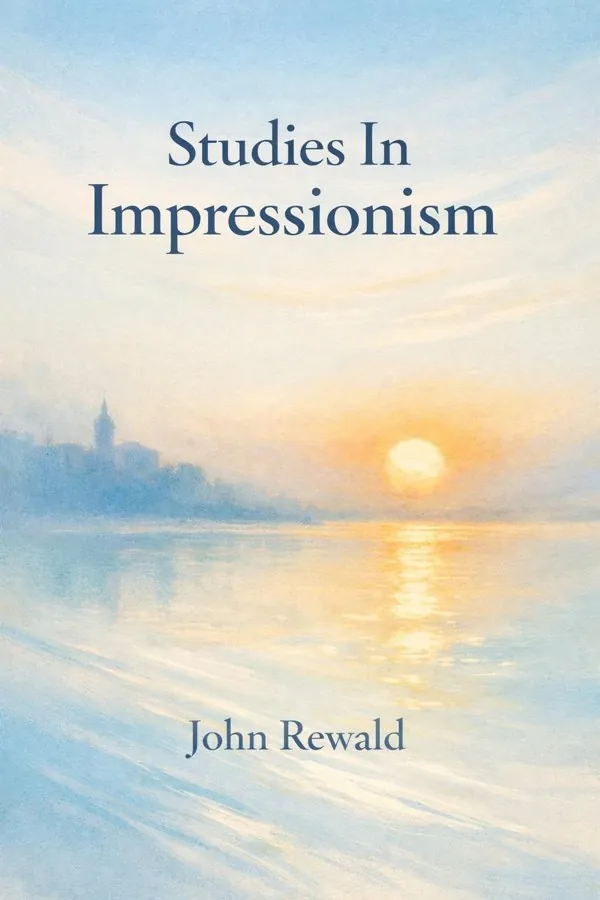
Studies In Impressionism: Summary & Key Insights
by John Rewald
 10 min9 chaptersAudio available
Key Takeaways from Studies In Impressionism
Every major art movement begins by changing not just style, but perception itself.
Great artistic breakthroughs are rarely solitary achievements; they are usually forged in communities of exchange.
Sometimes the most important thing in a painting is not the object depicted, but the conditions under which it appears.
Art becomes historically decisive when it expands what a culture considers worthy of attention.
A brushstroke is never just a brushstroke; it carries a philosophy of representation.
What Is Studies In Impressionism About?
Studies In Impressionism by John Rewald is a art_history book. John Rewald’s Studies In Impressionism is a rich, illuminating exploration of one of the most influential movements in modern art. Rather than treating Impressionism as a simple story of pretty landscapes and broken brushstrokes, Rewald reveals it as a serious artistic revolution shaped by friendship, rivalry, experimentation, and changing ideas about how reality should be seen and painted. Through close attention to artists, exhibitions, techniques, and historical context, he shows how painters such as Monet, Renoir, Degas, Pissarro, and others challenged academic conventions and redefined visual experience. What makes this book matter is its combination of scholarly rigor and vivid insight. Rewald was one of the twentieth century’s great historians of French art, especially Impressionism and Post-Impressionism. His work is respected for its archival depth, sensitivity to artistic development, and ability to connect artworks to the lives and social worlds behind them. In this book, he helps readers understand not only what Impressionist painting looks like, but why it emerged when it did and why it continues to shape the way we see art. For students, museumgoers, collectors, and curious readers alike, Studies In Impressionism offers a deeper, more intelligent way to encounter modern painting.
This FizzRead summary covers all 9 key chapters of Studies In Impressionism in approximately 10 minutes, distilling the most important ideas, arguments, and takeaways from John Rewald's work. Also available as an audio summary and Key Quotes Podcast.
Studies In Impressionism
John Rewald’s Studies In Impressionism is a rich, illuminating exploration of one of the most influential movements in modern art. Rather than treating Impressionism as a simple story of pretty landscapes and broken brushstrokes, Rewald reveals it as a serious artistic revolution shaped by friendship, rivalry, experimentation, and changing ideas about how reality should be seen and painted. Through close attention to artists, exhibitions, techniques, and historical context, he shows how painters such as Monet, Renoir, Degas, Pissarro, and others challenged academic conventions and redefined visual experience.
What makes this book matter is its combination of scholarly rigor and vivid insight. Rewald was one of the twentieth century’s great historians of French art, especially Impressionism and Post-Impressionism. His work is respected for its archival depth, sensitivity to artistic development, and ability to connect artworks to the lives and social worlds behind them. In this book, he helps readers understand not only what Impressionist painting looks like, but why it emerged when it did and why it continues to shape the way we see art. For students, museumgoers, collectors, and curious readers alike, Studies In Impressionism offers a deeper, more intelligent way to encounter modern painting.
Who Should Read Studies In Impressionism?
This book is perfect for anyone interested in art_history and looking to gain actionable insights in a short read. Whether you're a student, professional, or lifelong learner, the key ideas from Studies In Impressionism by John Rewald will help you think differently.
- ✓Readers who enjoy art_history and want practical takeaways
- ✓Professionals looking to apply new ideas to their work and life
- ✓Anyone who wants the core insights of Studies In Impressionism in just 10 minutes
Want the full summary?
Get instant access to this book summary and 100K+ more with Fizz Moment.
Get Free SummaryAvailable on App Store • Free to download
Key Chapters
Every major art movement begins by changing not just style, but perception itself. One of Rewald’s central insights is that Impressionism was revolutionary because it altered how artists approached seeing. Academic painting had long privileged polished surfaces, historical subjects, and carefully staged compositions. Impressionist painters challenged those expectations by turning toward fleeting light, ordinary life, changing weather, urban movement, and direct sensory experience. Their paintings were not simply looser in technique; they embodied a new belief that modern life could be captured through immediacy rather than idealization.
Rewald helps readers understand that this shift did not happen in isolation. It emerged from broader cultural changes: the growth of Paris, new leisure habits, railway travel, photography, and scientific interest in optics and color. The Impressionists were responding to a world in motion. Their broken brushwork and luminous palettes reflected an effort to record the instability of vision itself. A river at noon, a boulevard in rain, a dancer in rehearsal, or sunlight across haystacks became worthy subjects because reality was now understood as momentary and changing.
This idea has practical value for anyone looking at art today. Instead of asking whether an Impressionist painting is finished or realistic by traditional standards, Rewald encourages us to ask: what experience is being captured, and how? In museums, this means paying attention to atmosphere, rhythm, and the sensation of time passing. In creative work more broadly, it suggests that innovation often starts when people question inherited standards of what counts as important or complete.
Actionable takeaway: When viewing an Impressionist work, spend one full minute noticing not objects alone, but light, motion, and mood—train your eye to see experience rather than just subject matter.
Great artistic breakthroughs are rarely solitary achievements; they are usually forged in communities of exchange. Rewald emphasizes that Impressionism developed through a dense network of friendships, rivalries, conversations, and collaborations among painters who were collectively dissatisfied with official art institutions. Monet, Renoir, Sisley, Bazille, Pissarro, Degas, and others did not simply arrive at similar ideas by accident. They learned from one another, debated technique, shared studios and models, exhibited together, and responded to common pressures from the Salon and the marketplace.
This social dimension matters because it corrects the myth of the lone genius. Rewald shows that artistic identity often takes shape within groups. Even painters with highly distinct styles benefited from mutual encouragement and contrast. Monet’s serial attention to landscape, Degas’s urban interiors, and Pissarro’s patient observation of rural and city life all emerged in dialogue with wider conversations about modernity, composition, and painterly freedom. At times these relationships were warm and supportive; at others they were strained by ego, politics, or economics. Yet the movement gained force precisely because multiple artists were pushing related questions at once.
Readers can apply this lesson beyond art history. Creative progress in any field often depends on entering circles where ideas are tested, challenged, and refined. Writers’ groups, design communities, research labs, and entrepreneurial teams all function in similar ways. Innovation becomes stronger when people work near others who share ambition but not necessarily identical methods.
Rewald’s account invites us to study not just masterpieces, but ecosystems. To understand a movement, one must examine exhibitions, dealers, critics, letters, and personal alliances. Art history becomes more dynamic when paintings are seen as outcomes of human interaction rather than isolated miracles.
Actionable takeaway: If you are pursuing any creative or intellectual work, build a small circle of peers who can exchange feedback regularly—movements grow where conversation is sustained.
Sometimes the most important thing in a painting is not the object depicted, but the conditions under which it appears. Rewald repeatedly highlights how Impressionist artists transformed light from a descriptive tool into a primary subject of painting. Earlier art had certainly represented illumination, but the Impressionists made changing light itself central to meaning. They studied how sunlight dissolves contours, how shadows carry color, how reflections alter perception, and how atmosphere changes a scene from hour to hour.
This shift helps explain many of the movement’s most recognizable qualities: visible brushstrokes, bright pigments, outdoor painting, and an emphasis on transient effects. Monet is the clearest example, with his fascination for cathedrals, water, haystacks, and riverbanks under varying conditions. Yet Rewald shows that the concern with light extends across the movement, even where subject matter differs. Renoir’s figures shimmer in social warmth, Pissarro’s roads and villages pulse with climate, and Morisot’s interiors and gardens feel suspended in luminous air.
Practically speaking, this insight teaches viewers to look past outlines and narratives. An Impressionist painting may depict a harbor, a café, or a garden, but the deeper question is often: what is light doing here? Is it scattering, flattening, warming, or fragmenting the world? This approach can also sharpen everyday observation. Photographers, designers, and even travelers can borrow the Impressionist habit of noticing how morning and evening transform the same place.
Rewald also reminds us that technical experimentation served expressive ends. Quick strokes and unusual color contrasts were not random modern gestures; they were methods for translating optical sensation. The Impressionists did not abandon reality. They pursued a more fluid, time-bound version of it.
Actionable takeaway: Revisit a familiar place at three different times of day and note how light changes color, mood, and detail—this is the perceptual exercise at the heart of Impressionist seeing.
Art becomes historically decisive when it expands what a culture considers worthy of attention. Rewald shows that one of Impressionism’s greatest achievements was its embrace of modern life as serious artistic material. Instead of relying mainly on mythology, grand history, or idealized scenes, Impressionist painters turned toward cafés, train stations, suburban leisure, boulevards, theaters, racecourses, gardens, and domestic routines. These subjects were not chosen casually. They reflected a conviction that contemporary experience deserved representation in all its variety and instability.
This move was tied to the social transformation of nineteenth-century France. Paris was being rebuilt, class interactions were shifting, and new forms of public entertainment were emerging. Painters were observing not just landscapes but behaviors: strolling, dancing, commuting, watching, consuming, and social display. Degas’s dancers and bathers, Caillebotte’s streets, Monet’s stations, and Renoir’s gatherings all document the rhythms of a changing society. Rewald’s scholarship helps readers see these works as historical evidence as well as aesthetic objects.
The practical implication is powerful: art can train us to notice the significance of ordinary environments. What looks mundane in one era may become revealing in another. A train platform, a backyard lunch, or a crowded street can tell us as much about a civilization as a monumental event. This is useful not only for art appreciation but for journalism, photography, sociology, and writing. Paying attention to everyday scenes can uncover patterns of class, labor, pleasure, and identity.
Rewald thus reframes Impressionism as more than visual delight. It is also an archive of modernity. The movement captures how people inhabited a world accelerated by technology, urban growth, and new social rituals.
Actionable takeaway: The next time you encounter an ordinary public scene, ask what it reveals about your time—habits, technology, status, and relationships often hide in plain sight.
A brushstroke is never just a brushstroke; it carries a philosophy of representation. Rewald is especially valuable in showing that Impressionist technique must be understood as inseparable from artistic intention. Loose handling, visible paint, unconventional cropping, fresh color contrasts, and apparent incompleteness were not merely stylistic quirks. They reflected a larger commitment to immediacy, observation, and the unstable nature of visual experience.
Many critics initially saw these paintings as unfinished because they judged them by academic standards of smoothness and compositional closure. Rewald explains why that criticism missed the point. If an artist wants to convey a passing cloud, bustling crowd, or vibration of reflected light, then a polished, fixed surface may actually falsify the experience. Technique becomes meaning. Broken color suggests visual fluctuation; rapid marks imply movement; unusual framing can mimic the partiality of lived perception.
This lesson matters for readers because it applies across the arts. In literature, fragmented narration may reflect fractured consciousness. In film, jump cuts may evoke instability. In architecture, exposed materials may communicate honesty or industrial modernity. Form always shapes content. Rewald teaches us to stop treating style as decoration and start reading it as argument.
For museum visitors, this means slowing down and looking carefully at how a painting is built. Where is paint thick or thin? Where does detail concentrate or dissolve? How does the surface direct the eye? These observations reveal not only craftsmanship but purpose. The Impressionists did not simply paint differently because they lacked discipline. They painted differently because they understood reality differently.
Actionable takeaway: When studying any artwork, list three formal choices—color, composition, surface, framing—and ask how each supports the work’s deeper meaning.
Art history is not made only in studios; it is also made in public through display, debate, and reception. Rewald pays close attention to the exhibitions, critics, dealers, and institutions that shaped Impressionism’s development. The famous independent exhibitions were not merely logistical events. They were acts of self-definition, allowing artists excluded or marginalized by the Salon to present a collective alternative. In doing so, they reconfigured the relationship between artists and audience.
Critics played a similarly important role. Some mocked the movement, focusing on its rough execution and unconventional subjects. Others recognized its freshness and helped articulate its aims. Even hostile criticism mattered because it forced the public to confront new visual standards. The very label “Impressionism,” initially used derisively, became the name of the movement. Rewald’s historical method demonstrates that artistic meaning is often shaped through controversy as much as through creation.
This has clear relevance today. Whether in publishing, film, music, or digital media, reception influences legacy. Reviews, algorithms, curators, and cultural gatekeepers all help determine which works gain visibility and how they are interpreted. Rewald encourages readers to see cultural production as a system, not just a collection of individual talents.
For students of art, this means that understanding a painting includes understanding where and how it was shown, who wrote about it, and how audiences responded. A radical work can seem natural in hindsight precisely because the battles around it have faded from memory. Reconstructing those battles restores its force.
Actionable takeaway: Whenever you study a major artwork, look up its first exhibition context and early reception—you will often discover that what now seems obvious once appeared shocking.
No movement is truly understood if it reduces its members to a single formula. One of Rewald’s strengths is his refusal to flatten Impressionism into a uniform style. While the artists shared certain concerns—light, modern life, painterly freedom, resistance to academic norms—each developed a distinct visual language and emotional emphasis. Monet pursued atmosphere and serial variation; Degas explored movement, rehearsal, and unusual vantage points; Renoir emphasized sensuality and sociability; Pissarro combined structural patience with observational openness; Berthe Morisot brought delicacy, speed, and psychological subtlety.
This distinction is crucial because movements often become clichés in popular memory. We say “Impressionist” and imagine one look: soft landscapes, dappled sunlight, pleasant scenes. Rewald restores complexity by showing how different personalities and priorities shaped different results. Even shared techniques could mean different things in different hands. Loose paint in Monet and Degas does not produce the same experience, because their concerns are not identical. The movement is a coalition, not a copy machine.
There is a practical lesson here for anyone learning from traditions. Belonging to a school or influence does not require imitation. Strong creators absorb common ideas but transform them according to temperament and purpose. This applies to painters, writers, musicians, scholars, and entrepreneurs. A valuable tradition offers principles, not templates.
Rewald’s attention to individuality also improves museum viewing. Instead of merely identifying works as “Impressionist,” readers can begin to ask finer questions: whose modernity is this? Whose rhythm? Whose emotional temperature? That is where deeper appreciation begins.
Actionable takeaway: Compare two Impressionist works side by side and identify three differences in mood, composition, or handling—train yourself to see artists, not just movements.
A movement proves its importance not only by what it creates, but by what it makes possible afterward. Rewald makes clear that Impressionism was a turning point in modern art because it opened pathways that later artists would expand, challenge, or reject. By legitimizing contemporary subjects, visible technique, and subjective visual experience, the Impressionists loosened the rules that had governed painting for centuries. Post-Impressionists, Symbolists, Fauves, and modernists of many kinds inherited a world in which experimentation had become artistically credible.
This does not mean later art simply continued Impressionism unchanged. In fact, many successors reacted against it. Cézanne sought greater structure, Seurat introduced systematic division of color, Van Gogh intensified expression, and Gauguin moved toward symbolic simplification. Yet all of them worked in a field transformed by the Impressionist break with academic orthodoxy. Rewald helps readers grasp this historical continuity: a revolution is often most visible in the freedoms later generations take for granted.
For modern readers, the takeaway extends beyond painting. Change in any discipline often begins when a group proves that rules are historical rather than eternal. Once those rules are exposed as contingent, new possibilities proliferate. In education, business, science, and design, innovation often depends on this same shift.
Rewald’s perspective also enriches museum-going. Impressionism should not be seen as an endpoint of beauty but as a gateway into modernism. To understand why twentieth-century art became more abstract, expressive, or fragmented, one must see how Impressionism first redefined the relation between observation and representation.
Actionable takeaway: When studying a later modern artist, ask which freedoms they inherited from Impressionism—subject matter, color, surface, or viewpoint often reveal the connection.
The easiest way to misunderstand art is to treat masterpieces as timeless miracles detached from history. Rewald’s broader methodological contribution in Studies In Impressionism is his insistence on context. Paintings emerge from lived circumstances: economic pressures, personal ambitions, critical debates, technological changes, political tensions, and institutional barriers. Rewald does not diminish artistic genius by emphasizing these conditions; he clarifies it. Context shows what problems artists were trying to solve and why their solutions mattered.
This approach is especially important with Impressionism, which popular culture often sentimentalizes. Rewald moves beyond postcard familiarity and returns readers to the uncertainties of the period. These artists struggled financially, faced ridicule, negotiated with dealers, argued among themselves, and worked within a rapidly changing society. Their paintings were not born into instant reverence. They became important through a difficult process of experiment and reinterpretation.
This insight offers a practical framework for reading any cultural work. Whether one studies a novel, a film, a building, or a political speech, the key questions remain similar: what historical conditions shaped it? What conventions did it challenge? Who supported or resisted it? Such questions lead to richer understanding than simple admiration.
For general readers, Rewald’s method makes art history more intellectually satisfying. Instead of memorizing names and styles, one learns to reconstruct worlds. That shift turns looking into inquiry and appreciation into interpretation.
Actionable takeaway: The next time you encounter a famous artwork, spend five minutes learning about its historical moment—context often reveals more than the image alone can show.
All Chapters in Studies In Impressionism
About the Author
John Rewald was a major art historian whose work helped define modern scholarship on nineteenth-century French painting. Born in Berlin in 1912, he later became known internationally for his rigorous studies of Impressionism and Post-Impressionism. Rewald combined archival research, close visual analysis, and historical storytelling in a way that made complex artistic developments understandable without oversimplifying them. He is especially celebrated for his authoritative work on artists such as Cézanne, Van Gogh, and the Impressionists as a group. Over the course of his career, he taught, researched, and published extensively, earning a reputation as one of the leading interpreters of modern French art. His books remain influential because they connect artistic innovation with the personal, social, and institutional worlds in which it emerged.
Get This Summary in Your Preferred Format
Read or listen to the Studies In Impressionism summary by John Rewald anytime, anywhere. FizzRead offers multiple formats so you can learn on your terms — all free.
Available formats: App · Audio · PDF · EPUB — All included free with FizzRead
Download Studies In Impressionism PDF and EPUB Summary
Key Quotes from Studies In Impressionism
“Every major art movement begins by changing not just style, but perception itself.”
“Great artistic breakthroughs are rarely solitary achievements; they are usually forged in communities of exchange.”
“Sometimes the most important thing in a painting is not the object depicted, but the conditions under which it appears.”
“Art becomes historically decisive when it expands what a culture considers worthy of attention.”
“A brushstroke is never just a brushstroke; it carries a philosophy of representation.”
Frequently Asked Questions about Studies In Impressionism
Studies In Impressionism by John Rewald is a art_history book that explores key ideas across 9 chapters. John Rewald’s Studies In Impressionism is a rich, illuminating exploration of one of the most influential movements in modern art. Rather than treating Impressionism as a simple story of pretty landscapes and broken brushstrokes, Rewald reveals it as a serious artistic revolution shaped by friendship, rivalry, experimentation, and changing ideas about how reality should be seen and painted. Through close attention to artists, exhibitions, techniques, and historical context, he shows how painters such as Monet, Renoir, Degas, Pissarro, and others challenged academic conventions and redefined visual experience. What makes this book matter is its combination of scholarly rigor and vivid insight. Rewald was one of the twentieth century’s great historians of French art, especially Impressionism and Post-Impressionism. His work is respected for its archival depth, sensitivity to artistic development, and ability to connect artworks to the lives and social worlds behind them. In this book, he helps readers understand not only what Impressionist painting looks like, but why it emerged when it did and why it continues to shape the way we see art. For students, museumgoers, collectors, and curious readers alike, Studies In Impressionism offers a deeper, more intelligent way to encounter modern painting.
You Might Also Like
Art Since 1900: Modernism, Antimodernism, Postmodernism
Hal Foster, Rosalind E. Krauss, Yve-Alain Bois, Benjamin H. D. Buchloh
10 min
Art Since 1940: Strategies of Being
Jonathan Fineberg
10 min
Color and Meaning: Art, Science, and Symbolism
John Gage
10 min
Color: Travels Through the Paintbox
Victoria Finlay
10 min
Curatorial Activism: Towards an Ethics of Curating
Maura Reilly
10 min
How to Read a Painting: From Giotto to Jackson Pollock
Patrick De Rynck
10 minBrowse by Category
Ready to read Studies In Impressionism?
Get the full summary and 100K+ more books with Fizz Moment.